Topics (384k) Articles (398k) Users (410) Discussions (242) Comments (383) Files (13k) New article

Every module is a quotient of a free module , via . If is a projective module, lift through this surjection to obtain a section . The resulting split short exact sequence identifies with . Conversely, if is a summand of a free module, extend a prescribed map out of to the free module using the summand projection, lift each basis image through the given surjection, and restrict the lift to . This proves the equivalence with the lifting definition of a projective module, for arbitrary ranks.
A projective module is a direct summand of a free module. Free modules are flat because tensoring with a free module produces a direct sum of copies of the original module and map. If is flat, tensoring an injection with is the direct sum of its tensor maps with and , so each component is injective. Applying this to a free module containing proves that is flat.
A feasible timetable with finish time and a unit flow carried on a precedence path of total duration certify optimality. Summing the inequalities along that path proves every schedule needs at least , while the timetable attains it.
// Target: computer-science.bigb
C-peptide is the connecting peptide removed when proinsulin is processed into mature insulin. Processing allows the insulin A and B chains to remain linked while the connecting segment is released. Endogenous secretion releases both products, but their circulating concentrations differ because their clearance differs. C-peptide measurements can therefore inform endogenous secretion, provided that the physiological and measurement context is considered. [ref]
Insulin Biosynthesis, Secretion, Structure, and Structure-Activity Relationships. proinsulin processing and C-peptide release
The intersection of the maximal proper open subgroups of a profinite group. A subset topologically generates the profinite group exactly when its image topologically generates its quotient by this intersection: a proper closed generated subgroup is contained in a maximal open subgroup, obtained from a suitable finite quotient. For a pro-p group, , where the bar denotes closure of the algebraically generated power and commutator subgroups. Closedness cannot simply be discarded in infinite rank.
Every identity neighbourhood of a compact Hausdorff totally disconnected topological group contains an open normal subgroup. Choose a clopen set containing the identity inside that neighbourhood. Compactness and continuity give a symmetric identity neighbourhood with , hence . The setwise stabilizer is an open subgroup contained in . Its index is finite, so its normal core is an open normal subgroup contained in . These subgroups recover the profinite group as the inverse limit of its finite quotients.
A profinite group is procyclic if every quotient by an open normal subgroup is cyclic. Equivalently for one element . For the forward implication, the sets of lifts of generators of are nonempty clopen sets. Any finite intersection contains a lift of a generator of the cyclic quotient by the intersection of those open normal subgroups. Compactness supplies one element generating every finite quotient, and hence generating densely. The reverse implication follows by projecting that generator. For a pro-p group, two distinct maximal open subgroups would give a quotient , so a nontrivial procyclic group has a unique maximal open subgroup . Its profinite Frattini subgroup is , and any generates topologically: otherwise the proper closed subgroup it generates lies in a maximal open subgroup. The additive group of p-adic integers is an infinite example, generated topologically by .
The rank of a profinite group is , where runs through closed subgroups and is the least number of topological generators. If an open subgroup has rank , its normal core is open and has rank at most . Every closed has a normal subgroup generated by at most elements, while has order at most . A finite group of order at most is generated by at most elements, since each necessary new generator at least doubles the generated subgroup. Lifting generators yields . Thus finite rank is preserved in both directions under passage to an open subgroup.
An infinite profinite group is just infinite if every nontrivial closed normal subgroup has finite index, equivalently is open. Requiring closedness is part of the topological convention. This property says that every proper Hausdorff quotient is finite.
For a closed connected orientable surface of genus , the Künneth theorem gives the Betti numbers of as . The weak Morse inequalities give the displayed lower bound. A surface Morse function with one minimum, saddles and one maximum exists from its standard handle decomposition. Adding a positive multiple of the cosine Morse function on the circle makes a product of Morse functions, whose critical counts are precisely these four Betti numbers. The lower bound is attained.
A free Proca field is consistent and has three physical particle polarizations. The difficulty for generic interactions is the ultraviolet behavior of its Proca propagator: the longitudinal numerator makes part of it approach order , rather than decay as . Longitudinal external polarization vectors also behave as . Without suitable identities and cancellations, amplitudes grow with energy and perturbative counterterms of increasing dimension are needed. Conserved-current Abelian models and the Stueckelberg mechanism are important exceptions; a massive interacting vector is not intrinsically inconsistent as an effective field theory.
Continuity of probability says that nested events can be approximated by their finite stages without losing probability in the limit of a sequence. In a probability space , let . ThenThe sigma-algebra ensures that both limiting events belong to . These are continuity from below of a measure and continuity from above of a measure. The first holds even for an infinite measure; the second requires finite measure of the first set, which is automatic for a probability measure because .[ref]
For a concrete model, toss a fair coin through a sequence of independent Bernoulli trials, and let be the event of at least one head in the first tosses. Its complement is the event of initial tails. On the sample space of infinite head-or-tail sequences,Every finite waiting horizon has positive tail probability, yet the event of waiting forever has probability zero. That intersection is not empty: it contains the all-tails sequence. Thus a zero-probability event need not be impossible as an outcome, and eventual success almost surely does not supply a deterministic deadline. The waiting time for the first head has a geometric distribution with success probability . After ten tosses, the remaining tail probability is exactly ; nine tosses leave .
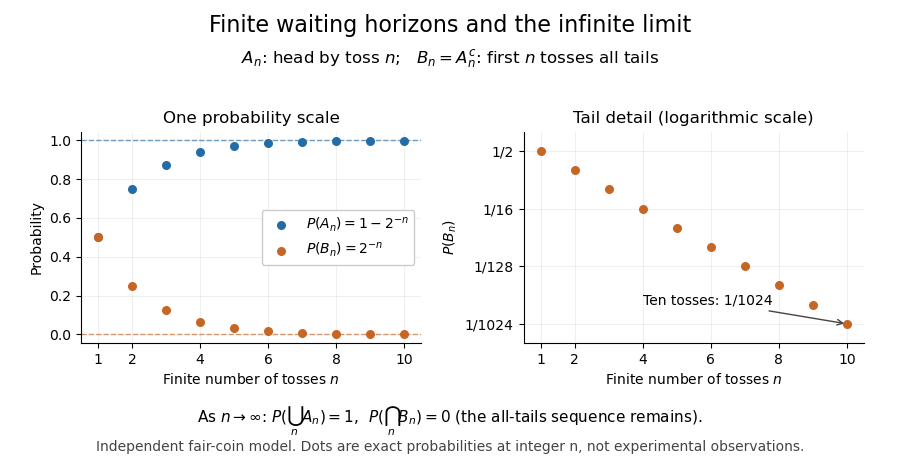
Exact fair-coin model: success by toss n increases to probability one, while the all-tails prefix probability decreases to zero
. Details. A proof outline exposes what makes countable additivity stronger than finite additivity of a set function. For increasing events, put and for . These set differences are pairwise disjoint events, their union is , and the first pieces have union . ConsequentlyFor decreasing events, their complements increase to ; applying the increasing result and the complement rule of probability gives . The finite-total-mass condition is essential for this subtraction. For comparison, the counting measure of each set of natural numbers is infinite, although their intersection is empty and has measure zero.
Conversely, on a sigma-algebra, a nonnegative normalized set function satisfying finite additivity of a set function and satisfies countable additivity. For pairwise disjoint events with , the remainders decrease to the empty set, andTaking the limit of a sequence recovers the infinite sum. This equivalence explains why continuity of probability is part of the foundations rather than a separate assumption about smooth curves.
One useful application controls infinitely many possible errors. If events satisfy , then the events decrease, and the union bound gives . Continuity of probability therefore makes : errors occur infinitely often with probability zero. This is the Borel-Cantelli first lemma, and it requires no independence. For the illustrative bounds , the probability of any error at index or later is at most , an explicit truncation guarantee.
The word continuity here concerns nested sets, not the absence of atoms in a probability distribution. For any real-valued random variable , the events decrease to . Hence its cumulative distribution function is right-continuous even when it has jumps, as for a geometric distribution. The nesting hypothesis matters: an arbitrary sequence of events need not admit either displayed interchange of limit and probability.
For a positive integer-valued random variable of finite support, this transform is a finite Dirichlet series. Its values encode ordinary moments, , and its derivatives at zero encode logarithmic moments: . Positive support is essential to these definitions; the transform is distinct from the ordinary probability generating function .
Encode a fair die with face labels by . Its probability generating function is . Two independent dice with polynomials have the same sum probability distribution as another pair if and all four dice have faces. Redistributing polynomial factors can construct unexpected examples, but each resulting polynomial must have nonnegative integer coefficients, no constant term if labels must be positive, and value at . For example, reallocating from one copy of to the other gives face labels and .
If a graph has edges and triangles, successively delete one edge from a remaining triangle. No new triangle is created and at most deletions are needed, so a triangle-free subgraph has at least edges. A random-graph expectation lower bound on therefore proves existence of a large triangle-free graph. With edge probability , the expectation is ; this is a useful existence bound but is not within a constant factor of the sharp quadratic Mantel theorem bound.
For two exhaustive mutually exclusive models of positive prior probability, prior odds compare their probabilities before observing the data. They must be distinguished from the parameter prior distributions within those models. A Bayes factor multiplies these prior odds to produce posterior odds.
Translate external information into a prior distribution by asking for representative values, uncertainty intervals and tail probabilities. Fit parameters of a suitable distribution to those judgments and inspect the resulting prior predictive distribution. For a probability believed near , a beta distribution with parameters has the desired mean; its concentration can be chosen to match a stated probability of exceeding . The words “near” and “unlikely” alone do not specify one unique prior.
Over a field , the ideal in a two-variable polynomial ring is not principal. A proposed generator would divide both and . Any nonconstant divisor of the degree-one polynomial is a scalar multiple of , which does not divide ; therefore the generator would have to be a unit. But every element of vanishes at , so the ideal cannot contain one. This contrasts with , where the division algorithm makes every ideal principal.
For , integrate the logarithmic derivative of an elliptic function and its product with around a fundamental cell. The first integral forces total degree zero; the second forces the weighted point sum to lie in the lattice. Conversely choose lifts of the points with equal zero and pole sums, and form the balanced ratio of translated Weierstrass sigma functions. Their quasi-period factors cancel, giving an elliptic function with exactly the prescribed divisor. Separate zero and pole divisors require disjoint support; common terms cancel when only their difference is prescribed.
The power series proves this estimate. There is no global bound , since the logarithm diverges as . The different estimate is valid wherever , and is sufficient for growth bounds on canonical products.
Pinned article: Introduction to the OurBigBook Project
Welcome to the OurBigBook Project! Our goal is to create the perfect publishing platform for STEM subjects, and get university-level students to write the best free STEM tutorials ever.
Everyone is welcome to create an account and play with the site: ourbigbook.com/go/register. We belive that students themselves can write amazing tutorials, but teachers are welcome too. You can write about anything you want, it doesn't have to be STEM or even educational. Silly test content is very welcome and you won't be penalized in any way. Just keep it legal!
Intro to OurBigBook
. Source. We have two killer features:
- topics: topics group articles by different users with the same title, e.g. here is the topic for the "Fundamental Theorem of Calculus" ourbigbook.com/go/topic/fundamental-theorem-of-calculusArticles of different users are sorted by upvote within each article page. This feature is a bit like:
- a Wikipedia where each user can have their own version of each article
- a Q&A website like Stack Overflow, where multiple people can give their views on a given topic, and the best ones are sorted by upvote. Except you don't need to wait for someone to ask first, and any topic goes, no matter how narrow or broad
This feature makes it possible for readers to find better explanations of any topic created by other writers. And it allows writers to create an explanation in a place that readers might actually find it.
Figure 1. Screenshot of the "Derivative" topic page. View it live at: ourbigbook.com/go/topic/derivativeVideo 2. OurBigBook Web topics demo. Source. - local editing: you can store all your personal knowledge base content locally in a plaintext markup format that can be edited locally and published either:This way you can be sure that even if OurBigBook.com were to go down one day (which we have no plans to do as it is quite cheap to host!), your content will still be perfectly readable as a static site.
- to OurBigBook.com to get awesome multi-user features like topics and likes
- as HTML files to a static website, which you can host yourself for free on many external providers like GitHub Pages, and remain in full control

Figure 2. You can publish local OurBigBook lightweight markup files to either OurBigBook.com or as a static website.
Figure 3. Visual Studio Code extension installation.
Figure 5. . You can also edit articles on the Web editor without installing anything locally. Video 3. Edit locally and publish demo. Source. This shows editing OurBigBook Markup and publishing it using the Visual Studio Code extension. 
- Infinitely deep tables of contents:



All our software is open source and hosted at: github.com/ourbigbook/ourbigbook
Further documentation can be found at: docs.ourbigbook.com
Feel free to reach our to us for any help or suggestions: docs.ourbigbook.com/#contact