Topics (384k) Articles (398k) Users (410) Discussions (242) Comments (383) Files (13k) New article

Dielectric strength characterizes the electric field at dielectric breakdown under specified test conditions. In an ideal uniform gap, it sets a voltage scale .[ref]
8.5 Molecular Model of a Dielectric. §8.5: dielectric strength definition and voltage limit for a specified plate separation
The parallel-plate capacitor model consequently gives the stored energy density scaleThis is a model scale, not an operating rating: fringing field of a capacitor make local electric fields differ from , while leakage and dielectric loss spend some supplied energy as heat. Comparing usable capacitor energy therefore requires insulation and breakdown performance as well as permittivity.The coordinate revealment of coordinate for a decision tree under input probability distribution isIt depends on the chosen decision tree and the probability distribution, not just on the Boolean function. Since no coordinate is queried twice on a graph path, indicator functions giveThe second equality uses linearity of expectation; it does not require independence of random variables or a product measure. The cited paper defines these inspection probabilities and their sum for product measures; the displayed indicator function argument extends the identity to any input probability distribution.[ref]
For the three-bit majority decision tree under the discrete uniform distribution, , whose sum is . Reading coordinate 3 first, then coordinate 1, and stopping on agreement gives the same majority function, depth and expected query cost, but coordinate revealments . The asymmetry belongs to the chosen query order. Parity gives for every exact decision tree without repeated queries. If repeated queries were charged, inspection probabilities would count distinct coordinates; total query count would instead require expected multiplicities.
For a fixed decision tree and input probability distribution , its expected query cost isUnder the discrete uniform distribution on the eight three-bit inputs, the three-bit majority decision tree hasThis is an exact average, not a fractional query made during one execution. It is also optimal among exact deterministic decision trees under this discrete uniform distribution: one observed bit never determines the majority function; whichever two distinct coordinates are inspected first, their values disagree with probability , forcing a third query. In comparison, querying all three bits unconditionally has the same actual depth three but expected query cost three.
For an arbitrary input probability distribution, the same fixed three-bit majority decision tree gives . For three independent random variables, each a Bernoulli random variable with common one-probability , this becomes ; the value depends on . Averaging over inputs should also be distinguished from averaging over an algorithm's internal random choices at a fixed input.[ref]
CDK1 activity and protein abundance are different observables. A total-CDK1 Western blot estimates protein amount under its calibration and loading assumptions. A phosphosite-specific Western blot asks about a particular CDK1 phosphorylation state. A histone H1 kinase assay asks how much substrate modification occurs under specified assay conditions. Any conversion between them needs a model and suitable controls.
An original counting example stipulates CDK1 molecules, with bound to cyclin B in each of two hypothetical samples. In sample A, bound molecules are activity-permissive and are inhibited; in sample B, are activity-permissive and are inhibited. The other are unbound in both samples. Total CDK1 and bound CDK1 agree, but activity-permissive counts differ fourfold. These are invented counts for bookkeeping, not measured biological populations.
If each activity-permissive molecule contributes the same reaction rate, substrate and ATP remain available, and the assay stays linear in time, a simple illustrative readout isHere is the recorded signal, is a matched blank signal, is the activity-permissive count, the reaction interval, and a common signal contribution per active molecule per unit time. The corrected signals in the stipulated samples have ratio , although their total protein amounts agree. This is an assay accounting assumption, not an ordinary differential equation for the cell cycle. The no-added-cyclin B baseline in the inspected experiment can itself contain catalytic activity; it need not equal an enzyme-free blank .
Substrate depletion, differing inhibitory conditions or a saturated detector can break the simple proportionality. Comparing samples therefore requires matched reaction intervals, substrate supply, loading and detector response, rather than assuming that brighter histone H1 labeling automatically means more total CDK1.
A histone H1 kinase assay measures protein kinase action on supplied histone H1, a protein substrate. When the transferred phosphate carries a radioactive isotope label, label incorporated into histone H1 reports catalytic action over the assay interval. It does not count CDK1 molecules, and a crude preparation can contain other protein kinases acting on histone H1. Attribution therefore needs controls.
A 2010 study prepared human HeLa S3 extracts after a double thymidine block, using swelling, a Dounce homogenizer, centrifugation, dialysis and concentration. Added recombinant cyclin B1 incubated for minutes.[ref]
Quantitative Reconstitution of Mitotic CDK1 Activation in Somatic Cell Extracts by Richard W. Deibler and others. Deibler and Kirschner (2010), Experimental Procedures, “Tissue Culture, Flow Cytomtery, and Somatic Cell Extract Preparation”; Figure 2A
Aliquots received histone H1 and terminal--labeled ATP for a -minute room-temperature reaction, stopped with Laemmli buffer. Dried SDS-PAGE gels exposed a phosphorimager screen; a BioRad Molecular Imager FX quantified labeling. No-added-cyclin B activity set the normalization baseline; RO-3306 reduced H1 activity approximately . Companion Western blots monitored Tyr15 phosphorylation, with actin Western blot loading control.[ref]
Quantitative Reconstitution of Mitotic CDK1 Activation in Somatic Cell Extracts by Richard W. Deibler and others. Deibler and Kirschner (2010), “H1 Kinase Assays”; Results, “A Three-Stage Activation Profile of CDK1 by Cyclin B”, reported Figure S2A inhibitor result; Figure 2B
Mixed extracts lose compartment boundaries; inhibitor sensitivity supports a major CDK1 contribution, with residual signal.[ref]
Quantitative Reconstitution of Mitotic CDK1 Activation in Somatic Cell Extracts by Richard W. Deibler and others. Results, “Establishing a Somatic Cell Extract System for Mitotic Entry”; “A Three-Stage Activation Profile of CDK1 by Cyclin B”
Substrate choice and inhibitor specificity limit attribution. The cell-cycle hysteresis experiment supplies a separate history comparison with this kind of histone H1 readout; its dose thresholds should not be transferred to human biological cells.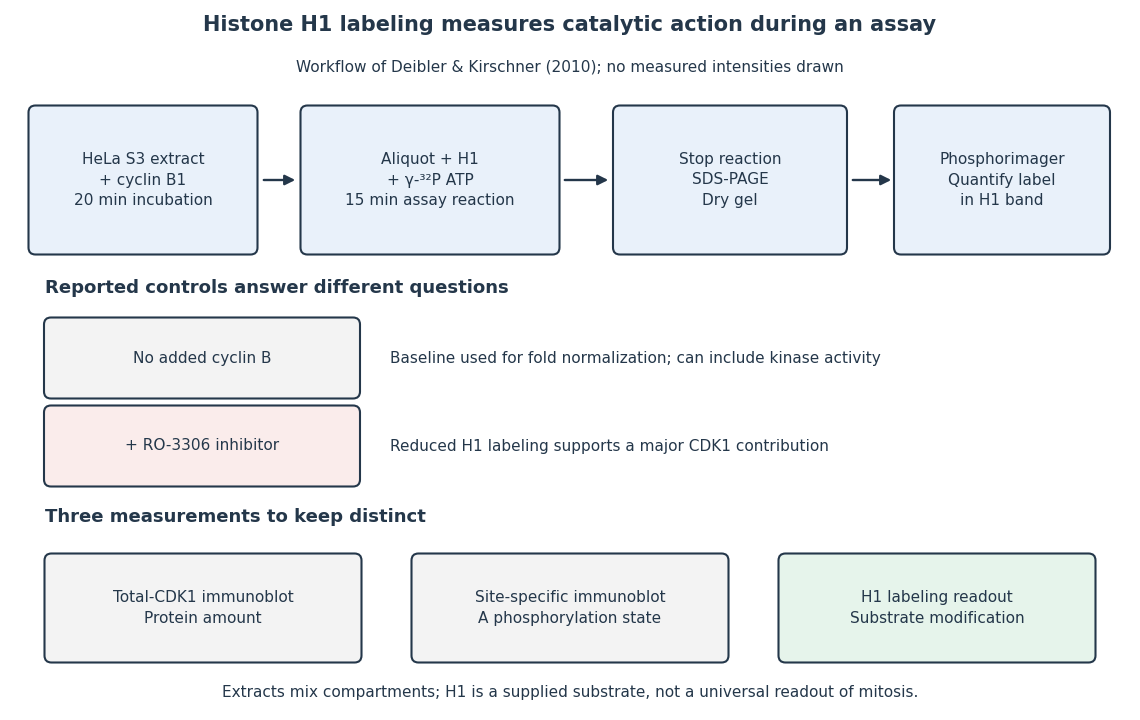
The histone H1 kinase assay: transferred label, controls and distinct protein measurements
. Original explanatory workflow of the inspected 2010 assay. The -minute extract incubation and -minute assay reaction are separate intervals. No gel lanes or measured intensities are simulated. The no-added-cyclin B baseline and RO-3306 perturbation have different purposes; neither a total-CDK1 Western blot nor a site-specific phosphorylation Western blot replaces the catalytic readout. Details.A CDK1 phosphorylation state identifies modified amino acid residues. Different sites have opposite effects: in studied Xenopus laevis Cdc2, Thr14/Tyr15 are inhibitory, while Thr161 phosphorylation is activating. T denotes a threonine residue, Y a tyrosine residue, and numbers are protein primary structure positions. Do not assume this numbering for every species.[ref]
Role of phosphorylation in p34cdc2 activation: identification of an activating kinase by M. J. Solomon and others. Solomon, Lee and Kirschner (1992), abstract: mapped Xenopus Thr14/Tyr15, loss of activation with Thr161→Ala, and cyclin binding by the triple mutant
The 1992 study supplies a useful separation of mechanisms: replacing Thr14, Tyr15 and Thr161 still permitted cyclin B binding, but replacing Thr161 prevented activation of histone H1 phosphorylation. Binding therefore did not suffice for catalytic activity in that preparation. Activating phosphorylation also occurred with catalytically inactive Cdc2, supporting a separate CDK-activating kinase rather than a requirement for intramolecular autophosphorylation.[ref]
Role of phosphorylation in p34cdc2 activation: identification of an activating kinase by M. J. Solomon and others. Solomon, Lee and Kirschner (1992), abstract: cyclin-binding triple mutant and activating phosphorylation of the kinase-inactive K33R mutant
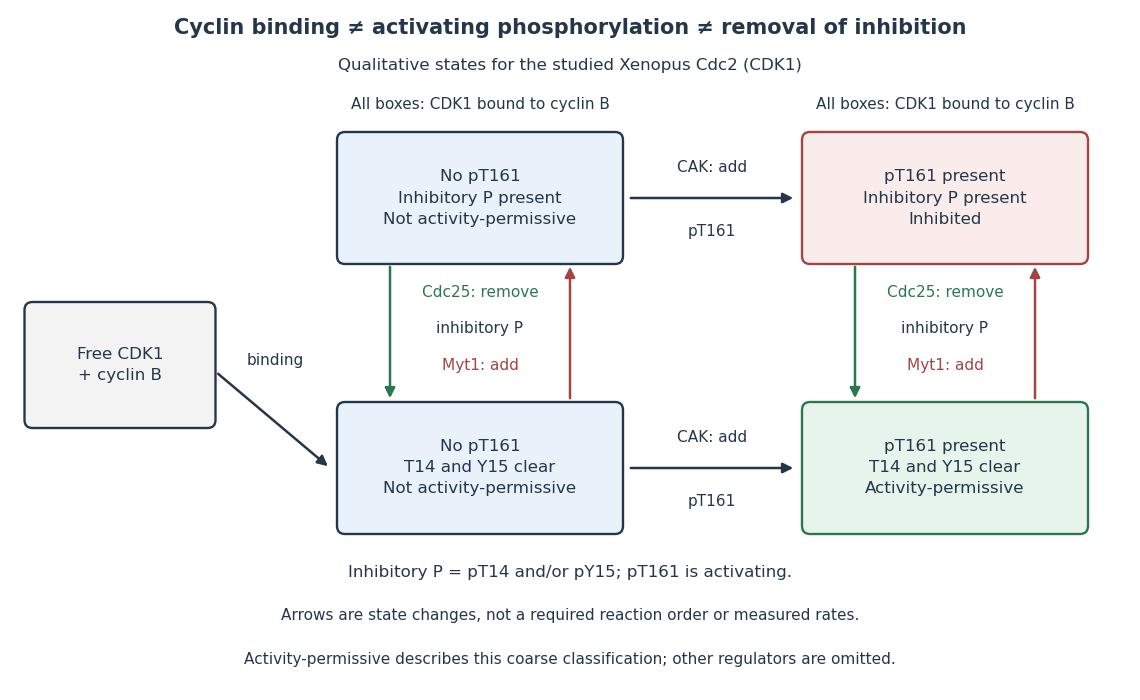
In this deliberately coarse classification, bound cyclin B, activating phosphorylation, and cleared inhibitory sites must coincide for the activity-permissive state. Removing inhibitory phosphate groups does not supply missing cyclin B or activating phosphorylation. Conversely, adding activating phosphorylation does not erase inhibitory modification. Actual preparations contain mixtures of states and additional regulators; this classification gives no numerical reaction rate.
A solid thermodynamic phase with a particular crystal structure, among distinct crystalline forms of the same chemical substance. Crystal polymorphism names the existence of these alternatives; a crystal polymorph names one of the forms.
In NIST's 2001 comparison, the Laser-Optimized Cryogenic Radiometer held its cavity near and controlled the heat sink separately. Opening the beam reduced heater power at fixed cavity temperature; an AC bridge read the temperature. Tests used stabilized, spatially filtered lasers at , and , with horizontal input and a movable photodiode transfer detector in the cavity's optical plane. The paper contrasts this with the High Accuracy Cryogenic Radiometer's optical heating followed by two electrical heating cycles and interpolation.[ref]
Comparison of Two Cryogenic Radiometers at NIST by Jeanne M. Houston and others. §§2–3, printed pp. 642–643: apparatus, wavelengths, readout and the two substitution protocols
The two laboratories compared calibrations of the same transfer detectors, and checked their spatial response. Alignment differences and transported dust limited that comparison; its agreement did not prove universal equivalence. Its correction tables retain window transmission, cavity radiometric absorptance, alignment, electrical readout and optical-electrical heating non-equivalence. The heat sink was controlled, but §3 does not specify its numerical setpoint: the reference in the preceding example is stipulated.[ref]
Comparison of Two Cryogenic Radiometers at NIST by Jeanne M. Houston and others. §§3–5, printed pp. 643–646, especially Tables 2–3 and spatial-uniformity checks
For a reproducible substitution measurement, record the beam's wavelength and entrance boundary, receiver and reference temperatures, heater terminal voltage and electric current, dark readings before and after illumination, and the settling rule. Check beam collection at the aperture, window transmission, radiometric absorptance, deposited lead heating, and sensitivity to beam position. Repeatability alone misses a stable correction error. Photometric calibration can subsequently use this radiant flux scale, but photometry still needs the appropriate spectral visual weighting; the cold receiver does not itself measure luminous flux.
A triangulation of a convex polygon divides a convex polygon into triangles using diagonals between its existing vertices of a polytope, with no diagonal crossings in the interior. For vertices it uses diagonals and produces triangles. Fixing one boundary edge, its adjacent triangle separates two smaller polygon regions; summing over the possible third vertices of a polytope gives the Catalan recurrence. Thus the number of triangulations of a convex polygon is , with the Catalan number. A quadrilateral has two choices and a pentagon has five.
For a parametric curve represented by fixed scalar functions and control points in Euclidean space, writeThe influence function of this handle is : the resulting displacement vector is , and its norm is . These are exact finite changes, not only a first-order estimate. Where is negative the displacement points opposite to . Where , the curve is unchanged at that parameter.
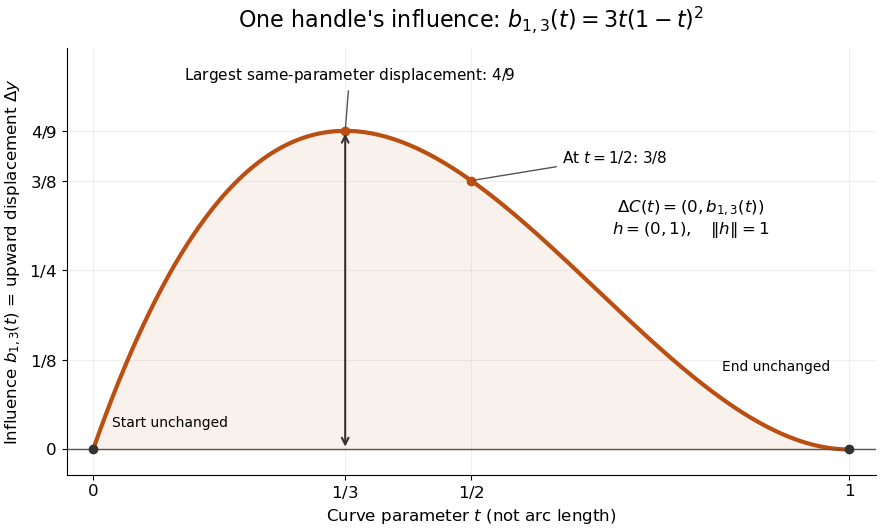
The influence coefficient 3t(1-t)^2 equals the vertical displacement for a unit upward move of P1, reaches 4/9 at t=1/3, and vanishes at both endpoints
. Details. For the cubic Bézier curve above, the Bernstein basis influence function is . Its derivative isIt increases up to and decreases thereafter on . Consequently the largest displacement at corresponding parameters isFor it is . This is a comparison at the same parameter. A geometric closest-distance comparison, as in a closest-point search on a subdivision curve, instead minimizes over another parameter:The closest parameter can differ from , so is not automatically a maximum closest-distance separation of the two curves. Neither parameter is assumed to be arc length.
The support of a function is the closure of the parameter values where . It bounds where a nonzero handle move can act, but may include boundary points where the actual displacement is zero. Here the support of a function is all of relative to the parameter domain, while the endpoints are unaffected. In contrast, a B-spline of order has support within in its spline knot sequence, so its handle affects only that parameter range; the support and Gram bandwidth of B-splines describes the same locality in another application. Changing the spline knots or the basis along with the handle requires a different comparison.
When the basis functions form a partition of unity, , each evaluation is an affine combination of the control points. Applying an affine map to all handles givesThis is affine equivariance of a geometric basis, also called affine covariance: affine maps preserve affine combinations. In particular, translating every handle by translates the whole curve by , whereas moving just one handle produces . The Bernstein basis has this partition of unity property.[ref]
Curves and Surfaces in Geometric Modeling: Theory and Algorithms by Jean Gallier. §4.3, pp. 132–133: Bernstein weights sum to one
Nonnegative weights further make evaluations convex combinations, giving the convex hull bound illustrated by the control polygon; nonnegativity is not needed for affine covariance.For a proof outline of the influence formula, subtract the two basis representations: every unchanged coefficient cancels, leaving . The same subtraction with several moved handles gives . No claim about interpolation, closest-point search on a subdivision curve or endpoint motion follows until the actual basis values are examined.
An inclined plane tilted slowly from horizontal turns a coefficient of static friction into a critical angle. Assume a nonrotating block on a stationary, rigid, dry surface, with gravitational weight and the contact forces as its only forces. Take to be the angle between the uphill surface direction and horizontal. Let be a unit vector pointing uphill and a perpendicular unit vector pointing outward from the surface. Resolving the gravitational weight givesThe angle between the downward vertical and the inward normal is also . Thus the inward component uses cosine and the downhill component uses sine. These are components of one force, not two additional forces.
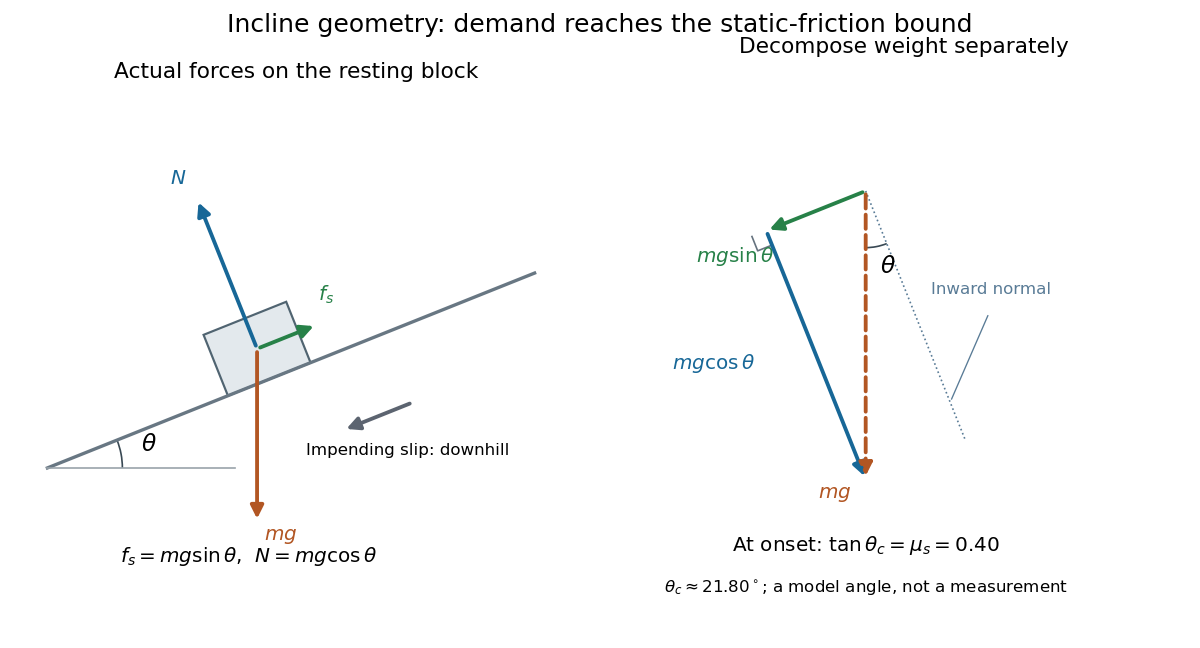
Before downhill contact slip, zero acceleration and Newton's second law requireThe required static friction points uphill. Substituting into the bound and dividing by the positive givesThe tangent function increases on this range of angles, so the last admissible resting angle isThe inverse tangent takes a dimensionless quantity to an angle. At equality the ideal model still permits a limiting resting state; increasing further excludes it. At a smaller angle, is the demand ratio, not the coefficient of static friction.[ref]
For the stipulated , and , the critical angle is approximately . At , and , comfortably below the bound . At , maintaining rest would require , but the bound is only : rest is impossible. At , and . Notice that the limiting tangential force here is smaller than the horizontal limit because tilting reduces the normal force.
Cancellation of mass makes this relation useful: the ideal critical angle tests a contact coefficient without needing a calibrated force gauge. Doubling the block's mass doubles both demanded static friction and its bound, leaving unchanged if is unchanged. This is a testable model prediction. It need not survive a change in surface condition, a direction-dependent coefficient, appreciable deformation, or vibration.
The derivation also assumes continued contact and that sliding occurs before tipping or rolling without slipping. The resultant contact force must act within the supporting footprint so that the block can satisfy torque balance; a tall block may tip first. No extra tension, imposed tangential pull, or lift is included. In a slowly raised apparatus, quasistatic process means that motion of the board contributes negligible inertial forces while locating the threshold. Once downhill contact slip begins, a constant-velocity sliding angle would concern kinetic friction, not the onset of static friction.
A clique records pairwise relationships. If vertices represent sets and an edge means a nonempty intersection, a clique does not by itself guarantee an element common to every set. TakeThen , and , so their intersection graph is . But . The graph faithfully records all three pairwise intersections; the stronger claim of a single shared element requires additional hypotheses.
A maximum clique is a clique with the greatest possible number of vertices in the graph. Its size is the clique number. Every maximum clique is a maximal clique, since adding a vertex would produce a larger clique. A graph can have several maximum cliques; the word maximum specifies their common size, rather than uniqueness.
Leonhard Euler's 1751 correspondence already studied triangulations of a convex polygon and gave a closed formula for their counts. Johann Andreas von Segner supplied a combinatorial recurrence relation in a paper written in 1758. Eugène Charles Catalan's nineteenth-century work connected the formula to bracketed products. This history, documented in Igor Pak's account, shows how the same counting structure reappeared through different objects; the modern name alone does not establish discovery priority.[ref]
History of Catalan numbers by Igor Pak. §§2–3 and §5, printed pp. 2–4: Euler correspondence, Segner recurrence and Catalan's bracketed products
A binary parenthesization specifies the order of binary operations on a fixed ordered list of operands, combining exactly two existing expressions at each step. It has a full binary tree as its expression structure: operands are leaves and operations are internal vertices. For four operands , the five possibilities are , , , , and .
A binary parenthesization of operands contains binary operations. At the last operation, its left expression can contain operations and its right expression . The Catalan recurrence therefore gives possible evaluation structures. The order of operands stays fixed; this is not a count of their permutations. Even for an associative operation whose result is unchanged, different structures can have different evaluation costs, as in the matrix-chain multiplication problem.[ref]
Bijective Proof Problems by Richard P. Stanley. §5, Problem 154, printed p. 38: binary parenthesizations of n+1 letters
The first-return decomposition of a Dyck path and the rule of product giveFor a given , choose the inside path in ways and its suffix in ways. Different first-return locations give disjoint groups, so the rule of sum adds their counts. For , the terms are . Iterating the recurrence relation computes the counts without enumerating every full path.
Pinned article: Introduction to the OurBigBook Project
Welcome to the OurBigBook Project! Our goal is to create the perfect publishing platform for STEM subjects, and get university-level students to write the best free STEM tutorials ever.
Everyone is welcome to create an account and play with the site: ourbigbook.com/go/register. We belive that students themselves can write amazing tutorials, but teachers are welcome too. You can write about anything you want, it doesn't have to be STEM or even educational. Silly test content is very welcome and you won't be penalized in any way. Just keep it legal!
Intro to OurBigBook
. Source. We have two killer features:
- topics: topics group articles by different users with the same title, e.g. here is the topic for the "Fundamental Theorem of Calculus" ourbigbook.com/go/topic/fundamental-theorem-of-calculusArticles of different users are sorted by upvote within each article page. This feature is a bit like:
- a Wikipedia where each user can have their own version of each article
- a Q&A website like Stack Overflow, where multiple people can give their views on a given topic, and the best ones are sorted by upvote. Except you don't need to wait for someone to ask first, and any topic goes, no matter how narrow or broad
This feature makes it possible for readers to find better explanations of any topic created by other writers. And it allows writers to create an explanation in a place that readers might actually find it.
Figure 1. Screenshot of the "Derivative" topic page. View it live at: ourbigbook.com/go/topic/derivativeVideo 2. OurBigBook Web topics demo. Source. - local editing: you can store all your personal knowledge base content locally in a plaintext markup format that can be edited locally and published either:This way you can be sure that even if OurBigBook.com were to go down one day (which we have no plans to do as it is quite cheap to host!), your content will still be perfectly readable as a static site.
- to OurBigBook.com to get awesome multi-user features like topics and likes
- as HTML files to a static website, which you can host yourself for free on many external providers like GitHub Pages, and remain in full control

Figure 2. You can publish local OurBigBook lightweight markup files to either OurBigBook.com or as a static website.
Figure 3. Visual Studio Code extension installation.
Figure 5. . You can also edit articles on the Web editor without installing anything locally. Video 3. Edit locally and publish demo. Source. This shows editing OurBigBook Markup and publishing it using the Visual Studio Code extension. 
- Infinitely deep tables of contents:




All our software is open source and hosted at: github.com/ourbigbook/ourbigbook
Further documentation can be found at: docs.ourbigbook.com
Feel free to reach our to us for any help or suggestions: docs.ourbigbook.com/#contact