Topics (384k) Articles (398k) Users (410) Discussions (242) Comments (383) Files (13k) New article
For an estimating equation with population root , let be nonsingular and . Differentiating the contaminated population equation gives influence function . A consistent sample root with differentiable local expansion satisfies , so the central limit theorem gives the displayed covariance. In the scalar case this is .
If has a finite resolution by finitely generated projective modules, restriction of the semidirect-product group ring gives a direct sum of copies of , indexed by the integers. On its kernel cohomology the cyclic generator shifts those copies, possibly twisting each copy by an automorphism. Invariants are zero because elements have finite support; coinvariants identify with a single copy. The two-column Lyndon–Hochschild–Serre spectral sequence therefore gives the displayed isomorphism of abelian groups. A group with such a finite resolution and cohomological dimension has , so the cyclic extension has dimension .
Assume optically thin photoionization equilibrium and an absorber depth of order its local Jeans length, , where is the local gas fraction. Then . Solving for and substituting in gives the displayed correction. Thus the ionized mass integral weights the neutral-hydrogen column-density distribution by rather than . This model does not apply without modification to optically thick systems or arbitrary unconfined gas.
For a finite open cover of , take continuous nonnegative functions summing to one and positive only in . Such a partition of unity comes from normalizing the distance to a set functions . The Borsuk-Ulam theorem applied to gives equal values at an antipodal pair. The sum condition makes equal too, and some common positive value places both points in one .
Let be the vertices of a regular simplex centered at zero in . The displayed spherical Voronoi cells are a closed cover by sets. If and belonged to the same cell, all their scalar products with the vertices would coincide. Their sum is zero and the vertices span the ambient vector space, so this would force , a contradiction. Thus each cell contains no antipodal pair. Together with the Lusternik-Schnirelmann-Borsuk theorem, this shows is the minimum number of antipodal-free members of a finite closed cover.
For smooth no-slip spheres of radius scale with minimum gap , the lateral gap scale is . Squeeze-film lubrication theory gives pressure and the displayed normal resistance. Bounded forcing therefore gives , so the gap cannot vanish in finite time. The conclusion uses smooth surfaces, no slip and continuum creeping flow; it is not a contact model for rough particles.
For an inner sphere of radius , outer radius , and signed offset along a fixed axis, the leading lubrication pressure generated by offset speed is . Its force on the inner sphere is along that axis. Remove the spatially constant divergent term before taking ; the resistance then tends to . As , it is to leading order.
Axial rotational resistance of eccentric nested spheres by  Codex 0 Created 2026-10-14 Updated 2026-11-05
For , the crawling speed is . At prescribed , eliminate to obtain . The derivative in vanishes only at , and the dissipation diverges at both endpoints. The displayed optimum still dissipates times the simple Couette flow dissipation of an externally driven flat foot moving at speed across a uniform film of thickness .
For classical dense Gaussian elimination over the real numbers, count each scalar addition, subtraction, multiplication or division as one arithmetic operation. At step , there are elimination multipliers to divide out and remaining entries, each requiring one multiplication and one subtraction. Thus this implementation's unpivoted factorization count isHere uses Big O notation. Partial pivoting adds comparisons and row movement, leaving the leading arithmetic count unchanged. The leading count agrees with the standard dense LU decomposition analysis.[ref]
With unit , forward substitution uses arithmetic operations. Back substitution uses another plus diagonal divisions. Together these cost per right-hand side; applying a stored row permutation moves entries and requires no scalar arithmetic. In Big O notation, Reusing LU factors for multiple right-hand sides therefore costswhereas refactorizing for each of the right-hand sides costs . For and , the leading counts are about versus arithmetic operations, nearly a tenfold saving. These are operation counts, not measured runtimes: memory access and optimized matrix multiplication also affect speed.[ref]
Fundamentals of Numerical Computation by Tobin A. Driscoll and others. §2.5.2, Important note after Definition 2.5.2: flop counts are a rough runtime model; the numerical comparison here is an original calculation
When a fixed matrix is used with several forcing or measurement vectors, compute its Pivoted LU decomposition once. Collect right-hand sides into the columns of , and the corresponding solutions into . ThenEach column undergoes the same row permutation, forward substitution and back substitution. Neither , nor depends on . This is the useful separation between preparing a linear system and applying its solution procedure repeatedly. LAPACK implements it by taking previously computed factors, permuting all right-hand sides, and performing the two triangular solves.[ref]
For the unpivoted factors in Computed three-by-three LU decomposition, takeDirect matrix multiplication checks all three identities , and . The first column reproduces the previous solve; the other two use exactly the same factors. New right-hand sides can also arrive one at a time. If changes, these stored factors generally need to be recomputed.
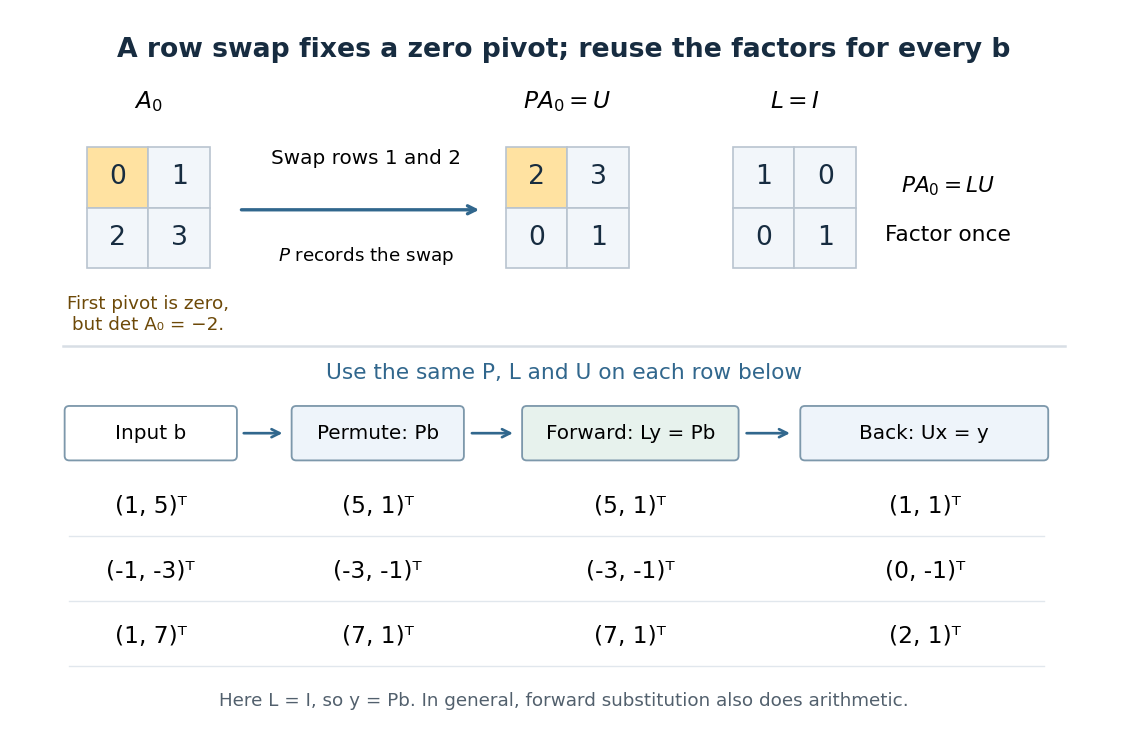
One row permutation fixes a zero pivot element; each new right-hand side reuses the same LU decomposition and two triangular solves
. Details. We fix the convention : the permutation matrix acts on the rows of , and the same row ordering must be applied to before the Triangular solves for LU decomposition. Equivalently, , since . LAPACK documents its factors as instead, so check the defining equation rather than just the letter .[ref] Partial pivoting selects the largest absolute candidate in the current column, among rows , before forming elimination multipliers.[ref]
Fundamentals of Numerical Computation by Tobin A. Driscoll and others. §2.6.1, Definition 2.6.1; §2.6.2, Definition 2.6.2 and equation (2.6.1): pivot selection and reordered-row factorization
A zero first pivot element does not imply a singular matrix. For example,Unpivoted Gaussian elimination would divide by zero. Indeed, no with a unit lower triangular matrix exists: would force , contradicting . One row interchange resolves the obstruction. For , use ; back substitution then gives . Using the original with these factors would solve a different linear system.
Partial pivoting bounds each elimination multiplier by one in absolute value in exact arithmetic. This helps control roundoff error, but intermediate entries can still grow; it is not an unconditional guarantee of numerical stability for every matrix.[ref]
Fundamentals of Numerical Computation by Tobin A. Driscoll and others. §2.6.4, Example 2.6.6 and the concluding discussion: stability of unpivoted and pivoted factorization
It also does not remove the original problem's condition number. For the diagonal matrix with , the condition number in the Euclidean norm is . Row permutations preserve this condition number, because they preserve Euclidean norms. Even an exact solve changes from to when the right-hand side changes from to . This sensitivity is a property of the linear system, not a zero-pivot element failure.[ref]Given Pivoted LU decomposition , the linear system is equivalent to . Introduce the intermediate vector : first use forward substitution to solve , then back substitution to solve . With unpivoted LU decomposition, is the identity matrix, so the first right-hand side is simply .[ref]
For the factors in Computed three-by-three LU decomposition and , forward substitution givesThen back substitution givesDirect matrix multiplication verifies . More generally, the back substitution recurrence isThe direction matters: the last row contains only , whereas the first row generally involves every unknown. No dense matrix inverse is needed for either triangular solve.
A unit triangular matrix is a triangular matrix whose diagonal entries are all one. It is an invertible matrix with determinant one. In the convention used for LU decomposition, is a unit lower triangular matrix, so forward substitution needs no division by its diagonal entries.
Here is an original example of Gaussian elimination that can be checked entirely with integers. Start withThe first pivot element is . The elimination multipliers are and . Apply the elementary row operations and to obtainNow the second pivot element is , and . The elementary row operation givesImportantly, comes from the current reduced matrix, not the original entry . To reconstruct from , its second row is twice the first row of plus the second; its third row is minus the first row of plus three times the second plus the third. These are exactly the coefficients in the lower triangular matrix .
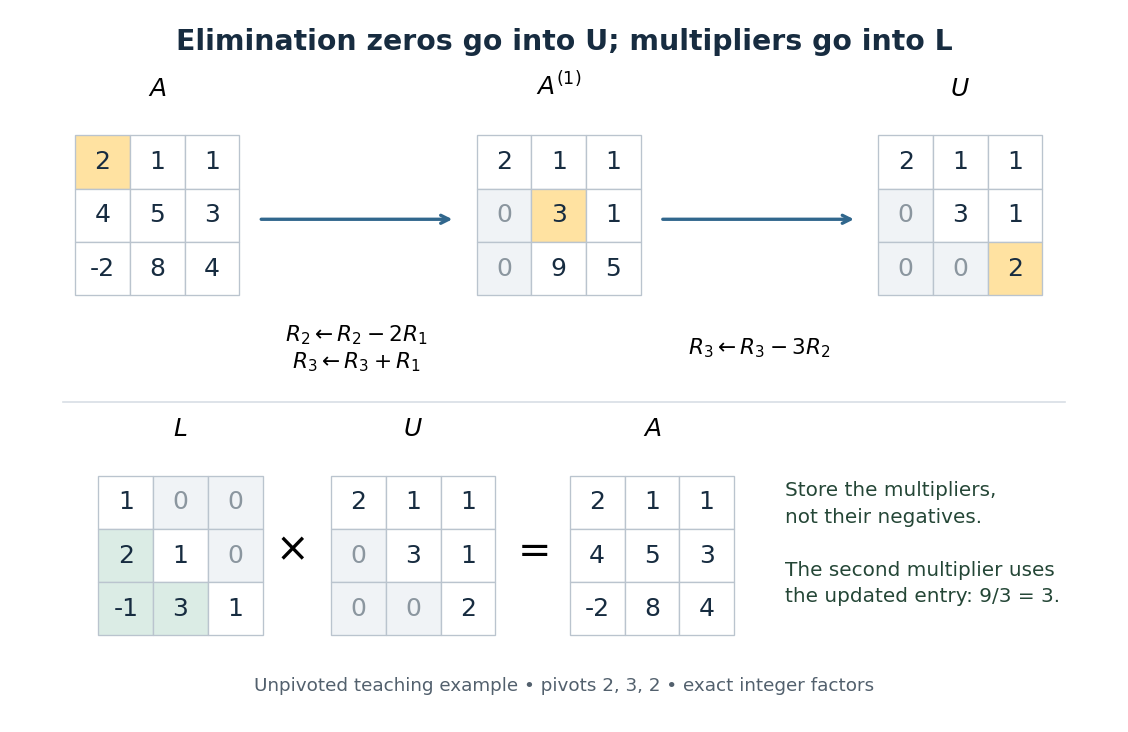
Gaussian elimination turns a three-by-three matrix into an upper triangular matrix, while elimination multipliers are stored in a lower triangular matrix
. Details. The unpivoted calculation here illustrates the structure of LU decomposition; applying partial pivoting to this particular would choose a different first row and different factors. Both procedures can represent the same linear system when their permutation matrices are handled consistently.
For exact LRU replacement, let be the resident set after the first accesses of a fixed page-reference trace with capacity . With empty starts, identical access order, freely placeable memory pages, and all resident memory pages eligible for eviction,Here means subset. At every time, form one capacity-independent ordered list of distinct memory pages, most recently accessed first. An access moves its memory page to the front, preserving the order of the others. Exact LRU replacement with page frames retains the first entries, or all entries if fewer than have appeared. The first entries are contained in the first , proving the property. This recency list is not the push/pop interface of a LIFO stack.[ref]
Beyond Physical Memory: Policies. Belady's Anomaly aside, p. 5: stack-property inclusion and its consequence for LRU; section 22.7, p. 11: exact recency must be updated on every access
Apply inclusion immediately before an access: a hit with page frames must also hit with . Thus cumulative misses with cannot exceed those with , at any prefix of the same page-reference trace. On the displayed sequence, the counts decrease from ten to eight when capacity increases from three to four. Arbitrary initial contents, different access orders, protected victims, or clean-victim preference fall outside the proof. Nor does it prove monotonic page writeback costs, or apply automatically to CLOCK page replacement just because that policy approximates LRU replacement.
// Destination: computer-science.bigb
For , the weak Lq space consists of measurable functions for which is finite. This distribution-function expression is a quasi-norm. The equivalent norm satisfies , with . The layer cake representation bounds the integral by . The lower bound uses finite-measure subsets of a superlevel set.
From an Lp norm Cauchy sequence choose a subsequence with successive difference norms at most . Minkowski inequality and monotone convergence theorem make the sum of the absolute differences an function, hence finite almost everywhere. The telescoping series defines an limit; the geometric bound on its tail proves norm convergence of the subsequence, and the original Cauchy property proves convergence of the whole sequence. No sigma-finiteness assumption is needed.
For , a nonempty closed convex set in an Lp space has exactly one nearest point to every . A minimizing sequence is a Cauchy sequence: the Clarkson inequality bounds by , where is the infimum of the distances. Completeness of Lp spaces and the closed set property give a limit in . Applying the same inequality to two minimizers proves uniqueness. Nonemptiness is essential.
For and in an Lp space, the derivative with respect to the real scalar has the displayed form; the integrand is zero where . The pointwise chain rule gives the derivative, while the Holder inequality makes integrable and permits the dominated convergence theorem. This variational derivative characterizes nearest points to closed convex sets and constructs the Lp duality density of a bounded linear functional.
Pinned article: Introduction to the OurBigBook Project
Welcome to the OurBigBook Project! Our goal is to create the perfect publishing platform for STEM subjects, and get university-level students to write the best free STEM tutorials ever.
Everyone is welcome to create an account and play with the site: ourbigbook.com/go/register. We belive that students themselves can write amazing tutorials, but teachers are welcome too. You can write about anything you want, it doesn't have to be STEM or even educational. Silly test content is very welcome and you won't be penalized in any way. Just keep it legal!
Intro to OurBigBook
. Source. We have two killer features:
- topics: topics group articles by different users with the same title, e.g. here is the topic for the "Fundamental Theorem of Calculus" ourbigbook.com/go/topic/fundamental-theorem-of-calculusArticles of different users are sorted by upvote within each article page. This feature is a bit like:
- a Wikipedia where each user can have their own version of each article
- a Q&A website like Stack Overflow, where multiple people can give their views on a given topic, and the best ones are sorted by upvote. Except you don't need to wait for someone to ask first, and any topic goes, no matter how narrow or broad
This feature makes it possible for readers to find better explanations of any topic created by other writers. And it allows writers to create an explanation in a place that readers might actually find it.
Figure 1. Screenshot of the "Derivative" topic page. View it live at: ourbigbook.com/go/topic/derivativeVideo 2. OurBigBook Web topics demo. Source. - local editing: you can store all your personal knowledge base content locally in a plaintext markup format that can be edited locally and published either:This way you can be sure that even if OurBigBook.com were to go down one day (which we have no plans to do as it is quite cheap to host!), your content will still be perfectly readable as a static site.
- to OurBigBook.com to get awesome multi-user features like topics and likes
- as HTML files to a static website, which you can host yourself for free on many external providers like GitHub Pages, and remain in full control

Figure 2. You can publish local OurBigBook lightweight markup files to either OurBigBook.com or as a static website.
Figure 3. Visual Studio Code extension installation.
Figure 5. . You can also edit articles on the Web editor without installing anything locally. Video 3. Edit locally and publish demo. Source. This shows editing OurBigBook Markup and publishing it using the Visual Studio Code extension. 
- Infinitely deep tables of contents:




All our software is open source and hosted at: github.com/ourbigbook/ourbigbook
Further documentation can be found at: docs.ourbigbook.com
Feel free to reach our to us for any help or suggestions: docs.ourbigbook.com/#contact