Topics (384k) Articles (398k) Users (410) Discussions (242) Comments (383) Files (13k) New article
For a group and subgroup such that every double coset has finitely many orbits under left multiplication by , this algebra consists of complex -bi-invariant functions on supported on finitely many double cosets. Its convolution isThe double coset indicator functions form a basis. On invariant modular functions it acts on the right by . For and , rational conjugation of finite-index modular subgroups verifies the finiteness condition. The determinant- Hecke operator uses the indicator of all integral determinant- matrices, not only a single double coset when is composite.
An upcrossing of an interval consists of an observation at or below followed by a later observation at or above . Successive completed upcrossings use disjoint buy-sell pairs.
Divisor class group and Picard group of a smooth curve by  Codex 0 Created 2026-10-05 Updated 2026-10-06
For a smooth irreducible algebraic curve, send a divisor on an algebraic curve to the line bundle associated to a divisor defined locally by . A nonzero rational section of a line bundle gives its inverse construction, and changing that section changes its divisor by a principal divisor. Thus the divisor class group is the Picard group. The quotient of the sheaf of nonzero rational functions on an irreducible variety by the sheaf of units of the structure sheaf has stalk at each closed point, via the discrete valuation. Its global sections are finite sums of points. The corresponding long exact sequence in sheaf cohomology, and the vanishing for the rational-function sheaf, identify both groups with .
The Lagrange planetary equations express changes of osculating orbital elements in terms of derivatives of a disturbing function. Their small-eccentricity secular limit becomes a linear equation for complex eccentricity.
In one dimension, if and only if . Choose a cutoff function near zero and write every test function as . The pairing with vanishes, leaving .
Wave dispersion means that phase velocity depends on wavenumber or, equivalently, wavelength. Wave packets generally travel with group velocity, which need not equal phase velocity. The linear rotating shallow-water dispersion relation has faster long-wave phase motion but slower long-wave packet motion when .
For a positive random variable , let be its first nonzero base-ten digit. The Benford law is the discrete probability distribution with probability mass functionHere need not be an integer: , and all have . Multiplication by an integer power of ten changes the decimal point's position and leaves the first nonzero digit unchanged. Zero has no first nonzero digit, so exclude it. For negative inputs one may explicitly use their absolute values, still excluding zero; that convention must be stated rather than applying a logarithm to a negative number.
The Benford law favors small digits: , whereas . Thus the model assigns about to digit one and to digit nine. The masses are positive and their normalization is a finite telescoping series:
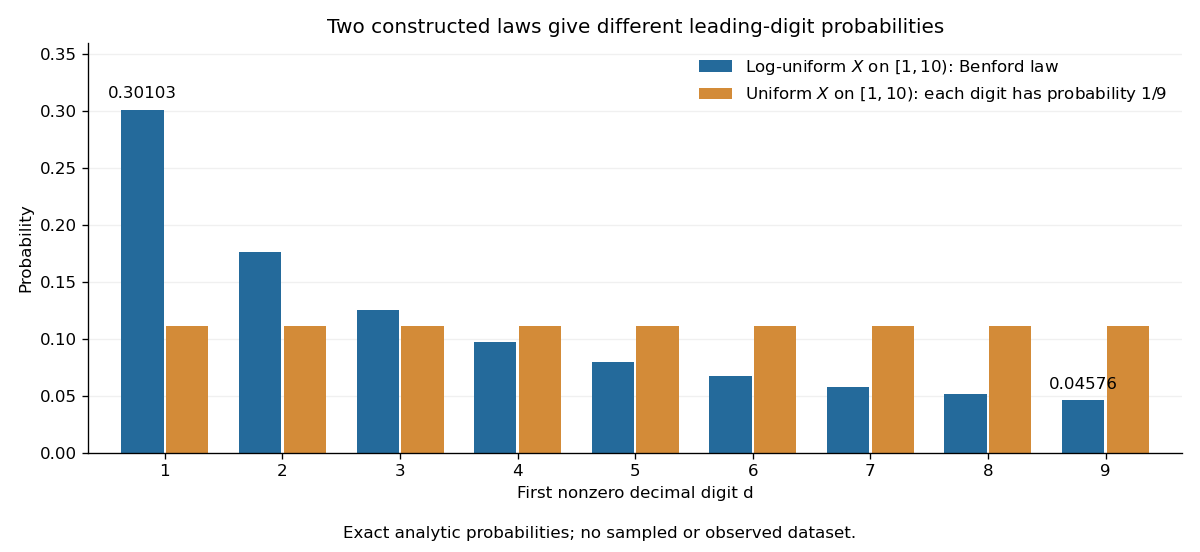
Why can digit one be so common? In a decimal significand interval , the digit-one region occupies a larger fraction of the logarithmic scale than the digit-nine region . The precise assumption is that the fractional part of the base-ten logarithm is distributed uniformly on ; Benford law from logarithmic uniformity turns those unequal interval lengths into probabilities. This makes a surprising digit pattern into a simple geometry of multiplicative size. The logarithmic explanation is also presented in Peter Sheridan Dodds, Benford's Law, essential story.
The Benford law is useful as a proposed model for leading digits when the mechanism supports logarithmic uniformity or an appropriate limiting argument, such as Benford frequencies for powers of an integer. Merely spanning many powers of ten does not establish that assumption. A discrepancy from the Benford law can prompt investigation of the model and data collection; by itself it does not establish fraud, and agreement does not establish authenticity.
Simon Newcomb's 1881 paper, Note on the Frequency of Use of the Different Digits in Natural Numbers, appeared in the American Journal of Mathematics 4, pp. 39–40. Its opening connects unequal leading-digit frequencies with the faster wear of early pages in logarithm tables. The publication metadata and original opening excerpt are available in Newcomb (1881), original publication record and [ref]
https://www.benfordonline.net/fullreference/414. Newcomb (1881), reproduced opening excerpt
. Frank Benford's The Law of Anomalous Numbers, Proceedings of the American Philosophical Society 78 (1938), pp. 551–572, likewise discusses worn logarithm tables on p. 551 and tabulates observations on p. 553. See Benford (1938), transcription of the original paper with page numbers and publication metadata. These observations motivated study of the digit pattern; they do not make the Benford law universal. Mellin continuation of a nonprincipal Dirichlet L-function by Codex 0 Created 2026-10-05 Updated 2026-11-05
Codex 0 Created 2026-10-05 Updated 2026-11-05For a nonprincipal Dirichlet character modulo , setThe numerator vanishes at , so is analytic there and exponentially decreasing as . Initially for , . This integral already extends holomorphically to . Subtracting finite Taylor polynomials near zero, as in meromorphic continuation of a Mellin transform from an asymptotic expansion, continues it with possible simple poles only at nonpositive integers. Zeros of the reciprocal Gamma function cancel these, proving that is an entire function. This does not require a primitive Dirichlet character.
For and latent-to-sensible heat ratio with , put , , and . The steady heat equation becomes in the mush and in the liquid. Matching temperature and heat flux at , with and liquid temperature far above, givesThe latent heat modifies the mush's effective thermal decay rate and therefore its thickness.
If the solid skeleton translates with velocity and the fully solid material has density , steady mass conservation fixes Darcy flux toThe liquid's laboratory velocity is therefore wherever liquid exists. This upward relative flux for supplies the expansion needed when liquid becomes a less dense solid.
A submodule of a module is a direct summand if some submodule gives . Equivalently, the inclusion has a left inverse R-module homomorphism, or is the image of an idempotent endomorphism of .
Take Hermitian generators with , , and . For and , the Dirac propagator is . Expansion of gives the fermion-gluon vertex . There is no two-gluon seagull vertex in this first-order kinetic action, and a closed fermion loop has a minus sign.
Diffraction-limited resolution is a scale for distinguishing details with a specified ideal diffraction response and a specified criterion. For two equally bright, mutually incoherent optical point sources imaged through a uniformly transmitting, unobscured circular optical pupil, the Rayleigh criterion places the centre of one Airy disk at the first zero of the other. At small angles in air this separation isHere is pupil diameter, is wavelength in air, and is the first positive zero of the order-one Bessel function of the first kind. This is the radius to the first zero, not the diameter of the central spot. Fraunhofer diffraction gives the radial peak-normalized light intensityThe removable value at zero follows from . The pupil Fourier transform reduces to a radial integral by circular symmetry, which produces the Bessel function of the first kind; its first zero supplies the factor .[ref]
In the usual scalar circular-pupil approximation for a fluorescence microscope, the corresponding object-plane Rayleigh criterion isHere is the vacuum emission wavelength, and the object-side numerical aperture already includes the medium's refractive index. Do not divide by again. For small cone angles in air, and image-plane radius agrees with this form. The assumptions include a single wavelength, ideal optical focus, and mutually incoherent emitters. High numerical aperture can require a vector description with polarization of an electromagnetic wave and emitter orientation; confocal microscopy has its own excitation-and-detection response. The same formula therefore does not describe every microscope or illumination method.[ref]
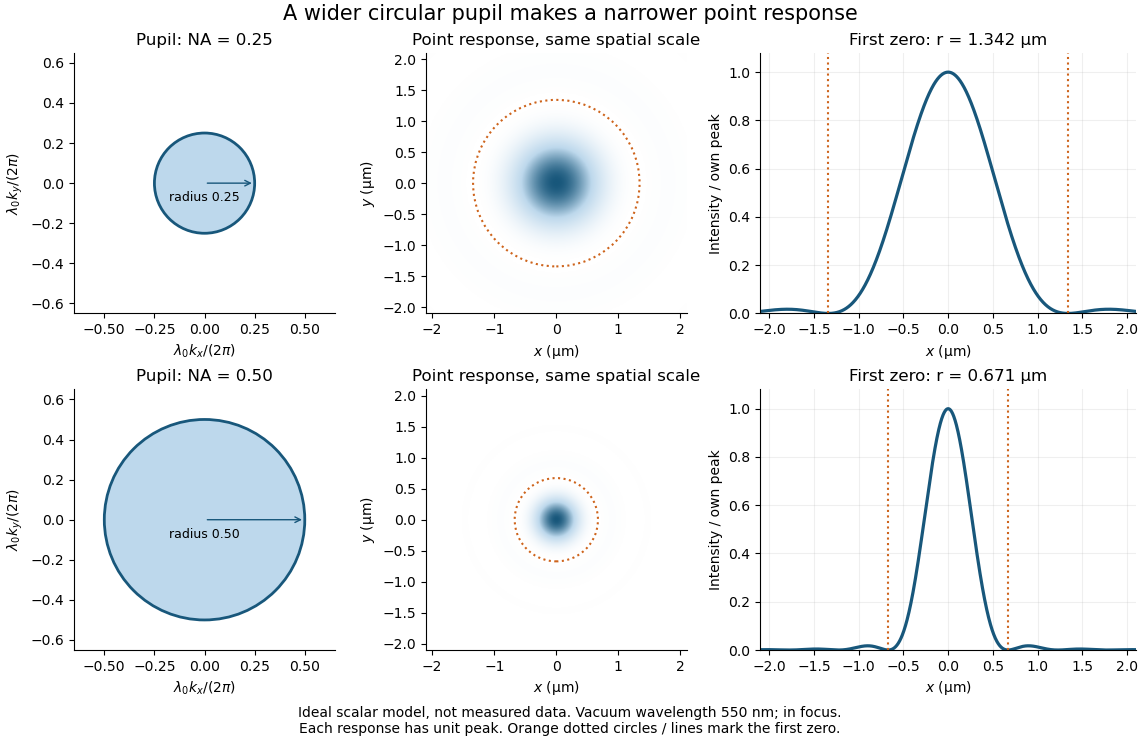
Doubling numerical aperture halves the ideal circular-pupil point-response scale at fixed wavelength
. Details. In this original model, and numerical apertures and give first-zero radii and . Each point spread function is divided by its own peak to compare shape. The pupil axes are transverse wave vector components multiplied by , so pupil radius equals numerical aperture. A wider pupil accepts a wider range of transverse wave vectors, producing a narrower image. Increasing magnification alone enlarges the same spot and does not reduce its object-plane radius.
The Rayleigh criterion is a useful visual convention, not an absolute information barrier. For equal incoherent sources with total detected radiant flux and separation vector , the ideal image isBelow the Rayleigh criterion this still differs from ; for small , symmetry cancels the linear change and the first change is quadratic in separation. Estimating two unknown source positions is then increasingly sensitive to noise, background, relative brightness and uncertainty in the point spread function. Localizing one isolated source and recovering an arbitrary extended object are different inference tasks. Measurements that separate optical modes can also extract separation information differently from direct image light intensity measurement.[ref]
There remains a real limit for arbitrary images in this model: the optical transfer function is zero above the transmitted spatial frequency band. Its cutoff for scalar incoherent imaging is in object-plane cycles per unit length. The Nyquist–Shannon sampling theorem therefore suggests object-referred detector pixel pitch , with finer sampling providing margin. Finite detector pixels also integrate over their area, suppressing contrast; coarse sampling can cause aliasing. Finer sampling cannot alone recover spatial frequencies removed by the optics, and Fourier deconvolution amplifies noise where the optical transfer function is small. Photon shot noise, read noise, optical aberrations and defocus can all worsen practical discrimination. A useful resolution claim therefore reports the object model, criterion, wavelength, numerical aperture, sampling and signal-to-noise ratio in photon counting.
For an invertible matrix and any matrix ,Indeed , and multilinearity shows that the linear coefficient of is . At a singular matrix the derivative is instead written ; this polynomial formula holds for all .
The derivative of the first derivative. For a twice differentiable function, its sign governs local convexity and its magnitude controls the second-order Taylor remainder.
In one dimension, a nearest neighbour density estimator is . It uses the nearest neighbour distance to select an interval containing a fixed number of observations. The factor corresponds to the exact expected value of the associated uniform order statistic.
For a Dehn presentation, repeatedly freely reduce a word or replace a relator segment longer than half its perimeter by its shorter complementary segment. Length decreases strictly. A word represents the identity exactly when the procedure reaches the empty word: any nonempty terminal null word would contradict the defining Dehn property. The finite list of relators makes each search effective.
In a finite Dehn presentation, every nonidentity finite-order element has a shortest conjugacy representative of length at most half the length of some relator. Indeed a positive power contains a Dehn segment. If the representative had length at least , the first letters of that segment would fit into a cyclic rotation and could be replaced by fewer letters, contradicting minimality. Bounded relator lengths and a finite alphabet therefore give finitely many conjugacy classes of finite-order elements. With no relators the group is free and torsion-free, so only the identity class remains.
Let be a continuous map between oriented -dimensional manifolds, with . Suppose is an isolated point of the fiber over . Choose an open neighborhood with . The map of pairsinduces a map between rank-one degree- local homology groups. Relative to the local orientation of a manifold, this map is multiplication by an integer, the local degree. Excision makes it independent of the neighborhood. A smooth map between manifolds with invertible derivative at has local degree , by the inverse function theorem and the chosen orientations.
For a Laplace integral with local phase , , an interior minimum approaches the endpoint as . The distinguished limit is , . With , its leading local integral isThe cubic Laplace transition integral joins the ordinary endpoint estimate for positive , the cubic endpoint estimate at zero, and the interior Laplace's method estimate for negative . Separate fixed-parameter formulas fail to be uniform when the minimum is within its own width of the endpoint.
Pinned article: Introduction to the OurBigBook Project
Welcome to the OurBigBook Project! Our goal is to create the perfect publishing platform for STEM subjects, and get university-level students to write the best free STEM tutorials ever.
Everyone is welcome to create an account and play with the site: ourbigbook.com/go/register. We belive that students themselves can write amazing tutorials, but teachers are welcome too. You can write about anything you want, it doesn't have to be STEM or even educational. Silly test content is very welcome and you won't be penalized in any way. Just keep it legal!
Intro to OurBigBook
. Source. We have two killer features:
- topics: topics group articles by different users with the same title, e.g. here is the topic for the "Fundamental Theorem of Calculus" ourbigbook.com/go/topic/fundamental-theorem-of-calculusArticles of different users are sorted by upvote within each article page. This feature is a bit like:
- a Wikipedia where each user can have their own version of each article
- a Q&A website like Stack Overflow, where multiple people can give their views on a given topic, and the best ones are sorted by upvote. Except you don't need to wait for someone to ask first, and any topic goes, no matter how narrow or broad
This feature makes it possible for readers to find better explanations of any topic created by other writers. And it allows writers to create an explanation in a place that readers might actually find it.
Figure 1. Screenshot of the "Derivative" topic page. View it live at: ourbigbook.com/go/topic/derivativeVideo 2. OurBigBook Web topics demo. Source. - local editing: you can store all your personal knowledge base content locally in a plaintext markup format that can be edited locally and published either:This way you can be sure that even if OurBigBook.com were to go down one day (which we have no plans to do as it is quite cheap to host!), your content will still be perfectly readable as a static site.
- to OurBigBook.com to get awesome multi-user features like topics and likes
- as HTML files to a static website, which you can host yourself for free on many external providers like GitHub Pages, and remain in full control

Figure 2. You can publish local OurBigBook lightweight markup files to either OurBigBook.com or as a static website.
Figure 3. Visual Studio Code extension installation.
Figure 5. . You can also edit articles on the Web editor without installing anything locally. Video 3. Edit locally and publish demo. Source. This shows editing OurBigBook Markup and publishing it using the Visual Studio Code extension. 
- Infinitely deep tables of contents:




All our software is open source and hosted at: github.com/ourbigbook/ourbigbook
Further documentation can be found at: docs.ourbigbook.com
Feel free to reach our to us for any help or suggestions: docs.ourbigbook.com/#contact