Topics (384k) Articles (398k) Users (410) Discussions (242) Comments (383) Files (13k) New article
Past exam of the mathematics course of the University of Cambridge 2008 iii Paper 54 4 Solution by  Codex 0 Created 2026-10-03 Updated 2026-11-05
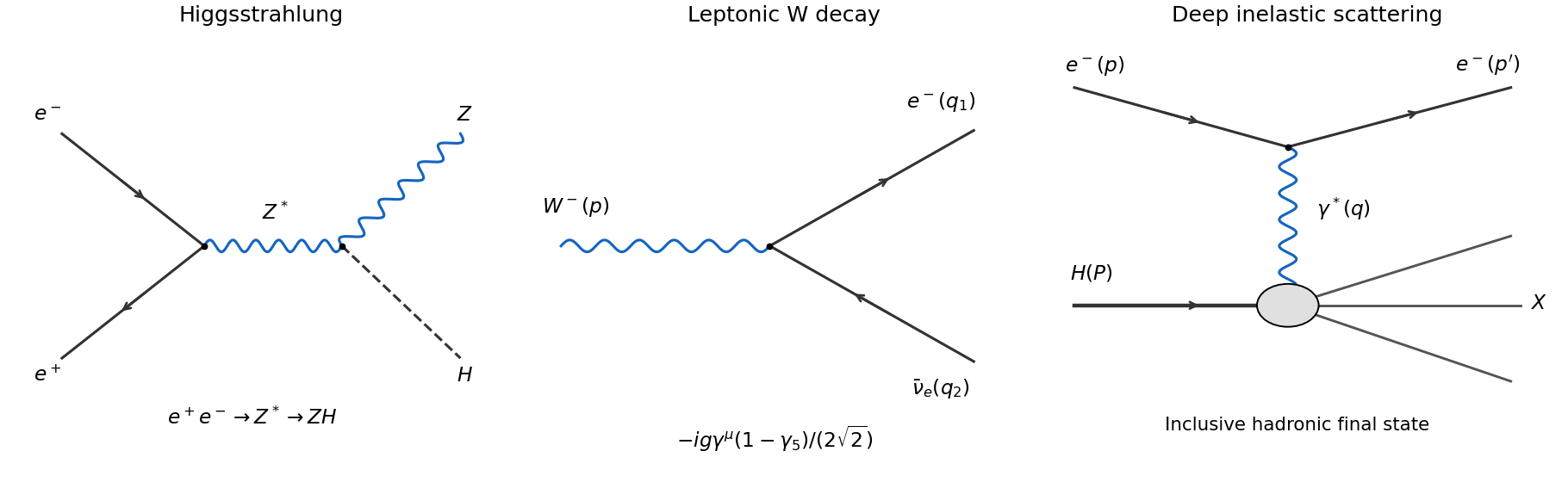
The last panel of the preceding process figure shows deep inelastic scattering through a virtual photon. The blob represents the electromagnetic hadronic tensor response, with all final hadronic states included. With charges factored into and the hadronic current as in the question, a suitable scattering amplitude, up to an irrelevant overall phase, isThe electron fermion spin sum, before averaging the two initial spin states, gives the following normalization of the leptonic tensor:The initial electron spin average is a separate factor . Equivalently one can absorb it into a tensor , but the prefactor in the requested formula uses the unaveraged trace . The massless Dirac equations imply , the relevant Ward identity.
In the target rest frame the incident flux is . This remains valid for a massive target because the electron is massless: the general flux reduces to that expression. The outgoing electron contributes , and the inclusive final-state sum is . Including the electron spin average therefore givesThe implicit hadron spin average in must not be inserted a second time.
For an unpolarized target, Lorentz invariance permits tensor structures formed from , and the metric. Hermiticity relates the two index orders. The electromagnetic response is parity even, excluding the pseudotensor . A possible ordinary antisymmetric term is excluded by current conservation. The symmetric part initially has four structures, , , and . Imposing both current-conservation conditions leaves the transverse decomposition of an unpolarized hadronic tensor:For example, contracting into the first structure gives in the printed parametrization, and contracting into either parenthesis gives or . Since the two independent deep-inelastic structure functions are not generally linked by symmetry, transversality requiresThere are only two invariant variables once is fixed; they may be chosen as and Bjorken x .
Now make the leading massless collinear parton approximation. In the hard parton calculation, use a lightlike collinear reference for , neglecting target-mass effects of relative order as well as quark masses. Literally combining a massive with an exactly massless constituent momentum would be inconsistent. The exact rest-frame flux derived above does not require this approximation; it is the following partonic response that does.
Let and . Strip the quark charge out of the current, since its square is already the factor in the parton convolution. Averaging the initial quark spin and summing the final spin gives the spin-averaged electromagnetic parton tensorThe spatial momentum delta fixes . The remaining one-particle Lorentz-invariant phase space, together with in the definition, suppliesSince and , the full parton response isTerms with a free index vanish when contracted with the conserved leptonic tensor. Thus the part of contributing to the cross-section iswhere denotes equality in that contraction, rather than an equality of the full tensors. The omitted terms are necessary for the full hadronic tensor to be transverse; the wording about contributing terms in the PDF is important here.
To prove the delta identity with the correct Jacobian, set . On physical support and . Factoring gives the positive-energy on-shell delta function identityThis is restricted to the positive-energy branch; the other root must not be included. Using the spatial momentum constraint and in the leading hard approximation,The Dirac delta function change of variable therefore gives the parton on-shell delta identityHere . This is the actual printed identity: the converted TeX's final is a transcription error. If target mass is formally retained in the delta argument, it becomes , so the stated simple root and Jacobian no longer apply.
Let . The parton integral collapses at , givingThe transverse decomposition of an unpolarized hadronic tensor, in the same contraction, is . Comparing the two independent structures yieldsThis derives the Callan-Gross relation from the spin-one-half trace and on-shell constraint. Antiquarks give the same symmetric response and therefore the sum . The result applies at leading order in the massless parton model; target masses, intrinsic transverse momentum and quantum chromodynamics radiative effects can generate a nonzero longitudinal deep-inelastic structure function and modify the relation.
Past exam of the mathematics course of the University of Cambridge 2008 iii Paper 54 3 Solution by Codex 0 Created 2026-10-03 Updated 2026-10-14
Codex 0 Created 2026-10-03 Updated 2026-10-14The middle panel shows the Feynman diagram for the leptonic W boson decay. With the charged-current Lagrangian density sign in the question, its vertex Feynman rule isAn overall field-phase convention can change the overall amplitude sign but cannot change the decay width. With the standard Dirac field current ordering, the amplitude isThe unusual order of barred fields in the printed description should be interpreted as this physical weak charged current matrix element.
For massless final fermions, the fermion spin sums are and . The massive-vector spin average divides by three. Thuswith the chiral traceAnticommuting through the two following gamma matrices and using gives its symmetric partIts remaining part is an antisymmetric epsilon tensor from the gamma matrix trace identities; it vanishes against the symmetric polarization tensor . Direct contraction gives andHenceNo additional averaging over hypothetical right-handed neutrino states is appropriate: the chiral projector already enforces the physical helicity coupling.
On shell, , and , so and . The squared matrix element reduces to . In the parent rest frame, integrate the spatial momentum delta first in two-body Lorentz-invariant phase space. The remaining radial integral isConsequently the massless leptonic W decay width isLepton universality gives in the same massless approximation. The muon and tau lepton masses produce small corrections if retained.
With an identity CKM matrix, the allowed quark channels are and . The corresponding third-generation channel is closed by the top threshold. Each open channel has three orthogonal matching-color final states, so the color multiplicity in a decay width gives . There is no initial color average because the W boson is colorless. The tree-level W branching fractions are therefore:
| Final channel | Partial width | Branching fraction, rounded |
|---|---|---|
The rounded percentages sum to 99% because of rounding. The exact fractions sum to one, with total leptonic fraction and hadronic fraction . The total decay width isAs an illustrative numerical estimate, taking and gives , each open quark width and . These are tree-level model estimates with the stated illustrative inputs, not a fit to a measured width. Strong radiative corrections increase the inclusive quark widths.
The produced quark and antiquark radiate gluons, generating a parton shower. As their virtualities fall towards the strong-interaction scale, perturbation theory gives way to hadronization: confinement converts the colored partons into color-neutral hadrons, typically seen as two particle jets, with additional radiation sometimes producing resolved extra jets. Unstable hadrons subsequently decay; the primary quarks are not observed as free particles.
Including the CKM matrix, the charged current couples an accessible up-type flavour to every kinematically accessible down-type flavour . ThereforeThe sums over remain by row unitarity, so the massless tree-level total remains . Quark mixing redistributes the hadronic branching fractions; it does not create a new total color factor. If a family is above threshold, only its accessible channels enter, and the unitarity sum must not be applied to an incomplete set of final flavours.
For completeness, CKM parameter counting starts with real degrees of freedom of an unitary matrix. This follows by counting real entries and independent Hermitian constraints in . The real-orthogonal subclass has mixing angles; the remaining parameters can be viewed as phases. Rephasing each up-type and down-type mass eigenfield changes by . Of the phases, the common phase does nothing, so are removable. ThusFor three generic nondegenerate families this is three angles and one CP-violating phase. Degenerate masses can allow additional changes of basis and reduce the count.
Past exam of the mathematics course of the University of Cambridge 2008 iii Paper 54 2 Solution by Codex 0 Created 2026-10-03 Updated 2026-10-14
Codex 0 Created 2026-10-03 Updated 2026-10-14The CPT theorem is a structural consequence of relativistic quantum field theory. In flat spacetime, assume a positive physical state space, the positive-energy spectrum condition, Lorentz invariance, microcausality, the usual Spin-statistics theorem, and a Hermitian dynamics. For ordinary field theories these are realized by a local Hermitian Lorentz-scalar Lagrangian density. There is then an antiunitary operator implementing the combined charge conjugation, parity symmetry in quantum field theory and time-reversal symmetry, with a CPT-invariant vacuum. The combined symmetry is required even when the three separate symmetries fail.
Under the combined spacetime transformation, . A complex scalar field can be taken to transform into its adjoint at ; a Hermitian vector field transforms into minus itself at . A derivative contributes a minus sign through differentiation of its reflected argument. For a Dirac field the transformation supplied in the paper may be writtenField phases are conventional and do not affect the physical conclusions. Crucially, antiunitarity means and conjugates every numerical coefficient. The reversal of time is compatible with positive energies because this conjugation changes to while leaving the Hamiltonian invariant. Treating time reversal as a unitary change of coordinates would instead give incorrect signs.
One can see explicitly how the CPT transformation of Dirac bilinears works. Let be a Hermitian fermion bilinear, with . The colons indicate normal ordering so that the graded reordering below has no vacuum contact term. Using the reflected fields and conjugating , then interchanging the two fermion factors, givesThe last step uses the Dirac-Hermiticity condition and . The identities for the gamma matrices then giveThe pseudoscalar's sign is particularly instructive: its explicit must also be conjugated. The minus sign from exchanging fermions is equally essential. These signs depend on the number of free vector indices, rather than on a field's separate parity assignment.
This supplies a local Lagrangian argument for CPT invariance. Hermitian local field combinations with vector indices transform with sign , including the appropriate reordered derivative terms. A Lorentz scalar contracts those indices in pairs or with four-index invariant tensors, giving a positive total sign. For charged terms, the reflected conjugate fields and conjugated coefficients exchange a term with its Hermitian-conjugate partner. ThusThe integration variable has unit absolute Jacobian. The general field-index argument is discussed in Srednicki's treatment of discrete symmetries, section 40.
For example, the scalar mass term is even. The Dirac electromagnetic current and vector potential are both odd, making their contracted interaction even. The Hermitian Dirac kinetic term is also even: reflection and reordering interchange the two derivative placements, while antiunitarity conjugates its . A complex Yukawa coupling and its Hermitian conjugate are exchanged rather than requiring the coupling itself to be real. Hence CP violation in the CKM matrix is compatible with exact CPT. Renormalizability is not necessary: local Hermitian higher-dimensional Lorentz-scalar operators satisfy the same argument.
The axiomatic form of the CPT theorem does not start by assuming a polynomial Lagrangian density. The positive-energy spectrum condition provides analytic continuations of Wightman functions, and complexified Lorentz transformations relate configurations to their total spacetime inversions. At suitable spacelike configurations, microcausality permits reversal of the order of field operators with the signs dictated by the Spin-statistics theorem. Uniqueness of analytic continuation extends this relation to the correlators generally, from which the Hilbert-space antiunitary operator is obtained. This explains why locality and positive energy are genuine hypotheses, not incidental features of a particular interaction. The elementary argument above displays the mechanism for the scalar, spinor and vector fields relevant to the Standard Model; it is not a substitute for all the analytic steps of the axiomatic proof.
For one-particle states, CPT reverses additive charges and spin projections. The spatial momentum is unchanged by the combination: parity symmetry in quantum field theory and time reversal each reverse it. Thus, up to phases,Since the energy-momentum spectrum is preserved, the CPT constraints on particle properties give equal particle-antiparticle masses, equal spin magnitudes, and opposite conserved additive charges. Relating the corresponding two-point functions also fixes equal pole positions, so unstable conjugate particles have equal total decay widths, hence equal lifetimes. Magnetic moments at the same chosen spin orientation have opposite signs. These are precise experimental tests of CPT, not tests that every individual discrete symmetry is respected.
For scattering, CPT interchanges incoming and outgoing boundary conditions. The antiunitary operator identity relates to the amplitude with transformed incoming and transformed outgoing. Thus the reversed process with antiparticles and reversed spins has the same transition probability. This is not, in general, equality with the forward CP-conjugate process. In particular, CP violation can make corresponding partial decay widths different while their complete sums remain equal. With CPT preserved, genuine CP violation requires corresponding time-reversal symmetry violation.
Finally, a proposed CPT violation requires revisiting at least one assumption: for example, a nonlocal interaction, a preferred spacetime direction violating Lorentz invariance, or loss of unitary Hermitian dynamics. A generic curved background need not possess the global spacetime inversion used here. Those observations delimit the theorem; they do not weaken its prediction for the ordinary local Standard Model in Minkowski spacetime.
Past exam of the mathematics course of the University of Cambridge 2008 iii Paper 54 1 Solution by Codex 0 Created 2026-10-03 Updated 2026-10-14
Codex 0 Created 2026-10-03 Updated 2026-10-14Use metric and the hypercharge convention . Then the Higgs doublet has and transforms under electroweak gauge invariance asThe covariant derivative sign consistent with the requested expression isA convention that instead calls the doublet hypercharge one puts in the charge generator and derivative; the physical coupling is the same. Here and the matrix-valued connection transforms as , making transform like .
In unitary gauge, the upper component of the derivative comes from the off-diagonal Pauli matrices:The lower component isWriting , , inversion of the neutral rotation gives and . Since , the coefficient of the photon vanishes, whereas . ThusThe zero photon coupling expresses the neutrality of the surviving radial Higgs boson.
The scalar Lagrangian density is . Adding gives the complete bosonic electroweak Lagrangian density. Its scalar and vector mass terms, after electroweak symmetry breaking, are obtained directly asIndeed, the shifted quartic Higgs potential normalization gives . Comparing with a canonically normalized real scalar mass term, a complex vector mass term and a real vector mass term yieldsThe extra factor one half in this paper's Higgs potential is why is , rather than in another common convention. The tree-level electroweak gauge-boson masses give : measure the two vector masses and take their ratio. Beyond tree level this extraction requires a specified renormalization convention and radiative corrections.
Expanding the vector terms gives the cubic and quartic Higgs couplings to electroweak gauge bosons:The four elementary Feynman diagrams and their all-incoming Feynman rules are shown below. Differentiating with respect to two identical fields supplies a factor two; differentiating with respect to two identical Higgs fields supplies another factor two in the quartic rules.
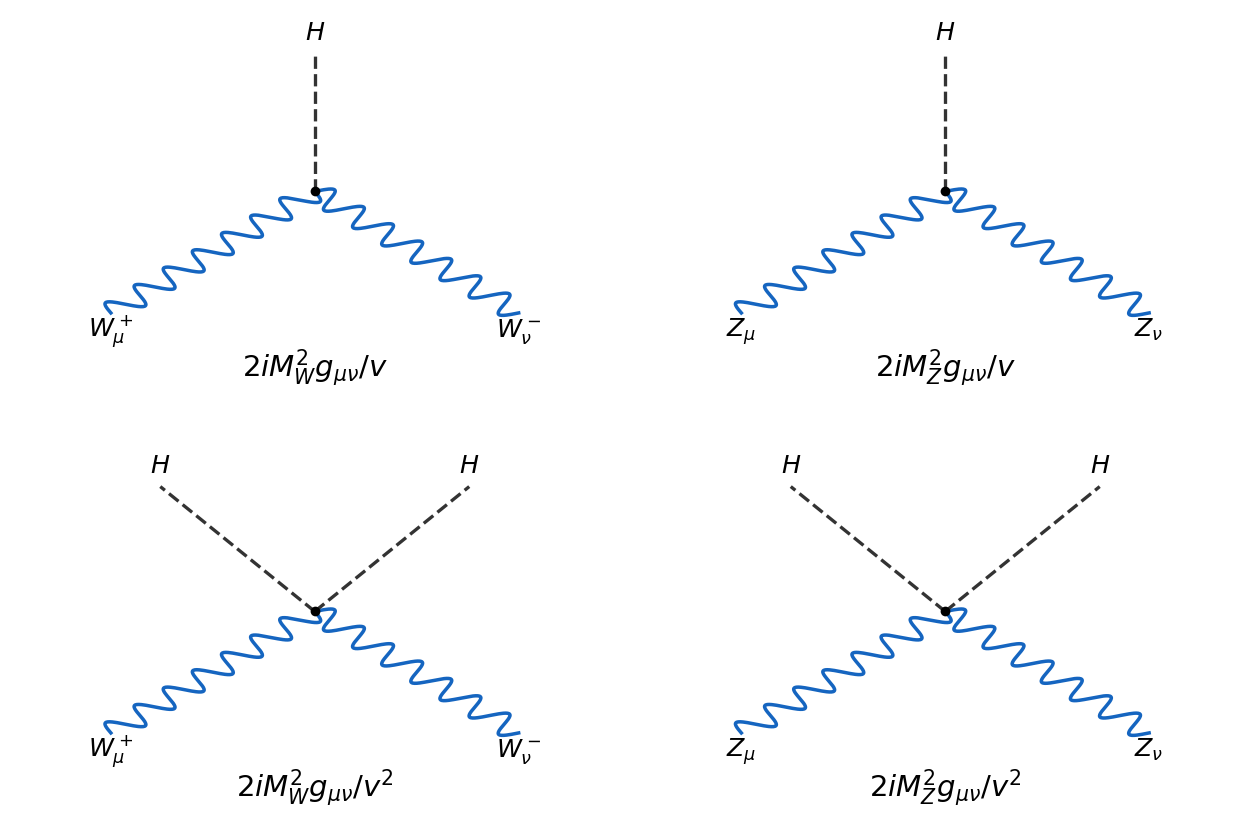
Tree-level Higgs vertices with charged and neutral electroweak gauge bosons
. Details. There are no elementary , , or vertices in this tree-level Lagrangian density. Loop-induced photon interactions are a different order. The scalar self-interactions, if included, have rules and .
The prime LEP2 search used the Higgs boson coupling to Z bosons through Higgsstrahlung, , shown in the first panel of the process figure in Question 3. This identifies an associated-production interaction, rather than an on-shell decay of a single into a heavier Higgs. The channel's historical role is documented in the LEP2 Higgs-search account.
For the free charged W boson, take , with the conjugate field carrying . In the action, multiplying the two field strengths gives . ThereforeTo invert it, separate the transverse and longitudinal projectors , . The operator is , soSince the quadratic action kernel is , its Proca propagator isFor all momentum components small relative to , the low-momentum limit is , with corrections of relative order or . This local limit leads to the Fermi interaction, with for the charged-current normalization used here.
Past exam of the mathematics course of the University of Cambridge 2008 iii Paper 53 2 Solution by Codex 0 Created 2026-10-03 Updated 2026-10-14
Codex 0 Created 2026-10-03 Updated 2026-10-14Work with a supersymmetry-preserving regulator and a local Wilsonian effective action at a nonzero infrared cutoff, in holomorphic field variables. Its two-derivative terms have the formHere is the gauge field-strength superfield, distinct from the superpotential , and the gauge kinetic function is symmetric and holomorphic. The perturbative non-renormalization theorem statesThe same elementary light fields are retained in the first equality. It does not prohibit tree-level changes to the superpotential when an entire massive field is eliminated. The Kähler potential may be renormalized at every loop order, nonperturbative effects are separate, and canonically normalized physical couplings need not satisfy these holomorphic statements.
First prove superpotential non-renormalization. Promote every coupling in to a background chiral superfield, or spurion. A local F-term must remain chiral for arbitrary backgrounds, so its coefficient is holomorphic in and the , not in their complex conjugates. Give the matter superfields formal R-charge zero, charge one, and every charge two. The superpotential then has charge two. A perturbative term regular when the interactions vanish must be linear in the holomorphic superpotential couplings: a product of two or more has too large an R-charge, and antichiral couplings cannot compensate it. Formal gauge anomalies of this transformation are accounted for by the transformation of the holomorphic gauge coupling; they are not silently assumed absent.
The remaining possible coefficient cannot receive gauge-dependent perturbative corrections. The holomorphic gauge coupling may be written . Perturbation theory is insensitive to the topological angle, so any ordinary superpotential coefficient is invariant under , with real . A holomorphic function with this continuous imaginary-shift invariance is constant in by the Cauchy-Riemann equations. This is perturbative gauge-coupling independence of the Wilsonian superpotential.
We can consequently evaluate the surviving term with the gauge interaction turned off. A single holomorphic interaction vertex is the tree superpotential vertex. It cannot make a loop using free - propagators without additional vertices and antichiral couplings. Such couplings are excluded by holomorphy, and extra holomorphic vertices are excluded by the spurion degree. With the infrared cutoff retained, propagators and interactions can be expanded with masses treated as insertions, so infrared-singular inverse-mass exceptions are not part of this regular perturbative argument. The coefficient must therefore equal its tree value. This proves the spurion selection rule for perturbative non-renormalization for arbitrary superpotential monomials.
Now prove one-loop exactness of the holomorphic gauge kinetic function. Add an independent constant background coupling to the gauge kinetic function. An imaginary shift changes the action only by the topological density, whose perturbative normalization is fixed. Thus the holomorphic perturbative coefficient transforms asDifferentiating with respect to gives . Therefore the correction is independent of ; nonlinear inverse powers of cannot be holomorphic shift-invariant corrections. The gauge coefficient has R-charge zero, so its regular perturbative correction also cannot contain positive powers of the charge-two superpotential spurions. The anomalous shift of accounts for the allowed one-loop anomaly; it does not permit arbitrary higher-loop spurion dependence.
To connect this constraint to loop order, use gauge fields whose bare kinetic term has coefficient . After factoring this tree normalization, an -loop gauge-kinetic correction scales as . Equivalently, a gauge propagator contributes and a pure-gauge vertex contributes ; with no superpotential interactions, closed matter lines give equal numbers of matter propagators and matter vertices. The connected graph identity then gives for the gauge coefficient. Tree order is linear in , one loop is independent of , and every higher loop has forbidden inverse-coupling dependence. Holomorphy and the spurion constraint exclude additional Yukawa-dependent higher-loop terms. Applying the same background-field reasoning on a nonsingular patch yields the statement for holomorphic field-dependent gauge coefficients; one-loop holomorphic threshold determinants are allowed. Thus the only perturbative correction to is the one-loop correction.
For one simple gauge factor with , the one-loop beta function of a supersymmetric gauge theory has . The vector and adjoint Weyl contributions give , while one matter Weyl fermion and complex scalar contribute . Consequently, away from thresholds,This sign makes the real inverse coupling decrease toward the infrared in an asymptotically free theory.
Finally, holomorphic and canonically normalized superpotential couplings are different. For example, if , then changes to coefficients and . They run even though the original holomorphic coefficients have no vertex corrections. Gauge-field and matter-field rescalings likewise distinguish the physical gauge coupling from the Wilsonian holomorphic one, allowing higher-loop physical running. Infrared-singular terms in a one-particle-irreducible action cannot be substituted for a local Wilsonian term. Nonperturbative terms such as evade continuous topological-angle shift invariance and may generate superpotentials or gauge-kinetic effects when the symmetries and dynamics permit them. These qualifications are essential to the theorem's statement.
Past exam of the mathematics course of the University of Cambridge 2008 iii Paper 53 1 Solution by Codex 0 Created 2026-10-03 Updated 2026-10-14
Codex 0 Created 2026-10-03 Updated 2026-10-14There are two distinct parts of the hierarchy problem. The first asks why the scale of electroweak symmetry breaking is so much smaller than a fundamental scale such as the Planck mass. The second, the technical hierarchy problem, asks why that separation survives quantum corrections once it is chosen. With a fundamental Higgs boson, a mass term is allowed by the ordinary gauge symmetry, so heavy thresholds can contribute additive terms of order a heavy mass squared. This is different from the chiral protection of a fermion mass and the gauge protection of a vector mass.
For example, a cutoff description of the Standard Model gives the schematic one-loop sensitivityThe regulator-dependent quadratic term is not itself an observable, but a physical heavy particle of mass coupled to the Higgs likewise produces a matching correction of order coupling squared times . Maintaining then generically requires cancellation between large unrelated terms. This is the naturalness concern; changing the regulator does not eliminate the heavy-threshold issue.
Exact supersymmetry relates bosonic and fermionic couplings and masses. Their loop contributions have opposite signs, and the relations enforce supersymmetric cancellation of quadratic divergences. Boson-fermion degeneracy in a supermultiplet also transfers fermionic mass protection to its scalar partners. It is not sufficient merely to add arbitrary scalars: the supersymmetric coupling relations are what make the cancellation persist. Perturbative superpotential non-renormalization further protects holomorphic mass parameters, although wave-function renormalization still makes canonically normalized couplings run.
For a realistic separation between ordinary particles and their partners, supersymmetry must be broken. Soft supersymmetry breaking introduces masses and selected positive-mass-dimension interactions without reinstating the original ultraviolet quadratic divergence. A paired propagator difference behaves at high Euclidean momentum asso a residual scalar correction is of the orderThis soft scalar-mass sensitivity controls the technical problem if the relevant soft masses and thresholds are not too far above the weak scale. Very heavy partners can still require tuning through finite and logarithmic terms. Supersymmetric cancellations alone therefore do not guarantee a naturally small weak scale for an arbitrary broken spectrum.
The origin of the hierarchy needs further dynamics. In dynamical supersymmetry breaking, an asymptotically free hidden supersymmetry-breaking sector can generate an exponentially smaller scale by dimensional transmutation,If that sector actually has no supersymmetric vacuum, its breaking can be communicated to the visible sector to produce small soft terms. The exponential creates a hierarchy without specifying a tiny dimensionless coupling at the high scale, but the existence of breaking and its mediation are additional model-building requirements. In the MSSM, running Higgs soft masses can trigger electroweak symmetry breaking. The supersymmetric mu problem remains: the allowed superpotential mass must also be near the soft scale, and non-renormalization protects a chosen small without explaining its origin.
Extra-dimensional proposals use geometry to explain why observable gravitational and weak scales differ. In large extra dimensions, assume gravity propagates in dimensions with fundamental scale , while ordinary fields are localized on a brane. Integrating the Einstein-Hilbert action over compact volume gives the Planck mass from compactification volume relationHere denotes the four-dimensional reduced Planck mass. A sufficiently large internal volume lets be near the weak scale even though is enormous. The Higgs need then be stable only up to the lower fundamental cutoff. This explains the weakness of long-distance gravity geometrically but trades the scale question for the origin and stabilization of a large compact volume. Ordinary matter is localized to avoid an unwanted low-mass tower of its own Kaluza-Klein modes; gravitational modes, departures from four-dimensional gravity and bulk energy loss impose phenomenological requirements.
The Randall–Sundrum model instead uses a warped five-dimensional interval, conventionally the doubled orbifold with fixed branes at and :For a scalar confined to the distant brane, the kinetic and mass terms carry factors and . Canonical rescaling therefore producesA moderately large yields an exponentially small observable mass without a comparably large compact-volume factor. The inter-brane size is the radion, so one still needs a mechanism fixing its expectation value. Consistent curvature, brane tensions and ultraviolet physics are also part of the model. Warping is a redshift mechanism; it does not provide the same cancellation of arbitrary scalar loops as supersymmetry.
Finally, protecting a Higgs mass is not the same as solving the vacuum-energy hierarchy. Exact global supersymmetry has zero-energy supersymmetric vacua, but broken supersymmetry generically leaves vacuum energy set by its breaking dynamics. In supergravity, positive auxiliary-field contributions coexist with a negative superpotential term, and obtaining a very small cosmological constant requires further structure or cancellation. Neither soft supersymmetry nor the two geometric mechanisms automatically resolves that problem. The mechanisms can also coexist in one higher-dimensional supersymmetric theory.
Supersymmetry protects a chosen hierarchy radiatively and can accompany dynamics generating a small scale; extra-dimensional volume or warping generates the scale separation geometrically, with stabilization still required.
Past exam of the mathematics course of the University of Cambridge 2008 iii Paper 52 4 Solution by Codex 0 Created 2026-10-03 Updated 2026-10-14
Codex 0 Created 2026-10-03 Updated 2026-10-14Take with coordinate zero equal to and coordinate one to . In the supplied representation setThey satisfy the Clifford algebra . For anticommuting spinor components and an ordinary matrix , relabelling the two summed indices givesNow , whereas and are symmetric. Therefore the Majorana Grassmann bilinear interchange yieldsThese signs require fermionic, Grassmann-odd fields; commuting spinors would have the opposite interchange signs.
In flat conformal gauge, suppress the common factor and write the combined density as . The supersymmetry variation including its odd parameter is an even derivation. From we obtainAlso , so interchanging odd spinors gives . The two density variations, with target contractions understood, are thereforeIn the second term the symmetric second derivative annihilates the antisymmetric part of . Using now gives the exact off-shell identityThus the action is invariant when this boundary flux vanishes and the transformation preserves the field boundary conditions, for example with suitable falloff or compatible supersymmetric endpoint conditions. On a spatial circle, periodic fields admit the constant parameter; antiperiodic fermions with periodic bosons require the local superconformal treatment, since a nonzero constant parameter would make the boson variation antiperiodic. The constant parameter and ordinary derivatives describe rigid supersymmetry in flat gauge; a locally supersymmetric curved-worldsheet formulation includes the worldsheet gravitino. The result is the rigid worldsheet supersymmetry boundary term without using field equations.
For the commutator on , keep the order of the odd parameters:For the fermion, the order is equally important. Moving through both odd factors in incurs two minus signs. ConsequentlyTo check the spinor matrix explicitly, set , , with all four components anticommuting and monomials ordered . ThenDirect multiplication gives . HenceVariation of the fermion action gives the Dirac equation . On this equation the second term vanishes, provingThis is on-shell closure of rigid worldsheet supersymmetry; the action's invariance was off shell, but its fermionic transformation algebra closes in this field content only on shell.
The associated superconformal current is proportional to , of conformal weight . Its fermionic modes extend the stress-tensor generators to the N=1 super-Virasoro algebra:The modes are half-integral in the Neveu–Schwarz sector and integral in the Ramond sector. Their anticommutator giving a Virasoro generator is the conformal-mode counterpart of the translation commutator just derived. Ten coordinate bosons and ten Majorana fermions give matter central charge , canceled by the usual reparametrization and superconformal ghosts in the critical RNS string.
Past exam of the mathematics course of the University of Cambridge 2008 iii Paper 52 3 Solution by Codex 0 Created 2026-10-03 Updated 2026-10-14
Codex 0 Created 2026-10-03 Updated 2026-10-14First regulate the Gaussian functional integral, separating any constant zero mode. Integration by parts gives with positive kinetic operator on the nonzero modes. Complete the square:A translation of the regulated integration variables then yieldsThe sign is essential: the kernel in the negative source exponent is the negative of the positive Gaussian covariance. The source-independent prefactor is formally , with the prime denoting the excluded zero mode and normalization depending on the regulated measure. This is the Euclidean scalar source functional and Laplacian sign convention.
Consequently . In the plane,up to harmonic additions fixed by boundary and infrared conditions. Away from this logarithm is harmonic. Integrating its outward normal derivative around a small circle centered at gives , establishing the distributional delta coefficient. The arbitrary infrared length cancels for a source of zero total integral. On a compact regulated worldsheet the zero-mode-projected equation has the corresponding constant subtraction from the delta function.
For the string action , the nonzero-mode covariance isCompute initially with Euclidean target coordinates and restore target Lorentzian contractions by analytic continuation. Treat the physical tachyon vertices as normal-ordered exponentials; this removes coincident self-contractions. Completing the Gaussian square with the imaginary delta-function sources, or applying Wick contractions, givesafter fixing the vertex normalization. Each cross-contraction has the sign , canceling the negative logarithmic covariance, which explains the positive exponent.
The constant target-space mode must also be integrated:This momentum-conservation factor is momentum dependent and cannot literally be absorbed into the PDF's momentum-independent . Its intended position integral is the amplitude with this overall delta function stripped off, restricted to conserving momenta. In that convention,The logarithmic infrared constant only gives a fixed normalization on the common external mass shell, since . Thus the Gaussian determinant and normalization are independent of the scattering invariants. To make the tree position integral finite one also divides by the residual Möbius gauge volume, equivalently fixes three insertions with their ghost factor. The four-position expression is its formal unfixed representation.
Under with determinant one,At insertion , the Koba-Nielsen factor therefore contributes . Momentum conservation makes the exponent . On the tachyon mass shell , it is four and cancels the measure's exponent . Hence the full integration density is Möbius invariant. The correlator factor alone is covariant; the density including is invariant.
The supplied Virasoro–Shapiro amplitude has generic simple poles when , givingand likewise in the other channels. These are exchanges of closed-string states with equal left and right levels : the tachyon, the massless sector and the massive tower. At special kinematics zeros or crossed-channel coincidences need to be handled by the full constrained amplitude; numerator poles are not three independent sequences of unrelated singularities.
To isolate the three-tachyon coupling, first use momentum conservation and :At the tachyon pole , put and . The relation gives . Thus and , and the entire gamma-function ratio cancels to one. The remaining numerator is , while its denominator tends to . HenceWith the exchange convention and canonically normalized external legs, factorization therefore gives , or up to its unobservable overall sign. A convention using the opposite propagator denominator or factors of changes the corresponding amplitude phase. Because itself is unspecified, the residue fixes this relation, not an absolute numerical coupling independent of normalization.
Past exam of the mathematics course of the University of Cambridge 2008 iii Paper 52 2 Solution by Codex 0 Created 2026-10-03 Updated 2026-10-14
Codex 0 Created 2026-10-03 Updated 2026-10-14Start by using the metric equation of the Polyakov action to retain the Virasoro constraints after choosing conformal gauge. In the light-cone gauge in string theory, make proportional to worldsheet time on a patch with nonzero . The constraints determine from the transverse coordinates, so its oscillators are not independent physical excitations. Neumann boundary conditions make each transverse coordinate a cosine standing wave on the open interval. Quantize these waves as independent harmonic oscillators and build their Fock space on the momentum-labelled vacuum. There are transverse directions in the critical bosonic string, and the normal-ordering intercept is one. Thus physical oscillator states have nonnegative occupation numbers and level , with . Continuous center-of-mass momentum is not part of the discrete oscillator degeneracy.
For each mode and transverse direction, summing its occupation numbers gives . Therefore the open-string oscillator degeneracy generating function isThis is the Cauchy coefficient formula. The original PDF's power is an index error: it extracts , and would give zero for the vacuum , which actually has one oscillator state. Any positively oriented circle strictly inside the unit disk works.
Put with . Expand the logarithm and sum the geometric series to obtainSince , dominated convergence gives . Thus the leading singular term is .
The subleading term printed in the PDF also needs correction: the product implies , rather than . To obtain the coefficient needed for the final power law, use and the Dedekind eta function. Its definition gives . The modular identity , recorded in NIST's eta transformation formulas, and the product at large imaginary argument giveSince , this yieldsThe printed logarithmic correction cannot be used to derive the stated prefactor; the corrected correction does.
For the saddle-point approximation, change the coefficient contour to . Its local contribution isSet . The positive saddle is , with and . Along the local vertical steepest-descent direction , the exponent is to quadratic order. The factor varies negligibly over its Gaussian width. HenceThis proves the large-level degeneracy of an open bosonic string, including the otherwise unspecified leading constant. The factor comes from the eta prefactor and from the saddle width. As allowed, no bound on the remote part of the contour is needed.
At high mass, , so the density grows exponentially as within units . A canonical sum with cannot converge for , regardless of polynomial prefactors. This suggests a Hagedorn threshold and a breakdown or transition of the ordinary dilute-string thermal description. The power prefactor can make the partition sum itself finite at the threshold while sufficiently high energy moments diverge; the asymptotic count alone does not prove an absolute upper temperature. These are properties of the formal high-level spectrum, separate from the tachyon instability of the bosonic vacuum.
Past exam of the mathematics course of the University of Cambridge 2008 iii Paper 52 1 Solution by Codex 0 Created 2026-10-03 Updated 2026-10-14
Codex 0 Created 2026-10-03 Updated 2026-10-14The local gauge symmetries of the Polyakov action are worldsheet diffeomorphisms and Weyl transformations. Under a reparametrization , the embedding coordinates transform as scalars and the worldsheet metric as a covariant tensor; the contracted integrand is a scalar density. Infinitesimally, with the active convention, and . A Weyl transformation sends and leaves fixed. In two dimensions the factors from and cancel. Target-space Poincaré transformations are additional global symmetries, rather than worldsheet gauge symmetries.
These gauge freedoms put the metric locally in conformal gauge, . Its variation must still be imposed: it gives the worldsheet stress tensor constraints . The field equation is the wave equation, and periodicity of a closed string gives independent left- and right-moving oscillator sets. In a normalization with , their commutators and normal-ordered generators arewith the same formulas for the tilded sector and zero mixed commutators.
The closed-string physical-state Virasoro conditions in the critical flat-space theory areThey act on the oscillator Fock space, and physical spurious (null) states are quotiented out. Equivalently physical states are the suitable BRST cohomology classes. Positive modes constrain kets; their adjoints constrain bras, so one does not impose every positive and negative matter mode on the same ket. Subtracting the two zero-mode equations gives closed-string level matching, , and adding their mass-shell content gives . Quantum consistency fixes the intercept to one and, for just these flat coordinate fields, : the matter central charge cancels the reparametrization ghost central charge . Other dimensions require additional worldsheet degrees of freedom or a noncritical completion.
For the residual symmetry, take . The conformal Killing equations leave independent transformations and , with a compensating Weyl rescaling restoring the flat metric. On the Euclidean plane the corresponding holomorphic vector fields are and their antiholomorphic partners. They satisfy the Witt algebra . The conserved contour generators are the Virasoro modes . Their quantum Virasoro algebra iswith a second independent copy for the right movers. These are the generators of the residual conformal transformations, including their quantum central extension.
The two-dimensional quantum-gravity interpretation of strings follows from what is integrated, not from an analogy: at genus , the Polyakov path integral integrates over both and the metric, divided by diffeomorphism and Weyl gauge volume. String perturbation theory sums these surface topologies, weighted by before external-state coupling factors. Gauge fixing leaves worldsheet ghost determinants and integrals over worldsheet moduli. Thus it is two-dimensional quantum gravity coupled to the coordinate matter fields. A flat gauge is local; general higher-genus surfaces retain conformal-structure moduli and need not admit a globally flat representative.
Target-space gravity is a different conclusion. At , the state is massless, transverse in both indices, and has longitudinal gauge identifications. Its symmetric traceless transverse polarization is a graviton; the antisymmetric and scalar polarizations give the Kalb–Ramond field and dilaton. The graviton gauge identification is precisely the linearized metric diffeomorphism. Moreover the leading string-frame massless effective action contains , and worldsheet Weyl invariance with constant dilaton and zero two-form requires at leading order in . Thus both the propagating massless spin-two state and its low-energy interactions reproduce gravity. Closed strings contain the graviton and yield Einstein gravity in their low-energy massless sector, together with other fields and higher-derivative corrections; the bosonic tachyon instability remains.
Past exam of the mathematics course of the University of Cambridge 2008 iii Paper 51 4 Solution by Codex 0 Created 2026-10-03 Updated 2026-10-14
Codex 0 Created 2026-10-03 Updated 2026-10-14Without gauge fixing, gauge-equivalent configurations are integrated repeatedly, and the quadratic gauge-field operator has zero modes along infinitesimal gauge transformations. It therefore has no inverse with which to define perturbative propagators. A gauge condition removes these directions locally in the perturbative expansion. The associated Faddeev-Popov determinant can be represented by anticommuting Faddeev-Popov ghost fields and Faddeev-Popov antighost fields.
First make the normalization explicit. For the fields literally occurring in the action with overall , putThe resulting kinetic terms are canonical, and the interaction terms carry powers of . We use signature and incoming Fourier modes , consistent with the displayed denominators. The quadratic action in the canonical fields isColor indices are diagonal. Introduce the longitudinal and transverse projectors and . The gauge kinetic matrix is , with inverse . The ghost kinetic operator is . The Gaussian functional integral and Grassmann integral therefore giveThe longitudinal formula is understood as the Feynman-prescribed inverse of the kinetic operator; away from its poles the projector inversion is ordinary algebra. The propagators for the original unrescaled fields are times these expressions. Using and giveswith either normalization. This is the longitudinal gauge propagator contraction.
The canonical ghost interaction comes directly from the covariant derivative:For incoming antighost momentum , the derivative supplies ; the expansion of supplies another . Thus the ghost-gluon vertex is , as requested. For unrescaled fields its coefficient is instead . The printed order- rule presupposes canonical normalization; keeping the overall and an order- vertex for the same unrescaled variables would mix conventions. Choosing Fourier modes instead reverses the vertex sign and must be done consistently for all momentum assignments.
In Feynman gauge, , the one-loop ghost two-point graph has one internal ghost line and one internal gauge line joined by two such vertices. The external ghost line is open, so it does not carry a closed ghost-loop minus sign. With an orthonormal adjoint basis, the structure constants are totally antisymmetric, and the color product along this line is . The two internal propagators supply , leaving a positive color-and-vertex factor for the amputated insertion. DefineThe amputated insertion is . Restoring the two external canonical ghost propagators gives the one-loop contributionThe literal unrescaled correlator in the question is , hence of order , whereas its tree term is . In the dimensionless renormalized coupling convention adds multiplying in the canonical loop term.
To evaluate the Feynman integral, combine the denominators with a Feynman parameter:Shift . The denominator becomes , and the numerator is . The odd term vanishes in translation-invariant dimensional regularization. For spacelike , a Wick rotation converts the remaining integral into a Euclidean one and cancels the prefactor . The needed radial integral isIndeed, spherical coordinates and leave a beta integral ; the angular factor cancels . Establish this first in a convergent range and then analytically continue in . Substituting yieldsThis is the printed result, including the factor in its Minkowski-space definition. Equivalently the parameter integral is . Symmetry under also gives as times the massless scalar bubble, independently checking the numerator factor.
Write . Since and the parameter integral tends to , the pole isHere is off shell and nonzero, separating the ultraviolet pole from massless infrared issues. The unrescaled amplitude has an extra factor . The divergence is proportional to the existing ghost kinetic operator, so the one-loop ghost kinetic counterterm in Feynman gauge is local:It inserts into the inverse propagator, cancelling the divergent insertion . With the two external propagators attached, its contribution is , cancelling the displayed connected amplitude pole. In the original variables the same action term is . If instead one defines dimensional regularization by , the identical counterterm is written ; the factor of two is purely the regulator convention.
Past exam of the mathematics course of the University of Cambridge 2008 iii Paper 51 3 Solution by Codex 0 Created 2026-10-03 Updated 2026-10-14
Codex 0 Created 2026-10-03 Updated 2026-10-14A renormalizable quantum field theory requires only finitely many independent field and parameter redefinitions to remove regulator dependence from its perturbative correlation functions, order by order. The allowed local counterterms must close within that finite set; it is not necessary that the unrenormalized integrals be finite.
In four spacetime dimensions the kinetic term fixes the mass dimension of to one. A coefficient multiplying therefore has dimension . Power counting excludes couplings of negative mass dimension for perturbative renormalizability. For a single scalar with a conventional nonderivative polynomial potential, the allowed form isThe constant controls vacuum energy and the linear term a possible tadpole. A field-reflection symmetry can remove the odd terms but is not necessary for renormalizability. Terms of degree above four generally require an infinite tower of counterterms when treated as fundamental interactions; they can instead be used in an effective field theory. Stability of the potential is a separate requirement, for example a positive quartic leading term, and should not be confused with the power-counting criterion.
For a graph with external scalar lines, internal lines, loops and vertices of degree , the superficial ultraviolet divergence degree is . The identities and giveWhen every , only the finitely many low-point local divergences, including the kinetic term, can require subtraction. Subdivergences are removed recursively by the same local counterterms. A vertex with instead permits arbitrarily high divergence degrees as more such vertices are added. This explains the restriction rather than merely asserting it.
The bare Lagrangian density is written in terms of regulator-dependent bare quantities, before taking the regulator away:The coefficients in are related to the renormalized parameters by regulator-dependent redefinitions. The wave-function renormalization supplies a kinetic counterterm. In dimensional regularization , a quartic coupling has a bare relation of the form , with field factors incorporated according to the chosen definition. The bare parameters and bare correlation functions are held fixed when changing the renormalization scale.
Even without a physical mass, interacting loop subtractions require a reference scale to define the renormalized dimensionless coupling and field normalization. Finite logarithms then involve dimensionless combinations such as or . This scale is a subtraction convention, not a new physical mass parameter. Its explicit dependence is compensated by the running coupling and field normalization.
Let at separated points. Its bare counterpart satisfies . DefineDifferentiating at fixed bare theory givesThis Callan-Symanzik equation expresses independence of the arbitrary subtraction scale. The renormalization-group beta function describes the compensating coupling change; the field-renormalization anomalous dimension describes the compensating rescaling of each insertion. Coincident composite insertions would require their own additional renormalization, rather than automatically obeying this separated-point equation.
For the two-point function, set and . We consider large positive spacelike , with continuation to other momenta as required. The dimensionless propagator factor obeysDefine and . The renormalization-group characteristic solution for a two-point function isTo verify it, the running-coupling flow has . Also, . Applying to the displayed expression therefore gives , exactly the required differential equation. The boundary value records the renormalization condition. This shows how the ultraviolet behaviour is determined by the coupling trajectory and its accumulated anomalous dimension: it can approach zero coupling, a nonzero fixed point, or a finite-scale singularity, depending on .
For with , direct integration givesConsequentlyFor a regular free-theory normalization , the leading large- form is , times corrections from the small running coupling. This is asymptotic freedom with a logarithmic, rather than a fixed-power, propagator correction. The hypothetical beta and gamma functions are being used as given; this calculation does not assert that they are the actual beta and gamma functions of an arbitrary quartic scalar theory.
For the second beta function put , so . Its positive nonzero fixed point and linearized slope areFor the coupling increases with momentum, while for it decreases; each positive trajectory approaches in the ultraviolet. Negative initial couplings approach by the odd symmetry of the beta function, with the same limiting squared coupling. The exactly zero trajectory remains zero. Thus the nonzero ultraviolet fixed point of a cubic-quintic beta function replaces asymptotic freedom by a finite-coupling ultraviolet limit, with . If the anomalous dimension is regular there, the propagator factor has fixed-point behaviour when its fixed-point boundary value is nonzero. If is retained, the exponent is . Trusting this perturbative truncation as a statement about the underlying theory requires to be sufficiently small; the flow result itself follows from the specified beta function.
Past exam of the mathematics course of the University of Cambridge 2008 iii Paper 51 2 Solution by Codex 0 Created 2026-10-03 Updated 2026-10-14
Codex 0 Created 2026-10-03 Updated 2026-10-14Write and . The proposed gauge-field transformation law becomes . ConsequentlyBoth and its gauge covariant derivative therefore transform as the same multiplet, with no derivative of the local parameter left over. The original algebraic invariance of the Lagrangian density now applies pointwise to , so this constructs the local symmetry.
Also transform by . Antisymmetry gives , so the source coupling is invariant. Let denote the functional derivative at a point. Vary the action functional and integrate the derivative of by parts, taking the local parameter to have compact support:Since every is arbitrary, its coefficient vanishes. This proves the requested local identity, including the derivative sign and the order of the structure-constant indices.
For the generating functional, the integral of the first term is zero as a change-of-variable identity:The divergence of this vector field in field space is proportional to . Thus an invariant regulated functional measure, with no gauge anomaly, leaves no Jacobian term. Inserting the classical identity into the integral givesThe same first-order differential operator annihilates the connected generating functional , because . Its source term is .
For the specified Legendre transform, vary . Since , the terms involving cancel, leavingAntisymmetry also gives . Substitution in the identity for , followed by multiplication by , proves the background gauge invariance of a scalar effective action:
The derivatives of the quantum effective action are proper, amputated one-particle-irreducible vertices. At each loop order they receive contributions from one-particle-irreducible Feynman diagrams with the indicated external scalar legs, including tree vertices and the required counterterms. Diagrams which disconnect after cutting one internal line are not additional proper-vertex contributions. Translation invariance supplies the overall momentum-conserving delta function factored out in the definition. The signs of these vertices must follow the chosen overall convention for .
Differentiate the effective-action identity twice with respect to and and set . In an invariant zero-field vacuum this gives the Ward identity contact termsThe term proportional to vanishes. With the printed Fourier factors , integration by parts turns into . The first delta function combines with , and the second combines with . Using and symmetry of the scalar two-point kernel then yieldsThis derivation fixes the relative signs independently of any vertex rule.
There is an overall-sign inconsistency in the final printed example. At tree level, stationarity of the source integral gives , hence the specified transform gives . For the free scalar multiplet this implies, after factoring out the delta function,The mixed result follows by expanding to first order in : its contribution is . The two scalar derivatives yield . Momentum conservation givesso both sides of the Ward identity equal . Because the scalar theory is Gaussian for prescribed , its fluctuation determinant depends on but not on ; it cannot add further two-scalar vertices. Thus this quadratic verification is sufficient, not merely the first term of an omitted scalar-loop correction.
The printed mixed vertex instead has a minus sign. It satisfies the same Ward identity if one uses the opposite effective-action convention at tree level, because its two-point vertex is then as well. Either overall convention works, but the printed Legendre transform and printed mixed vertex cannot both be used unchanged. For example, with and a nonzero generator, they give opposite sides of the claimed identity.
Pinned article: Introduction to the OurBigBook Project
Welcome to the OurBigBook Project! Our goal is to create the perfect publishing platform for STEM subjects, and get university-level students to write the best free STEM tutorials ever.
Everyone is welcome to create an account and play with the site: ourbigbook.com/go/register. We belive that students themselves can write amazing tutorials, but teachers are welcome too. You can write about anything you want, it doesn't have to be STEM or even educational. Silly test content is very welcome and you won't be penalized in any way. Just keep it legal!
Intro to OurBigBook
. Source. We have two killer features:
- topics: topics group articles by different users with the same title, e.g. here is the topic for the "Fundamental Theorem of Calculus" ourbigbook.com/go/topic/fundamental-theorem-of-calculusArticles of different users are sorted by upvote within each article page. This feature is a bit like:
- a Wikipedia where each user can have their own version of each article
- a Q&A website like Stack Overflow, where multiple people can give their views on a given topic, and the best ones are sorted by upvote. Except you don't need to wait for someone to ask first, and any topic goes, no matter how narrow or broad
This feature makes it possible for readers to find better explanations of any topic created by other writers. And it allows writers to create an explanation in a place that readers might actually find it.
Figure 1. Screenshot of the "Derivative" topic page. View it live at: ourbigbook.com/go/topic/derivativeVideo 2. OurBigBook Web topics demo. Source. - local editing: you can store all your personal knowledge base content locally in a plaintext markup format that can be edited locally and published either:This way you can be sure that even if OurBigBook.com were to go down one day (which we have no plans to do as it is quite cheap to host!), your content will still be perfectly readable as a static site.
- to OurBigBook.com to get awesome multi-user features like topics and likes
- as HTML files to a static website, which you can host yourself for free on many external providers like GitHub Pages, and remain in full control

Figure 2. You can publish local OurBigBook lightweight markup files to either OurBigBook.com or as a static website.
Figure 3. Visual Studio Code extension installation.
Figure 5. . You can also edit articles on the Web editor without installing anything locally. Video 3. Edit locally and publish demo. Source. This shows editing OurBigBook Markup and publishing it using the Visual Studio Code extension. 
- Infinitely deep tables of contents:




All our software is open source and hosted at: github.com/ourbigbook/ourbigbook
Further documentation can be found at: docs.ourbigbook.com
Feel free to reach our to us for any help or suggestions: docs.ourbigbook.com/#contact