
Moment-of-inertia triangle inequalities 2026-10-18
For three mutually perpendicular axes through one point of a nonnegative mass distribution, , with cyclic counterparts. Equality holds precisely when the mass distribution is supported in the plane , giving the perpendicular axis theorem. The point need not be the centre of mass, and the axes need not be principal axes.
A uniform solid with circular cross-sectional radius can be sliced into thin discs. A slice of thickness has mass and axial moment of inertia . ThusAll slice axes coincide, so no parallel axis theorem correction is needed. For a linearly tapered section of length with end radii , direct integration gives and .
Axial moment of inertia of a hollow cylinder Created 2026-10-18 Updated 2026-10-20
For a cylinder of uniform mass density , length , inner radius and outer radius , an annular element has . Thus the axial moment of inertia is . Dividing by yields the displayed result. At fixed mass, the solid-cylinder limit is and the thin-shell limit is .
Work by Mizuki Sekiya Created 2026-10-18 Updated 2026-11-05
Pure noncompetitive inhibition 2026-10-18
Set , so that . The reversible enzyme inhibition equation reduces toAt the chosen , every reaction rate is one quarter of its uninhibited value. The plateau falls to , but half that plateau still occurs at . Increasing substrate cannot restore the uninhibited plateau. An unchanged apparent Michaelis constant here expresses equality of the two binding effects, rather than an absence of inhibitor binding to the enzyme-substrate complex.
Cytochrome c oxidase Created 2026-10-18 Updated 2026-11-05
Cytochrome c oxidase is respiratory complex IV. It receives electrons from cytochrome c and reduces molecular oxygen to water at metal-containing catalytic centers.
This reaction consumes substrate protons and is coupled to additional proton translocation across the membrane. Distinguishing chemical proton consumption from pumped protons is essential in counting the complex's contribution to the proton-motive force.
Respiratory complex III Created 2026-10-18 Updated 2026-11-05
Respiratory complex III, the cytochrome bc1 complex, transfers electrons from ubiquinol to cytochrome c. Its Q-cycle mechanism separates the two electrons from a quinol and couples their transfer to vectorial proton movement.
Cytochrome c carries one electron at a time, whereas ubiquinol carries two. The mechanism therefore connects carriers with different electron stoichiometries while contributing to the membrane electrochemical gradient.
Succinate dehydrogenase Created 2026-10-18 Updated 2026-11-05
Succinate dehydrogenase oxidizes succinate to fumarate and transfers the electrons through bound cofactors to ubiquinone. In mitochondria it is respiratory complex II, linking the citric acid cycle with the respiratory chain.
Respiratory complex I Created 2026-10-18 Updated 2026-11-05
Respiratory complex I, or NADH:ubiquinone oxidoreductase, transfers electrons from NADH to ubiquinone and couples the process to proton translocation across the inner mitochondrial membrane. Its flavin and iron-sulfur centers form part of the electron-transfer pathway.
The resulting contribution to the proton gradient can support ATP synthesis. Electron transfer and proton movement are coupled molecular processes; the complex does not directly phosphorylate ADP. Its physiological direction and behavior depend on redox and membrane-potential conditions.
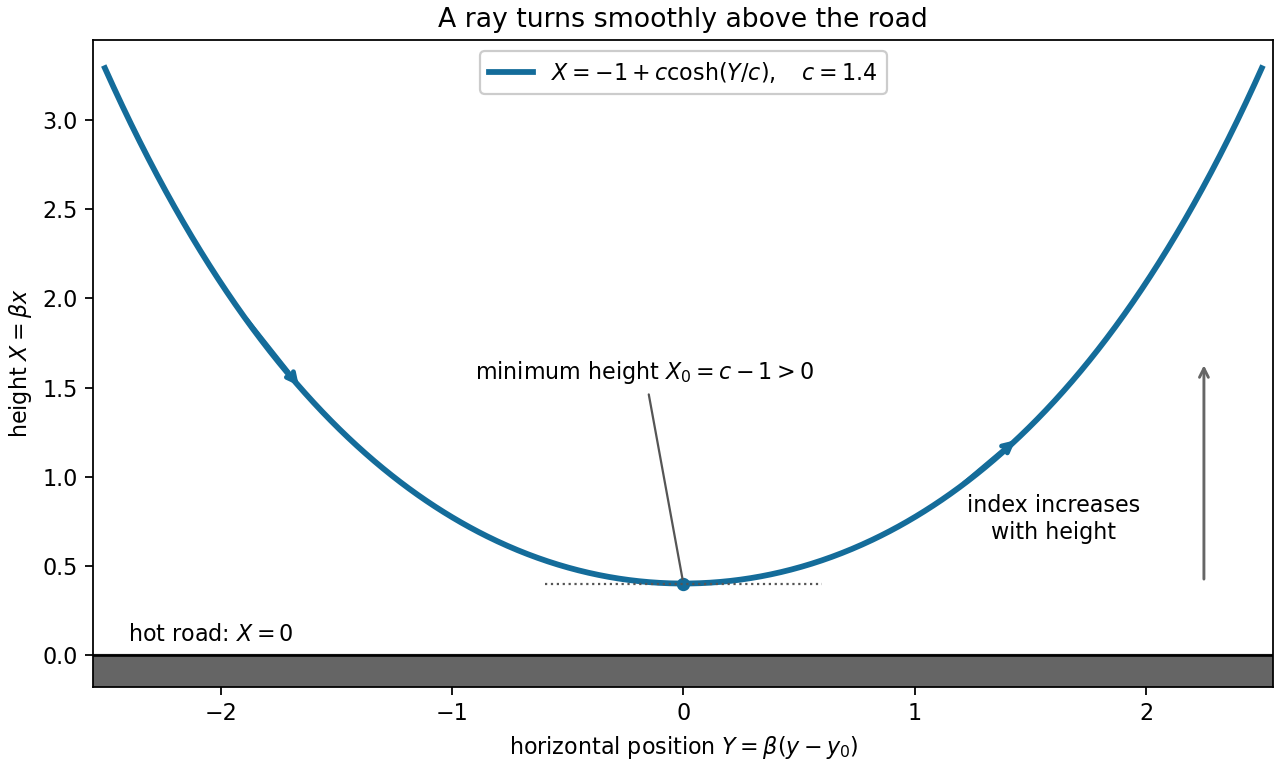
For height and horizontal position , Fermat principle in a positive index profile , , conserves on a graph . For positive magnitude of the horizontal optical momentum, integration gives the displayed catenary. Its minimum height is , at . Thus produces a smooth turning ray wholly above a road at . The two graph branches have opposite signs of ; continues smoothly through their common horizontal tangent. For a signed negative graph constant, use in the prefactor; gives a vertical ray separately.

Work by Mir Subhan Mulla 2026-10-18
Galactic Center Created 2026-10-18 Updated 2026-11-05
The Galactic Center is the central region of the Milky Way, where the compact source Sagittarius A* and nearby stellar motions provide a test of a concentrated gravitational potential. It is a region, rather than another name for the entire black hole or one emitting point.
Infrared observations reduce the obscuration that limits ordinary visible-light measurements. Combining stellar astrometry with line-of-sight velocities constrains an orbit and the central mass; precise departures from a Kepler orbit can test general relativity.[ref]
Detection of the Schwarzschild precession in the orbit of the star S2 near the Galactic centre massive black hole by GRAVITY Collaboration. Abstract: combined stellar positions, radial velocities and relativistic orbital fit
A resolved apparent trajectory alone does not supply every orbital component or remove reference-frame uncertainty. Work by Michael Edidin 2026-10-18
Conditional expectations for maximum cut 2026-10-18
Let be a finite undirected simple graph, with vertices and edges. A cut of a graph assigns each vertex a label zero or one; an edge crosses precisely when its endpoints have different labels. Its size is the number of crossing edges. A maximum cut maximizes that size.
For the analysis, assign independent fair bits to the vertices. For each edge , the indicator random variable has expected value : exactly two of the four equally likely endpoint assignments cross. Thus linearity of expectation gives the random cut lower bound:Linearity of expectation does not require the indicator random variables to be independent. What matters here is the stipulated distribution of the endpoint bits.
Conditional expectation choice invariant Created 2026-10-18 Updated 2026-10-31
Let be a real-valued objective function of finitely many choices, with finite expected value. Suppose a prefix has positive probability. Write . If the next choice is a fair bit, the law of total expectation givesAt least one child is at least this average. Choose a child with the larger value, using a fixed rule for ties. The resulting loop invariant is . At a complete assignment , there is only one completion left, so and therefore .
For a biased choice or more than two possibilities, use the corresponding weighted average:Some positive-probability child is at least the weighted average. For minimization, choose a child at most the current conditional expectation and reverse the invariant. The averaging identity is the same in both directions.[ref]
Discrete Probability by Jeff Erickson. Jeff Erickson, Discrete Probability, §1.2.2, printed pp. 6–7: conditional expectation decomposition and linearity; authorship stated on the author's Algorithms notes page
The word "probabilities" in the method's name also covers an indicator random variable for an undesirable outcome: keeping its conditional expectation, which is its conditional probability, strictly below one eventually forces that indicator to be zero. Optimizing an ordinary numerical objective function is the method of conditional expectations formulation used below.
List of meteorologists 2026-10-18
Work by Mayumi Nakanishi-Matsui Created 2026-10-18 Updated 2026-11-05
Work by Max Delbrück 2026-10-18
Thomson electron transmission diffraction experiment Created 2026-10-18 Updated 2026-10-20
Alongside the 1927 Davisson–Germer experiment, George Paget Thomson developed an independent transmission test. Alexander Reid first used celluloid; Thomson used thin metal films. A narrow electron beam crossed a film about thick, reaching a photographic plate perpendicular to the beam. Rings appeared. Accelerating voltages of – set the de Broglie wavelengths; metal structures known from X-ray diffraction allowed quantitative comparison. A downstream magnetic field deflected ring-forming electrons like those passing through holes, identifying the carriers as electrons rather than X-rays. Celluloid's uncertain structure limited its quantitative interpretation.[ref]
The Davisson–Germer experiment uses crystal reflection and angular electric current scans; this transmission camera records a spatial pattern behind the specimen. Both probe interference in electron diffraction, with different specimen preparations and readouts. A developed photographic plate records accumulated detections, not a direct image of the wavefunction.
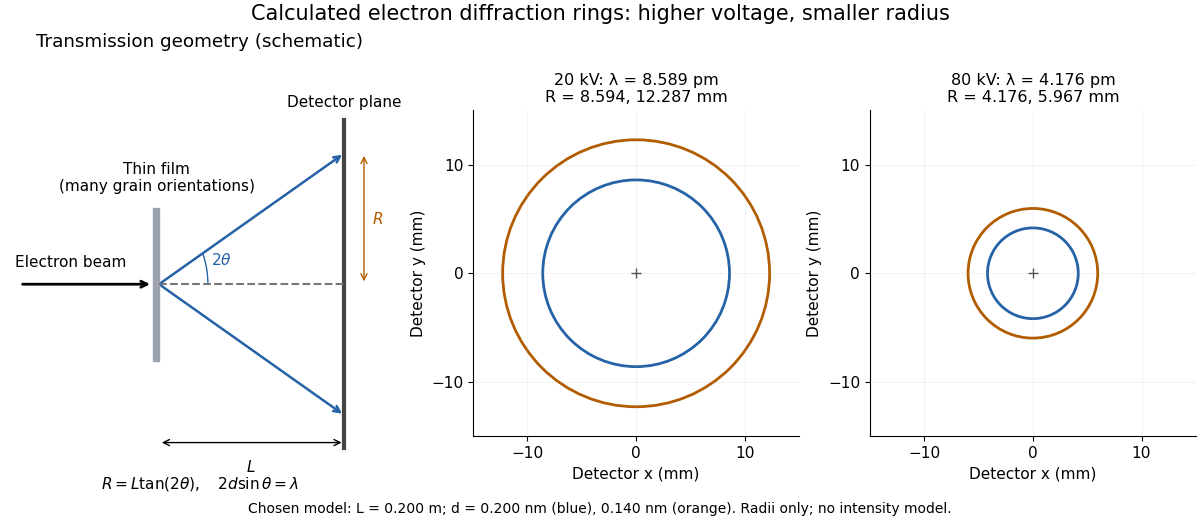
Why rings? In an ideal film containing many small crystals with uniformly distributed orientations, a family of lattice planes with spacing can satisfy Bragg's law at every azimuth about the incident beam. First-order elastic scattering then forms a cone of opening half-angle , where . A flat detector a distance downstream cuts this cone in a circle:The last expression requires small scattering angles. It explains a useful control: hold the specimen and camera distance fixed, increase accelerating voltage, and the ring radii should shrink with the electron accelerating-voltage wavelength. It predicts positions, not intensities: preferred crystal orientations, film thickness and repeated quantum scattering can alter a real pattern.
For a chosen example, take and . The exact relativistic electron accelerating-voltage wavelength gives at and at . The corresponding exact ring radii are and . These are calculated examples with chosen spacings and camera distance, not Thomson's measurements. The higher voltage lies outside the range quoted from his lecture, deliberately illustrating a prediction rather than reconstructing his data.

Relativistic matter-wave velocities Created 2026-10-18 Updated 2026-10-20
For a one-dimensional free particle with and , take the positive total energy from the relativistic energy-momentum relation:A fixed plane wave quantum phase obeys . Its phase velocity is thereforeFor a narrow wave packet centered at , expand its dispersion relation as . In the Fourier inversion integral building the wave packet, the envelope then depends on . Thus its group velocity isThe superluminal phase velocity follows a repeating phase marker; it does not describe a localized signal or superluminal transport of energy. Higher derivatives of the dispersion relation produce wave packet spreading, so the translated-envelope argument is a narrow-band approximation. For , the Lorentz factor is , and : the group velocity is while the phase velocity is .
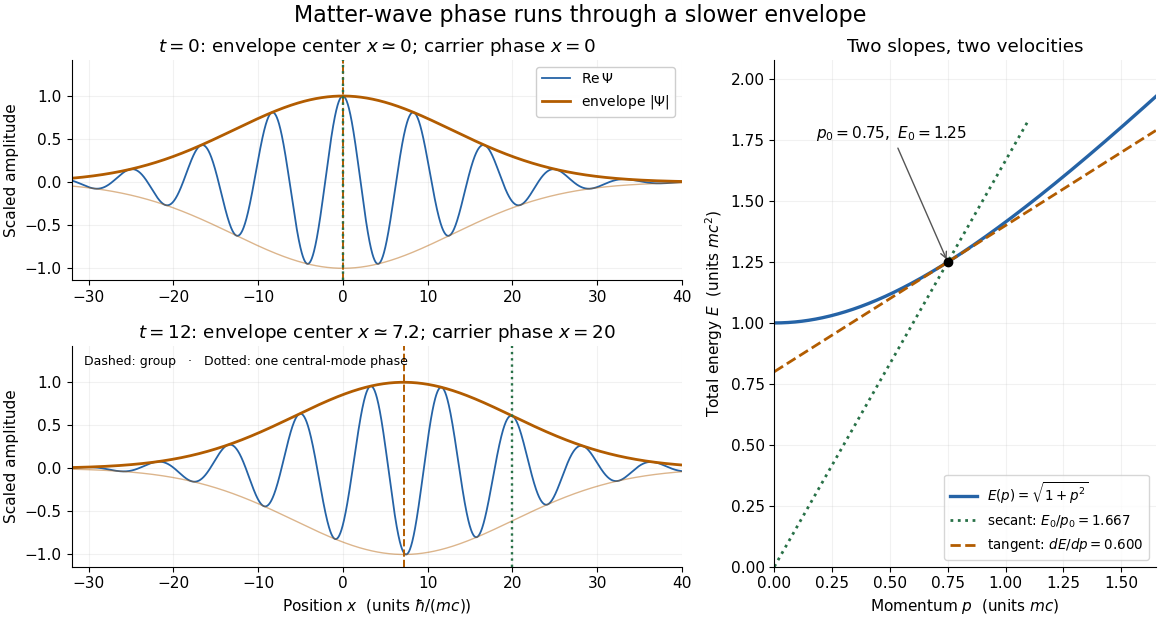

The total-energy convention matters. Define to remove the common rest energy from a wavefunction with total-energy time dependence. ThenThis is exactly the free-particle momentum convention used by the Schrödinger equation here. Removing a common time-dependent global phase changes the reported phase velocity, while leaving the de Broglie wavelength, relative spatial quantum phases and group velocity unchanged. Adding again to a total energy would count the rest energy twice.
There are unlisted articles, also show them or only show them.