
For , the Green function of on with zero Dirichlet boundary conditions is the displayed negative kernel. Here and . The left and right homogeneous solutions are and , with Wronskian . The kernel is continuous and its first derivative jumps by , giving . Reversing the operator sign reverses the kernel sign.
Omega baryon discovery experiment 2026-10-18
The 1964 report exposed Brookhaven's 80-inch hydrogen bubble chamber to a mass-separated negative-kaon beam. A photographed decay chain, track momenta and bubble density supported the particle identification. Two converted photons helped reconstruct a neutral pion. Alternative assignments were tested kinematically. The authors reported an Omega baryon candidate with , and mass , reserving a detailed systematic-error discussion for further events.[ref]
Observation of a Hyperon with Strangeness Minus Three by V. E. Barnes. Original Barnes et al. letter, Phys.Rev.Lett.12(1964), pp.204–206: Fig.2, TableI and final identification
This is an inference from several linked observations. A charged particle can leave a visible bubble-chamber track, while a neutral segment must be reconstructed from its production and decay products. Agreement between possible decay channels, electric charge, momentum conservation and the reconstructed mass is stronger evidence than a suggestive track shape alone. The event tests a predicted hadron pattern; it does not photograph the three strange quarks individually.
For example, an independently constructed two-body kinematic check usesIn a parent rest frame with equal and opposite daughter momenta, the momentum sum vanishes, giving . In units , stipulated daughter masses , and momentum magnitude give , and . A common Lorentz boost changes the daughter energies and momenta while preserving this reconstructed invariant mass. These chosen units and numbers are an illustration, not a reanalysis of the 1964 event.
Set , , , with , and . Differentiating the position vector gives pairwise orthogonal coordinate tangents and the displayed scale factors of orthogonal coordinates. Thus the positive volume density is . The ordered Jacobian determinant is negative for the order ; volume uses its absolute value. Positive constant surfaces are oblate spheroids. For , constant gives the half of the one-sheet hyperboloid with the sign of fixed by . At the coordinates cover the equatorial disk, while covers the exterior equatorial plane.
Velocity Verlet method 2026-10-18
For an ordinary differential equation with acceleration independent of velocity, the velocity Verlet method advances position and velocity byHere is the time step and . For sufficiently smooth , the global error on a fixed time interval is , so halving reduces the leading global error by a factor of four once the asymptotic regime is reached.
Linear scale 2026-10-18
A linear scale places a value at a position , where and are constants. Equal differences in occupy equal distances because . This contrasts with a logarithmic scale, which assigns equal distances to equal ratios.
Screen space of a null congruence Created 2026-10-18 Updated 2026-11-05
The screen space of a null congruence describes directions transverse to a bundle of lightlike trajectories. For a nonzero null vector , its orthogonal space contains itself, so the induced metric there is degenerate. Removing this physically longitudinal direction gives the quotient vector spaceIn four-dimensional Lorentzian manifold it is two-dimensional and has a positive-definite induced metric under the convention.
Choosing an auxiliary null direction lets one represent this quotient by an ordinary transverse plane and a screen projector. That choice is useful for calculation, but the quotient is the intrinsic object. The optical matrix of a null congruence then describes expansion, shear and rotation of transverse separations rather than a spurious change along the rays themselves.
Neutron separation energy 2026-10-18
Writing positive nuclear binding energy as and nuclear mass as ,The two-neutron nuclear separation energy is . In an independent-particle example, let the last occupied energy level have and the next empty level , for a chosen positive energy unit . With an unchanged core and no residual interactions, removal from the filled level costs , whereas removing the first particle added above it costs : the drop equals the one-particle gap. These are invented model inputs, not measured nuclear values. Nuclear pairing, rearrangement of the nuclear mean field, and correlations complicate that identification in real masses; a finite difference of nuclear binding energies is not automatically a bare one-particle gap.
Nuclear drip line 2026-10-18
A nuclear drip line marks a boundary beyond which one- or few-nucleon emission becomes energetically allowed. One- and two-particle nuclear separation energies can give distinct boundaries because of nuclear pairing.
Proton separation energy 2026-10-18
With bare nuclear masses, the proton separation energy is the energy needed to remove a proton. A negative value means the daughter plus proton has lower rest energy. Proton emission can still have a finite lifetime because of a Coulomb or centrifugal barrier.
Nuclear pore transport balance 2026-10-18
Nuclear accumulation should compare concentrations, not just total cargo. In an original constructed example, a cell nucleus occupies one volume unit and the accessible cytosol occupies nine. Of tracer units, are nuclear and are cytosolic. With the amounts and the accessible volume, the concentration ratio isOnly of the cargo is nuclear, yet nuclear concentration is four times cytosolic concentration. A majority outside the cell nucleus does not rule out nuclear enrichment.
For comparison, freely exchanging nonbinding cargo at equal concentrations would have : the nuclear fraction would equal the nuclear fraction of accessible volume, . These are constructed amounts, not measurements from the nuclear pore localization experiment. Binding, unequal recovery or cargo degradation would require additional accounting before interpreting an assay.
A minimal two-compartment ordinary differential equation makes the distinction precise. Assume fixed accessible volume, no synthesis or degradation, and effective first-order exchange rates :Total cargo is conserved. Setting the derivative to zero givesFor symmetric passive exchange with conductance , and , so the concentration ratio is one even when the amounts differ. Choosing instead and in reciprocal model-time units gives for . The exact ordinary differential equation solution isSubstitution verifies the solution, and makes departures decay. This effective model can describe an asymmetric exchange balance, but does not by itself identify a nuclear localization sequence, transport receptor or source of energy.
The usefulness of the nuclear pore complex is precisely this combination of separation and exchange: a cell nucleus can maintain a distinctive protein population while receiving new cargo and exporting RNA. The nuclear pore localization experiment asks what feature controls entry; the nuclear pore transport balance asks what an accumulation readout actually means.
Nuclear pore localization experiment 2026-10-18
In a 1982 experiment, purified nucleoplasmin was labeled with radioactive iodine and cleaved by proteolysis. Microinjection delivered cargo into Xenopus laevis oocyte cytoplasm. Manually separated cell nuclei and cytoplasm were compared by gel electrophoresis and autoradiography; section autoradiography checked internal localization. Tail-bearing cargo entered the cell nucleus; tailless cores did not. Direct nuclear microinjection retained the cores: the tails mattered for entry, but the assay did not identify a receptor.[ref]
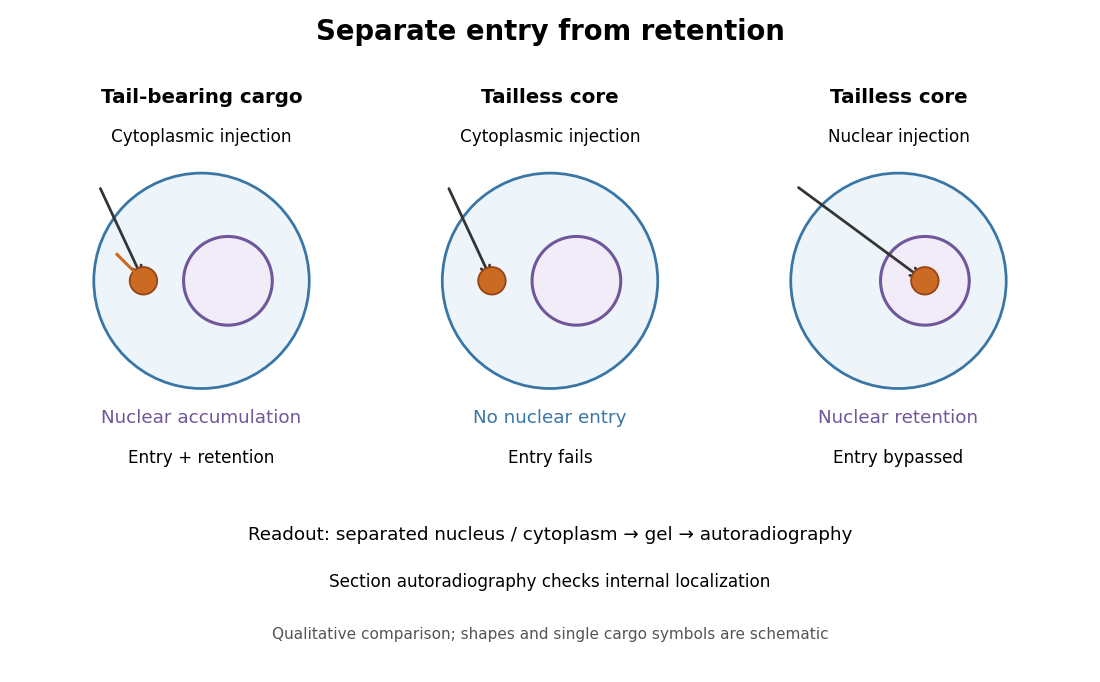
Changing cargo and injection site separates nuclear entry from retention
. Original qualitative summary of the nucleoplasmin comparisons above. Symbols represent localization, not measured counts or copied source images. Details.
Direct nuclear microinjection bypassed entry, distinguishing failure to enter from failure to remain inside a cell nucleus.
Nuclear localization sequence Created 2026-10-18 Updated 2026-11-05
A nuclear localization sequence is an ordered stretch of amino acid residues that can direct protein import into a cell nucleus. In the classical pathway, importin α recognizes the nuclear localization sequence, and importin β mediates passage through the nuclear pore complex. Other recognition pathways exist. An exposed nuclear localization sequence is a targeting feature, not a guarantee of import under every condition.[ref]
RNA export is a different cargo pathway: RNA travels associated with proteins, as a ribonucleoprotein, rather than being imported by its own nuclear localization sequence. Export of messenger RNA connects nuclear transcription to cytoplasmic biological translation.[ref]
The Cell: A Molecular Approach, 2nd edition by Geoffrey M. Cooper. Transport of RNAs, opening paragraphs
Nuclear level population balance 2026-10-18
For a complete ensemble of downward nuclear de-excitation cascades, let be the direct population of excited level and the total number of transitions from to . Conservation of population gives the displayed outward-minus-inward formula. A negative rules out a proposed scheme under the assumed complete transition inventory. Gamma ray counts equal transition counts only when unreported internal conversion and other competing paths can be neglected or corrected. Summing over all excited levels cancels internal transitions and leaves the transitions into the ground state.
Gamma decay 2026-10-18
Gamma decay is electromagnetic nuclear de-excitation by photon emission. It preserves mass number and atomic number, while changing the nuclear state. Angular momentum and parity constrain the allowed radiation multipoles. The gamma ray topic is broader than this nuclear process.
Internal conversion Created 2026-10-18 Updated 2026-10-20
Internal conversion transfers nuclear excitation energy directly to a bound atomic electron, which is emitted, rather than to a real gamma ray. Photon counts alone then underestimate the number of nuclear transitions unless the conversion contribution is included.
Nuclear elastic electron scattering cross-section Created 2026-10-18 Updated 2026-10-20
For an ultrarelativistic electron scattered elastically by a static, spherical, spin-zero atomic nucleus, a plane-wave Born approximation retains a single electromagnetic interaction. The Fourier transform of its Coulomb potential is proportional to . Relative to the same point charge, the scattering amplitude is therefore multiplied by and the differential scattering cross-section by :Here is the incident total electron energy, the scattering angle, a solid angle element, and the fine-structure constant. The cosine factor already accounts for the projectile's spin; a spinless projectile would give a different point-charge factor. The formula neglects nuclear recoil, electron rest-mass corrections, radiative corrections and Coulomb distortion in electron scattering. The latter can be substantial at large : electron waves then require treatment in the target's Coulomb potential, rather than undistorted plane waves.
Nonzero target spin can introduce magnetic and additional electric contributions, so division by this point-charge expression does not generally isolate one charge form factor for a proton or deuteron. Even for spin zero, finite energy resolution, recoil and Coulomb distortion in electron scattering can change a measured minimum. A zero of the uniform-sphere model is a clear illustration of amplitude cancellation, not a universal prediction of a zero experimental counting rate.
Uniform-sphere nuclear charge form factor Created 2026-10-18 Updated 2026-10-20
Consider an ideal nuclear charge distribution that is constant inside a ball of radius and zero outside:This is a deliberately sharp-edged model. Substitution into the spherical nuclear charge form factor gives, for ,At take the continuous limit . Direct radial integration gives , and the Taylor series provides an independent check:The first positive zero solves , equivalently , with . Consequently the first diffraction minimum moves toward smaller momentum transfer as increases.
For comparison, a smooth Gaussian function charge density with the same nuclear charge radius isThe Fourier transform of a Gaussian stays positive and has no zero. Both models have the same leading low- curvature, but they disagree at higher momentum transfer: at , the sphere gives and the Gaussian function gives . Measuring only a nuclear charge radius cannot distinguish these two nuclear charge distributions.
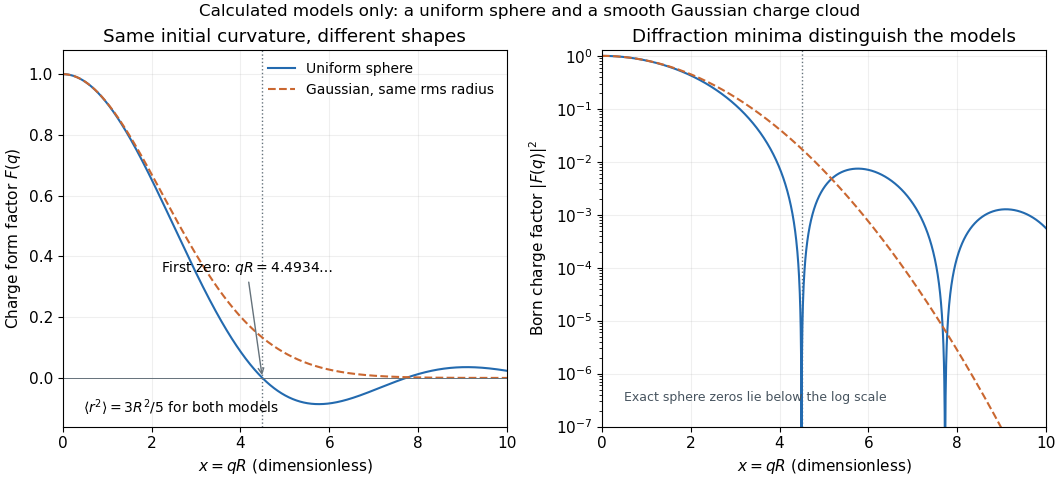

As a chosen scale illustration, take . The predicted first zero is , or using . With a ultrarelativistic electron beam and negligible nuclear recoil, it occurs at . These are consequences of chosen model parameters, not measured properties of carbon or a claim that all atomic nuclei are uniform balls.
North-east lattice path recurrence 2026-10-18
For positive integers , the north-east lattice path recurrence isThe boundaries have only straight north-east lattice paths. The origin counts the zero-step north-east lattice path once.[ref]
Discrete Mathematics: An Open Introduction (3rd edition) by Oscar Levin. §1.2, Lattice Paths: split by the final horizontal or vertical step
Proof outline. A north-east lattice path ending at has a final step either from or from . Deleting that step gives a shorter north-east lattice path; appending it reverses the operation. The two classes are disjoint and exhaust all possibilities, so the rule of sum adds their counts. At , the arrivals from contribute , while those from contribute : altogether .
Set if either integer coordinate is negative. Then the same recurrence relation applies on the nonnegative axes away from : one predecessor contributes one, and the other contributes zero. Initialize separately; applying the recurrence relation there would incorrectly give zero.
Computing the grid once in increasing order of is dynamic programming: every entry uses two earlier entries. If a specified point is forbidden, set its count to zero, then continue the same recurrence relation at allowed points. This counts north-east lattice paths avoiding the forbidden points, provided the origin and endpoint are allowed. The last-step argument remains valid because appending a step to an allowed endpoint cannot visit any new intermediate integer lattice point.
Bulk electric-dipole selection rule Created 2026-10-18 Updated 2026-10-20
Suppose a homogeneous bulk material is unchanged when all spatial coordinates are reversed. Both electric polarization and electric field reverse under this inversion, so a local electric dipole response must obey . Substituting the nonlinear optical susceptibility expansion givesFor every sufficiently small , all even coefficients vanish. In the full tensor relation, two reversed input electric fields leave their product unchanged while the output electric polarization changes sign, forcing every bulk electric-dipole component of to vanish.
The qualification matters: the argument assumes inversion symmetry, a local bulk electric dipole response, and no applied bias that breaks that symmetry. A surface breaks bulk inversion symmetry; spatially varying or magnetic responses also lie outside this local electric-dipole model. Thus detecting second-harmonic generation at a surface or through a weaker magnetic contribution does not contradict the bulk selection rule. Conversely, absence of inversion symmetry permits some quadratic components but does not guarantee a nonzero component in every beam geometry.
If a Lagrangian density depending on first and second derivatives has no undifferentiated field, the scalar-field shift symmetry gives the displayed Noether current. Its divergence is minus the Euler-Lagrange field equation with second derivatives, so it is conserved on shell. The spatial integral of is constant only if the boundary current vanishes. For , it gives , . Fixed transverse endpoint positions break the global shift symmetry of the boundary problem; support forces can then change the total transverse momentum even though the bulk continuity equation still holds.
There are unlisted articles, also show them or only show them.