
Nuclear shell closure 2026-10-18
Filling the accessible one-species nuclear shell model states below a substantial energy gap. A closed spherical level has all values occupied, so their sum is zero. In the independent-particle picture, a closed core therefore contributes zero total angular momentum; a single particle outside it, or a single missing particle inside it, supplies the leading spin assignment. Residual interactions can change this simple picture.
The three-dimensional isotropic harmonic oscillator alone has one-species shell capacities for oscillator index , including spin. Summing gives closures , rather than the complete traditional magic number sequence. Strong nuclear spin-orbit splitting can separate a high- level from its former neighbors. Realistic radial potential energies and residual interactions also matter: a chosen oscillator plus an arbitrary single constant is not a demonstrated explanation of every real nuclear gap.
Traditional nuclear shell closures can weaken along isotope chains far from stability, as in neutron-rich magnesium.[ref]
Magic numbers disappear and expand area of nuclear deformation by RIKEN. 20 November 2013, magnesium shell weakening
The relevant test is the actual energy gap and the correlated nuclear quantum states, rather than membership in an immutable numerical list.
Sonic flow 2026-10-18
A sonic flow has Mach number exactly one: the local fluid speed relative to the body equals the local sound speed. In uniform gas flowing at past a resting body, an upstream-directed acoustic wave has zero body-frame velocity. A sonic point is a location where this equality holds. In the moving-point acoustic wavefronts construction, old spheres touch the source at the origin; the Mach angle tends to as the supersonic flow approaches this threshold.
Moving-point acoustic wavefronts 2026-10-18
Take a steady moving point source in uniform resting gas, with constant sound speed and source velocity . Place the source at the origin at the current time . In the linear acoustics model, an emission at an earlier time has a spherical wavefront centered at with radius . An axial cross-section is the circle in the displayed equation. It is centered at the old release position, not the source's present position. The circles describe the geometry of weak acoustic waves, not a measured shock wave or its pressure jump.
For , every old circle contains the present source because its center is from the origin while its radius is the larger distance . It reaches ahead of the source. For , the rightmost point of every old circle is : the source outruns all of its old wavefronts. The continuously emitted wavefronts have a common geometric envelope, the Mach cone. The plotted discrete release times sample this continuous family; rotating the axial section about the motion axis recovers the three-dimensional construction.
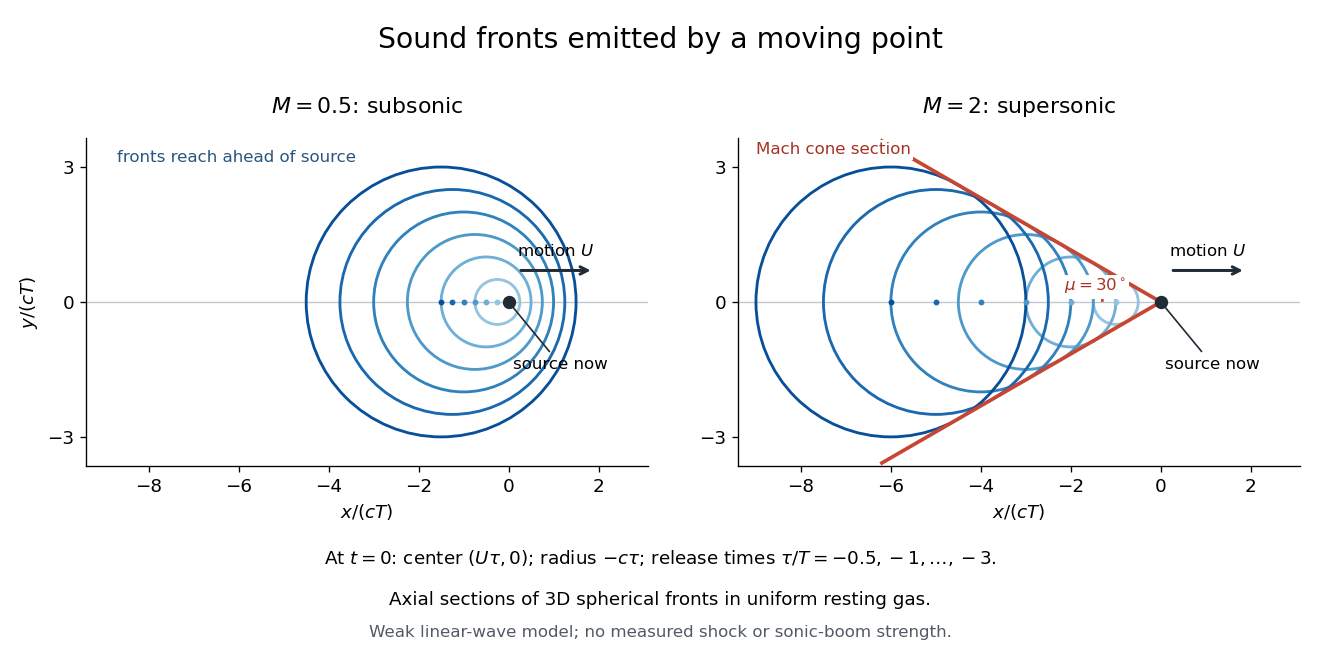
Subsonic and supersonic acoustic wavefronts from a moving point
. Original axial cross-sections at for Mach numbers and . With an arbitrary positive time scale , the sampled release times are . Each circle has center and radius ; red lines give the Mach cone section. This weak linear acoustics model predicts geometry, not measured shock wave or sonic boom strength. Details.In the 1951 study by Jacques Berthet and Christian de Duve, liver from fasted rats was immediately chilled in an ice-cold isotonic chemical solution. The tissue was generally pressed through wire mesh; the weighed pulp was homogenized in cold sucrose using a glass Potter-Elvehjem homogenizer. Their acid phosphatase test concerned activity toward added glycerophosphate at pH : the readout was substrate hydrolysis, rather than an image of a particle.[ref]
Tissue fractionation studies. 1. The existence of a mitochondria-linked, enzymically inactive form of acid phosphatase in rat-liver tissue by Jacques Berthet and Christian de Duve. Berthet and de Duve (1951), Tissue fractionation studies. 1, printed p. 174, introduction and Methods: Fractionation of tissue constituents; inspected first-page text
Christian de Duve's retrospective describes successive centrifugation steps, separating centrifugation pellets and supernatants, and comparing enzyme distributions across the recovered fractions. Membrane disruption exposed previously inaccessible acid phosphatase activity, providing the crucial comparison with the membrane-preserving preparation. Joint fractionation patterns and release behavior of several acid hydrolases supported a shared population of digestive particles. By 1955, this evidence supported the lysosome concept.[ref]
The inference was biochemical: a barrier restricted access to active enzymes. Co-sedimentation could confuse distinct particles; a crude mitochondrial fraction did not establish residence inside mitochondria. Lysosomal enzyme latency neither images an organelle nor determines its shape. Electron microscopy of enriched fractions supplied separate morphological evidence.[ref]
Exploring Cells with a Centrifuge by Christian de Duve. Printed pp. 153–157: mixed populations and distribution patterns; pp. 161–164: incomplete separation and subsequent electron microscopy of lysosome-rich fractions
Let , and . Every real matrix preserving has a unique form with . The boost subgroup is normal because . Its four cosets form the Klein four-group, giving the displayed quotient group. In contrast, the four-element subgroup generated by is not normal: is not diagonal for . This distinguishes the normal identity component from a chosen set of component representatives.
Philip J. Boland Created 2026-10-18 Updated 2026-11-05
Philip J. Boland works on statistical and probabilistic aspects of reliability and the history of statistics. UCD's 2005–06 institutional record lists research interests in reliability theory, life testing, actuarial probability and mathematical statistics. These are historical affiliations and interests in that record, rather than a claim about his present appointment.[ref]
https://www.ucd.ie/students/t4media/2005-6%20science_pg.pdf. Printed p. 90, Philip J Boland staff entry
reliability theory connects distributions of component lifetimes to the behavior of a whole system. Statistical inference then estimates those lifetime distributions or compares designs from observed failures and surviving units. Boland also wrote the Dictionary of Irish Biography entry on William Sealy Gosset, connecting the mathematical development of small-sample inference with its industrial setting.[ref]
Institutional biographical record: www.ucd.ie/students/t4media/2005-6%20science_pg.pdf
William Sealy Gosset Created 2026-10-18 Updated 2026-11-05
William Sealy Gosset published statistical research under the name Student while working as a brewer for Guinness. His practical problems involved variation in ingredients and brewing conditions, where obtaining a large sample was often difficult. This motivated methods that account for uncertainty in estimating variability from a small sample.[ref]
https://www.dib.ie/biography/gosset-william-sealy-student-a3543. Dictionary of Irish Biography, brewery work and small-sample research
The Student's t-distribution describes the standardized mean of an independent normal sample when its unknown standard deviation is replaced by the sample standard deviation. Its heavier tails, compared with a Standard normal distribution, reflect that extra uncertainty. Gosset's work helped turn the limitations of a small experiment into an explicit part of inference rather than treating a variance estimate as known.

Portrait of William Sealy Gosset
. Unknown photographer; scan credited to Wujaszek; subsequent descreening by Quibik. Public domain; Public Domain Mark 1.0. Source and usage information on the linked Wikimedia file page. Source. Larry Wasserman Created 2026-10-18 Updated 2026-11-05
Larry Wasserman works on statistical theory and its connections to machine learning and scientific applications. His research statement lists nonparametric inference, large-sample theory, mixture models, Bayesian methods, multiple testing and Causal inference. It also describes collaborations in computer science and astrophysics.[ref]
https://www.stat.cmu.edu/GSS/wasserman.html. Author research statement, theoretical interests and scientific collaborations
His expository books connect mathematical foundations with practical statistical procedures, including nonparametric methods that avoid specifying a small fixed family of probability distributions. Such flexibility does not remove assumptions: sampling structure, smoothness and complexity still determine what can be learned and how uncertainty should be quantified. His homepage links the books and their accompanying datasets.[ref]
Homepage: www.stat.cmu.edu/~larry/

Portrait of Larry Wasserman
. Capolitsch, own work, 23 June 2021. Creative Commons Attribution-Share Alike 4.0 International., via Wikimedia Commons. Source. Purnamrita Sarkar Created 2026-10-18 Updated 2026-11-05
Purnamrita Sarkar works at the intersection of high-dimensional statistics, machine-learning theory, differential privacy and large-scale optimization. Her University of Texas at Austin profile describes this combination of statistical and computational research.[ref]
https://stat.utexas.edu/directory/purnamrita-purna-sarkar. Institutional biography and research fields
Her lecture on the Efron–Stein inequality presents a general way to control the variance of a function of independent inputs: compare the function with versions in which one input is independently replaced. For a sum, the resulting bound recovers the familiar sum of variances; for a complicated estimator, it gives a route to uncertainty control without expanding every covariance term.[ref]
Lecture 7a: Efron Stein inequality by Purnamrita Sarkar. PDF pp. 1–9, independent-copy bound and equality for sums
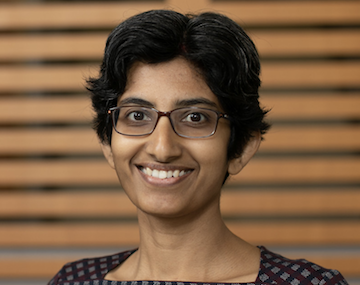
Portrait of Purnamrita Sarkar
. Charles M. Stein Created 2026-10-18 Updated 2026-11-05
Charles M. Stein changed the theory of estimation by showing that estimating several normal means together can permit improvement over their separate usual estimates under a combined squared-error loss. The James–Stein estimator expresses this phenomenon through shrinkage: introducing bias can lower the total mean squared error when variance is reduced sufficiently. The guarantee concerns the specified aggregate loss, rather than promising a better estimate for every coordinate in every dataset.
Stein also developed tools connecting normal distributions, derivatives and probability approximations. With Bradley Efron, he coauthored The Jackknife Estimate of Variance by Bradley Efron and Charles M. Stein, a source associated with the Efron–Stein inequality. His Stanford obituary records his mathematical career and death in 2016.[ref]
https://news.stanford.edu/stories/2016/12/charles-m-stein-extraordinary-statistician-anti-war-activist-dies-96. Stanford institutional obituary, 1 December 2016

Yen-Chi Chen Created 2026-10-18 Updated 2026-11-05
Yen-Chi Chen works on nonparametric statistics, Causal inference, missing data and geometric analysis of data. His University of Washington research page also lists mixture models, astrostatistics and applied statistics.[ref]
His bootstrap notes explain the distinction between the unknown population distribution and the empirical distribution used for resampling. They also discuss when a bootstrap approximation can fail, including an endpoint of a uniform distribution. This is a useful bridge between a computational recipe and the mathematical conditions needed for reliable statistical inference.[ref]
Lecture 12: The Bootstrap. The Bootstrap; High level idea of how bootstrap works; Failure of the bootstrap
Homepage: faculty.washington.edu/yenchic/

Bradley Efron Created 2026-10-18 Updated 2026-11-05
Bradley Efron's work connects statistical theory, computation and applications. His bootstrap estimates a statistic's sampling uncertainty by repeatedly sampling from the empirical distribution and recalculating that statistic. For example, resampling the observed data and recomputing a median produces a simulated sampling distribution without requiring a normal population model. Validity still depends on the statistic and sampling setting; the method is not automatically correct for every extreme-value or dependent-data problem.
His bootstrap work has distinct records as a July 1977 Stanford technical report and a January 1979 journal article.[ref]
Bootstrap Methods: Another Look at the Jackknife by Bradley Efron, BIO 32 technical report. Stanford catalogue, BIO 32 and July 1977 report date
[ref]Bootstrap Methods: Another Look at the Jackknife by Bradley Efron, 1979 journal article. Annals of Statistics 7(1), 1–26, January 1979 bibliographic record
His Stanford profile describes research spanning theoretical statistics, biostatistics and astrophysical applications.[ref]Homepage: efron.ckirby.su.domains/
Institutional profile: statistics.stanford.edu/people/bradley-efron

Portrait of Bradley Efron at the 2007 National Medal of Science ceremony
. Ryan K. Morris, National Science and Technology Medals Foundation; cropped by Wikimedia user Dudek1337. Public domain, as recorded on Wikimedia Commons. Source usage terms. Source. James F. Price Created 2026-10-18 Updated 2026-11-05
James F. Price is a physical oceanographer whose research addresses upper-ocean response to wind and heating, internal waves, and the interaction between hurricanes and the ocean. His institutional curriculum vitae lists studies of storm wakes, diurnal heating and cooling, and wind-driven currents.[ref]
https://www2.whoi.edu/staff/jprice/curriculum-vitae/. Research Interests and publications: hurricane response (1981), internal-wave wake (1983), diurnal cycling (1986)
In Draining a Tank by James F. Price, experiments connect Torricelli's law to measured drainage through openings and outlet pipes. He compares observed flow with successive models incorporating surface tension and viscous drag, using dimensional analysis to organize the measurements. The study shows how apparently simple outflow can depart from an ideal-fluid law as the head decreases or the outlet geometry changes.[ref]
Draining a Tank by James F. Price. Summary; sections 2–6; section 8 attributes experiments, models, code and technical figures to the author
David Vernet Created 2026-10-18 Updated 2026-11-05
David Vernet is identified as an optician in the C2PU team at the Observatoire de la Côte d’Azur. [ref]
L’équipe du C2PU. Team entry for David VERNET, Opticien, OCA, département Galilée
The observatory's description of its LISE optical workshop names Vernet as its head and documents fabrication for the C2PU one-metre telescopes. Photographs show polishing and inspection of the primary mirrors. This work connects optical instruments to the practical task of making accurately shaped reflecting surfaces: a reflecting telescope depends on the surface figure as well as the mirror diameter. [ref]
Optique by Observatoire de la Côte d’Azur. Workshop description and C2PU primary-mirror polishing captions; no publication date established


K. Sreekumaran Nair Created 2026-10-18 Updated 2026-11-05
A researcher who coauthored methods for functional assessment of isolated mitochondria, relating respiration measurements to preparation yield and integrity.[ref]
Functional Assessment of Isolated Mitochondria In Vitro. 2009, author roster; Mitochondrial yield and integrity; Mitochondrial respiration
John G. Wood Created 2026-10-18 Updated 2026-11-05
John G. Wood was an accelerator technician who helped develop the hydrogen bubble chamber in Luis Walter Alvarez's group. Alvarez's retrospective describes Wood constructing an all-glass chamber about inches across and observing particle tracks in liquid hydrogen in early 1954. The visible tracks established more than an increase in bulk boiling under irradiation: a usable particle detector needed enough localized bubbles to resolve individual trajectories.[ref]
Recent Developments in Particle Physics by Luis Walter Alvarez. UCRL-18696, printed pp. 13–16, figure 2 and reference 41
Wood's observations also helped show that a long-lived state of superheating was unnecessary. With rapid expansion, useful particle tracks could form in the chamber's interior before boiling at the walls destroyed its sensitivity. That operational insight made larger bubble chambers with joints and windows practical, extending the instrument beyond small, exceptionally smooth all-glass vessels.[ref]
Recent Developments in Particle Physics by Luis Walter Alvarez. Printed pp. 15–16: Wood's observation about superheat duration and its significance for later chambers
Liposome 2026-10-18
A liposome is a closed artificial lipid vesicle enclosing an aqueous compartment. It may contain one lipid bilayer or several concentric bilayers. A single-bilayer spherical model distinguishes the inner aqueous radius, the boundary between opposing tail regions, and the outer head-group radius; finite molecular packing constrains all three.
Rotational temperature 2026-10-18
For a linear rigid rotor, rotational temperature expresses the rotational energy constant in kelvins: , where is the perpendicular moment of inertia. With all integer allowed and degeneracies , its rotational canonical partition function is . It approaches at low temperature and at high temperature. The latter limit gives mean rotational energy and heat capacity per rotor.
Linear probing cluster 2026-10-18
A maximal consecutive run of occupied or deleted slots in linear probing, bounded by never-used slots when any exist; adjacency wraps around by modular arithmetic. Deleted slots still belong to the search run.[ref]
5.2 LinearHashTable: Linear Probing. Open Data Structures: An Introduction by Pat Morin; Section 5.2.1, definition of a run using non-nil entries and modular indices
In the eight-slot example, array indices form one linear probing cluster. Inserting absent hash table key starts at , passes the occupied slots , and fills . This extends the same linear probing cluster despite having a different initial array index from . A hash collision at the initial slot is enough to make later slots compete too.
For a worst-case family, insert integer hash table keys into an empty capacity- array, using the hash function , where . They occupy array indices . Lookup of absent needs hash table probes. Taking gives hash table load factor at most while the number of hash table probes grows with . Thus occupancy alone cannot promise constant lookup work.
Before any rebuilding, bounded lookup, deletion by hash table key, and insertion with a duplicate check each have worst-case time complexity in Big O notation, assuming constant-cost hash function evaluation, array access and key equality. The counterexample gives a matching linear worst-case growth in the number of hash table probes. Hash table resizing is additional work; expensive string comparisons or hashing also fall outside these constant-cost assumptions.
Operator exponential Created 2026-10-18 Updated 2026-10-25
For a bounded linear operator, the series converges in operator norm. For an unbounded self-adjoint operator , the spectral theorem instead defines the bounded unitary operator by applying the scalar function to its projection-valued measure. This yields unitary time evolution without assuming that every vector lies in the domain of every power of . In finite dimensions it is the matrix exponential.
There are unlisted articles, also show them or only show them.