
de Broglie phase harmony 2026-10-18
In the 1923 note Waves and Quanta, Louis de Broglie proposed a periodic process associated with rest energy, remaining in phase with a wave along the moving particle's path. He distinguished the internal frequency slowed by time dilation from the wave frequency based on total energy.[ref] The proposal developed into his 1924 thesis.[ref]
Louis de Broglie - Biographical. Nobel Lectures, Physics 1922–1941; Louis de Broglie, Biographical, printed p. 257: 1924 thesis and doctoral degree
In the 1929 lecture The wave nature of the electron, he reconstructed the argument using a Lorentz transformation.[ref]The Wave Nature of the Electron by Louis de Broglie. Nobel Lectures, Physics 1922–1941; 12 December 1929, printed pp. 247–249: rest-frame periodicity, Lorentz transformation and momentum
Here is that quantum phase argument in modern notation. Set in the rest frame. A Lorentz transformation to a frame where the particle has velocity givesAlong , proper time is , soThis is the harmony: evaluating the spatial wave at the moving particle gives the slower clock phase. At fixed , its angular frequency is instead . Since , the de Broglie wavelength follows as . The proposed clock was a theoretical construction, not an observed mechanical vibration.
Matter-wave coherence Created 2026-10-18 Updated 2026-11-05
Matter-wave coherence is the ability of alternative matter wave amplitudes to retain a sufficiently stable relative quantum phase to produce reproducible interference. In an interferometer, splitting a single wave packet into two paths can preserve coherence even when individual detections remain localized.
For a pure state with path amplitudes and , recombination gives a term in the detection probability. Uncontrolled changes of wash out this term on averaging. In a density matrix, the corresponding off-diagonal path entries quantify coherence in that chosen basis. Unequal path populations, imperfect mode overlap and environmental information about the path can all reduce observed fringe visibility. The absence of visible fringes therefore needs an explanation in terms of the preparation and measurement, rather than an assumption that the particles lack wave behavior.
Finite oscillator commutator boundary defect 2026-10-18
Retain the first number states of a quantum harmonic oscillator. Let be the orthogonal projection onto their span and compress , , restricted to this span. The compressed annihilation operator satisfiesFor , the two products give and ; on the top state they give and . Thus, with ,On every quantum superposition of , this commutator acts exactly as . For a normalized retained state with coefficients ,Small probability at the cutoff must therefore be judged relative to for this expectation. For , the diagonal of is , with zero trace.
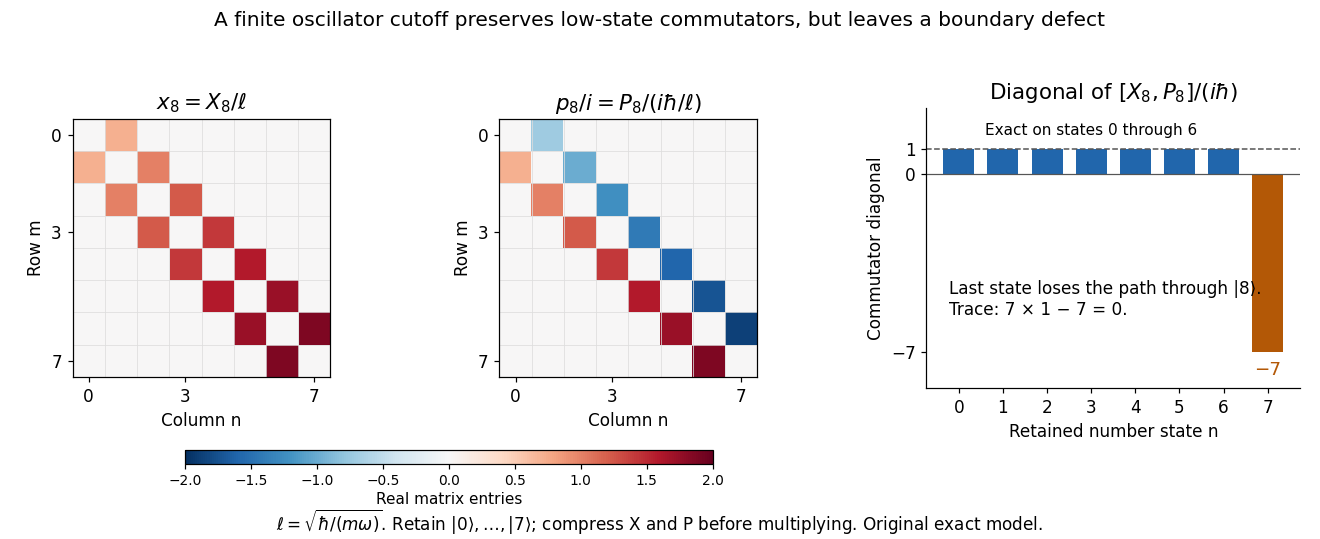

This is unavoidable for finite matrices: trace of a matrix commutator gives , whereas . Compression does not preserve products: can use intermediate states outside the retained span, while cannot. Accordingly, compressing the full oscillator Hamiltonian operator gives , but building it from the compressed squares givesThe two prescriptions agree on lower number states and disagree at the boundary. In the infinite oscillator, the canonical commutation relation holds on the common invariant dense subspace of finite number state combinations. Its unbounded position and momentum operators do not admit the finite trace argument; writing the formal identity does not assert that both products act on every vector of the Hilbert space.
Matrix and wave mechanics equivalence 2026-10-18
In 1926, Erwin Schrödinger constructed arrays from differential operators and complete orthogonal function systems, showing how their products reproduce the array calculus. His paper connected wave mechanics with matrix mechanics; the translation's sections 2–3 develop the product and commutation rules.[ref]
On the Relation between the Quantum Mechanics of Heisenberg, Born, and Jordan, and that of Schrödinger by Erwin Schrödinger. Collected Papers on Wave Mechanics, On the Relation between the Quantum Mechanics of Heisenberg, Born, and Jordan, and that of Schrödinger, pp. 48–51, equations (6)–(10)
The modern proof is a change of orthonormal basis. If form a complete orthonormal basis of the physical Hilbert space, map a wavefunction to its coefficients:Completeness makes this map unitary: it preserves the inner product and reconstructs from its coefficients. Inserting the complete orthonormal basis proves the matrix multiplication rule. The Schrödinger equation becomesFor a time-independent Hamiltonian operator, the Heisenberg picture transfers the same evolution to the observables, preserving measurement predictions. Unitary equivalence requires matching operator domains as well as formal entries. A finite selection of eigenfunctions gives a compression, not an exact replacement of the full Hilbert space; a continuous spectrum needs its spectral integrals. This equivalence concerns representations of specified operators, and does not remove the ordering question when quantizing an arbitrary classical expression, as Weyl ordering illustrates.
From Heisenberg arrays to Born-Jordan commutation Created 2026-10-18 Updated 2026-10-20
In 1925, Werner Heisenberg proposed replacing classical orbital quantities with arrays of transition amplitudes and frequencies. His paper's opening demanded relations between quantities observable in principle; section 1 built products by summing over an intermediate state and noted their dependence on order. The formulas above express that construction in modern linear operator notation.[ref]
On the quantum reinterpretation of kinematical and mechanical relationships by Werner Heisenberg. Heisenberg, 1925; introduction and section 1, equations (5), (8), (15), (20), (24)–(25); Doria translation
Pumping and a heated bath prepared Mercury vapor around a hot platinum wire, mesh and collector in the original Franck-Hertz experiment. A galvanometer read collector electric current while accelerating voltage varied at fixed retarding voltage. Retarding scans distinguished outgoing electron energies.[ref]
Über Zusammenstöße zwischen Elektronen und den Molekülen des Quecksilberdampfes und die Ionisierungsspannung desselben by James Franck and Gustav Ludwig Hertz. 1914, pp. 459–461, Figs. 1–2
The losses constrain excitation of chemical atoms; they do not determine every optical coupling. The Franck-Hertz experiment explains the original mistaken ionization interpretation.Such excitation and spectral line evidence motivated a mechanics of discrete energy levels and transitions. Replacing one representation by another was a theoretical construction; the Franck-Hertz experiment does not measure a matrix product or establish a unique representation of an observable.
Later in 1925, Max Born and Pascual Jordan developed the array calculus systematically. Their section 3 states , equivalently the modern canonical commutation relationThis relates position and momentum through an intrinsically noncommuting product.[ref]
Zur Quantenmechanik by Max Born and Pascual Jordan. Born and Jordan, Zur Quantenmechanik, 1925; section 3, equation (38), translation p. 14
For the quantum harmonic oscillator, the canonical commutation relation and creation and annihilation operators give , recovering both the spacing and zero-point energy algebraically. One must retain infinitely many number states for the exact relation: the finite cutoff below reveals the obstruction explicitly.
Noncommuting observables in two dimensions 2026-10-18
For two dimensionless observables on a two-level system, takeBoth are Hermitian matrices: has eigenvalues and has eigenvalues . YetFor instance, whereas . In , acts first. Neither product is self-adjoint, so the product of two observables is not automatically another observable. The commutator records this dependence on order. These operator products by themselves do not specify the outcomes of consecutive measurements; that additionally requires measurement in quantum mechanics.
Observable matrices in an energy basis 2026-10-18
Choose normalized energy eigenstates of a time-independent Hamiltonian operator, with , and assume first that they form a complete orthonormal basis. For a pure state and an observable ,The column index labels the input basis vector, and row labels the output component. Self-adjointness gives , so a finite example is a Hermitian matrix. A matrix element can be negative or complex; by itself it is not generally a probability. The Born rule assigns measurement probabilities using the eigenstates of , which need not be energy eigenstates. For an unbounded observable, these expressions require a suitable operator domain; a system with continuous spectrum also needs the corresponding spectral integrals.
Matrix commutation with an inverse Created 2026-10-18 Updated 2026-11-05
If two square matrices satisfy and is invertible, multiplication on the left and right by gives . Consequently a polynomial in a matrix commutes with the matrix inverse of any invertible polynomial in the same matrix.
Material surface element evolution Created 2026-10-18 Updated 2026-11-05
Parameterize a material surface by fixed particle labels , with tangents , . The material derivative gives and similarly for . Differentiate and use the cross product identityThis proves the displayed oriented-area evolution law, with . It allows both area change and rotation; even incompressible flow need not preserve the magnitude of a material area element.
Planar lamina 2026-10-18
A planar lamina is an ideal mass distribution confined to a plane, with surface mass density and infinitesimal mass . Its moment of inertia about an axis is the integral of squared perpendicular distance against this mass element. Three mutually perpendicular axes through one point, with two in the lamina's plane, obey the perpendicular axis theorem even when the density is nonuniform.
Work by Masasuke Yoshida Created 2026-10-18 Updated 2026-11-05
Work by Masamitsu Futai Created 2026-10-18 Updated 2026-11-05
Work by Marshall Warren Nirenberg 2026-10-18
Work by Marco Mazzotti 2026-10-18
Malate 2026-10-18
Malate is the anion obtained by removing both carboxyl protons from malic acid. Its protonation state distinguishes it from the acid.
An eigenstrain is the deformation a material would prefer locally without applied stress. In a one-dimensional linear elasticity model, let be Young's modulus, take tension as positive stress, and write . A free rod has and follows . A perfectly blocked rod has and . Thus positive preferred elongation produces compressive stress when blocked.
For stipulated , cross-sectional area , and , blocking gives and axial force . This idealization ignores changes of magnetization caused by the load itself. A real magnetostrictive actuator therefore needs both magnetic and mechanical constitutive information: a free-length measurement alone does not determine its loaded motion.
As an original stipulated low-field model, take the axial magnetic field intensity in and prescribeAll strain components are dimensionless, and their trace vanishes. This is an even, quasistatic, unsaturated toy law with a fixed measuring axis. It is distinct from the fixed-magnitude directional model in saturated isotropic magnetostrictive strain. In particular, one must not replace local unit magnetization by normalized net magnetization in a many-domain specimen and assume this law follows.
For , , and , a trigonometric identity givesThe axial strain ranges from zero to , with mean and a component of amplitude . The cosine coefficient is negative with the chosen time origin. For the length ranges from zero to relative to . There is no term in this unbiased model.
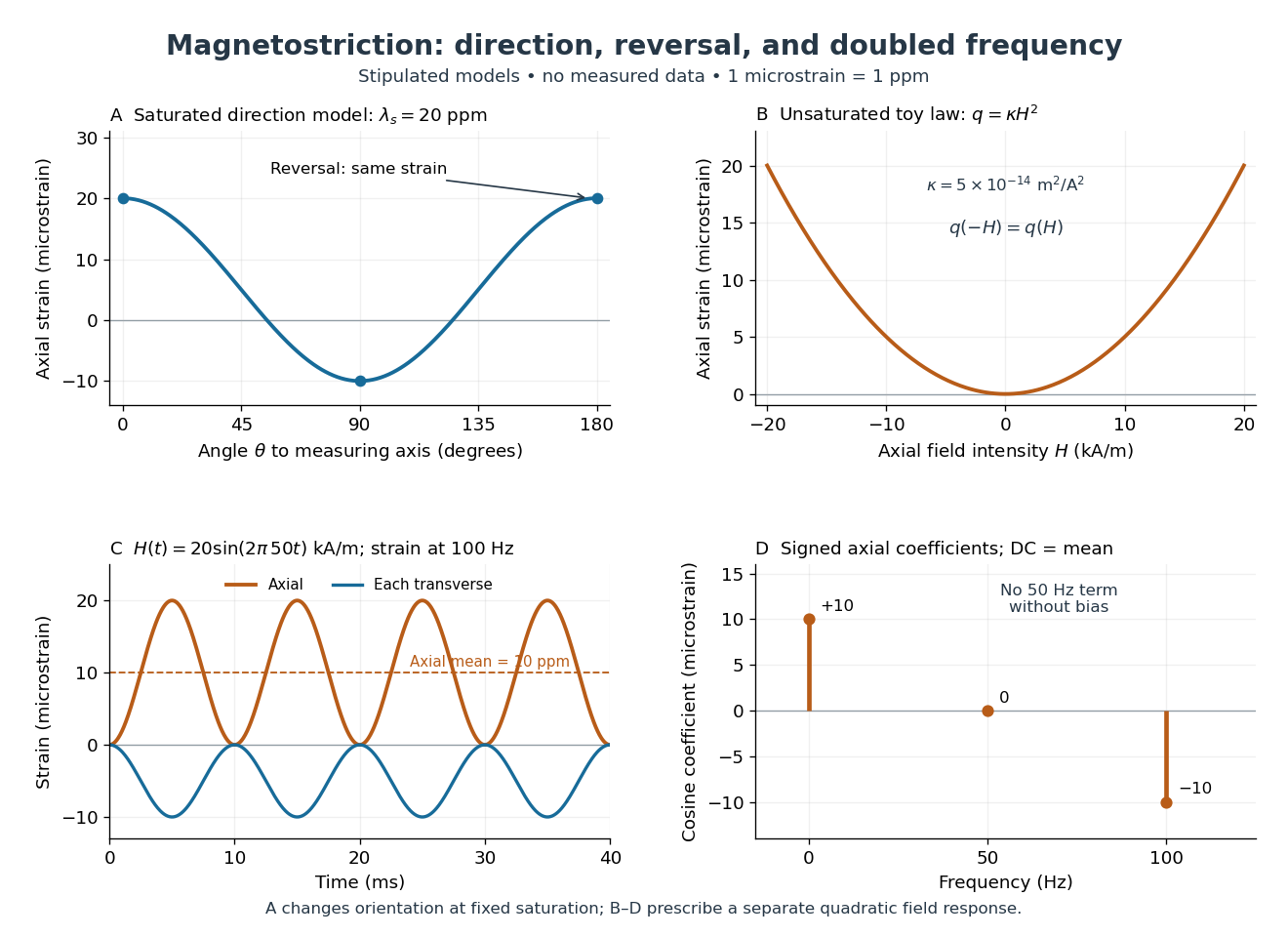
Stipulated angular, reversal, and frequency responses of magnetostrictive strain
. Original calculations, not experimental data: the angular panel uses a saturated isotropic model with positive saturation magnetostriction; the other panels use a separately stipulated quadratic field law. Microstrain denotes a relative length change of one part per million. Details.
A static bias changes the conclusion. Expanding produces a fundamental-frequency term as well as the doubled-frequency term. This is an incremental linear response about a state with a chosen magnetic axis; it does not contradict isotropic linear magnetostriction vanishes at an unbiased isotropic reference. Real hysteresis, thermal expansion from Joule heating, and mechanical resonance can add further components or change their phases. Frequency alone cannot identify the cause of motion: Joule heating also contains an even-in-electric current contribution.
A single crystal of gadolinium antimonide carried a fibre Bragg grating cyanoacrylate-bonded along its axis. The pulsed magnetic field paralleled that axis. Broadband light, a circulator and a spectrometer resolved reflected-wavelength shifts at . Pre-pulse readings measured noise; low fibre thermal expansion reduced thermal background. A residual post-pulse shift indicated possible heating. Spectral distortion checked bond uniformity, while the fibre's smaller cross-section limited loading; bonding was not assumed force-free. Longitudinal strain showed a kink near .[ref]
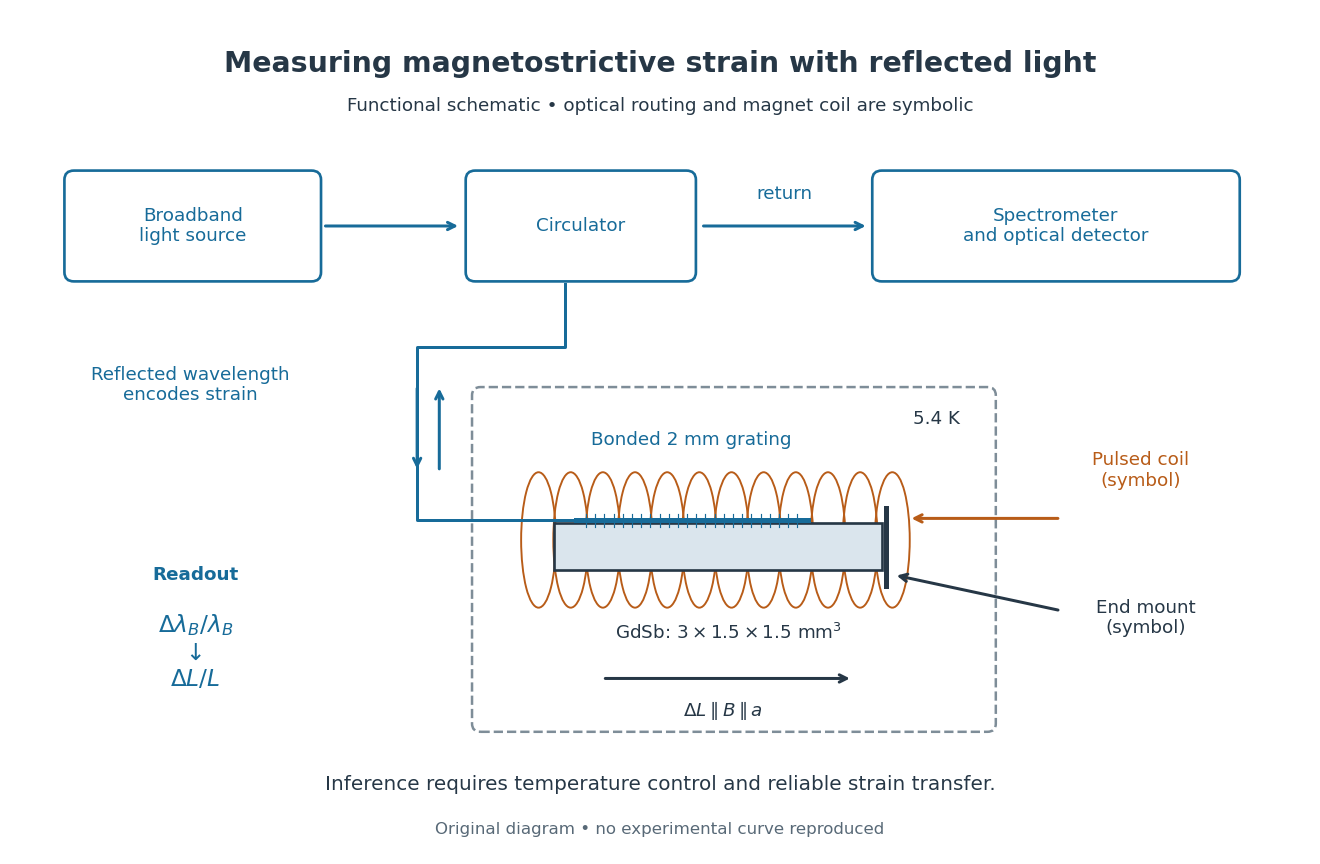
Functional optical chain for measuring magnetostrictive strain
. Original schematic of the bonded-sensor experiment. The magnet coil and optical routing are functional symbols, not a reconstruction of winding geometry or instrument placement.[ref]High resolution magnetostriction measurements in pulsed magnetic fields using Fibre Bragg Gratings by Ramzy Daou and others. PDF Fig. 1 and methods
Details.
The distinction between readout and inference is essential. The fibre Bragg grating senses a change of reflected wavelength; interpreting this as the specimen's strain requires good strain transfer and a controlled temperature. A useful independent control would compare a bonded sensor with a nearby unloaded sensor through the same pulse. Another would vary bond stiffness or specimen cross-section to test loading. These are proposed checks, not additional procedures claimed for the experiment above. The pulsed magnet's winding details were not specified in the inspected account.
This experiment measures one longitudinal component of strain. Establishing the first-order volume change would require three orthogonal normal components under the same conditions. GdSb also has its own antiferromagnetism and field-dependent magnetic structure: this measured curve does not establish the simple saturated isotropic law. Its role here is to make the measurement chain and its limitations concrete.
Saturated isotropic magnetostrictive strain 2026-10-18
Consider a mechanically free isotropic model of a saturated ferromagnet, at fixed temperature and fixed magnitude of magnetization. Let be a unit vector, where is the saturation magnetization. The magnetostrictive strain is an infinitesimal strain tensor, measured relative to a reference with randomly oriented magnetic domains. This reference convention matters: it sets the orientational average of the preferred strain to zero. Define , the saturation magnetostriction, as the longitudinal relative length change in this model.
Rotational symmetry permits a symmetric second-rank tensor made from of the form , where is the Kronecker delta. If we restrict attention to a change of shape with zero first-order volume change, its trace gives . Requiring the longitudinal component to equal gives . HenceThe tensor product is symmetric and unchanged under . It uses two copies of the magnetic direction, so the third-rank isotropic tensor obstruction in isotropic linear magnetostriction vanishes does not apply. More generally, a small-magnetization expansion can contain ; isotropy alone does not require its trace to vanish. The displayed saturated formula isolates the volume-preserving orientational contribution, rather than asserting that every material has zero volume magnetostriction.
Along a measuring unit vector , with , the fractional length change isFor a stipulated and reference length , alignment gives and a perpendicular orientation gives . Rotating from perpendicular to parallel therefore changes the length by , even though the saturated longitudinal value relative to the random reference is . A negative reverses these elongation and contraction signs.
The eigenvalues of this infinitesimal strain tensor are , so to first order. This is not exact finite incompressibility: using the illustrative deformation gradient givesA finite-deformation law would need higher-order corrections if exact volume conservation were required.
Magnetostrictive strain 2026-10-18
There are unlisted articles, also show them or only show them.