
Proportional limit 2026-10-18
The proportional limit bounds the loading interval over which stress is proportional to strain. It does not by itself establish the last load that permits complete recovery of elastic deformation.
Isotropic elastic modulus relation Created 2026-10-18 Updated 2026-11-05
Under uniform compressive pressure , isotropic Hooke's law gives each normal strain as . The volume strain is three times this, so the bulk modulus iswhere is Young's modulus and is Poisson's ratio. The shear modulus is .
For stable three-dimensional isotropic linear elasticity, both and must be positive. With finite , these two positivity requirements giveFiniteness of alone does not establish the upper inequality: its positive sign is essential. The bounds come from positive strain energy density for both volumetric strain and deviatoric strain, rather than a prohibition on negative Poisson's ratio.
For example, and give and , both positive. A negative Poisson's ratio is compatible with stability. The limit at fixed sends the bulk modulus to infinity and represents an incompressible limit, rather than a finite positive-modulus point.
Plane stress Created 2026-10-18 Updated 2026-11-05
A stress tensor state with all traction components involving one normal direction zero. In an isotropic solid, its two remaining normal stresses obey and . The out-of-plane strain need not vanish: . Constraining the out-of-plane deformation instead would be a different boundary condition.
Radial equilibrium of a thick elastic cylinder Created 2026-10-18 Updated 2026-11-05
An axisymmetric small radial displacement gives radial strain and hoop strain . Radial force balance on an annular wedge gives . Under plane stress, isotropic Hooke's law gives and . Substitution into equilibrium gives the displayed displacement equation. Its power-law exponents are and , so . The hoop-stress solution is not based on treating a thick wall as a membrane.
Mechanical mobility Created 2026-10-18 Updated 2026-11-05
Mechanical mobility relates a steady drift velocity to a weak applied mechanical force. For isotropic linear drag , terminal force balance gives with , in units . For a sphere obeying Stokes's law, it is . The corresponding translational hydrodynamic mobility matrix is . The Stokes–Einstein relation reads , and the velocity relaxation time is . In the bare-force spherical model, a particle with electric charge has electrophoretic mobility ; ionic-atmosphere effects can modify that simple model.
Projectile motion with linear drag 2026-10-18
For constant acceleration vector and , a projectile initially at with velocity hasThe integrating factor solves the first-order linear ordinary differential equation for the velocity; one more integration proves the position formula. The terminal velocity is , and is the relaxation time. For and , eliminating time when givesFor finite , the physical domain is . If , the path is vertical and cannot generally be represented as a single-valued graph . Expanding at fixed as recovers .
Work by Leon van Dommelen 2026-10-18
Radix sort suffix invariant 2026-10-18
After passes, , the array is in nondecreasing order of , the integer represented by its lowest numerical digits. Equivalently it is ordered by the tuple under lexicographic order, with the most significant processed numerical digit first. Among equal suffixes it retains the original order of the complete sorting records.
The loop invariant has a simple mathematical induction proof. Before any pass, for every sort key, so the original array satisfies it. Suppose it holds after passes. The next stable digit sort puts smaller groups first and preserves the existing order within each tie. Sincethe new array is ordered by . Equal new suffixes have equal current numerical digits and equal old suffixes, so their original order is also preserved. Every pass is a permutation of complete sorting records, establishing sorting permutation preservation. At termination , the assumption gives : the invariant becomes whole-key sortedness, together with stable sorting.
In 1970 Larry Frye and Michael Edidin fused mouse C11D and human VA-2 cell lines with Sendai virus, forming heterokaryons. Suspensions were maintained in a shaking water bath at . Removed aliquots were stained by indirect immunofluorescence: antibodies against parental surface antigens, then differently fluorescent secondary antibodies. A Leitz Ortholux fluorescence microscope used a mercury lamp and color-selecting filters. Green mouse and red human surface patterns became intermixed.[ref]
The rapid intermixing of cell surface antigens after formation of mouse-human heterokaryons by Larry Frye and Michael Edidin. Frye and Edidin, The rapid intermixing of cell surface antigens after formation of mouse-human heterokaryons, pp. 319–325: Summary, Cell fusion, Fluorescent staining, Fluorescence microscopy, Table 1, time-course results
Same-species fusions tested antibody specificity; stable hybrid lines supplied a two-color control. Inhibitors of biological translation did not prevent mixing; lowering temperature inhibited it. These observations supported lateral redistribution over rapid synthesis. The authors could not conclusively exclude passage through cytoplasm and return. The readout compared populations, not trajectories of a continuously observed individual biological cell, and did not establish unrestricted motion of every membrane protein.[ref]
The rapid intermixing of cell surface antigens after formation of mouse-human heterokaryons by Larry Frye and Michael Edidin. pp. 324–331: specificity controls, inhibitor studies, temperature dependence and Discussion of mechanisms iii and iv
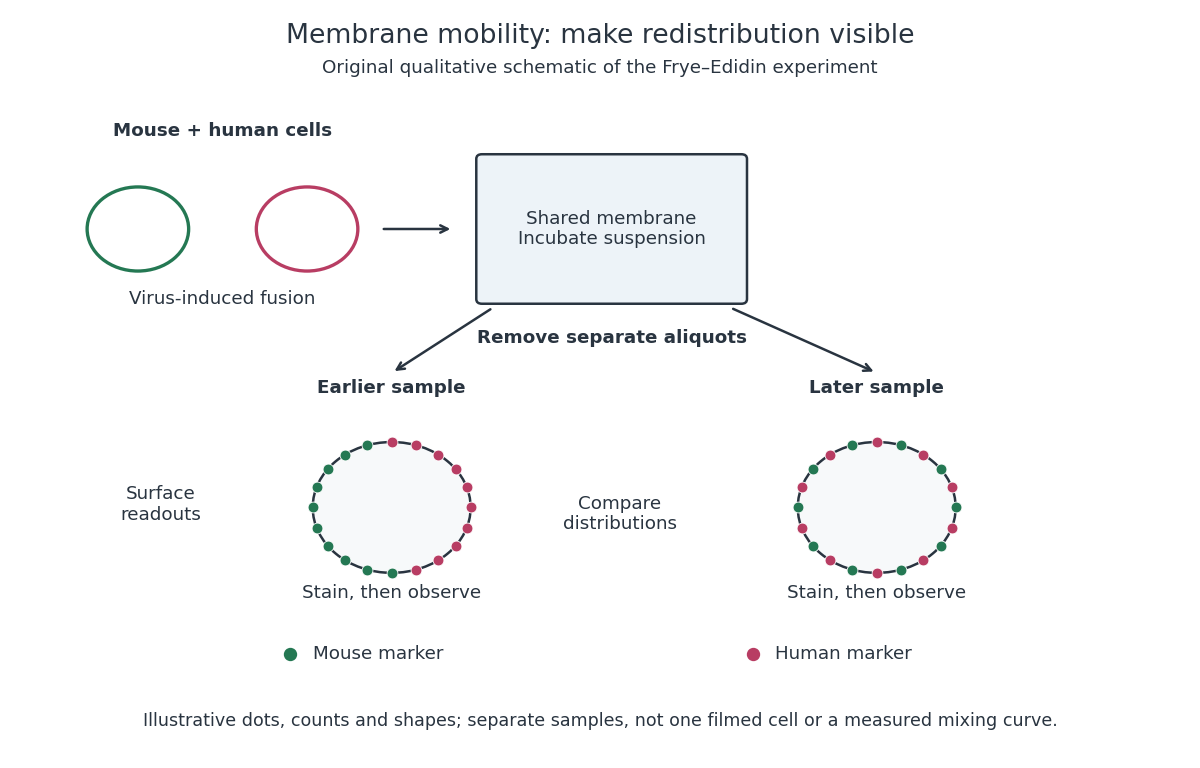
Separate time-point samples reveal changing surface distributions
. Original qualitative schematic of the mouse-human heterokaryon membrane-mixing experiment. Dot counts and shapes are illustrative; separate samples show distributions rather than individual trajectories or measured mixing curves. Details.
The decisive design idea is to begin with spatially distinguishable material. A uniformly labeled surface can look unchanged while its components move. Bringing together differently identifiable parental surfaces creates an initial pattern whose loss reveals redistribution; antibody specificity makes that loss interpretable. Membrane topology asks which side a part faces, whereas this experiment asks where it can move along that side.
Work by Larry Frye 2026-10-18
For a nonrelativistic point charge, let be the time-averaged second moment of acceleration, without subtracting its mean. The outgoing radiation zone fields satisfy and . Their Poynting vector gives the displayed power per solid angle. Its integral is , the averaged Larmor formula.
For periodic motion the mean acceleration vanishes and is also its covariance matrix. More generally the second moment, rather than the centered covariance matrix, is the relevant quantity. The angular formula is valid to leading nonrelativistic order and evaluates source motion at retarded time.
Dissociative adsorption 2026-10-18
In dissociative adsorption, an arriving molecule splits into bound fragments. For the idealized process , let denote a vacant adsorption site and let count sites occupied by . A mean-field approximation with independent vacancies takes the forward rate proportional to and the reverse rate proportional to . Equating them yieldswith a positive coefficient of inverse-pressure units that includes the chosen pair-counting convention. This square-root dependence illustrates why the intact-molecule Langmuir isotherm cannot simply be assumed for splitting molecules. Requirements for neighboring vacancies or interactions can further change the mean-field approximation.
Competitive adsorption Created 2026-10-18 Updated 2026-10-20
Competitive adsorption occurs when different chemical species seek the same adsorption sites. For intact molecules and , retain identical adsorption sites and no interactions, but replace the vacant fraction by . The same equilibrium balance givesHere and are partial pressures, not total pressure. Increasing can reduce at unchanged : replacing by total pressure in a single-species Langmuir isotherm loses this competition.
Heat-capacity jump in quartic Landau theory Created 2026-10-18 Updated 2026-11-05
For zero field, with has ordered minima below . Minimizing gives . Since , the ordered-phase excess heat capacity is and its jump relative to the disordered side is . The value is a total heat capacity or a heat-capacity density according to the normalization of .
Particle-hole continuum Created 2026-10-18 Updated 2026-11-05
The particle-hole continuum is the range of energy and momentum transfers that can excite an occupied fermion state into an unoccupied state, leaving a hole behind. For a free gas at zero temperature, choose and ; the excitation energy is .
Varying the initial momentum produces a continuum at fixed transferred wavevector. For small in an isotropic gas, its positive frequencies extend approximately up to . A collective mode overlapping these excitations can decay by creating particle–hole pairs; a zero sound branch outside that region can avoid this particular damping channel. Interactions change the response and effective parameters, so the free-gas boundary is a useful starting model rather than a universal exact spectrum.
Quasiparticle residue 2026-10-18
The quasiparticle residue is the coherent pole weight of the single-particle Green's function. Its coherent spectral term contributes to the zero-temperature momentum occupation. A smooth remainder leaves a jump at the Fermi surface; Landau quasiparticle occupations have a unit step.[ref]
For the local illustrative distribution in the figure, put and is the Heaviside step function. Its one-sided limits are and , giving . The smooth term is stipulated; this local curve does not specify a normalized distribution over all momenta. In particular, is neither the fraction of atoms above the Fermi surface nor .
Fermi-liquid effective mass 2026-10-18
In a three-dimensional uniform isotropic continuum obeying the Principle of Galilean relativity, with one bare particle mass , the Fermi-liquid effective mass satisfiesA band effective mass need not satisfy this relation.[ref]
The Theory of a Fermi Liquid by Lev Davidovich Landau. Section 2, equations (8)–(11), metallic-quasimomentum footnote
For the stipulated in the occupation figure, this relation requires if those assumptions apply. At fixed , is half its free-particle value, so moving by from the Fermi surface costs approximately instead of . The factor of three belongs to the three-dimensional angular average, not to a universal definition of effective mass.
Landau quasiparticle energy functional Created 2026-10-18 Updated 2026-10-20
Changing one Landau quasiparticle occupation changes the energies of others. To second order around equilibrium,Here is volume, occupations are per momentum and spin state, and has units of energy times volume.[ref]
On the Theory of the Fermi Liquid by Lev Davidovich Landau. p.70, equation (1); integrate the energy shift to obtain the quadratic functional
For a toy two-state change at fixed volume, take , , , and unperturbed energies . The expression gives . The factor counts the interaction of the same pair once; it does not halve each excitation's energy. This finite-state illustration only explains the bookkeeping of the Landau quasiparticle energy functional.
Lactate 2026-10-18
Lactate is the conjugate base of lactic acid. Lactate dehydrogenase couples its interconversion with pyruvate to the NAD+/NADH redox pair.
Rod wavelength in a Kundt tube 2026-10-18
A freely moving rod end has zero axial stress, not zero axial displacement. For a uniform slender rod of length , its low-frequency extensional modes have shapes and wavelengths . A centre clamp is compatible with the displacement node and ; clamps at and are compatible with and . The support positions therefore matter before a gas wavelength can determine a rod speed of sound.
For a chosen model with , and , the slender-rod extensional relation gives . The two-quarter-support mode then has . If the gas has stipulated , its half-wavelength is , andThe centre-supported fundamental would instead have and twice that gas spacing. The same rod material has not changed its wave speed. In this slender-rod model, is Young's modulus; a bulk compressional wave involves a different elastic-modulus combination, so the two wave speeds are not interchangeable.
There are unlisted articles, also show them or only show them.