
Shift current of an elastic rod Created 2026-10-18 Updated 2026-11-05
For a longitudinal displacement field and Lagrangian density , uniform field shifts give Noether current , . Its spatial integral is the rod's longitudinal mechanical momentum. A prescribed position-dependent mass density changes to but does not break this internal shift symmetry. Boundary traction can carry momentum into or out of a finite rod, so action symmetry alone does not guarantee conservation of the integrated charge.
Gauss's law for gravity 2026-10-18
The outward flux of the Newtonian gravitational field through a closed surface is times the enclosed mass. A sphere around a point mass establishes the coefficient; superposition extends the integral law to general mass distributions. The minus sign expresses attractive gravity. A symmetric Gaussian surface can turn the flux relation into a local field calculation, but the integral law alone does not imply that the field is uniform on an arbitrary surface.
A circular infinite cylinder of radius and uniform mass density has linear mass density . A coaxial Gaussian surface of length has inward radial gravitational field and no end-cap flux. Gauss's law for gravity gives outside, hence the displayed result. Inside, enclosed linear mass density is , so . An exterior circular orbit has speed independent of radius. The exterior formula presupposes circular axial symmetry; area alone would not specify the near field of a noncircular rod.
Gravitational field of a finite uniform line segment Created 2026-10-18 Updated 2026-10-20
Spread mass uniformly along on an axis, with linear mass density . In its perpendicular bisector plane, axial field components cancel, and the radial component isThis is an exact line mass model and a thin-rod approximation for a physical cylinder. A centred circular orbit in this symmetry plane has . Thus for , and for . For a finite-width rod, the first limit is useful only while its transverse size remains much smaller than .
Stipulated chirps and detector projections 2026-10-18
To construct an original example rather than imitate GW150914, set , , and adopt the rounded solar mass . Compare and solar mass binaries starting at . Stop each at the stipulated orbital compactness thresholdThis is a conservative pedagogical stopping rule, not a claimed error bound: the relative speed already reaches . Higher-order corrections accumulate wave phase well before merger, and precision inference requires better models. The two cutoffs are approximately and respectively; doubling the chirp mass multiplies at fixed by .
For a nearby stipulated source at distance , neglect redshift and define inclination as the angle between the orbital angular momentum and the line of sight. The leading quadrupole formula yieldsThe numerator of has units , matching , so both polarizations are dimensionless. Its growth and the rising frequency produce the tightening, strengthening oscillations. For face-on viewing the polarization components have equal magnitudes in phase quadrature; for edge-on viewing the cross component vanishes, agreeing with circular-binary quadrupole radiation.
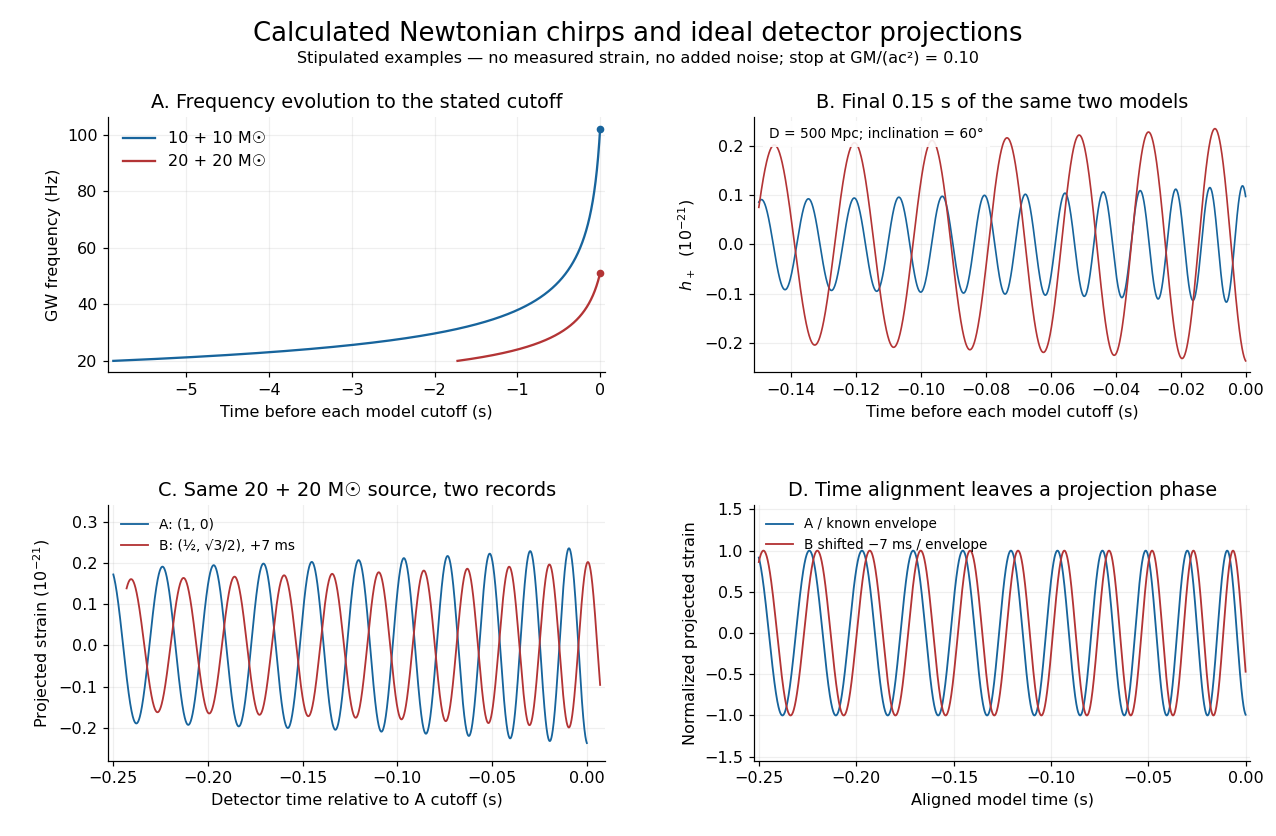
Stipulated Newtonian binary chirps and two ideal detector projections
. Calculated examples only: no measured LIGO strain or noise. Upper panels compare equal-mass binaries up to . Lower panels use solar masses, and degrees. Ideal overhead detectors have and ; the second record has a stipulated delay, then is shifted back for comparison. These geometries and delay are not fitted Hanford–Livingston responses. Details.
Shifting an arrival time aligns the chirp evolution, but different polarization projections need not overlay after only a sign flip. The last panel divides the ideal projected records by their known envelope factors to expose this phase difference. A physical source model must jointly explain those differences, not erase them by arbitrary rescaling. Independent integration of the separation equation, the radiated power and checks the analytic chirp against orbital energy balance over the entire stipulated interval.
Chirp mass 2026-10-18
The chirp mass is the combination of two component masses controlling the leading Newtonian binary chirp. Inverting its frequency equation givesUse in hertz and in hertz per second to obtain kilograms. For equal component masses , . A stipulated solar mass system therefore has solar masses. In a cosmological observation the time and frequency measured at the detector instead yield , where is redshift; phase evolution alone does not independently determine the source mass and redshift.
Exact Newton error identity for a quadratic Created 2026-10-18 Updated 2026-10-25
For the quadratic polynomial with , consider the Newton root-finding iteration towards the polynomial root . If , its signed error satisfiesIndeed the iteration for is , and subtracting yields . This exact identity explains quadratic convergence near the simple polynomial root. If an initial error is asymptotic to and as , one step changes its leading power to and its coefficient to .
Kamiokande Created 2026-10-18 Updated 2026-10-20
Kamiokande, associated with Masatoshi Koshiba, was an underground water Cherenkov detector viewed by photomultipliers. Improved water purity and reduced background enabled solar neutrino observations. A concentration of reconstructed recoil directions toward the Sun distinguished a source signal above an approximately direction-independent background.[ref]
For solar neutrinos, electron elastic scattering supplies a directional recoil, with different cross sections for active neutrino flavors. Neither the Homestake experiment deficit nor the SN 1987A neutrino burst alone established neutrino oscillation; later evidence compared complementary channels and propagation effects.[ref]
Nobel Lecture: Birth of neutrino astrophysics by Masatoshi Koshiba. pp. 1013, 1016–1018: scattering and combined oscillation evidence
Bragg gap ladder for a linear dispersion 2026-10-18
For a scalar one-dimensional dispersion and a potential of period , a reciprocal vector , , connects degenerate right- and left-moving states at . Their unperturbed energy is . Thus consecutive allowed Bragg thresholds have spacing , whereas shifting momentum by a full reciprocal period changes a linear branch's energy by . The potential's Fourier coefficients and higher-order couplings determine which gaps actually open and their widths, so a geometric period alone does not imply an exactly energy-periodic spectrum. A graphene pseudospin selection rule can further suppress scattering; the scalar-chain model omits that internal structure.
Rectangular-lattice Fermi-surface reconstruction Created 2026-10-18 Updated 2026-10-20
Consider a spin-degenerate two-dimensional free electron model with rectangular periods and two electrons per unit cell. Write , , and . If , the circular Fermi contour crosses only the vertical boundaries of the first Brillouin zone. Folding translates its protruding caps back by a reciprocal lattice vector . A weak periodic potential mixes the intersecting plane waves, reconnecting the contours into two open first-band sheets and a closed second-band pocket. The pocket is centred on a zone boundary: its halves on opposite sides of a reduced-zone plot are identified periodically and belong to one closed sheet.
Natural boundary condition on the slope 2026-10-18
For a functional , two applications of integration by parts leave the boundary termIf the endpoint displacement is fixed but its slope is free, while is arbitrary. The first variation therefore forces at that endpoint. For the beam energy density with , this gives , the zero-bending moment condition. A clamped endpoint instead prescribes the slope and has .
Work by Nancy Hall 2026-10-18
Coupled inductors Created 2026-10-18 Updated 2026-10-20
Coupled inductors are inductors whose magnetic flux linkages depend on each other's electric currents. A two-circuit linear model uses two self-inductances and a mutual inductance.
CMOS 2026-10-18
An integrated circuit technology using complementary MOSFETs. CMOS names a circuit technology; active-pixel sensor names a detector architecture.
Gate-to-substrate Fermi-level difference Created 2026-10-18 Updated 2026-10-20
An ideal insulating gate blocks particle exchange between the gate and substrate of a MOSFET. Their electrochemical potentials, represented by their band-diagram Fermi levels, therefore need not coincide. An applied gate voltage fixes their difference; with and voltage defined by an electron reservoir, . Contact work-function differences also affect band bending, so equal Fermi levels do not imply flat bands. Each conducting region can separately have a spatially constant equilibrium electrochemical potential.
Ketose Created 2026-10-18 Updated 2026-11-05
A ketose is a monosaccharide whose open-chain form contains a ketone group. Fructose is a familiar example, with a carbonyl group at carbon 2 in its open-chain structure.
A ketose can form cyclic structures by reaction of its carbonyl group with one of its own hydroxyl groups. The distinction from an aldose concerns carbonyl connectivity, rather than simply the number of carbon atoms.[ref]
Aldose Created 2026-10-18 Updated 2026-11-05
An aldose is a monosaccharide whose open-chain form contains an aldehyde group. Glucose is an example, even though much of the glucose in aqueous chemical solution has a cyclic structure.
Monosaccharide ring-chain interconversion 2026-10-18
In water, D-glucose mainly occupies cyclic forms. The C5 hydroxy group adds to the C1 aldehyde, forming a cyclic hemiacetal; reversible opening restores the aldehyde. Reclosure can give either anomer. Their changing proportions cause mutarotation, the approach of optical rotation to an equilibrium value. This pathway involves changing chemical bonds, rather than simply rotating a hydroxy group about a single chemical bond.[ref]
25.5 Cyclic Structures of Monosaccharides: Anomers. McMurry, Organic Chemistry, §25.5: intramolecular hemiacetal formation and final mutarotation discussion
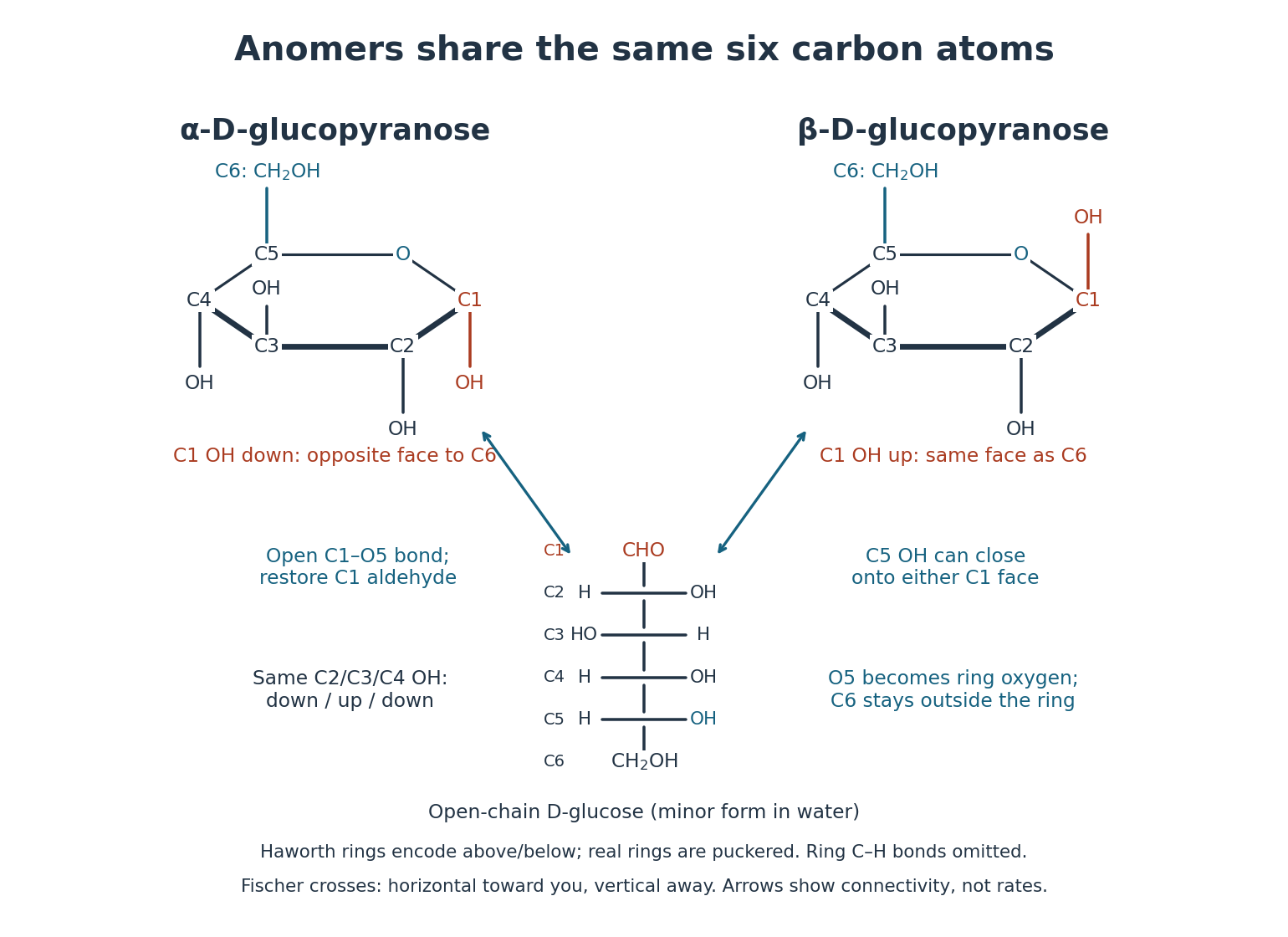

In this conventional Haworth projection, C5's group points up. The alpha anomer's C1 hydroxy group points down, on the opposite face; the beta anomer's points up, on the same face. C2/C3/C4 retain down/up/down hydroxy groups. These are above/below relationships to a reference ring plane, not a claim that the ring is physically flat.[ref]
2-Carb-5. Cyclic forms and their representation. Nomenclature of Carbohydrates (Recommendations 1996) by Alan D. McNaught; IUPAC–IUBMB, Nomenclature of Carbohydrates (1996), 2-Carb-5.4 and 5.7: Haworth representation and nonplanar conformations
The anomeric carbon is C1, the existing carbonyl group carbon that becomes a new stereocenter; no extra carbon chemical atom appears. The two anomers differ at that centre while retaining the other configurations.[ref]
2-Carb-6. Anomeric forms; use of α and β. Nomenclature of Carbohydrates (Recommendations 1996) by Alan D. McNaught; IUPAC–IUBMB, Nomenclature of Carbohydrates (1996), 2-Carb-6.1–6.2: anomeric centre and configurational relationship
Trace the ring as C1–C2–C3–C4–C5–O5–C1, where O5 denotes the oxygen originally in the C5 hydroxy group. It contains five carbon chemical atoms and one oxygen; C6 remains attached outside the ring. The C1 carbonyl group oxygen becomes the C1 hydroxy group oxygen. This accounts for every oxygen: O5 in the ring and five hydroxy groups at C1, C2, C3, C4 and C6. Ring closure preserves . A six-membered ring and a six-carbon sugar are thus different counts.
Recoil Created 2026-10-18 Updated 2026-10-20
Recoil is the motion acquired by a body when it exchanges momentum with an emitted, absorbed or scattered particle. For isolated emission from a body initially at rest, momentum conservation makes the remaining body acquire the opposite momentum. If its final mass is and the recoil is nonrelativistic, its kinetic energy is . A photon of energy has momentum magnitude , so . The transition energy is shared between the photon and the recoiling body; nuclear recoil is an important example.
Moment of inertia of a uniform square plate 2026-10-18
A uniform square of side has the displayed moment of inertia about the perpendicular axis through its centre. Integrating over gives ; multiplying by the surface mass density gives the result. A square prism of any uniform thickness has the same axial formula when expressed in terms of its total mass. If the side is denoted instead, the result is , so the side-length convention must be specified before substituting numerical data into a normal mode calculation.
There are unlisted articles, also show them or only show them.