
Past exam of the mathematics course of the University of Cambridge 2004 iii Paper 66 2 Solution Created 2026-10-03 Updated 2026-10-14
First velocity moment. Assume a stationary, spherical, nonstreaming collisionless stellar system with constant mass-to-light ratio . Use a luminosity-weighted galactic distribution function, with luminosity density . Multiplying the Collisionless Boltzmann equation by and integrating over velocities, with its velocity-space boundary terms vanishing, givesSpherical symmetry makes the stress tensorHere is one tangential component, as in the paper; the total tangential variance is . Its radial divergence is , since the divergence of the radial unit vector is . With the velocity-anisotropy parameter , and enclosed mass , this gives the Spherical Jeans equationThis uses a constant ratio of total gravitating mass to luminosity, rather than an arbitrary independent dark halo.
Projection and elimination of anisotropy. Write for projected radius and for spherical radius. The Abel transform of the luminosity density giveswhose inverse is the displayed density inversion in the paper. At a point on this line of sight, . The line-of-sight second stellar velocity moment is . Therefore the measured quantity satisfiesThe Spherical Jeans equation gives . Substitution yieldsThe inner printed in the PDF's definition of must therefore be : the literal expression has an extra gravitational factor and lacks the density. Both this derivation and dimensional consistency require the correction. Define the projected spherical Jeans residual byTo express it entirely in terms of the radial stress, putDifferentiating the nonsingular representation gives . HenceIf vanishes at zero and infinity, then . These are the absence-of-boundary-stress conditions needed for the global result.
The virial relation, term by term. Interchange the order in the residual integral and useIt follows thatThe first term is : spherical averaging assigns one third of the integrated velocity-square to any fixed viewing direction, giving . The gravitational potential energy isThus the integrated residual is exactly , and its vanishing is the virial theorem. Solving for gives the global projected virial estimate of a mass-to-light ratio,It is independent of the radial anisotropy profile when the full aperture and the stated boundary conditions are used. A finite aperture retains a boundary term.
Past exam of the mathematics course of the University of Cambridge 2004 iii Paper 66 1 Solution Created 2026-10-03 Updated 2026-10-14
The separated disk modes. Away from the plane of a razor-thin disk, there is no volume source, so the Newtonian gravitational potential obeys the Laplace equation in cylindrical coordinates. Separation of variables givesHere is a radial wavenumber, with units of inverse length. Regularity on the axis selects the Bessel function of the first kind rather than the singular second solution. Decay away from the disk, continuity across it and reflection symmetry select . These conditions apply to each nonzero-wavenumber mode; a uniform sheet is a separate zero-mode problem.
Integrate the Poisson equation for Newtonian gravity across the disk to obtain the jump conditionFor the unit-amplitude separated mode, the jump is . ThusAn individual basis density is signed; positive physical surface densities are built by superposition.
An arbitrary axisymmetric surface density. Define its order-zero Hankel transform byMatching the coefficients of the mode densities gives the Hankel representation of thin-disk gravity,The boundary conditions exclude added external fields. For sufficiently decaying surface density, this is the isolated-disk potential; for infinite scale-free disks, only potential differences or regularized forces need be finite.
The Mestel disk. Put . The Bessel function integral , understood with a decaying regulator, gives . Differentiate the potential before removing the regulator and use :The last integral is , since . Therefore the circular speed and enclosed mass areConsequently . This equality follows from the specific Mestel disk calculation; the spherical shell theorem cannot be applied to general disks. Its total mass and absolute potential referenced to infinity diverge. A convenient finite midplane reference is .
The rotating distribution function. Use specific energy and . For the printed positive exponential, take and ; has units of squared velocity. If instead means ordinary total energy and , the velocity integral diverges, so that literal convention cannot define the requested galactic distribution function. Equivalently one can retain ordinary energy and choose the printed negative.
With the binding-energy convention, write the amplitude as to distinguish it from the function:Integration over both radial velocities and positive azimuthal velocities givesThe half-line integral follows by setting in the defining Gamma function integral and requires . Matching its radial power and normalization to the Mestel disk yields the rotating Mestel disk distribution function parametersSince , the required integrability condition is automatic. The amplitude uses the stated potential reference; changing the additive potential constant changes without changing the physical distribution.
Past exam of the mathematics course of the University of Cambridge 2004 iii Paper 65 4 Solution Created 2026-10-03 Updated 2026-10-14
In the rapidly rotating magnetohydrodynamics of a conducting core, the magnetostrophic balance neglects inertia and, initially, viscosity:Take a spherical or suitable axisymmetric impenetrable container, with gravity/buoyancy having no azimuthal component and no applied mechanical torque. Small Rossby number is the slow-motion assumption. It does not imply that an arbitrary magnetic field is compatible with the balance.
Use cylindrical coordinates and integrate the azimuthal momentum equation over the fluid portion of a cylinder. The pressure term integrates to zero because it is a periodic derivative. The Coriolis contribution is proportional to the radial flux . By incompressibility and impermeability it is zero: closing the cylinder with the container's caps and applying the divergence theorem produces no net flux. There is no azimuthal buoyancy term. ConsequentlyThis is Taylor's condition. Equivalently define the torque per radial thickness by ; it must vanish. In a shell, cylinders split by the inner boundary require the corresponding connected-region conditions. These compatibility conditions concern rotating-fluid torque, distinct from force-free magnetic relaxation in a plasma. Their primary origin is Taylor's rotating-fluid analysis.
A magnetostrophic Taylor state allows construction of the flow's ageostrophic part. Taking the curl givesIntegrate along rotation-axis lines and impose impermeability, then use incompressibility and periodicity to reconstruct a particular solution . In a sphere the boundary geometry supplies the independent endpoint conditions; a cylinder with parallel planar end normals has additional degeneracies. The homogeneous momentum equation admits any differential cylindrical rotation . Its Coriolis force is a radial pressure gradient, so momentum balance alone cannot determine .
The additional equation is dynamic preservation of the constraint. LetThis is the first variation of the cylindrical Lorentz torque. The resistive induction equation supplies . Define and . Then the geostrophic flow preserving the Taylor constraint solvesFor a given field this is linear in ; it prescribes the cylindrical rotation needed to keep the field on the Taylor-state manifold. The magnetic boundary conditions must also be imposed on . Boundary terms cannot generally be discarded for insulating exteriors; their role in a correct construction is described in Hardy and collaborators' primary analysis.
For example, when magnetic surface torque vanishes, as for compatible conditions, the Maxwell stress tensor givesCylindrical rotation induces component changes and . Their product variation integrates to , since the azimuthal derivative integrates to zero. Thus the geostrophic part of the preservation equation reduces toRegularity and compatible boundary conditions fix the nontrivial integration freedom; total angular momentum fixes the solid-body rotation null mode. If vanishes on an entire cylinder, the magnetic coupling coefficient degenerates and generic uniqueness must not be asserted. The simplified expression is conditional on the surface-torque assumption, rather than a general replacement for the boundary-compatible operator equation.
With small positive viscosity the momentum equation adds . Its cylinder integral becomes the viscous regularization of the Taylor constraintMagnetic torque need no longer vanish exactly; it can be transmitted by viscous stress. Bulk viscosity is order at fixed velocity. For ordinary no-slip rotating boundaries, thin Ekman layers have thickness of order and shear stress of order , larger than the bulk order- correction. Boundary pumping and this friction help select the otherwise undetermined geostrophic flow. In the inviscid interior only impermeability is imposed; no-slip matching is supplied by the thin layer, so simply imposing all viscous boundary conditions on the zero-viscosity equations is incorrect.
For bounded velocities, the viscous torque tends to zero as , recovering the leading Taylor condition. A prescribed order-one uncompensated magnetic torque would instead require a velocity growing like under Ekman friction, or under bulk friction alone. Such growth eventually invalidates the assumed small Rossby number: the limit is singular, not a regular guarantee that every imposed magnetic field has an inviscid solution. With stress-free boundaries the leading no-slip friction is absent, and bulk stresses, magnetic boundary conditions and angular-momentum normalization require their own treatment. Retaining inertia permits torque-driven torsional motion rather than an exact magnetostrophic constraint. Thus zero viscosity gives a magnetic compatibility condition and an induction-based selection of cylindrical rotation, while small viscosity replaces it by a torque balance whose bounded solutions approach compatible Taylor states.
Past exam of the mathematics course of the University of Cambridge 2004 iii Paper 65 1 Solution Created 2026-10-03 Updated 2026-10-14
Consider the complex field before taking its real part. Put and . Both components are perpendicular to , so the solenoidal magnetic-field constraint holds. The time-dependent phase obeysbecause and . Moreover , and magnetic stretching is . Thus the changing basis exactly supplies the shear-stretching term. Finally,and acts as . Equating coefficients verifies
Take and first . Remove magnetic diffusion by writing , , whereThen , , and . Equivalently, rescaling time by and replacing by gives the pair used in the question. Its growing WKB approximation isThe complex relative phase follows directly from ; the printed is sufficient for magnitudes but omits that phase.
The phase-averaged magnetic energy is , hence for a nonzero growing-mode componentAt , , so its leading exponential isThe positive quadratic term permits strong amplification before the negative cubic diffusion term dominates. The leading maximum occurs near . Put and . A well-separated late-time growing interval requiresThe first ensures ; the second ensures the WKB condition at the peak, since . For fixed nonzero both follow by taking sufficiently small positive . The peak's leading exponent is , whereas the eventual exponent tends to minus infinity. This is mean-field shearing-wave transient amplification, not sustained dynamo action.
Growth from the initial instant is possible explicitly: choose with . The initial logarithmic energy derivative is when . Growth is not asserted for every initial polarization, for example an identically zero field. If , the amplitudes simply diffuse and the energy is proportional to ; shear can still give algebraic transient amplification of an in-plane field for small diffusivity, but a purely vertical field only decays. Positive diffusivity is essential to the final decay.
Past exam of the mathematics course of the University of Cambridge 2004 iii Paper 64 4 Solution Created 2026-10-03 Updated 2026-10-14
For the basic axisymmetric flow, . The steady radial Euler equation for fluid motion gives ; the other components give . Thus, in the absence of an additional body force,The additive constant is undetermined without an imposed reference pressure; the rigid boundary does not prescribe a uniform boundary pressure. Its shape is fixed by the container rather than by a free-surface pressure condition.
Let be the small velocity amplitudes and the pressure amplitude. Linearizing the cylindrical Euler equations for an inviscid fluid about uniform rotation, the material derivative is . The intrinsic frequency for the stated phase convention is thereforeThe radial and azimuthal curvature terms supply the Coriolis acceleration terms, givingFor , solving these equations givesThe incompressible flow constraint isOn substitution, the terms proportional to cancel. The remaining equation iswhich provesThis is the pressure equation for inertial modes in a rigid rotating sphere. The exceptional frequencies used in the divisions must instead be treated in the original momentum system; they are not needed for the mode below.
A fixed rigid sphere is impermeable, so its normal velocity vanishes:Using the solved amplitudes and multiplying by givesEquivalently divide by for . Smoothness means tangential slip is allowed: there is no no-slip condition on these inviscid normal modes. Nor is there a condition , since the wall supplies the required varying normal pressure.
For an axisymmetric oscillation, and . Write . For the radial and vertical operators areThe interior pressure equation therefore requiresThe boundary equation becomesSubstituting , this polynomial must vanish for every boundary height. Its constant and coefficients consequently giveTogether with the interior relation the latter condition is . A nontrivial nonsingular oscillatory solution needs : if and , the other equations force . Hence , givingThe cubic axisymmetric inertial mode of a rigid sphere is explicitlyIts cubic pressure is regular at the axis and centre, and its reconstructed velocity is divergence free and tangent to the sphere by the preceding identities. The frequency lies within the inertial wave band : Coriolis acceleration, rather than compression or a moving surface, supplies the restoring dynamics. The amplitude is arbitrary in this linear problem.
Past exam of the mathematics course of the University of Cambridge 2004 iii Paper 64 3 Solution Created 2026-10-03 Updated 2026-10-14
Let denote the Eulerian perturbation of a fluid variable that is the pressure amplitude, and keep constant. The linearized Euler equations and incompressible flow constraint areThe last equation gives . Substituting it into the first yieldsDifferentiating this formula and using the vertical momentum equation produces the Rayleigh equation for inviscid shear flow:For a growing normal mode, is nonreal, so never vanishes on the real axis. In each open region the base velocity is constant or linear and ; therefore . Decay away from the layer selects above and below, while both exponentials are retained inside. Conveniently normalize these asThese are the spatially localized discrete modes relevant to instability, rather than all possible generalized neutral disturbances at a critical layer in a shear flow.
At each corner is continuous and jumps. The two sides have the same normal velocity and normal stress: there is no membrane, density jump or singular external force supplying a pressure jump. Thus and must be continuous. The pressure formula proves the required continuity of . This is pressure matching at a piecewise-linear shear interface; it does not require to be continuous. Equivalently integrating the Rayleigh equation for inviscid shear flow through a corner gives .
Write , , and . Continuity of normal velocity givesAt , the outside derivatives are , , while the inside derivatives are , . Hence pressure matching reduces toSimilarly at , the outside derivative is and the inside derivative is . Matching givesThe two equations can be written asA nonzero mode therefore requiresThis is the dispersion relation for the unbounded piecewise-linear shear layer.
With the phase convention , positive gives exponential temporal growth. Since the displayed is real, a growing/decaying pair occurs precisely whenFor , by the strict exponential tangent inequality, so every such mode is unstable. For , define . Its derivative is positive, while and . There is consequently exactly one root in that interval, andAt the cutoff the discrete roots merge at ; above it the roots are real and have no exponential growth. The physical wavelengths in the unstable band satisfy .
This is a finite-thickness Kelvin-Helmholtz instability: long disturbances roll up the layer and draw kinetic energy from its shear. The off-diagonal terms describe coupling of the two vorticity discontinuities. Short disturbances decay across the layer before strongly coupling its edges and are neutral. Indeed at the two phase speeds approach the velocities of the separated edges. At , expansion of the numerator gives , recovering the vortex sheet result ; the growth rate then behaves as .
Past exam of the mathematics course of the University of Cambridge 2004 iii Paper 64 2 Solution Created 2026-10-03 Updated 2026-10-14
The equilibrium isothermal equation of state is . Hydrostatic equilibrium gives , henceHere is assumed. This is the same local harmonic-gravity balance as isothermal vertical structure in stellar gravity.
For , this equilibrium is stably stratified under adiabatic fluid perturbations. Its squared buoyancy frequency isA general perturbation can therefore support acoustic waves restored by compression and internal gravity waves restored by buoyancy, with nonoscillatory entropy or vortical disturbances also possible. The prescribed velocity is purely vertical and horizontally uniform. It describes vertical acoustic waves; it does not contain the horizontally varying circulation required for an oscillatory internal-gravity branch. For zero horizontal wavenumber, that branch has zero frequency. An isothermal equilibrium must not be confused with an isothermal perturbation: the latter would remove the buoyancy restoring force.
Introduce the fluid Lagrangian displacement , so . Use for fluid Eulerian perturbations and for fluid Lagrangian perturbations. The continuity equation and the adiabatic relation areThe fixed external gravitational potential is not perturbed. The vertical linearized Euler equations consequently giveSubstituting the preceding relations, and using and , reduces its right-hand side toSince and , the same equation holds for :The rigid fixed base supplies the essential condition . At infinity the condition is finite kinetic energy, not bounded velocity amplitude; a polynomial can grow while the Gaussian mass density makes its energy finite.
Put and . The equation becomes the Hermite differential equation in its probabilists' convention,For , its recurrence isThe base condition makes and therefore every even coefficient zero. An odd series terminates at degree when . It remains to prove that a nonterminating odd solution cannot have finite energy; termination alone would not establish the requested exhaustion of modes.
For that purpose, set . The finite-energy condition is , and its equation isBecause the coefficients are even and the solution is odd at the base, extend oddly to the whole real line. Define lowering and raising operatorsIntegration by parts gives , so . These identities apply to the square-integrable solution: multiplying its equation by a compactly cut off conjugate and taking larger cutoffs bounds and in , and removes the endpoint terms. The same argument applies to each lowered eigenfunction.
If is not a nonnegative integer, repeatedly apply . Each application lowers by one and remains nonzero whenever its current value is positive, by the norm identity. After finitely many applications it would yield a nonzero square-integrable eigenfunction with negative , contradicting that identity. Thus is a nonnegative integer. At , gives , which is even. Lowering reverses parity, so an initially odd eigenfunction can reach this even ground state only if is odd. Consequently . The recurrence then terminates and uniquely determines the odd solution from .
The complete adiabatic vertical modes of a Gaussian atmosphere are thereforeHere is the Probabilists' Hermite polynomial. For example the first shapes are , , and , with frequencies squared , , and . Either sign of each real frequency gives a time-harmonic solution. Gaussian moments make every displayed polynomial have finite kinetic energy. Without the fixed-base condition, finite energy alone would also admit even polynomials, which is why that condition is necessary.
Past exam of the mathematics course of the University of Cambridge 2004 iii Paper 64 1 Solution Created 2026-10-03 Updated 2026-10-14
Take for inward radial velocity, and assume a constant specific-heat ratio . The isentropic flow has and adiabatic sound speed . Steady spherical mass conservation and the radial Euler equation for fluid motion giveEliminating the mass density derivative gives , orDifferentiating gives the corresponding sound speed equation:At a smooth sonic point, . A finite derivative requires the numerator of the flow equation to vanish too. ThusThis regularity requirement concerns a smooth transonic branch, rather than an arbitrary singular solution reaching unit Mach number.
Integrating the momentum equation using the specific enthalpy yields the Bernoulli equationFor a finite positive mass accretion rate, its large-radius solution hasThese expressions satisfy both the flow equations asymptotically and show and . In particular agrees with the first boxed equation. Combining the Bernoulli equation with sonic regularity additionally gives , so a finite positive sonic point occurs in the range identified below.
For the small-radius inward free fall branch, neglecting enthalpy against in the Bernoulli equation predicts . The continuity equation then fixes , and consequently . The neglected-to-leading ratio isIt tends to zero precisely whenThis makes the assumed supersonic flow and leading free fall self-consistent. At equality, the ratio is of constant order rather than vanishing; above it, the proposed asymptotic balance fails. The isothermal limit also permits free fall, with logarithmic rather than power-law enthalpy.
For the stellar funnel, write the magnetic scalar potential as , where and . Its magnetic dipole field has and , so a magnetic-field-line equation isThe edge of the polar flux tube meets the stellar surface at . Thus, near the pole, , and its transverse radius is . This proves the dipolar flux-tube area lawEquivalently magnetic flux conservation gives and . The stipulated small cross section keeps the tube close to the polar axis, where its direction is approximately radial; the approximation is not valid all the way to arbitrarily large .
Outside the star the prescribed field is a gradient, hence and . Its Lorentz force density is therefore . The magnetic-pressure and magnetic-tension parts cancel in this exact current-free dipole. Field-aligned velocity also has , consistent with a steady prescribed field. The following calculation uses the narrow polar funnel approximation.
Now steady mass conservation reads . With , replace the spherical factor 2 by 3:The Bernoulli equation is unchanged because the magnetic field supplies no work or force. On a gravity-dominated free fall branch, , but and . HenceThe same bound follows from regular transonic accretion in a power-law tube: and the reservoir-matched Bernoulli equation gives . The stellar surface cuts off the mathematical small- limit; the criterion refers to a funnel that becomes gravity dominated and crosses its sonic point before reaching that surface.
Past exam of the mathematics course of the University of Cambridge 2004 iii Paper 63 4 Solution Created 2026-10-03 Updated 2026-10-14
A star of roughly solar stellar composition begins on the zero-age main sequence with a hot convective core, a mostly radiative envelope, and hydrogen burning dominated by the CNO cycle. The strong temperature dependence of the CNO cycle concentrates the stellar energy-generation rate near the centre, helping produce the convective core. Core mixing replenishes hydrogen within that region; it does not homogenize the entire star. The nuclear fuel supply gives a stellar nuclear timescale of order years. For a numerical comparison, Table 2 of Ekström et al.'s solar-metallicity models gives core hydrogen burning lifetimes of about and million years for nonrotating and rotating models, respectively.
After central hydrogen exhaustion, an inert helium core contracts and heats through Kelvin-Helmholtz contraction, while a hydrogen-burning shell supplies the growing luminosity. The envelope expands and cools: the track crosses the Hertzsprung gap toward the red giant region. Its deepening convective envelope causes first dredge-up, bringing material altered by hydrogen burning to the surface. The rapid structural crossing has a thermal timescale, roughly – years for a star of this mass, rather than the full stellar nuclear timescale; an estimate follows from the Kelvin-Helmholtz cooling time with the evolving radius and luminosity.
The helium core reaches ignition before becoming strongly supported by electron degeneracy pressure. Thus a normal star starts core helium burning without the helium flash characteristic of lower-mass stars. The Triple-alpha process produces carbon-12, and carbon-12 alpha capture produces oxygen-16; these reactions build a carbon-oxygen core. There is a convective core and continued hydrogen-burning shell activity. Core helium burning lasts order years: the same model table gives approximately and million years. The changing core and envelope structure can produce a blue loop in the Hertzsprung-Russell diagram; its extent depends on stellar composition, mixing and stellar rotation.
After central helium exhaustion, the carbon-oxygen core contracts and becomes increasingly supported by electron degeneracy pressure. A helium-burning shell forms above it, beneath the hydrogen-burning shell. The star returns to a cool, luminous Asymptotic giant branch configuration. On this early branch, helium-burning shell activity is an important energy source; the overlying hydrogen-burning shell can weaken during readjustment and resume later. At this mass, a deepening convective envelope can cause second dredge-up. This shell-supported evolution to the first AGB thermal pulse takes order years, with model-dependent duration. As the helium-burning shell becomes sufficiently thin, the thin-shell instability ends steady shell burning and marks the onset of AGB thermal pulses.
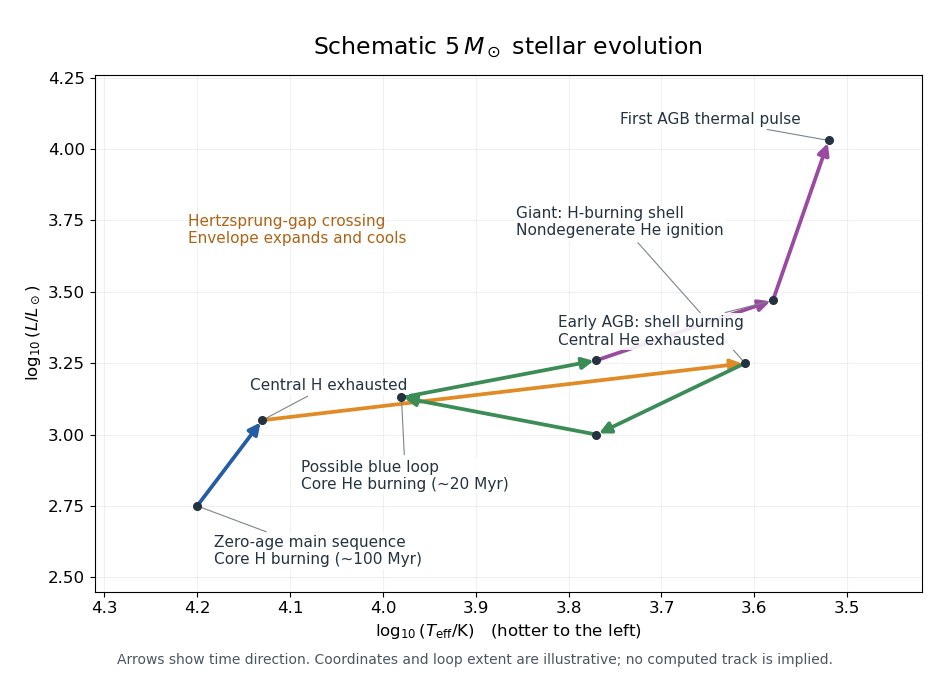

The original sketch shows the direction of stellar evolution, with higher effective temperature to the left. It illustrates a possible blue loop; its coordinates and loop shape are schematic, rather than a computed stellar model. The stages before the first AGB thermal pulse are the requested track; the later remnant evolution is described below.
In the usual final evolution, stellar winds and an AGB superwind remove the envelope before the carbon-oxygen core can ignite substantial carbon burning. Once shell fuel is exhausted, the exposed core contracts and heats, potentially ionizing the expelled gas as a planetary nebula, and finally becomes a carbon-oxygen white dwarf that loses its stored thermal energy by cooling. The relevant competition is between the AGB envelope-loss and core-growth timescales, not just the total initial mass.
Much higher late-stage mass loss strips the envelope sooner, shortens the Asymptotic giant branch phase, and allows less core growth, usually producing a smaller carbon-oxygen white dwarf. Much lower mass loss prolongs shell burning and permits greater core growth. In an extreme hypothetical case, retention of the envelope could let a degenerate carbon-oxygen core approach the Chandrasekhar mass and undergo explosive carbon burning: the proposed type 1.5 supernova channel. This is not an inevitable fate for a star. Doherty et al.'s evolutionary calculations emphasize the uncertainty of that channel and find that their adopted mass loss removes carbon-oxygen envelopes before such ignition. If carbon burning instead proceeds without disruption, the possible further evolution depends on the resulting core and continued envelope retention; lowering mass loss alone does not establish an electron-capture supernova outcome.
Past exam of the mathematics course of the University of Cambridge 2004 iii Paper 63 3 Solution Created 2026-10-03 Updated 2026-10-14
For Roche-lobe overflow, . Cubing the Roche lobe approximation and using the donor's mass-radius relation givesKepler's third law therefore yields the Roche-lobe period-mass relation for a linear donor radius law:The component distances from the centre of mass are and . Summing their angular momenta gives the circular-binary orbital angular momentumDuring conservative binary mass transfer, and . Logarithmic differentiation at constant angular momentum gives . Thus the Roche-lobe radius response exponent givesTheir difference is . Since the donor loses mass, this is positive for : the donor shrinks relative to its Roche lobe, so transfer shuts off without an external driver. The Roche lobe itself expands only for ; for it shrinks more slowly than the donor.
Gravitational-wave emission from a binary system provides such a driver: the orbit emits gravitational waves carrying energy and angular momentum, and the shrinking Roche lobe can maintain contact. Allowing , the binary mass-transfer contact equation becomesIt gives a negative transfer rate for .
For the classical nova, assume isotropic re-emission from a binary star: ejecta carry the accretor's specific angular momentum . The eruption lasts many orbital periods, so the orbit responds approximately adiabatically and remains nearly circular; an instantaneous asymmetric kick would be a different model. To first order,Differentiating the circular-binary orbital angular momentum formula during the ejection givesThe accompanying Roche lobe change is thereforeThe donor does not change mass in the eruption and moves inside its expanded Roche lobe: this is nova-induced binary detachment.
Put for the constant external loss. During detachment the component masses are fixed, so the Roche lobe shrinks at fractional rate . Closing the fractional gap takes . During the subsequent semidetached binary phase, the binary mass-transfer contact equation gives , so accumulating the next eruption's mass takes . ConsequentlyBoth times are evaluated to first order in , with the same equilibrium donor mass-radius relation; changes of and the transfer rate within one cycle affect higher orders.
There are unlisted articles, also show them or only show them.