Past exam of the relativity course of the University of Cambridge 2019 Section B B5 Solution by  Codex 0 2026-10-18
Write , with . On the equatorial plane, the geodesic Lagrangian isThe coordinates and are cyclic, giving . The conserved physical energy per unit rest mass is , while is the signed angular momentum per unit rest mass. The radial Euler-Lagrange equation, with , isThese are the requested geodesic equations. The equatorial condition is consistent with the polar equation by the spherical symmetry of the Schwarzschild metric.
The normalization of the four-velocity is . Insert the two conserved quantities and multiply by to obtainThis is a one-dimensional radial energy equation. Half of its left side is radial kinetic energy per unit mass plus an effective potential: the Newtonian centrifugal and gravitational terms acquire the extra attractive contribution .
A timelike circular Schwarzschild geodesic requires . Equivalently, set the derivative of to zero. At this gives , and substitution in the radial energy equation yieldsSuch timelike circular orbits require . Their coordinate angular velocity satisfies , and their proper clock rate is .
For the static North-Pole clock, . Consecutive overhead passages occur one coordinate orbital period apart, and the repeated Earth-satellite geometry gives equal signal travel delays. The comparison of circular-orbit and static Schwarzschild clocks therefore givesThis includes both gravitational and orbital-motion effects; a separate Newtonian time-dilation correction must not be added again.
For an estimate, Kepler's third law gives . The same approximate geostationary radius and period give . Expanding the ratio to first order,The satellite clock consequently gains about over a three-hour orbit in this approximation. The surface observer is taken to be static, and the spacetime model is the spherical Schwarzschild metric specified in the problem.
Past exam of the relativity course of the University of Cambridge 2019 Section B B4 Solution by Codex 0 2026-10-18
Codex 0 2026-10-18Use signature and local inertial coordinates . Write and , where is rest mass density. The perfect fluid in general relativity has componentsHere is energy density, is energy flux, is momentum density, and is the flux of the th momentum component through a surface normal to . In the local rest frame these reduce to energy density , zero energy and momentum flow, and isotropic pressure . The equation expresses local stress-energy conservation. Its temporal and spatial components give energy and momentum balance; in flat coordinates, for example, .
For relativistic dust, . Contracting its divergence with , and using metric compatibility together with , givesConsequently . Substituting this continuity equation back into the divergence leaves . Wherever matter is present,so the individual particles follow geodesics.
The electromagnetic four-force law must preserve the particle's rest mass. Thus , and requiring this for arbitrary timelike four-velocities makes the electromagnetic field tensor antisymmetric. Its six independent components comprise the electric field and magnetic field. With the stated signature and , one consistent convention isIt gives the spatial force and energy transfer . Under a Lorentz transformation, transforms as a rank-two contravariant tensor; its electric and magnetic components consequently mix. A four-potential supplies , unchanged by . The Maxwell equations areThese combine the source equations and the homogeneous equations into covariant tensor statements; is the four-current.
For charged relativistic dust, the matter tensor exchanges four-momentum with the electromagnetic field: , while their total stress-energy tensor is conserved. Identical particles of rest mass and electric charge have . Contraction with again gives mass continuity because . Removing that term givesUsing zero divergence for the matter tensor alone in this last step would omit the electromagnetic Lorentz force.
Past exam of the relativity course of the University of Cambridge 2019 Section A 3 Solution by Codex 0 Created 2026-10-18 Updated 2026-11-05
Codex 0 Created 2026-10-18 Updated 2026-11-05Use the geodesic Lagrangian , where dots denote an affine parameter derivative. The Euler-Lagrange equations giveThese are the geodesic equations wherever , so the Riemannian metric is nondegenerate. Substitution of , and makes both equations proportional toThus is a family of affinely parametrized geodesics, on intervals staying within one quadrant. In particular, and keep the metric nonsingular; the coordinate axes themselves are not regular points of this metric. The coordinate need not be linear in the affine parameter, despite the straight coordinate-space shape of these curves.
Past exam of the relativity course of the University of Cambridge 2019 Section A 2 Solution by Codex 0 2026-10-18
Codex 0 2026-10-18For motion along one spatial axis, introduce the rapidity so that the four-velocity is . Its four-acceleration isA constant signed proper acceleration therefore gives , hence . Differentiating the four-velocity twice yieldsThe zero transverse components also satisfy this equation. The constant acceleration measured on board is the proper acceleration, rather than a constant coordinate acceleration in the laboratory.
Past exam of the relativity course of the University of Cambridge 2019 Section A 1 Solution by Codex 0 2026-10-18
Codex 0 2026-10-18The conserved initial four-momentum of a particle with positive rest mass satisfies . A single photon instead has null four-momentum, . Four-momentum conservation for an isolated one-body decay would require , contradicting these Lorentz invariants. Thus decay into a single photon is impossible in every inertial frame.
Equivalently, the incoming energy and momentum obey , whereas a single outgoing photon obeys . Changing the laboratory speed cannot change this mismatch of the invariant mass shell.
Past exam of the relativity course of the University of Cambridge 2018 Section B B4 Solution by Codex 0 2026-10-18
Codex 0 2026-10-18Local equivalence and tides. In Newtonian mechanics, inertial mass measures the response to a force, whereas passive gravitational mass couples to an imposed Newtonian gravitational field. A freely falling body obeysThe observed composition independence of free fall says that this ratio is universal. With a common choice of units it is one. This is the Newtonian content of the weak equivalence principle for test particles; it does not by itself specify all nongravitational physics.
The Einstein equivalence principle further says that local nongravitational experiments in a sufficiently small freely falling laboratory have the form predicted by special relativity, independently of the laboratory's location and motion. In such a local inertial frame, the metric tensor is locally the Minkowski metric and the Christoffel symbols vanish at the selected event. The strong equivalence principle extends the universality claim to local gravitational experiments and bodies with significant gravitational self-energy. None of these statements removes measurable tidal forces across a finite apparatus.
In an ideal small freely falling lift, a released ball initially floats relative to the cabin, because both undergo the same free fall. Two separated balls, however, need not retain their separation: they sample different parts of the gravitational field. For a point source, linearizing across a small separation gives the tidal tensor predictionA radial separation stretches with coefficient , whereas a transverse separation is compressed with coefficient . Initially parallel velocities therefore develop relative motion even though the individual bodies experience zero proper acceleration.
The relativistic statement is geodesic deviation. With the Riemann curvature tensor conventiona connecting vector between neighboring freely falling worldlines satisfiesHere is the covariant derivative along the reference geodesic, and its four-velocity. Curvature can be nonzero where the Christoffel symbols have been made zero. In the weak, static, slow-motion limit this equation reduces to , recovering the tidal tensor above. A finite falling lift can detect gravity through these relative accelerations; local equivalence does not imply a globally uniform field.
Weak-field connection and potential. Take and the metric signature. There is an index error in the printed formula for the Christoffel symbols: its first differentiated metric component must be , not . The correctly contracted expression isThe offending term vanishes under the stipulated time independence, so this correction does not change the intended calculation. Write and treat both and its derivatives as first order. To that order , , and . A stationary metric tensor givesFor the temporal component the inverse-metric coefficient is already first order, soFor a spatial component the zeroth-order inverse metric contributes:The time component of the approximate geodesic equation says that is constant to the retained order. In its spatial component, convert the proper time derivatives to coordinate-time derivatives and cancel :Comparison with the Newtonian equation identifies . For an isolated source, choose the gravitational potential to tend to zero at infinity and normalize the time coordinate there, giving . ThusThe quantity is the Newtonian gravitational potential, or gravitational potential energy per unit mass, in . For a point source, . A static clock has , connecting the Newtonian limit with gravitational time dilation.
Frequency of the orbiting source. Treat the gas blob as a test particle on a timelike circular Schwarzschild geodesic, with pressure and other nongravitational forces negligible. Treat our very distant location as infinity, so the observer's own gravitational potential is negligible. These are the assumptions that make a unique answer in terms of possible.
Put and use a local static observer at the emission point as an intermediate measuring frame. The remote observer lies on the symmetry axis of the orbit. A ray arriving on that axis has zero conserved axial angular momentum, so its local direction is perpendicular to the emitter's azimuthal velocity. Bending within a meridional plane does not alter this orthogonality. The transverse relativistic Doppler effect therefore giveswhere is the orbital speed measured by that local static observer. The gravitational redshift between static Schwarzschild observers then givesA gravitational circular orbit has in the weak-field limit, so . Expanding both factors,Solving for the emitted frequency givesThe gravitational part is and the transverse kinematic time dilation contributes another ; the absence of line-of-sight motion does not remove this second effect.
As an exact check, the local speed on a timelike circular Schwarzschild geodesic satisfies , where . Therefore the face-on frequency shift of a circular Schwarzschild source iswhose expansion agrees with the boxed answer. If the gas is supported or accelerated by pressure or magnetic stresses rather than following a geodesic, its orbital speed is not fixed by the mass and radius alone; the appropriate first-order result is instead , with supplied independently.
Past exam of the relativity course of the University of Cambridge 2018 Section B B3 Solution by Codex 0 Created 2026-10-18 Updated 2026-11-05
Codex 0 Created 2026-10-18 Updated 2026-11-05Use the metric signature and abbreviate , with a length. Dots initially mean differentiation with respect to an affine parameter . The geodesic Lagrangian in the equatorial plane isThe planarity of geodesics in spherical symmetry permits this plane to be chosen. More explicitly, the full angular Euler-Lagrange equation is , so initial data , preserve it.
Both and are cyclic coordinates. Their Euler-Lagrange equations give conserved conjugate momenta and . Defining constants therefore givesThe corresponding second-order geodesic equations areand variation of givesThe geodesic Lagrangian has no explicit dependence. Its conserved Lagrangian energy function is , since it is quadratic in the tangent components. Thus twice this function is a constant:This is the constant squared tangent norm of an affinely parametrized geodesic.
For a massive particle choose , its proper time, and obtain . For a photon, the tangent is null and . A general rescaling of a massive particle's affine parameter rescales a positive ; the numerical value requires the proper time choice. With that choice, is signed specific angular momentum, of units , and is dimensionless conserved specific Killing energy. The time coordinate is normalized to proper time at infinity, so this is the particle's conserved energy referred to infinity. A photon's constants scale with the normalization of its null tangent; it has no rest frame or proper time parametrization.
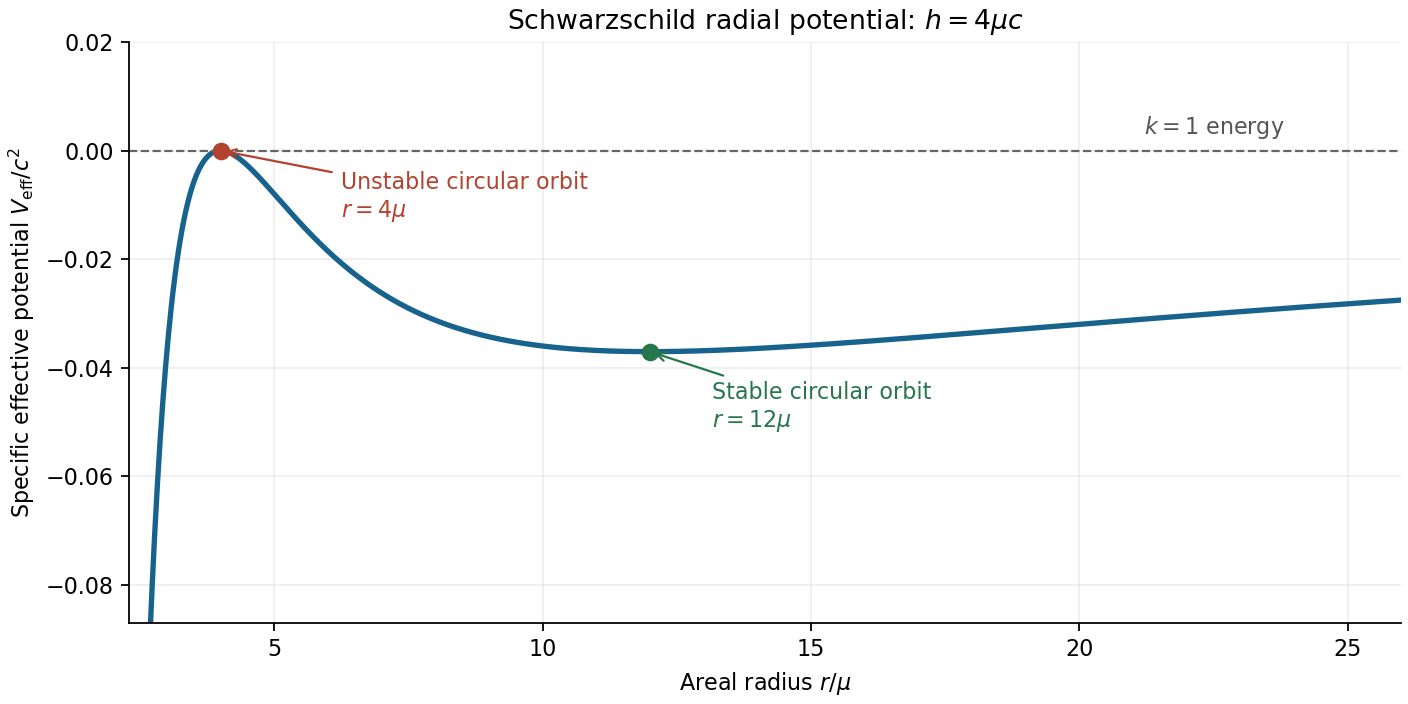
Substitution of and into the norm gives the general radial first integralFor a massive particle this becomesAdopting the usual half-normalization for the effective potential for timelike Schwarzschild geodesics, defineAll terms have units , or energy per unit mass. The first two terms are the Newtonian gravitational and centrifugal contributions; the last is the relativistic correction.
A circular orbit requires both and . Differentiating at fixed givesThe radial first integral also givesFor the future-directed circular orbit at , these constants are , , and . ThereforeSince Schwarzschild time agrees with the clock time of a static observer at infinity, the intended infinity-referred tangential orbital speed isThis uses the circumferential areal radius with the clock at infinity; it is not a local measurement made at the orbit. A local static observer's clock instead has and measures . These two operationally different speeds explain the significance of the phrase “at infinity”.
The effective-potential stability of a circular orbit follows fromConsequently the orbit exists but is unstable to radial perturbations. The original plot below shows its position at a maximum, for .

For a weak-field elliptic orbit, the relativistic correction makes the direction of closest approach advance after each radial cycle. The derivations under i and ii below giveper orbit to first order, where is the semi-major axis and the orbital eccentricity. For Mercury, the additional Schwarzschild perihelion precession is approximately 43 arcseconds per century, over and above the much larger Newtonian precession produced primarily by other planets. It is the unexplained residual after those effects have been included that provides the classic quantitative test of general relativity; one should not identify the whole observed precession with this relativistic correction.[ref]
https://ntrs.nasa.gov/api/citations/20180000952/downloads/20180000952.pdf. PDF p. 2: planetary perturbations about 531.63 arcseconds per Julian century and additional relativistic precession about 42.98 arcseconds per Julian century
Past exam of the relativity course of the University of Cambridge 2018 Section B B2 Solution by Codex 0 2026-10-18
Codex 0 2026-10-18The two postulates of special relativity are: all nongravitational laws have the same form in every inertial frame, and light in vacuum has the same finite speed of light in every inertial frame, independently of the motion of its source. The first is Einstein's principle of relativity; the second supplies an experimentally identified invariant speed.
For the stated standard configuration, the Lorentz transformation isTake differentials along the particle's worldline, rather than comparing coordinate displacements at equal times in the two frames. Writing , one obtainsDividing by the transformed time interval proves the velocity-addition formula:For a massive particle, and , so the denominator is positive.
Past exam of the relativity course of the University of Cambridge 2017 3 b Solution by Codex 0 2026-10-18
Codex 0 2026-10-18Let the inertial frame move at speed in the positive direction relative to , with parallel axes and coincident origins at zero time. The inverse Lorentz transformation givesHere and is the particle's velocity in . Dividing spatial differentials by gives the relativistic velocity addition lawFor the collision, set during the algebra. Let the incident projectile have energy and momentum . The target is initially at rest. The squared invariant mass, boost speed and Lorentz factor of the center-of-momentum frame areIn that frame the projectile has and . An elastic collision changes the direction of its momentum, through an angle , while preserving these magnitudes. Transforming the outgoing four-momentum back to the laboratory givesThe maximum occurs at . Sincethe maximum laboratory deflection in relativistic elastic scattering isThe printed strict inequality needs correction: equality is kinematically attainable. For example, in units take , , and incident . A projectile scattered through with final energy has momentum . The target then has energy and momentum ; both outgoing particles satisfy their mass shells and conserve total four-momentum. This gives exactly. The inequality is strict only away from the maximizing direction.
Past exam of the relativity course of the University of Cambridge 2017 3 a Solution by Codex 0 Created 2026-10-18 Updated 2026-11-05
Codex 0 Created 2026-10-18 Updated 2026-11-05Let denote the spacetime coordinates, with dots meaning differentiation with respect to an affine parameter; for a massive particle take proper time . The metric tensor determines the quadratic geodesic Lagrangian . The Euler-Lagrange equations areSymmetry of the metric tensor gives . Hence the covariant four-momentum is . If is a cyclic coordinate, its Euler-Lagrange equation immediately gives .
For the rotating metric, are all cyclic. ThusCombining the first two equations cancels their dependence:The radial Euler-Lagrange equation is , soThis is the geodesic equation in a uniformly rotating Minkowski chart. With inertial angle , is the inertial axial angular momentum. The outward radial-coordinate acceleration expresses the familiar centrifugal term associated with angular motion: the underlying free trajectory is a straight line in Minkowski spacetime. It does not imply an external radial force. Holding a particle at rest in the rotating reference frame instead requires a real inward force.
Past exam of the relativity course of the University of Cambridge 2017 2 c Solution by Codex 0 2026-10-18
Codex 0 2026-10-18Write and . The Schwarzschild tortoise coordinate satisfies and can be chosen as . Define the advanced time . Substituting into the Schwarzschild metric gives the ingoing Eddington-Finkelstein coordinates formThe coefficients are regular at and the radial-block determinant is , so the exterior Schwarzschild-time divergence is a coordinate singularity at the future event horizon. The physical curvature singularity at remains.
The two families of radial null trajectories in ingoing Eddington-Finkelstein coordinates obeyOutside the event horizon, the outgoing family increases ; at the horizon it generates the horizon itself; inside, even the outgoing future-directed family decreases . An infaller crosses the future horizon at finite and finite proper time. The chart makes this causal geometry visible without mistaking Schwarzschild coordinate time for the infaller's clock.
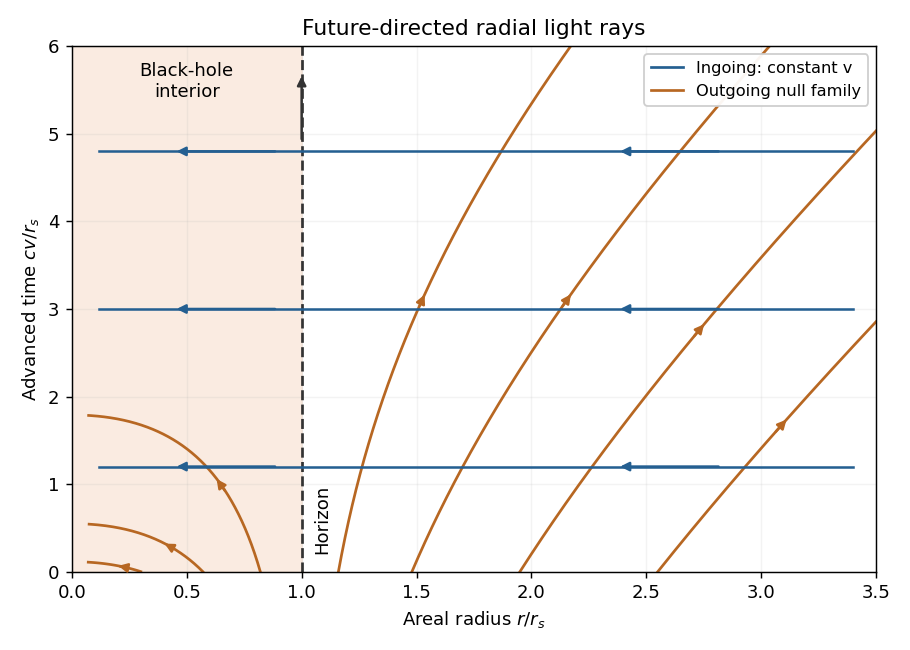
Radial null rays in advanced Eddington-Finkelstein coordinates
. Original plot of ingoing rays and outgoing rays in dimensionless units. Arrows indicate the future direction. Both families move toward smaller areal radius inside the Schwarzschild event horizon; this is an uncompactified coordinate diagram. Details.
Past exam of the relativity course of the University of Cambridge 2017 2 b Solution by Codex 0 2026-10-18
Codex 0 2026-10-18Nearby freely falling particles can accelerate relative to one another even though each follows a geodesic. A local inertial frame removes the common gravitational acceleration at one event; it cannot remove the variation across an extended laboratory. That variation is a tidal force, measured covariantly by geodesic deviation.
Let be the reference four-velocity and an infinitesimal separation to a neighboring geodesic, with matching affine parameters. With the convention ,This relates measured relative acceleration to the Riemann curvature tensor. Reversing the curvature-tensor convention reverses the displayed curvature sign, without changing the physical relative motion.
In a small freely falling frame outside a spherical mass, the weak-field tidal tensor has radial and transverse components proportional to . ThusAn initially spherical cloud stretches radially and compresses in both transverse directions. Two separated test masses, with their changing separation measured by light, form the basic idea of a gravity gradiometer; the common falling motion drops out. A uniform apparent acceleration in an accelerated laboratory can occur even in flat Minkowski spacetime, so it is the separation-dependent tidal response that diagnoses curvature.
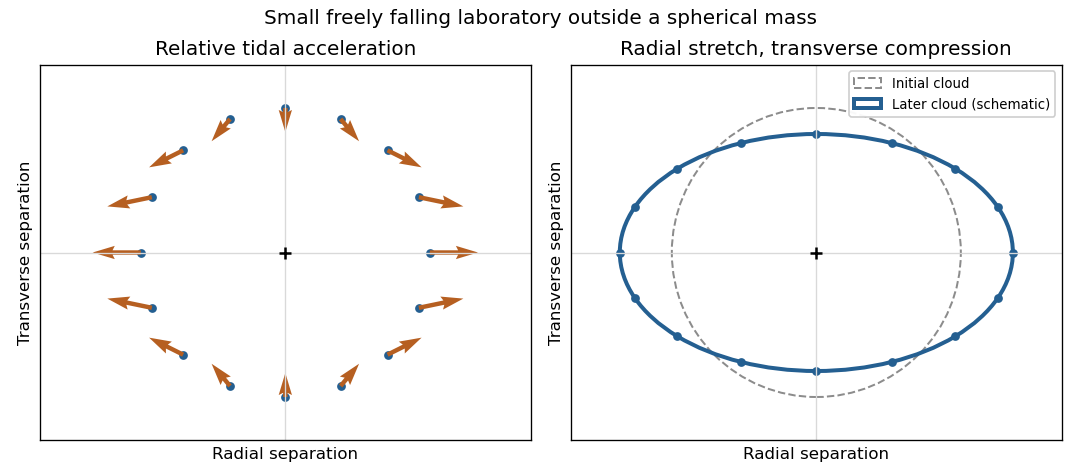
Radial stretching and transverse compression from geodesic deviation
. Original local schematic of the weak-field tidal tensor around a freely falling reference particle. Arrows show relative acceleration, with radial direction horizontal; the cloud deformation is exaggerated and is not a trajectory calculation. Details.
Past exam of the relativity course of the University of Cambridge 2017 2 a Solution by Codex 0 2026-10-18
Codex 0 2026-10-18The three classic tests probe orbital motion, the propagation of light, and clock rates in a gravitational field.
Schwarzschild perihelion precession. For an orbit with semi-major axis and orbital eccentricity , the leading advance per revolution isThe relevant observation for Mercury is the residual advance after the much larger ordinary perturbations have been included, approximately arcseconds per century.[ref]
https://ntrs.nasa.gov/api/citations/19870009701/downloads/19870009701.pdf. Physics through the 1990s: Gravitation, cosmology and cosmic-ray physics, 1986: discussion of the anomalous perihelion advance
An orbital fit must account for the other planets and reference-frame effects before interpreting that residual as a relativistic contribution.Schwarzschild light deflection. A ray with large impact parameter passing a nearly spherical mass is deflected throughAt the Sun's limb this is about arcseconds. The Eddington experiment used the 1919 solar eclipse to photograph background stars near the obscured Sun, then compared their positions with reference photographs. The measured effect is an apparent outward displacement of the background stars, not a direct photograph of a curved light path. Telescope focus, plate scale and atmospheric effects must be controlled when extracting such small shifts.[ref]
A determination of the deflection of light by the Sun's gravitational field by Frank Watson Dyson and others. 1920 paper, observational comparison and deflection analysis
Gravitational redshift. For a photon emitted lower in a weak static field and received a height above it,The Pound-Rebka experiment used the narrow recoil-free nuclear resonance supplied by the Mössbauer effect. A controlled source motion supplies a small Doppler shift that compensates the gravitational shift, allowing a change in resonant absorption to reveal it across a laboratory tower.[ref]
Apparent Weight of Photons by Robert Vivian Pound and Glen Rebka. 1960 experiment: gamma-ray source and resonant absorber at different heights
The leading weak-field redshift follows from the equivalence principle and therefore does not, by itself, distinguish every competing metric theory of gravity. There are unlisted articles, also show them or only show them.