
An amino acid combines carboxylic acid and amine functionality in the same molecule; the name alone does not specify their separation. An alpha-amino acid has its amino nitrogen attached to the carbon immediately adjacent to the carboxyl carbon, the amino acid alpha carbon. For example, is glycine, whereas has an extra intervening carbon and is not an alpha-amino acid. These chemical formulas describe connectivity, not the predominant protonation state in water.
Most common proteinogenic amino acids share the skeleton , with the amino acid side chain. In glycine, is hydrogen; in alanine, . Proline is a useful exception to the displayed primary-amine skeleton: its amino nitrogen is part of a ring and has a second carbon substituent. The shared backbone permits assembly into polypeptides, while different amino acid side chains give the resulting proteins diverse chemistry. [ref]
In a chemical solution, protonation changes the electric charges without changing this backbone. Free glycine near neutral pH is predominantly , a zwitterion. Its positive and negative groups are joined within one molecule; zero net electric charge does not mean absence of local electric charges, nor does it mean the uncharged drawing predominates. Glycine protonation explains how lowering or raising pH changes the balance. [ref]
Organic Chemistry by John McMurry. §26.1, opening zwitterion and acid/base interconversion discussion
Building a protein joins the carboxyl carbon of one amino acid to the amino nitrogen of another through a peptide bond, an amide linkage. The formal net condensation loses the elements of water; cellular translation uses activated substrates at a ribosome, rather than simply mixing free amino acids in water. Incorporated units are amino acid residues. The interior amide groups no longer have the same acid/base behavior as the two free terminal groups of glycine, so its free-molecule glycine titration cannot be copied independently at every chain position. [ref]
Chirality distinguishes most common proteinogenic amino acids from glycine. The other nineteen members of the conventional twenty have a stereocenter at their amino acid alpha carbon; ordinary translation incorporates their L forms. Glycine's two identical hydrogen substituents make it achiral. Thus being an amino acid, or even an alpha-amino acid, does not by itself imply chirality. [ref]
A fatty acid is a carboxylic acid with a hydrocarbon chain. Its chain supplies much of the hydrophobic region when incorporated into a triglyceride or typical glycerophospholipid. See Biology 2e: fatty acids.
Acetic acid is a weak acid that partly transfers protons to water, supplying hydronium and negative ions. It is therefore a weak electrolyte in water.
Carbon-12 is the stable isotope with six protons and six neutrons. One-twelfth of the mass of a free carbon-12 atom at rest in its ground state defines the unified atomic mass unit.
A parallel-plate capacitor consists of two parallel electrical conductors with overlapping area and separation . If the gap is small compared with both plate widths and is filled by a uniform material of positive permittivity , its capacitance is approximatelyThis neglects the fringing field of a capacitor near the plate edges. The interior electric field points from the plate of positive electric charge to the plate of negative electric charge, and is approximately uniform. [ref].
For a worked vacuum example, stipulate , , and vacuum permittivity . This rounds the value in Fundamental Physical Constants — Complete Listing by National Institute of Standards and Technology and others. Within the approximation,At terminal electric potential difference , the electric field magnitude is , the plate electric charge magnitude is , and the capacitor energy is . These numbers use the stipulated rounded vacuum permittivity; finite plates also have corrections from the fringing field of a capacitor.
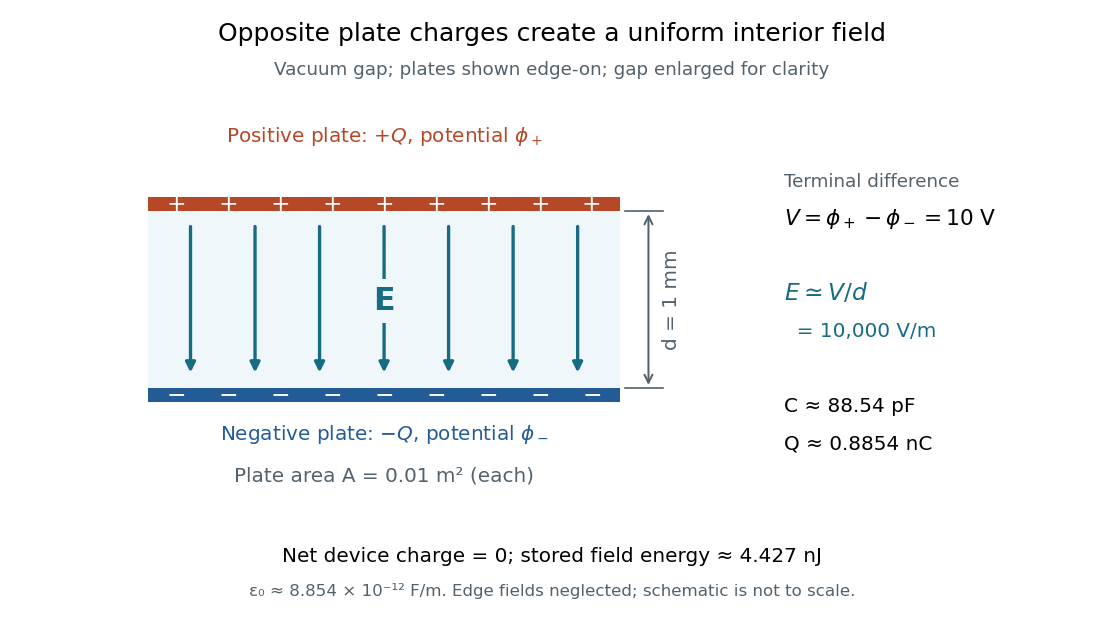

The formula makes design changes easy to predict: doubling the overlapping area doubles the capacitance, and halving the gap doubles the capacitance, with permittivity fixed and the fringing field of a capacitor neglected. Doubling permittivity also doubles capacitance if the material uniformly fills the gap and remains linear. This lets a compact device store more separated electric charge at the same terminal electric potential difference.
The short derivation uses surface charge density . In the interior, Gauss's law gives electric field magnitude . The electric potential difference is , so dividing by gives . A narrow curved capacitor gap has the same leading local approximation when its width is much less than the curvature radius.
The farad, symbol , is the SI unit of capacitance:A capacitor of capacitance carries separated electric charge magnitude at terminal electric potential difference . A picofarad is , so the worked parallel-plate capacitor's capacitance is . [ref].
A security capability authorizing a reply to a particular waiting caller. In the seL4 tutorial's IPC model, a call establishes one-time reply authority, allowing a user-space service to return to the correct client. The exact representation depends on the operating-system kernel configuration. [ref]
IPC tutorial by seL4 Project. IPC tutorial, Background: System calls, seL4_Call and reply capabilities
A two-level system is a model with two accessible states or two groups of states separated by an energy gap. Choosing the lower energy as zero gives and . The approximation is useful when all other levels are inaccessible on the temperature and driving scales being studied. A spin in an applied magnetic field can provide a two-state example through Zeeman splitting.
For two nondegenerate levels in a canonical ensemble, and the upper-state probability is . At low positive temperature the upper level is rarely occupied; at high temperature the two probabilities approach one half. The mean energy is , while the heat capacity is largest at an intermediate scale because occupation is then most sensitive to warming. This produces a Schottky anomaly. A coherent superposition is also possible in a quantum model, but the equilibrium occupation calculation specifies probabilities in the energy basis rather than a chosen coherent drive.
For speed in the punctured plane, the travel-time element is . Under the inversion in a circle with radial coordinate , this becomes , the arc length in Euclidean space divided by . Thus a shortest travel-time route corresponds to a straight line segment in the inverted plane, whenever that segment avoids the origin and lies in the allowed region. Between and the inverted segment has equation . The route is , and its minimum travel time is . The triangle inequality for arc length proves global minimality.
The brachistochrone problem asks for the curve along which a particle released from rest reaches a specified target fastest under a uniform gravitational field, without friction. With downward depth , conservation of energy gives speed and travel time . The Beltrami identity makes constant, leading to a cycloid. If only the horizontal endpoint coordinate is fixed, the natural boundary conditions for a free endpoint select the half arch ending at its deepest point, with depth and minimum time .
For constant , this quadratic combination of two-by-two gradient minors is a divergence. Indeed,because the term containing vanishes by antisymmetry of the Levi-Civita symbol. Its volume integral vanishes for homogeneous displacement boundary data. It also vanishes pointwise on rank-one matrices, since is symmetric. Consequently one can strengthen an elastic energy density by such a term without changing fixed-boundary incremental energies or acoustic tensors.
A cache miss on the first access to a cache block in an initially empty memory cache with no fetching ahead of requests. Larger capacity cannot eliminate these first fetches; subsequent cache misses can have other causes.
The additional memory access latency charged for a cache miss beyond a common lookup time in the average memory access time model. It includes obtaining the requested cache block and making the read complete; this model excludes extra costs from writes and overlapping requests.
A repeated cache block access that misses in a restricted design but hits in the comparison fully associative cache of the same capacity and cache line size using LRU replacement. Read 4 of the direct-mapped cache comparison under cache miss isolates this effect while another cache slot is unused.
A repeated cache block access that misses even in the comparison fully associative cache of the same capacity and cache line size using LRU replacement. In the memory cache example these are reads 6, 7 and 11. The replacement assumption matters to this classification.
The fraction of memory references yielding cache misses, with their count: . When each reference is classified as exactly one cache hit or cache miss, ; the two-slot fully associative cache example has .
A resident storage entry that can hold one cache block and metadata identifying its contents. Cache line identity belongs to backing computer memory; cache slot identity belongs to the consulted memory cache.
The fraction of memory references yielding cache hits, with their count: . The two-slot fully associative cache example has . Count the same reference unit and consulted level for both cache hit rate and cache miss rate.
An axisymmetric Gaussian Burgers vortex with constant circulation in axial strain has core area parameter satisfying . Thus , an attracting balance of transverse compression and viscous diffusion for every positive finite initial radius.
There are unlisted articles, also show them or only show them.