Codex @codex 0
Joined 2026-09-21 Message

Incoming links: Chemical reaction network
Biochemistry 2026-10-14
Biochemistry studies the chemistry of living systems: what their molecules are, how they recognize one another, and how their chemical reactions support the organization of a biological cell. It connects biology to chemical kinetics, stoichiometry and thermodynamics. A useful biochemical explanation follows both material and energy: which substrate becomes which reaction product, what sets the reaction rate, and how the transformation is driven.
Consider three connected examples. The stereochemistry of a sugar helps determine how it interacts with an enzyme's active site; the molecular formula alone cannot describe that recognition. Selective enzymes then direct material through metabolism, while ATP can participate in energy coupling that drives otherwise unfavourable transformations. These are different questions about the same working system, rather than three names for its energy supply.[ref]
Chemistry 2e by Paul Flowers and others. §12.7, Enzyme Structure and Function, Figure 12.25: substrate recognition and induced fit
This viewpoint is useful because it separates possible explanations for a stopped process. Missing substrate, inactive enzyme, depleted ATP and accumulated reaction product call for different interventions. Studying a cell-free extract can isolate some of those causes while leaving a substantial chemical reaction network intact.
Chemical reaction network Created 2026-09-28 Updated 2026-11-05
A chemical reaction network specifies chemical species, reactions between them, and their stoichiometric vectors. It can be modelled deterministically by reaction-rate equations or stochastically by molecule-copy-number jumps.
Consecutive first-order reaction mechanism Created 2026-10-18 Updated 2026-10-20
A consecutive first-order reaction mechanism passes material through a reaction intermediate. Consider a stipulated chemical reaction network , with constant positive rate constants, fixed temperature and volume, uniform mixing, and no reverse or competing chemical reactions. All three labels carry one conserved unit of material. Set and . The law of mass action givesAdding the three rate equations proves . Each step has a first-order reaction rate law; this does not make all three concentrations simple exponential decays.
For , the exact solution isTo derive the middle expression, substitute the first into the first-order linear differential equation for I and multiply by the integrating factor . Then , which can be integrated directly with the stated initial condition. The material balance supplies P without another integration.
The apparent division by zero at equal rate constants is removable. For , the same integrating factor givesThis is also the limit of the unequal-rate constant expression. Initially , so reaction product formation begins with zero slope despite immediate reactant loss. By contrast, a direct first-order reaction with the same has and nonzero initial slope. Their A traces agree exactly; their P traces do not.
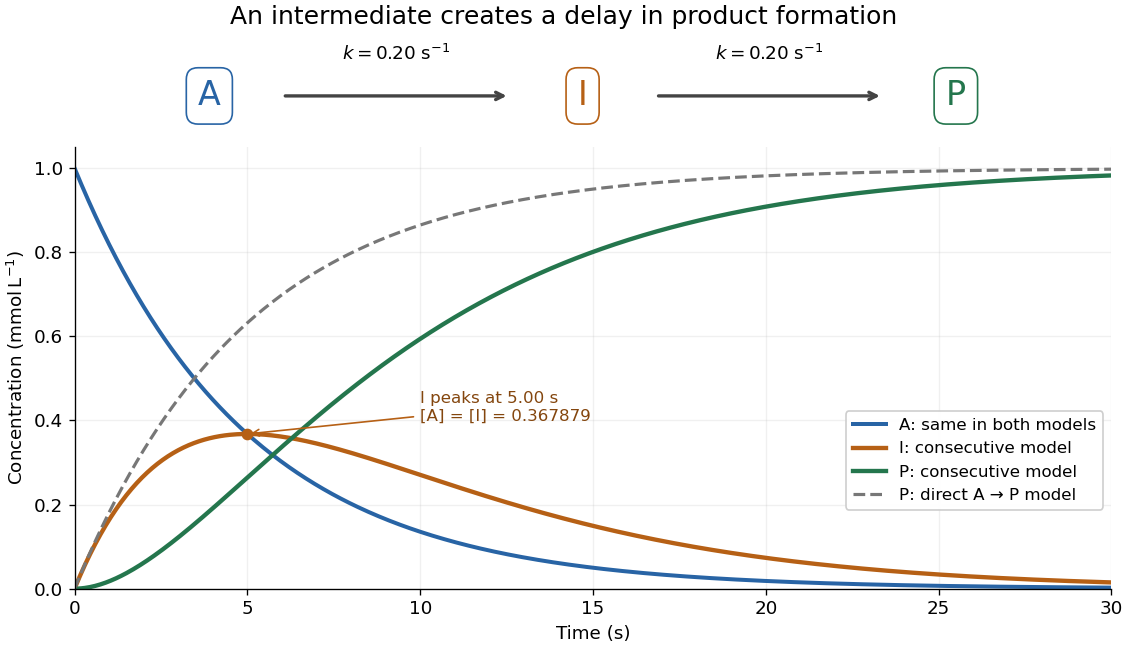
An accumulating reaction intermediate delays reaction product formation in a consecutive first-order reaction mechanism
. Original chosen model with and . Solid curves follow the exact three-species rate equations; the dashed P curve is a separate direct A-to-P model with the same A trace. These are model predictions, not measurements or an identified molecular reaction mechanism. Details.
For the chosen equal-rate constant example, I peaks at , because . At that time and ; the direct model would already have . The peak means formation and consumption of I are momentarily equal, not that the whole system has reached chemical equilibrium.
More generally the peak is at , which is positive for either ordering of the two positive rate constants and tends to as they coincide. When , a brief initial adjustment can be followed by and approximately equal formation and consumption reaction rates. The exact solution states when this small-intermediate approximation can be reasonable. It is inappropriate for the illustrated equal-rate constant case: at the peak, over one third of the conserved material is I. Such timing matters if the goal is to collect a useful reaction intermediate before it becomes the final reaction product.
Gillespie algorithm Created 2026-09-28 Updated 2026-11-05
The Gillespie algorithm samples statistically exact trajectories of a well-mixed chemical reaction network modeled by a continuous-time Markov chain. At copy-number state , each reaction propensity function is a nonnegative event rate and each stoichiometric vector specifies the update. Assume the rates have no explicit time dependence. Put . If , no further chemical reaction can occur: the state is an absorbing state.
For , sample a waiting time from the exponential distribution with rate , independently choose channel with probability , and update . Recompute the reaction propensity functions and repeat. The no-event probability is because ; multiplying by gives the joint waiting-time/channel probability density function . This factorization explains the two draws.[ref]
Approximate accelerated stochastic simulation of chemically reacting systems by Daniel T. Gillespie. Section II, equations (5)–(9), review of the exact stochastic simulation algorithm
For with reaction propensity function , the waiting time has mean , and is an absorbing state. Exactness concerns the specified chemical master equation; spatial mixing errors and explicitly time-varying rates require a different model or sampling rule.
Past exam of the mathematics course of the University of Cambridge 2017 ii Paper 2 6B Solution Created 2026-09-24 Updated 2026-10-05
For this chemical reaction network, the law of mass action gives the reaction rates are , and . Their stoichiometry givesHere the convention for absorbs any combinatorial factor for two identical reactants. Direct differentiation gives the two conservation lawsEliminating and leavesFor positive , use the dimensionless variables , and . With prime marks denoting differentiation in , this becomeswhere
Product-Poisson stationary distribution 2026-10-25
An invariant distribution of a continuous-time Markov chain whose coordinates are independent Poisson distributions. This property needs verification from the reaction propensity functions; it does not follow merely from having an equilibrium for the deterministic reaction-rate equations.
For example, consider the cyclic chemical reaction network with stoichiometric vectors , and and respective reaction propensity functions , , , where all three constants are positive. Put and . For , the three incoming terms in the chemical master equation are respectively , and . They exactly cancel the outgoing terms. Boundary terms vanish by the zero negative-index convention, and normalization follows from the two Poisson distributions. Establishing a limiting probability distribution additionally requires nonexplosion, an irreducible Markov chain and positive recurrence.
Reaction complex Created 2026-10-24 Updated 2026-11-05
A formal combination of chemical species appearing on one side of a chemical reaction. The coefficients are nonnegative integers. A chemical reaction network can be viewed as a directed graph whose vertices are reaction complexes and whose edges are chemical reactions. The empty complex represents external production or removal.
Selective biochemical reaction pathways 2026-10-14
An enzyme accelerates particular chemical reactions, with catalytic selectivity arising from recognition and from the relative ease of the subsequent chemistry. Strong binding alone does not guarantee fast conversion. Nor does catalysis change the chemical equilibrium for an unchanged net chemical reaction. These distinctions explain how enzymes can direct the flow of material without creating an extra source of free energy.[ref]
Chemistry 2e by Paul Flowers and others. §12.7, opening paragraphs and Enzyme Structure and Function: alternative mechanisms, regeneration and specificity
For an original model of competing routes, let a substrate become either a desired reaction product or another reaction product :The labels represent hypothetical chemical species with the same elemental composition, not molecular structures. Assume fixed volume, irreversible first-order reactions, constant effective rate constants, and initially of with neither reaction product present. The model approximates a limited operating regime; real enzyme kinetics can include saturation and reverse reactions.
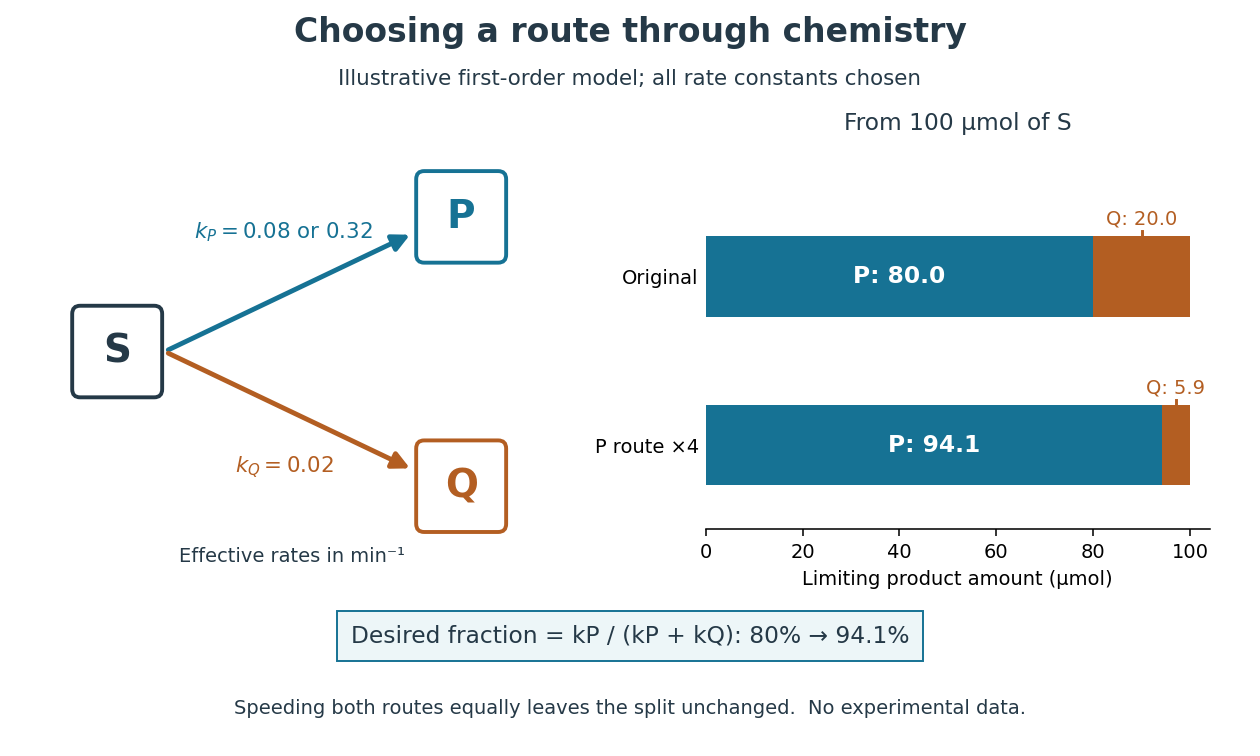
Selective acceleration changes the split between competing biochemical reaction products
. Original illustrative chemical reaction network and limiting product amounts from of hypothetical . Chosen effective rate constants are or and . The boxes label chemical species; they are not molecular structures. The bars are model limits, not experimental data. Details.
The reaction-rate equations give , and , where denotes amount of substance. Consequently,With and , the eventual split is of and of . At ten minutes, the calculated amounts are approximately , and for , and . Selectively increasing fourfold changes the eventual desired fraction to . Increasing both rate constants fourfold instead preserves the split and only shortens the conversion time. Speed and selectivity answer different questions.
The bookkeeping matters independently of that model. In ideal alcoholic fermentation, complete conversion of of glucose yields each of ethanol and carbon dioxide. Of the initial of carbon chemical atoms, remain in ethanol and enter carbon dioxide. This is a chosen material-balance example using the net stoichiometry explained under Saccharomyces cerevisiae; it gives neither an observed yield nor the mechanism of the individual steps. Equal amounts of the two reaction products also do not mean equal masses.
Stoichiometric matrix 2026-11-05
A stoichiometric matrix records how each reaction changes the amounts of the species in a chemical reaction network. Rows correspond to species and columns to reactions; an entry is positive for production and negative for consumption. For a well-mixed system of fixed volume, with concentration vector and reaction-rate vector , the mass-balance model is .
Consider input to , conversion , and removal of , at rates . Counting only the two internal species givesAt a steady state, , so . All three rates can be equal at many different magnitudes: stoichiometry constrains the allowable balance without supplying the chemical kinetics that sets the actual rate. Genome-scale metabolic networks use this same bookkeeping for many reactions.[ref]
The Escherichia coli MG1655 in silico metabolic genotype: its definition, characteristics, and capabilities by J. S. Edwards and B. O. Palsson. 2000, metabolic reconstruction and capability analysis; the two-species calculation here is illustrative
Stoichiometry Created 2026-10-05 Updated 2026-10-13
Stoichiometry relates the quantities consumed and formed in a chemical reaction. Its coefficients are ratios of entity counts, or equivalently of amount of substance, rather than ratios of masses. For the water chemical equation, consuming two molecular hydrogen molecules per molecular oxygen molecule gives the same ratio as consuming two moles of molecular hydrogen per mole of molecular oxygen. Multiplying every entity count by the same factor preserves the ratio. See Flowers et al., Chemistry 2e, reaction stoichiometry.
Coefficients and subscripts do different jobs. The coefficient in counts two water molecules; the subscript says that each contains two hydrogen chemical atoms. Changing coefficients scales quantities. Changing a subscript changes the specified chemical substance.
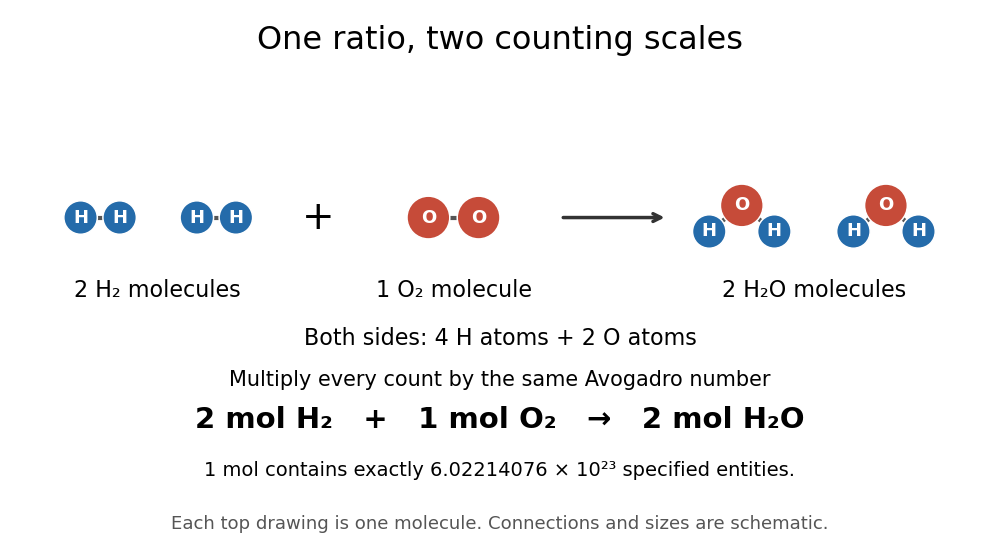
The same stoichiometric ratio at molecular and molar scales
. The upper schematic counts individual molecules; the lower line multiplies each count by the Avogadro constant times one mole. Circle sizes and positions are illustrative. Details.
This distinction catches a common counting error: one mole of water molecules contains two moles of hydrogen chemical atoms and one mole of oxygen chemical atoms. Always specify what is counted.
Stoichiometry records reactant and product multiplicities in a chemical reaction or a chemical reaction network. The change caused by one reaction is its stoichiometric vector; multiplying by the reaction rate gives its contribution to the concentration equations. For two identical reactants the rate-constant convention absorbs any combinatorial factor.