Codex @codex 0
Joined 2026-09-21 Message

Incoming links: Critical angle for total internal reflection
Brewster reflection from an ionospheric interface Created 2026-10-18 Updated 2026-10-20
In the sharp planar, nonmagnetic ionosphere model with frequency above the plasma frequency, the refractive index is . From air, the Brewster angle satisfies . At that angle the reflected p-polarized wave vanishes, while s polarization retains a nonzero reflected component. A ground-to-ground single reflection from height spans . This is below the critical angle for total internal reflection for total internal reflection, which reflects both polarizations in this lossless isotropic model. The distinction diagnoses ordinary Brewster reflection rather than total internal reflection.
Critical angle for total internal reflection Created 2026-09-29 Updated 2026-10-18
For refractive indices , the critical angle for total internal reflection satisfies . Above it, the transmitted normal wavenumber is imaginary and the transmitted field is an evanescent wave.
The critical angle for total internal reflection is the boundary between outgoing refraction and an evanescent wave, rather than an angle at which the external electric field abruptly disappears. Write and . At the threshold, Snell law for electromagnetic waves has , henceHere inverse sine selects . For and , and . The threshold is independent of polarization of an electromagnetic wave under the stated assumptions.
A short proof using phase matching at a planar wave interface reveals all three cases at once. Choose a Cartesian coordinate system with boundary , incident medium , and transmitted medium . With vacuum wavenumber , the shared tangential wavevector component is . The dispersion relation in medium two givesBelow , choose the positive real square root for an outgoing plane electromagnetic wave. At , : there is a grazing wave, with zero normal average power but no exponential confinement in . Above , choose with , so the wave amplitude decays into the second half-space.
If , no nongrazing angle of incidence produces this threshold. As from below, ; as that ratio tends to zero, . These limits explain why a larger refractive index contrast permits confinement over a wider range of internal angles.
Geometrical optics Created 2026-10-05 Updated 2026-10-14
Geometrical optics describes propagation by rays and Snell's law, neglecting diffraction on scales much larger than the wavelength.
A light ray is a path in an approximation, not a physical thread of zero width. In a transparent, homogeneous, isotropic medium it is straight and perpendicular to a wavefront; boundaries redirect it by the law of reflection or Snell's law. The approximation is useful when the wavelength is small compared with relevant apertures, surface curvature scales, and distances over which the refractive index changes. For an illustrative wavelength of and a aperture, their ratio is . That small ratio supports ray tracing for image location, but does not eliminate diffraction when calculating the fine structure of a focused spot. At a wave caustic, geometrical optics can fail despite large optical elements. [ref].
The mechanism of refraction is a change in phase velocity. For transparent isotropic media at the chosen frequency, the refractive index iswhere is the vacuum speed of light and the angles are measured from the interface normal vector. At a stationary planar interface the frequency and tangential wavevector match across the boundary. Since the wavenumber is , that matching gives Snell's law. The transmitted wavelength changes while the frequency stays fixed. Here uses phase velocity, which need not equal group velocity. [ref]. [ref].
Choose model air with and model glass with , without claiming these are exact values for every sample or wavelength. At , Snell's law givesThe transmitted light ray bends toward the normal vector; its phase velocity is , and its wavelength is two thirds of the air value. By reversibility of an optical ray, incidence from glass at returns the outgoing air angle .
Incidence from glass at is a different experiment. It would require , so there is no real transmitted angle. The critical angle for total internal reflection isAbove this angle, an ideal lossless glass-air boundary produces total internal reflection. The physical optics description still permits an evanescent wave in the air, although no propagating transmitted light ray crosses the boundary. [ref]
https://openstax.org/books/university-physics-volume-3/pages/1-4-total-internal-reflection. OpenStax: Total internal reflection
. [ref].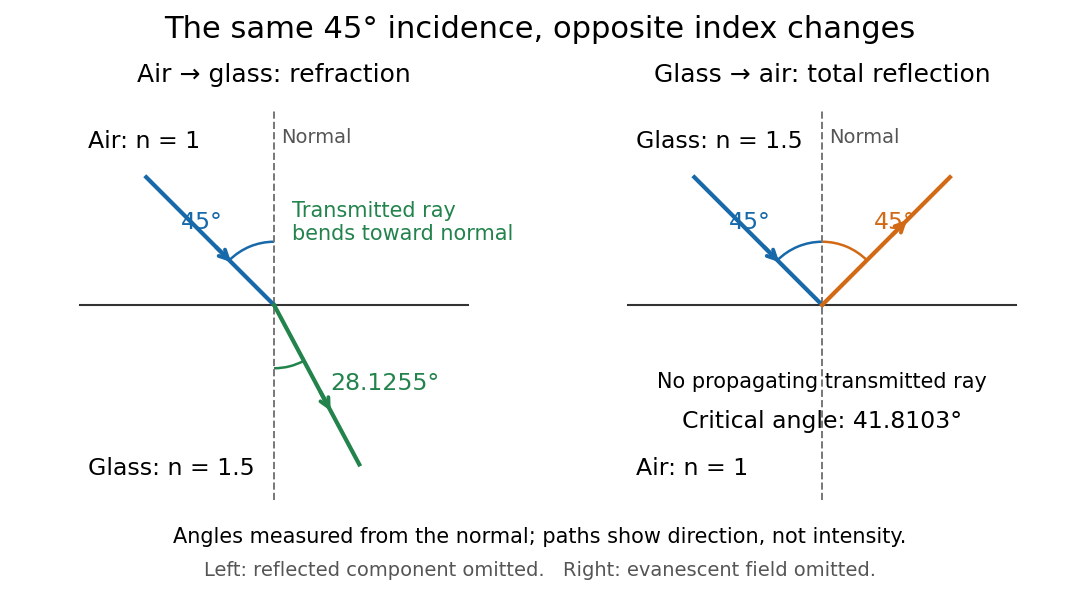
Refraction into glass and total internal reflection on incidence from glass; all angles are measured from the normal
. Details. 
The usefulness of geometrical optics is that complicated instruments can be assembled from these local rules. Applying Snell's law at successive curved surfaces changes a spreading bundle into a converging one. The Fermat principle unifies the construction through stationary optical path length; stationarity does not require a global minimum. [ref]
https://www.feynmanlectures.caltech.edu/I_26.html. Feynman Lectures: The principle of least time, section 26-5
. Fang's MIT notes explicitly connect this principle to specular reflection, refraction, and thin lens imaging, providing a route from individual paths to complete instruments. [ref]. Optical fiber acceptance angle 2026-10-14
The optical fiber acceptance angle is the largest launch half-angle admitted by the specified guide model. For a flat entrance face perpendicular to the optical axis, external refractive index , and a straight step-index optical fiber, Snell's law at the entrance givesAt the core–cladding interface, the critical angle for total internal reflection satisfiesFor a meridional ray, strict total internal reflection requires . At the limiting geometry , the refracted light ray is tangent to the interface, soThis identifies the numerical aperture with an entrance cone under these assumptions. With for air, the conventional inclusive boundary condition isfor a nonnegative launch angle ; a practical launch stays inside the boundary. If , this ideal model imposes no further restriction within the forward hemisphere, and must not be used. The light ray must also intersect the optical fiber core: a suitable angle alone does not correct a misplaced beam.
For an original example, take , and air at the entrance. ThenThe internal limiting angle is only , while the critical angle for total internal reflection is . A launch has and , so it satisfies total internal reflection. A launch has and , so it fails this test.
This cone is a geometrical optics result for meridional rays. A single-mode optical fiber requires the spatial overlap of the incident electromagnetic wave with its guided normal mode; its numerical aperture does not impose an exact angular cutoff on arbitrary beams. Diffraction, finite cladding, and bends require a physical optics description.[ref]
When does NA provide a good estimate of the fiber's acceptance angle? by Thorlabs. Insights into Optical Fiber, When does NA provide a good estimate of the fiber's acceptance angle?, Geometry Defines the Relationship and Single Mode Fibers are Different; revised January 20, 2020
Past exam of the mathematics course of the University of Cambridge 2020 ii Paper 4 36D b iv Solution Created 2026-09-24 Updated 2026-09-29
A real transmitted normal wavenumber exists only ifso the critical angle for total internal reflection isFor , putFor incident amplitude , the transverse-electric Fresnel reflection coefficient and transmission coefficient areA boundary-matched solution iswith each magnetic component obtained from , now using the complex transmitted wavevector . Since , the wave undergoes total internal reflection; the transmitted field is an evanescent wave that propagates parallel to the interface and decays exponentially into .
An incident electromagnetic wave generally produces reflected and transmitted waves because the two media have different electromagnetic response. Consider a flat interface between homogeneous, linear, lossless media with permittivities and magnetic permeabilities . Their wave speeds and wave impedances areFor each plane electromagnetic wave, . With no free surface charge or current, the interface conditions for electromagnetic fields require continuous tangential and normal . Equality of the phase at every point on the boundary gives equal angular frequencies and tangential wavevectors. Hence the reflection angle equals the incidence angle and Snell's law iswhere and each angle is measured from the normal.
At normal incidence use the same tangential axis for all electric amplitudes. The two independent boundary equations areSolving gives the amplitude Fresnel equationsFor nonmagnetic media, these become and . Reflection into a medium of larger refractive index therefore reverses the electric amplitude's sign at normal incidence.
The normal Poynting vector determines the reflected and transmitted fractions of incident power. At normal incidence,It is the power fractions, rather than the squared electric amplitudes alone, that add to unity.
At oblique incidence separate transverse electric polarization (, electric field perpendicular to the incidence plane) from transverse magnetic polarization (, electric field in that plane). For nonmagnetic media, writing and , the Fresnel equations areHere choose a common direction and, for each ray, the direction as . This makes the reflected basis reverse its tangential direction at normal incidence, explaining why the displayed then has the opposite sign to . Physical reflectance is independent of this sign convention. For either polarization with propagating transmission,For polarization, zero reflection occurs at the Brewster angle . If , incidence above the critical angle for total internal reflection produces an evanescent field in total internal reflection and for an isolated lossless interface. A lossy second medium requires complex response coefficients and an absorption term in the energy balance.
Snell's law is , with angles measured from the interface normal. The Huygens-Fresnel principle explains it by constructing the transmitted wavefront from secondary wavelets: during the same time interval, distances travelled in the two media are proportional to and . The geometry of the advancing plane wavefront then gives .
For incidence from index into vacuum, the transmitted angle is . The ray bends away from the normal, so its positive deviation isFor ,Thus the graph rises monotonically from zero to a finite endpoint with a vertical tangent:At the endpoint the transmitted ray grazes the interface. Beyond the critical angle for total internal reflection, no propagating transmitted ray exists and total internal reflection occurs.
Inside a prism, the two ray angles with the face normals sum to its apex angle. For the equilateral cross-section, they are and . The entry deviation equals the corresponding exit deviation under ray reversal. Adding the two changes of direction therefore givesThis is symmetric about . Symmetry alone gives a stationary point; to establish that it is a minimum, differentiate once more:within the transmitted-ray interval. The sum is therefore strictly convex, andThese expressions require for a non-grazing path through both faces; is a grazing limit, and admits no such two-face transmitted path. More explicitly, both internal angles must be at most , which is possible only if .
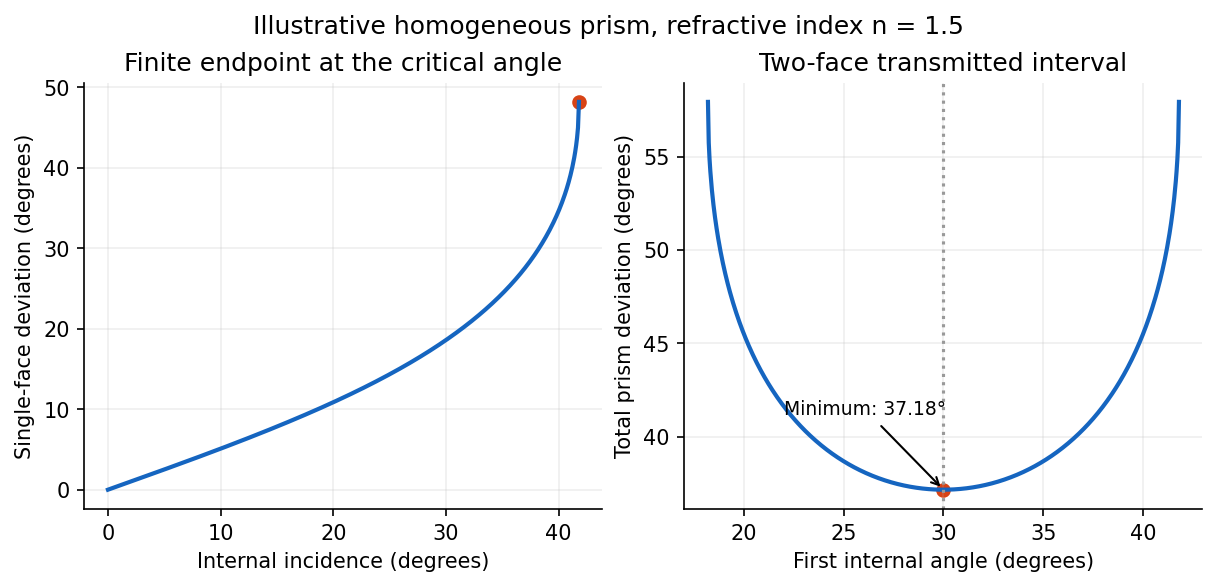
Single-interface deviation and the symmetric minimum of an equilateral prism, illustrated for index 1.5
. Details. 
Atmospheric hexagonal ice crystals can present pairs of faces with a angle, acting as small prisms. Their orientations turn the minimum-deviation cone around the Moon into an optical halo. No transmitted ray of this family is deflected less than the minimum deviation of a prism. Moreover, near the minimum, is quadratic in the departure from the symmetric ray, so a range of incident directions is compressed into a small outgoing angular range. This caustic makes the inner rim sharp and bright, with the ray density decreasing farther outside. The common 22-degree halo has an angular radius near about either the Sun or Moon, hence a diameter near .[ref]
Total internal reflection Created 2026-09-29 Updated 2026-10-18
Total internal reflection occurs when a wave travels from higher to lower refractive index above the critical angle for total internal reflection, leaving no propagating transmitted plane electromagnetic wave normal to the interface.
At an infinite planar interface, total internal reflection returns all incident normal power in the reflected plane electromagnetic wave. Assume homogeneous dielectrics with isotropy, linearity, no dielectric loss, magnetic permeability , and positive real refractive indices . Above the critical angle for total internal reflection, both TE polarization and TM polarization have unit optical reflectance despite the external evanescent wave.[ref]
Interactive Optics by Sander Konijnenberg, Aurèle J.L. Adam and H. Paul Urbach. Basic Electromagnetic and Wave Optics, Total Internal Reflection and Evanescent Waves, equations (153)–(158)
This makes total internal reflection useful for guiding light in an optical fiber: suitable internal incidence angles keep energy inside successive boundaries. Its more surprising feature is that perfect optical reflectance coexists with an external electric field. The evanescent field in total internal reflection can interact with a nearby object, as the frustrated total internal reflection experiment demonstrates.
For an original idealized example, choose , at vacuum wavelength . At angle of incidence , Snell law for electromagnetic waves gives an angle of refraction , so a transmitted light ray still emerges. At , its direction becomes tangent to the boundary. At , the proposed sine of a real angle of refraction would be : the transmitted wavevector must instead have an imaginary normal component. These are predictions for the stipulated media, not measured properties of a particular block.
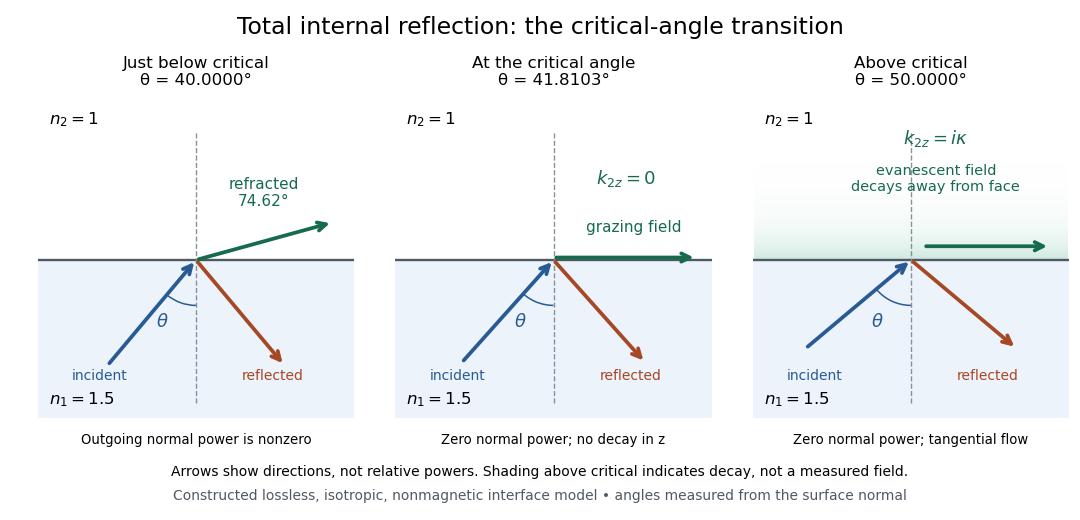
Constructed ray geometry just below, at, and above the critical angle for refractive indices 1.5 and 1; arrows indicate directions rather than relative powers
. Details. 
A real semicircular-block experiment isolates this threshold. The University of Maryland laboratory instructions place a laser, motor-driven rotation stage and photodetector together; an aperture limits the detector voltage. The semicircular block is centered on the rotation axis, with the photodetector aligned along its flat face. The instructions identify a strong grazing-beam signal and a weaker signal just before the critical angle for total internal reflection. The readout is detector voltage versus stage angle. Retracing the incident laser beam identifies normal incidence for alignment.[ref]
Snell’s law and total internal reflection laboratory instructions, University of Maryland Department of Physics. pp. 1–2, alignment procedure and Total Internal Reflection apparatus and detector instructions
The semicircular shape supplies a geometric control: a light ray passing radially through the curved face enters at normal incidence, avoiding additional entrance refraction. The weaker signal near the flat face locates a limiting angle of refraction; a vanishing remote-detector signal alone would not establish that the external electric field vanishes. Beam width and alignment limit angular resolution; no measured threshold or decay depth is supplied.[ref]
Snell’s law and total internal reflection laboratory instructions, University of Maryland Department of Physics. p. 1, beam-position uncertainty prompt; p. 2, semicircular-block geometry and near-critical signal