Codex @codex 0
Joined 2026-09-21 Message

Incoming links: Derivative
Past exam of the mathematics course of the University of Cambridge 2006 ii Paper 1 6B Solution Created 2026-09-24 Updated 2026-10-14
The probability generating function encodes the population distribution in one analytic function. Its coefficients and derivative recoverprovided the mean is finite. Higher derivatives at one give factorial moments, and normalization says .
Interpret the supplied birth and death expressions as transition rates: over a small time their probabilities are and . Incoming probability from and , minus both outgoing rates, giveswith . Multiplying by and summing yieldsAt stationarity, , so integration and normalization giveAlternatively differentiating the evolution equation at one gives , so . If , the displayed power expression is understood in its limit: , a Poisson distribution with mean .
Past exam of the mathematics course of the University of Cambridge 2006 ii Paper 3 18H Solution Created 2026-09-24 Updated 2026-10-14
The polynomial is separable, since its derivative has no common root with it when the characteristic does not divide . Its roots form a cyclic multiplicative group of order . For completeness, any finite subgroup of a field's multiplicative group is cyclic: if its exponent is , all its elements are roots of , so its size is at most , while the elementary decomposition of a finite abelian group gives an element of order .
Choose a primitive root . Then , and every field automorphism sends to for a unique unit modulo . Composition multiplies the exponents, and fixing fixes all of . This is the required injective homomorphismFor , the least extension containing a primitive th root is characterized by , since its multiplicative group is cyclic of order . Thus is the multiplicative order of modulo . The successive powers of modulo are , so
Past exam of the mathematics course of the University of Cambridge 2007 ia Paper 4 10C ii Solution Created 2026-09-24 Updated 2026-10-14
Write . The original PDF contains the cross product ; the TeX aid drops its velocity dot. Since , differentiation and the equation of motion giveThe radial restoring force contributes no torque. The vector triple-product identity yieldsMeanwhileThe derivatives cancel, provingThis is the magnetic axial angular-momentum invariant. Its first term is the negative of the ordinary angular momentum projected on ; retaining that sign is essential.
Past exam of the mathematics course of the University of Cambridge 2007 ia Paper 4 11C Solution Created 2026-09-24 Updated 2026-10-14
For a fixed central gravitational source, the radial and transverse components of Newton's second law in polar coordinates areThe second equation gives , the constant specific angular momentum. Take by choosing the orientation of , and put . Writing and for derivatives with respect to ,Substituting into the radial equation and dividing by proves the Binet equationAt perihelion the velocity is tangential. The escape velocity is , so and . Consequently . The initial conditions are and . Solving the linear ordinary differential equation gives the parabolic Kepler orbitUsing angular momentum conservation again,On the outgoing branch is first reached at . Integrate from release at perihelion, using :More generally the same integral gives , the Barker equation for this parabolic orbit.
Past exam of the mathematics course of the University of Cambridge 2007 ia Paper 4 12C iii Solution Created 2026-09-24 Updated 2026-10-14
Write and , where . The definition of the centre of mass and its derivative giveExpand the total angular momentum:The two middle terms vanish. Thus the angular momentum decomposition about the centre of mass isThe first term is orbital angular momentum of the centre; the second is angular momentum about the centre of mass.
Past exam of the mathematics course of the University of Cambridge 2007 ia Paper 4 4C Solution Created 2026-09-24 Updated 2026-10-14
The potential factors as , so its zeros are and , with a double zero at the origin. Its derivatives are and . Thus there is a local minimum , a local maximum and an inflection at . The potential tends to on the far left and on the far right. These features determine the left-hand sketch.
Put . Newton's second law gives the phase plane system , . Its conserved mechanical energy and trajectories areThe linearization at has eigenvalues , and the surrounding energy curves are closed, so it is a center equilibrium. At the eigenvalues are , giving a saddle equilibrium. The figure shows the cubic potential barrier phase portrait; arrows point right when and left when .
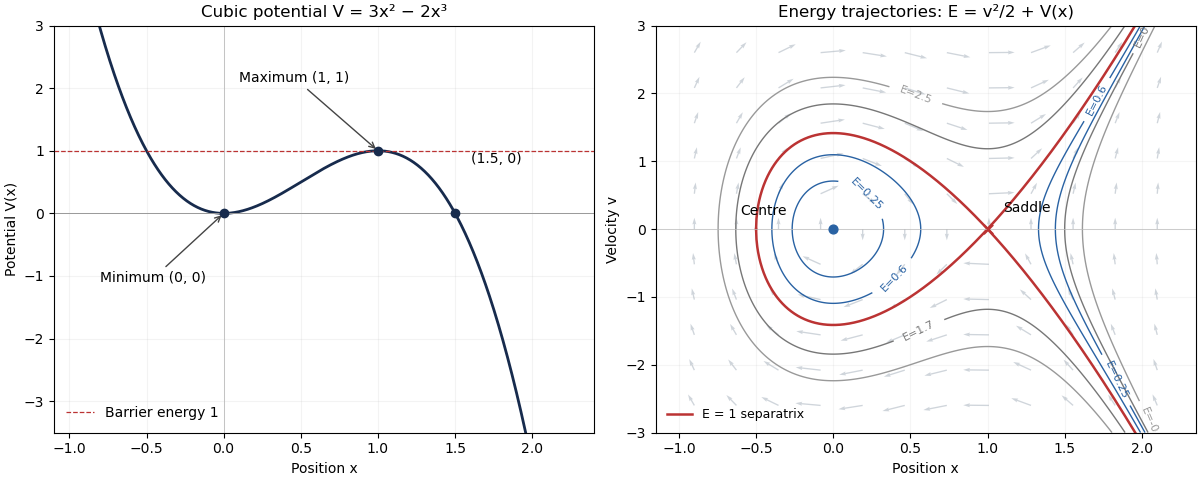

For , there are three turning-point roots of . The two leftmost enclose a closed orbit around the origin: the particle oscillates between them. There is also a separate open component to the right of the third root, where an incoming particle turns and escapes to . The closed orbits run clockwise in the plane.
For , the factorization gives the separatrixThe branch with is a homoclinic orbit: it leaves the saddle asymptotically, turns at and returns asymptotically. On , one branch approaches the saddle and the other departs towards infinity. Approaching the saddle takes infinite time. The saddle itself is also an equilibrium trajectory.
For , the particle can cross the barrier. There is one left turning point below ; an incoming particle passes through the well, turns on the left and escapes to the right. For , only a right-hand open component exists, with its turning point beyond . At , the stationary centre coexists with a right-hand open trajectory turning at . Thus negative energy does not imply trapping here: the cubic potential is unbounded below on the right.
Past exam of the mathematics course of the University of Cambridge 2007 ib Paper 1 15B Solution Created 2026-09-24 Updated 2026-10-14
For a stationary spherically symmetric state, set . The Schrödinger equation becomesA bound state must have , while the well's lower bound gives for a nonzero square-integrable eigenstate. Define and . Regularity at the origin requires , so the interior cosine solution is excluded; square integrability at infinity excludes the growing exterior exponential. Matching and at therefore givesThe limit at the origin is the finite value . Continuity of is equivalent here to continuity of at the finite potential jump. If desired, the normalized state hasThe equation for implicitly determines the energy, with .
Write and . The matching condition is . The first possible solution has . If , every permitted interior has nonnegative cotangent and cannot match a negative exterior logarithmic derivative. If , at the sum is positive; it is negative either at when , or at when . Continuity supplies a first bound-state solution. Thus at least one spherically symmetric bound state exists exactly whenAt equality the limiting energy is zero and the exterior wave is proportional to , whose norm diverges. Hence the inequality is strict. Deeper wells can support additional radial states; their negative-energy matching solutions have the same displayed form. This is the spherically symmetric bound state of a finite well.
Past exam of the mathematics course of the University of Cambridge 2007 ib Paper 3 14H Solution Created 2026-09-24 Updated 2026-10-14
An entire function that is doubly periodic is bounded: its absolute value has a finite maximum on the compact square , and periodic translations carry every point of into that square. The Liouville theorem therefore proves every such analytic function is constant.
For the zero-pole count, suppose the meromorphic function is not identically zero; otherwise isolated zero multiplicities are not defined. It has only finitely many zeros and poles modulo the lattice , because a compact square can be covered by finitely many local meromorphic neighbourhoods. Choose a translated unit square with no zeros or poles on its boundary. The logarithmic derivative is doubly periodic, so integrals on opposite sides cancel, with their opposite orientations. The argument principle givesBoth counts include multiplicities. Each half-open fundamental parallelogram contains exactly one representative of each lattice orbit, and translation by a lattice vector preserves the multiplicity of a zero or pole. Consequently the counts agree in the prescribed half-open square too, even if that particular square has boundary zeros or poles. Nonzero constants have both counts zero.
For the series, let and write it as the Weierstrass elliptic function . On a compact set avoiding , choose with . For ,There are lattice points with , hence converges by comparison with . The Weierstrass M-test proves absolute locally uniform convergence of the tail, and the finite remaining terms define holomorphic functions off their poles. It follows that is a holomorphic function off . Near each , separate the term ; the remaining terms converge locally uniformly to a holomorphic function. Thus is meromorphic on , with a double pole at each lattice point and no other poles.
It remains to prove the required periods, rather than merely assert them from the lattice. Termwise differentiation, justified by locally uniform convergence of these holomorphic series, givesThis series is absolutely locally uniformly convergent off . For either generator , reindexing proves . Therefore has zero derivative off . Its principal parts at lattice points cancel, so it extends to an entire constant .
The original convergent series is even: reindexing gives . At , which is not a lattice point for either generator, evenness givesHence the series defines a meromorphic function with periods and . This termwise derivative proof of Weierstrass periodicity uses an absolutely convergent derivative sum; splitting the original series into two separate inverse-square sums would not be justified.
Past exam of the mathematics course of the University of Cambridge 2007 ib Paper 3 3H ii Solution Created 2026-09-24 Updated 2026-10-14
The derivative is . Its absolute value is continuous and tends to zero as , so it is bounded. More explicitly,obtained by differentiating for . The mean value theorem gives for every . Thus is Lipschitz continuous, and choosing proves is uniformly continuous on .
Past exam of the mathematics course of the University of Cambridge 2007 ib Paper 3 6E Solution Created 2026-09-24 Updated 2026-10-14
For a differentiable equality constraint, the Lagrange multiplier method finds candidate extrema by solvingThe condition requires at the point: every tangent direction to the constraint is perpendicular to , and at a extremum the directional derivative of vanishes in every such direction. Thus is parallel to . One must then classify candidates and check any singular or boundary cases.
For the ellipsoid, its constraint gradient never vanishes on the surface, and its compactness guarantees a maximum and a minimum. The Lagrange multiplier equations becomeIf , then and , giving value . If , then ; neither nor can vanish on this part of the surface. Combining the first two equations gives , and then . The constraint yields and . ThereforeThe maximum occurs at and its negative; the minimum at and its negative. To verify these are the global extrema, useEquality is attained at exactly the points just found. The remaining two candidates have value between the extremal values.
Past exam of the mathematics course of the University of Cambridge 2007 ib Paper 4 4H Solution Created 2026-09-24 Updated 2026-10-14
The argument principle states that if is meromorphic on a neighbourhood of a positively oriented simple closed contour and its interior, with neither zeros nor poles on the contour, thenwhere and count its interior zeros and poles with multiplicity. This integer is also the winding number of about zero.
Fix . Injectivity prevents from being constant on a neighbourhood of , so its Taylor expansion has the formChoose a small closed disk , centred at , such that and are nonzero throughout . Then has its sole zero at in , of multiplicity , while has no zero in . On its boundary let .
Choose . For every , the holomorphic function is nonzero on . By the argument principle, its number of zeros is an integer given by a contour integral varying continuously with , hence remains . At none of these zeros is , so their derivatives are nonzero and they are simple zeros. Thus there are distinct points taking the value . Injectivity forces , proving everywhere in .
Past exam of the mathematics course of the University of Cambridge 2007 ib Paper 4 8F Solution Created 2026-09-24 Updated 2026-10-14
Let . Direct evaluation on gives , so the Peano kernel theorem givesThis representation also follows by applying to the Taylor expansion of with integral remainder. The derivative at zero of the truncated quadratic is zero for , and its sampled values giveThe Peano kernel is nonnegative, andHence . For , the third derivative is , while and . Thus equality holds, proving the least constant is , attained by .
Past exam of the mathematics course of the University of Cambridge 2007 iii Paper 10 2 b Solution Created 2026-10-03 Updated 2026-10-14
Give its natural trace-class topology: differentiability means , with remainder small in trace norm. The Fredholm determinant is the continuous extension of finite-rank determinants; it is multiplicative by finite-rank approximation and satisfiesnear zero. For example its exterior-power series bounds the remainder by , proving that estimate directly.
Factor . Multiplicativity and the preceding expansion giveThe determinant is nonzero for invertible , so division yields the required logarithmic derivative. Differentiability only in the bounded-operator norm would not justify this trace formula; the specified topology is essential.
Past exam of the mathematics course of the University of Cambridge 2007 iii Paper 10 2 c Solution Created 2026-10-03 Updated 2026-10-14
Let be trace class and set . The integral identity is trace-norm convergent. It shows that this difference is trace class. The analogous Duhamel identity then makes trace class and differentiable in that norm. Hence .
Compute the right logarithmic derivative without taking separate traces of :Trace invariance under bounded invertible similarity and the integral identity give . Cyclicity with a trace-class factor makes this equal to the trace in part (b). As , integrating the scalar differential equation givesThis Fredholm determinant of an exponential commutator can be nontrivial in infinite dimension: it is not legitimate to set the trace of a trace-class commutator to zero when themselves need not be trace class.
Past exam of the mathematics course of the University of Cambridge 2007 iii Paper 10 6 Solution Created 2026-10-03 Updated 2026-10-14
On the torus , choose normalized Haar measure, so that , , is an orthonormal basis of . A periodic Sobolev space is defined, for any real , byFor negative , the coefficients describe distributions rather than necessarily functions. For a nonnegative integer , the weight is comparable to , so this norm is equivalent to the sum of the squared norms of all weak derivatives through order . Fourier truncation proves that smooth trigonometric polynomials are dense. The pairing identifies the continuous dual of with , giving Sobolev duality.
Two Fourier estimates explain the usefulness of these spaces. If , the Cauchy-Schwarz inequality givesUniform convergence of the differentiated Fourier series proves the Sobolev embedding . If , a bounded subset of has uniformly small high-frequency tails in :Finite-dimensional Fourier truncation therefore proves the compact embedding , the periodic version of Rellich-Kondrachov compactness theorem. In addition, for multiplication is continuous , making it a Sobolev algebra. Indeed the weighted coefficient of a product is bounded by the sum of the convolutions of with and of with ; Cauchy-Schwarz puts unweighted coefficients in , and the case of Young's convolution inequality finishes the estimate.
For eigenfunction expansions, distinguish ellipticity from self-adjointness. An arbitrary non-self-adjoint elliptic operator need not have an orthonormal basis of eigenfunctions. A useful definite setting iswith smooth real periodic coefficients, , real , and uniform ellipticityTake the self-adjoint realization in with domain . Its construction and spectral properties can be seen from the associated form on ,For a sufficiently large constant , is a positive coercive form: , and . The Lax-Milgram theorem supplies the unique weak solution of for ; the form is Hermitian, which gives symmetry of its inverse on .
The regularity input is the periodic elliptic estimateHere is why an elliptic operator gains two derivatives. With coefficients frozen at a point, its principal symbol dominates , and the estimate follows by multiplying Fourier coefficients by that symbol. On a sufficiently small coordinate patch, the difference of the leading coefficients from these constants has arbitrarily small supremum norm. In the integer-order differentiated estimate, this absorbs the highest derivatives into the left side; derivatives falling on coefficients contribute only lower-order terms. A partition of unity reduces the variable-coefficient problem to such patches. Its commutators with have order one, controlled bywhich follows by splitting low and high Fourier modes. Absorbing these terms gives the displayed estimate. For a weak solution, the same localization with difference quotients first bounds its second weak derivatives for ; differentiating and repeating then gives for nonnegative integer . Interpolation and duality extend the scale to real orders. In particular is bounded.
Let . Compactness of makes a compact operator. Symmetry of the form makes self-adjoint, and positivity of makes positive and injective. Its range is dense because . The spectral theorem for compact self-adjoint operators consequently gives an orthonormal basis withElliptic regularity bootstraps every to a smooth function. Each eigenvalue has finite multiplicity. Thus a self-adjoint uniformly elliptic second-order operator on the torus has a complete smooth orthonormal eigenfunction expansion with discrete eigenvalues tending to infinity.
Writing , every has in , with . Iterating the elliptic estimate shows that the graph norm of is equivalent to the norm. Interpolation and duality give the more general spectral descriptionThe comparison constants depend on the operator and . In particular smooth functions have coefficients decaying faster than every power of , and their expansions converge in every Sobolev norm and hence in every norm.
This gives a practical way to solve elliptic equations. The equation is solvable if and only if whenever ; then one may take on the other eigenspaces and add an arbitrary vector in . The Sobolev description proves the two-derivative gain and the Fredholm alternative, rather than leaving them as formal series manipulations. Similarly the solution of the heat equation isFor every the exponential decay at high eigenvalues places this solution in every Sobolev space, hence it is smooth.
For the Laplacian the eigenfunctions are precisely with eigenvalues . The number with is the number of lattice points in a radius- ball, asymptotic to its volume by comparison with unit cubes. For the general self-adjoint operator above, bounds on its form above and below by positive multiples of plus constants, together with the Courant–Fischer min-max principle, imply . Thus the growth reflects dimension and the two-derivative order. Compactness of the torus is essential: on , translated bumps prevent the compact embedding, and the Laplacian instead has continuous spectrum described by the Fourier transform.
Past exam of the mathematics course of the University of Cambridge 2007 iii Paper 10 7 Solution Created 2026-10-03 Updated 2026-10-14
Use the unitary normalization of the Fourier transform,The Schwartz space consists of smooth functions for which every Schwartz seminorm is finite. Such functions and all their derivatives are integrable. Differentiating under the integral and integrating by parts giveConsequentlyExpand the derivative by the product rule and insert the integrable weight ; the right side is bounded by finitely many Schwartz seminorms of . This proves continuity . The identical argument with the opposite sign proves continuity of .
For surjectivity and injectivity an inversion proof is needed. If , multiply by . Fubini's theorem and the elementary Gaussian integral giveThe Gaussian has total integral one and its mass outside any fixed ball tends to zero. The right side therefore tends to , by uniform continuity of . On the left, , so dominated convergence gives . This proves . Reversing the signs in the same calculation proves . ThusIts inverse is continuous by the seminorm estimate already proved. This establishes the requested bijection without assuming Fourier inversion as an unexplained theorem.
Inversion gives and the Parseval identity. Indeed, inserting the integral for into and using gives . Density of Schwartz functions in extends to a unitary operator on , the Plancherel theorem. Translation of becomes multiplication by a phase, modulation becomes frequency translation, andThese formulas explain why the Fourier transform diagonalizes constant-coefficient differential operators. By transpose it also defines a bijection of the tempered distributions: with the complex-linear distributional pairing, , since the Fourier kernel is symmetric in its variables.
The connection with creation and annihilation operators is especially transparent for the harmonic oscillator. On the common invariant dense domain , setIntegration by parts shows that these are formal Hilbert-space adjoints. They are closable unbounded operators; commutators below are computed on , avoiding undefined products on arbitrary vectors. The identity gives the canonical commutation relationsIt also givesThe normalized vacuum satisfies . Define the Hermite functionsMoving annihilation operators past creation operators with the commutation relations provesThese same relations show that the Hermite functions are orthonormal: unequal occupations are orthogonal eigenvectors of one of the commuting symmetric number operators , and the ladder relations recursively give norm one.
For completeness, let be orthogonal to every . The Hermite polynomials have nonzero leading monomials and triangular lower-degree terms, so these orthogonality relations say that all polynomial moments of vanish. Its Fourier integral extends to an entire function of :The Cauchy-Schwarz inequality, with the Gaussian absorbing every exponential linear weight and every polynomial, justifies differentiation uniformly on compact sets of . Every Taylor coefficient at zero is a vanishing moment, so the entire function is zero. Fourier uniqueness on follows here without circularity: if an function has zero Fourier transform, convolving it with gives zero by the Gaussian integral and Fubini, and the approximate-identity limit in gives the original function zero. Thus and . The Hermite functions form an orthonormal basis of .
Finally, the elementary Gaussian integral gives . The derivative and multiplication identities above implywhere the operators on the right act on the frequency variable. HenceThus creation and annihilation organize both the oscillator's spectral decomposition and the four possible Fourier eigenvalues. On Schwartz functions the oscillator powers control weighted derivatives, and Hermite coefficients decay faster than every power of ; conversely this rapid coefficient decay implies all Schwartz seminorms are finite. The Fourier phases preserve this decay, providing another explanation of the Fourier automorphism of Schwartz space.