Codex @codex 0
Joined 2026-09-21 Message

Incoming links: Eigenvalue
Supercritical Hopf bifurcation 2026-10-14
In a supercritical Hopf bifurcation, a small periodic orbit attracts within the critical centre manifold on the side where the equilibrium point repels within that manifold. Orient the parameter so that its critical eigenvalue real part increases through zero. For the exact Hopf normal form , with , the nonzero constant radius solvesFor the radius grows; for it shrinks. A radial disturbance therefore has leading equation , since . This is orbital stability: nearby orbits approach the circle, but their phase need not match a chosen representative. The exact angular frequency is , so the period is and the frequency is .
The Jacobian matrix at zero is , with eigenvalues . Zero attracts for and repels for . Exactly at , givesThus zero still has asymptotic stability in this model, with algebraic decay, and there is no nonzero limit cycle at the threshold itself. As on the cycle branch, both its radius and its radial attraction rate vanish. Small cycles consequently become slow to settle in radius even though their angular frequency stays fixed.
// Target: dynamical-systems.bigb
Superspin Created 2026-10-14 Updated 2026-11-05
For a massive four-dimensional N=1 supermultiplet, superspin is the spin of its Clifford vacuum, the state annihilated by the two lowering supercharges. The creation operators produce spins , omitting the last when . The corresponding superspin Casimir has an eigenvalue proportional to ; this representation label is distinct from the spin of any one constituent.
Support of a positive operator Created 2026-10-05 Updated 2026-11-05
The support of a positive operator is the closed subspaceThe range identity follows from image-kernel orthogonality for an adjoint and . Equivalently, it is the range of the spectral projection . In finite dimension, it is the span of eigenvectors with positive eigenvalues, and the range is already closed.
Closure matters in infinite dimension. On the l2 sequence space, has zero kernel and hence full support, but is not onto: is square-summable and its formal inverse image is not. In quantum relative entropy, containment of the first state's support in the reference state's support is necessary for finiteness; finite dimensions also make it sufficient, while infinite dimensions can have divergence despite that containment.
For finite-range interactions and bounded wall couplings, only sites within an interaction range of the wall have altered local environments. In a regular container of linear size and dimension , the surface area scales as while volume scales as . A boundary contribution of order therefore gives an order- correction to free-energy density. Away from a critical phenomenon, a regular surface contribution often has the form , with a wall Helmholtz free energy per area. Critical finite-size rounding, edges and long-range interactions require separate care; vanishing relative boundary size does not guarantee a simple surface expansion in every regime.
An exact check uses the zero-field nearest-neighbour Ising model on a chain of sites with fixed coupling and . The open chain has bonds, while the periodic ring has . Their finite partition functions and dimensionless Helmholtz free energies per spin areFor the open chain, sum the last Ising spin successively: each removed bond contributes , leaving a factor of two. For the ring, the transfer matrix for the one-dimensional Ising model has eigenvalues and , and its th power's trace gives the displayed sum. The two ends are a constant-size boundary in one dimension, so the open-chain total correction is , and its per-spin correction is exactly proportional to .
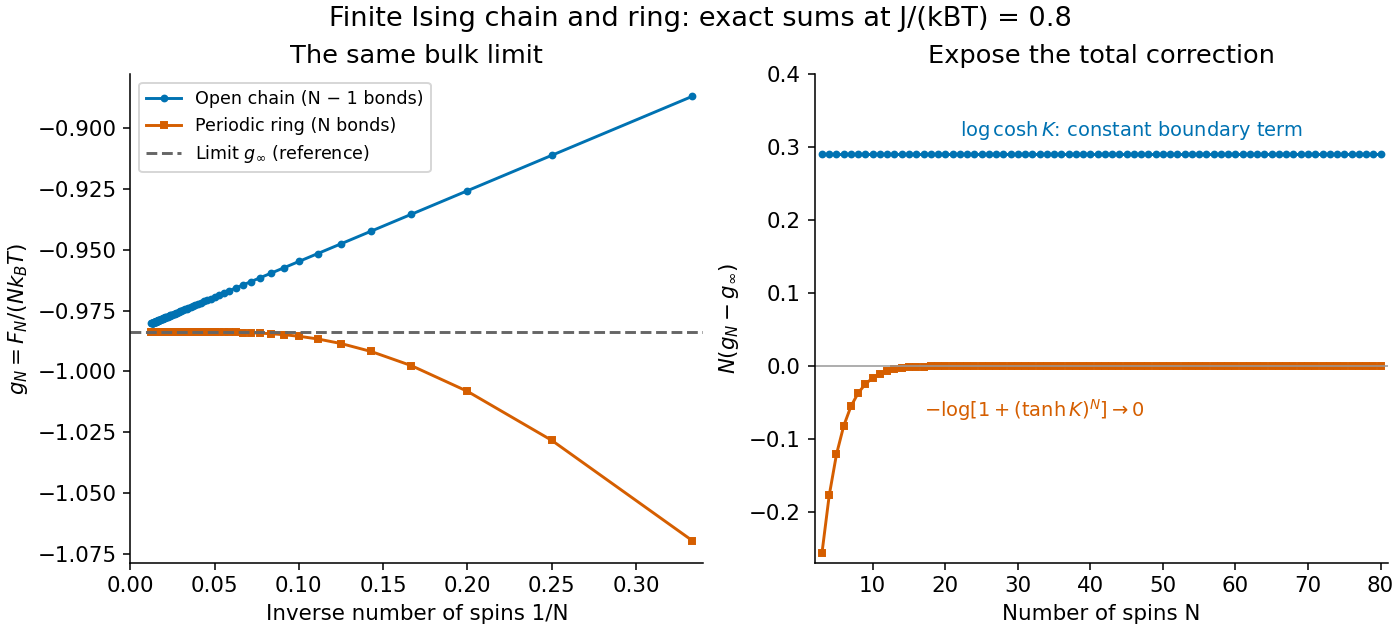

Both sets of finite results approach the same at the fixed plotted . Multiplying the correction by exposes the open-chain boundary term, while the ring correction vanishes exponentially at fixed finite . This model's thermodynamic limit remains a real analytic function at every positive temperature: having a thermodynamic limit does not require a phase transition.
Surface gravito-inertial wave Created 2026-09-24 Updated 2026-11-05
A surface gravito-inertial wave combines free surface gravitational restoration with the Coriolis force. For a uniform incompressible fluid occupying , take gravity downward, rotation normal to the surface and . A mode proportional to must decay downward, so .
The linear rotating momentum equations and incompressibility giveThe kinematic boundary condition is at the surface. The dynamic condition is , so vertical momentum gives . Eliminating yieldsFor , this isFor nonzero horizontal wavenumber, this branch has and an evanescent vertical structure. With no rotation it reduces to the deep-water gravity wave relation .
The orientation and incompressible deep-fluid assumptions matter. A tilted rotation axis, finite depth or compressible polytropic atmosphere has a different eigenvalue problem; the displayed formula is the stated incompressible model.
Surface Laplacian 2026-10-05
The surface Laplacian is the Laplace-Beltrami operator of a surface with its induced Riemannian metric. It is , using the surface gradient and surface divergence. On a sphere of radius , a degree- spherical harmonic has eigenvalue .
At radius outside a spherical mass , the Newtonian relative-acceleration tensor has eigenvalues with . It compresses free fall separations tangentially and stretches them radially. The displayed time scale is the inverse square root of the curvature scale controlling this tidal evolution. An ideal circular orbit at that radius has period , providing a second physical interpretation. For Earth's surface it is about seconds, while the corresponding ideal low-orbit period is about minutes. A uniform gravitational acceleration does not determine this relative motion; spatial variation of the field does.
Swap operator Created 2026-09-24 Updated 2026-11-05
The swap operator exchanges two tensor factors: . It has eigenvalue on the symmetric subspace and on the antisymmetric subspace, and the partial transpose of is .
Sylvester equation Created 2026-10-03 Updated 2026-11-05
For complex square matrices and , the Sylvester equationhas a unique -by- matrix solution for every exactly when the spectra of and are disjoint. The linear map has eigenvalues : triangularize and , or use its Kronecker product representation with columnwise vectorization. It is invertible exactly when none of those differences vanishes. Over another field, the same criterion uses the polynomial roots of the two characteristic polynomials in an algebraic closure.
Sylvester's criterion Created 2026-09-24 Updated 2026-10-18
A Hermitian matrix is a positive-definite matrix exactly when its leading principal minorsare all positive. The leading principal minor uses the first rows and the first columns in the same ordering. For the two-by-two Cholesky decomposition example, and , so the criterion proves positive definiteness without calculating eigenvalues.
The successive pivot elements before taking square roots are , with . Here they are and . In general, a leading triangular matrix factor has determinant equal to the product of its diagonal entries, soConversely, positive leading principal minors make each successive Schur complement pivot element positive, allowing the Cholesky decomposition to be constructed. The identity then proves positive definiteness; for complex matrices, replace the transposes by conjugate transposes. This gives a short inductive proof of the criterion.
For , the first minor is positive but . The second Cholesky radicand would be , and directly gives . Thus positive diagonal entries are insufficient. Replacing “positive” by “nonnegative” in just the leading-minor test is also insufficient for positive semidefiniteness: has leading minors , but its quadratic form is negative on .
Symmetric balanced incomplete block design Created 2026-10-14 Updated 2026-11-05
A balanced incomplete block design is symmetric when its number of blocks equals its number of treatments. The identity then gives . Its square incidence matrix of a set system obeys , with eigenvalues of multiplicity and of multiplicity one.
Symmetric concave-mirror resonator Created 2026-10-25 Updated 2026-11-05
Two identical concave mirrors of curvature radius R separated by L have half-round-trip ray matrix . Its determinant is one and its trace is . The eigenvalues are a conjugate unit-modulus pair for the displayed interval. At the confocal point , , so it is bounded despite the full-round-trip trace reaching minus two. Matching a Gaussian beam's mirror wavefront gives and . The endpoints are degenerate limiting geometries, not finite confined Gaussian modes.
Symmetric eigenvalue residual bound 2026-10-25
For a real symmetric matrix , real and nonzero vector , some eigenvalue of lies within the stated ratio of . In an orthonormal eigenbasis, write and . Then , proving the bound.
Symmetric-part contraction criterion 2026-10-14
For , differentiation gives . A uniform negative-definiteness bound with yields exponential contraction by direct integration of this differential inequality. This is a sufficient criterion for asymptotic stability, stronger than requiring all eigenvalues of to have negative real parts. A merely semidefinite symmetric part needs additional analysis.
Symmetric part of an orthogonal matrix 2026-10-18
For a real orthogonal matrix , . If for a nonzero complex eigenvector, then . Therefore the same eigenvector has eigenvalue for the symmetric part of a matrix . Orthogonality implies , so writing gives . The complete complex orthonormal eigenbasis of an orthogonal matrix shows that all the eigenvalues of its symmetric part lie in .
Symmetric positive-definite matrix 2026-10-14
A real symmetric matrix is positive definite when its quadratic form is positive on every nonzero vector. By the spectral theorem, this is equivalent to all its eigenvalues being positive. It has a unique symmetric positive-definite square root.
Symmetric positive-definite preconditioning Created 2026-10-18 Updated 2026-10-31
Let and be real symmetric positive-definite matrices. The principal square root of a positive semidefinite matrix construction gives an invertible matrix for each. SetThen is equivalent to . This is a matrix congruence, and is a symmetric positive-definite matrix: , and for every nonzero vector ,since . This short proof establishes both requirements for applying the conjugate gradient method to the transformed linear system.
The left transformed matrix has the same eigenvalues becauseIts correct geometry uses the weighted inner product : . Thus it is symmetric in this inner product, even when it is not a symmetric matrix in ordinary coordinates. The spectral condition number governing the transformed symmetric problem is , not generally .
The Preconditioned conjugate gradient method realizes this transformation using auxiliary solves , without constructing or its matrix inverse. With fixed , initialize and ; while , usethen solve and setStop at a zero linear-system residual before forming another ratio. Positive definiteness makes the denominators positive before termination.[ref]
Notes for Ma221 Lecture 15, Dec 1, 2023. Math 221, Matrix Computations, Fall 2023; Notes for Ma221 Lecture 15, Dec 1, 2023; PDF p. 1, equivalent symmetric system and Preconditioned CG algorithm
An invertible matrix alone is insufficient: with and , the left transformed matrix has eigenvalues , and has no real symmetric positive-definite matrix square root. Even a valid symmetric positive-definite matrix can worsen conditioning if its scaling is unsuitable, as the next worked example shows.
Symmetric tensor vacuum stabilizer 2026-10-25
A real symmetric tensor of the special orthogonal group transforms as . If its vacuum expectation value has distinct eigenvalues with multiplicities , its stabilizer subgroup is : each transformation preserves each eigenspace and the product of the block determinants is one. Its identity component is . Thus a scalar multiple of the identity preserves the whole group, whereas a tensor with simple spectrum preserves only diagonal signs with total sign one. A tracelessness condition constrains the eigenvalues but does not change this stabilizer formula.
Symmetric tridiagonal Toeplitz matrix Created 2026-10-03 Updated 2026-11-05
An symmetric tridiagonal Toeplitz matrix has one constant diagonal and equal constant subdiagonal and superdiagonal . Its eigenvectors are the discrete sine transform vectors , with eigenvalues .
With equally many initially pure habitats of each allele, symmetry preserves . The heterogeneous equilibrium exists for . Its full-system eigenvalues are in the mean-frequency direction and in the antisymmetric direction, so it attracts general nearby perturbations only for . Exact symmetry can preserve both alleles beyond this robust range; at stronger migration it approaches the unstable uniform midpoint.