Codex @codex 0
Joined 2026-09-21 Message

Incoming links: Lie algebra
Past exam of the mathematics course of the University of Cambridge 2016 iii Paper 313 1 Solution Created 2026-10-03 Updated 2026-10-06
Use the orientation selected by the volume form, and let be its normalized Riemannian volume form. The Euclidean metric induces an inner product on the exterior algebra of covectors. The Hodge star operator is the unique map from -forms to -forms satisfyingFor an oriented orthonormal coframe , it sends a basis wedge to the complementary wedge with the sign of the permutation that restores . Applying the Hodge star operator twice exchanges blocks of and covectors, soHere the supplied volume is interpreted in the usual metric-normalized sense. If instead one defines the operator with an arbitrary unnormalized , that operator is and its square on two-forms is . The usual self-duality statements use the metric-normalized Hodge star operator, with the supplied volume specifying orientation.
The projections give the Hodge splitting of Euclidean two-forms:Both spaces have dimension three. With , bases areThe Hodge star operator is an orthogonal involution on two-forms and therefore is self-adjoint. For a self-dual two-form and an anti-self-dual two-form ,ConsequentlyThis is the wedge orthogonality of opposite-duality two-forms.
For the Yang-Mills action, take an anti-Hermitian special unitary group connection and the fundamental matrix trace, so the positive invariant pairing on its Lie algebra is . Write its gauge curvature as using the Hodge splitting of Euclidean two-forms, and defineCross terms vanish by the wedge orthogonality of opposite-duality two-forms. ThusWith this anti-Hermitian convention the Second Chern number isFor example, this normalization follows by expanding and using . Interpreting the integral as an integer Second Chern number on assumes the usual decay and gauge behavior that allow extension over the point at infinity. The following norm inequality itself does not require integrality:The Yang-Mills instanton Bogomolny bound is saturated precisely when one component vanishes: or . In the stated convention the self-dual case has and the anti-self-dual case has . Reversing orientation, or defining topological charge with the opposite sign, reverses this assignment while leaving the absolute-value bound unchanged.
For the self-dual Yang-Mills equations in temporal gauge, choose and . The relevant Hodge star operator identities areWriting , the self-dual Yang-Mills equations giveIn temporal gauge, , so the gauge curvature component is . HenceThe minus sign follows from placing last in the orientation and first in the mixed curvature component.
Past exam of the mathematics course of the University of Cambridge 2016 iii Paper 313 3 Solution Created 2026-10-03 Updated 2026-10-06
A principal bundle separates the geometry of internal symmetry from a chosen local gauge potential. Let be a principal -bundle with a free right Lie group action. Each fiber is a copy of , but generally no single identification works globally. A principal connection tells us how to compare fibers over nearby base points. Its physical interpretation is a prescription for parallel transport of internal states.
For , the vertical fundamental vector field is . A principal connection is a Lie algebra-valued one-form on satisfyingEquivalently, the horizontal distribution of a principal connection complements the vertical tangent space and is preserved by right translation. Given a curve in and an initial point in its fiber, there is a unique horizontal lift. For a closed curve its endpoint differs from its start by a group element: the holonomy of a connection. Thus a principal connection contains both infinitesimal and global transport information.
Choose local sections . Their local principal connection forms are the usual gauge potentials. If on an overlap, equivariance and reproduction of vertical generators giveThis inhomogeneous law means that a gauge potential is not an ordinary globally defined tensor. Its local formulas glue to a global principal connection. The same law describes changing a local section by a gauge function. For example, to impose temporal gauge locally, solve so the transformed time component vanishes.
The curvature of a principal connection isUnlike the principal connection form, its curvature is horizontal and equivariant. Consequently , and the gauge curvature is globally a two-form on with values in the adjoint bundle . The curvature measures the failure of horizontal directions to close under brackets: for horizontal lifts , . A flat principal connection has an integrable horizontal distribution, although nontrivial global holonomy of a connection can remain around noncontractible curves.
The covariant exterior derivative on adjoint bundle-valued forms is locally . Expanding and using yields the Bianchi identityFor a representation of , the same principal connection induces transport in the corresponding associated vector bundle; locally its covariant derivative is . This explains why charged matter and the gauge curvature use the same gauge potential.
Now put an oriented Riemannian metric on a four-dimensional base and take . Use anti-Hermitian matrices with positive pairing , as in the preceding solution. The Yang-Mills action isIts gauge invariance follows from curvature conjugation and invariance of the trace. Under a compactly supported variation , . Integration by parts therefore givesThis is a second-order equation for the gauge potential. The self-dual Yang-Mills equations and the Anti-self-dual Yang-Mills equations are first-order equations. Either implies the full Yang-Mills equations immediately, since by the Bianchi identity. This is self-duality implies Yang-Mills equations.
A Yang-Mills instanton is a smooth finite-action Euclidean solution with self-dual or anti-self-dual gauge curvature. Its defining first-order condition depends on the principal connection, the metric and the orientation. Since the Hodge star operator on two-forms is unchanged under in four dimensions, self-duality and the Yang-Mills action are conformally invariant. In particular Euclidean solutions can be studied through conformal compactification, with appropriate behavior at infinity.
The global topology is encoded by Chern-Weil theory. Since , the Second Chern form and Second Chern number areon a compact oriented four-manifold. The Bianchi identity makes closed. More explicitly, under a connection variation,Thus the integrated Second Chern number is independent of the principal connection on a fixed bundle, with the usual fixed-boundary condition on a noncompact base. The space of connections is affine, so integrating this variation along a straight path also proves that their characteristic forms differ by an exact form.
Locally the same characteristic form has a Chern-Simons 3-form primitive:On the underlying bundle is trivial, but a finite-action instanton with the standard extendible behavior at infinity can define a nontrivial bundle after adding the point at infinity. The transition map on an equatorial takes values in ; for , its homotopy class lies in . The boundary integral of the Chern-Simons 3-form computes that integer with the chosen sign convention. This reconciles a local matrix-valued gauge potential on with nonzero global Second Chern number on .
Finally the Hodge splitting of Euclidean two-forms produces the Yang-Mills instanton Bogomolny boundEquality holds exactly when the opposite-duality component of the gauge curvature vanishes. Thus a Yang-Mills instanton is an absolute action minimum in its fixed topological sector, not merely a stationary solution. In this trace convention self-dual instantons have and anti-self-dual instantons have . In the zero sector, a self-dual or anti-self-dual finite-action solution has and hence .
Different principal connections related by bundle gauge transformations describe the same physical configuration. Fixing and taking the quotient of instanton solutions by this gauge equivalence of principal connections gives the instanton moduli space. Near an anti-self-dual solution, write a variation as . The linearized instanton equation and infinitesimal gauge transformations areA local gauge condition removes this redundancy. The combined operator is elliptic: for nonzero covector , its principal symbol has zero kernel. Choose ; the first component removes , and the self-dual projection of removes the three remaining components. This connects the instanton moduli space to geometric analysis, while the characteristic number and transport law explain its topological and physical meaning.
Past exam of the mathematics course of the University of Cambridge 2016 iii Paper 313 4 Solution Created 2026-10-03 Updated 2026-10-06
A Poisson bivector is a smooth antisymmetric contravariant two-tensorwhose bracket on smooth functions,satisfies the Jacobi identity. Bilinearity and antisymmetry are immediate, and the product rule makes the bracket a derivation in each argument. Together these properties define a Poisson manifold. Unlike a symplectic form, the Poisson bivector need not be nondegenerate.
Apply the Jacobi identity to the coordinate functions. Since ,Changing to and rearranging the three summands gives the printed coordinate Jacobi condition for a Poisson bivector:This is also sufficient: expanding the Jacobiator of three arbitrary smooth functions, all terms involving second derivatives cancel in pairs by antisymmetry. The remaining coefficient of is the coordinate-function Jacobiator displayed above.
For a Lie algebra, the natural global space carrying the proposed linear bracket is its dual space . If is the chosen basis, define its linear coordinate function by . The Lie-Poisson bracket iswhere are elements of . On a general manifold the same coordinate expression gives a local construction; a global one requires compatible transition rules. The use of supplies that compatibility intrinsically.
Here and . The left side of the coordinate Jacobi condition for a Poisson bivector is thereforeThe final coefficient is the negative of the coefficient of in the Lie algebra identity . Thus the Lie-Poisson bracket satisfies the Jacobi identity.
It remains to find the Lie algebra structure constants for the printed rotation fields. Distinguish their original spatial coordinates from the coordinates on the dual space. Use the conventional Lie bracket of vector fields. Their component vectors are , and , respectively. For example,Similarly,The negative sign is essential: these are the fundamental fields of a left rotation action with the stated Lie bracket of vector fields, and consequently have the infinitesimal left-action sign convention discussed above. The first field here has component , as printed in the PDF.
The Lie-Poisson bracket on the dual space consequently hasFor the evolution convention , the Hamiltonian function has derivatives . Substitution gives the quadratic rotational Lie-Poisson dynamicsThese are Euler-type Hamilton's equations on a noncanonical Poisson manifold. When , and with positive principal inertias, they are the Euler equations for a torque-free rigid body in body angular-momentum coordinates. As a check, is conserved by antisymmetry of the Poisson bracket, and is a Casimir function of a Poisson manifold. Direct differentiation of in the three equations cancels the terms . The Hamiltonian flow therefore lies on both an energy level and a sphere, a symplectic leaf of this signed rotational bracket.
Past exam of the mathematics course of the University of Cambridge 2017 iii Paper 102 1 i Solution Created 2026-10-03 Updated 2026-10-05
A simple Lie algebra is a nonabelian Lie algebra whose only Lie algebra ideals are zero and the whole algebra. Assume ; is not simple. We prove the assertion by the matrix-unit extraction lemma for special linear ideals, avoiding any classification theorem.
Let be a nonzero ideal in the special linear Lie algebra and . If an off-diagonal entry is nonzero, two commutators with the matrix unit giveso . If is diagonal and nonscalar, choose unequal diagonal entries; again supplies a matrix unit. A nonzero scalar matrix cannot have zero trace over , so these cases cover every nonzero .
Once , its bracket with gives , and puts the reverse unit in . Bracketing with the other off-diagonal matrix units generates every off-diagonal unit: for a third index , and ; using the reverse unit fills the remaining row and column, then fills the others. Opposite pairs generate every trace-zero diagonal matrix. These vectors span , so
Past exam of the mathematics course of the University of Cambridge 2017 iii Paper 128 6 Solution Created 2026-10-03 Updated 2026-10-05
A derivation of an algebra is a -linear map satisfying . The commutator is again a derivation: expanding cancels the two mixed terms and leaves . The commutator on endomorphisms is bilinear, antisymmetric, and satisfies the Jacobi identity by cancellation of its twelve triple-composition terms. Therefore is a Lie algebra.
In degree zero of the Hochschild cochain complex, , so for commutative . In degree one, is precisely the derivation rule; the boundaries are inner derivations, which vanish for commutative . HenceFor cochains , , the Hochschild cup product isDefine the insertion operation byA degree-zero cochain is an element of , inserted with no arguments; for the sum is empty. For the Gerstenhaber bracket we use the left graded Leibniz rule convention, compatible with the unsigned Hochschild cup product just displayed:Both degree-zero inputs have bracket zero. Another common insertion convention writes ; the two brackets differ by . With an unsigned Hochschild cup product, that convention uses the corresponding right graded Leibniz rule. The distinction matters for a degree-two cochain bracketed with a function. Either consistent convention gives the same degree-one Lie bracket and the same derivation action on functions.
If , this convention gives . The shifted Jacobi identity and therefore show that the Gerstenhaber bracket respects Hochschild cocycles and the images of the coboundary map. The Hochschild cup product and Gerstenhaber bracket induce operations on Hochschild cohomology. A Gerstenhaber algebra is a graded algebra with an associative degree-zero product with the graded commutative algebra rule , and a degree-minus-one graded Lie bracket making the shifted degrees into a graded Lie algebra. In particular,for homogeneous elements of a graded algebra of degrees . The shifted Jacobi identity isThe Hochschild cup product does not make the cochains a graded commutative algebra in general, but does make their cohomology a graded commutative algebra; the insertion operation supplies the homotopy for this assertion and for the graded Leibniz rule. Thus these axioms describe the induced Gerstenhaber algebra, not a claim of a graded commutative algebra structure on the cochain multiplication itself.
For , the enveloping algebra is , andis a projective resolution. The first map is injective since is an integral domain, and its cokernel is . Applying gives a zero coboundary map. ConsequentlyThe Hochschild cup product is ordinary multiplication of functions and scalar multiplication of derivations, with the product of two derivations zero because . Every derivation is , since it is determined by its value on . The Gerstenhaber bracket iswith all other orders fixed by graded antisymmetry. These formulas fully determine the Gerstenhaber algebra.
For , the Hochschild-Kostant-Rosenberg theorem identifiesThus the degrees zero, one, and two are , , and , and all higher groups vanish. The Hochschild-Kostant-Rosenberg map sends a wedge of derivations to the cochainThe factorial is invertible in characteristic zero. Equivalently, the groups follow from the Koszul resolution on the regular sequence in , whose dual coboundary maps vanish on .
The Hochschild cup product becomes the exterior product, and our Gerstenhaber bracket becomes the left Schouten-Nijenhuis bracket. It is determined by the commutator of derivations, , zero brackets of functions, and the displayed graded antisymmetry and left graded Leibniz rule. For explicit signs, put and . ThenThe last bracket has degree three, whose exterior power is zero. For two derivations, the coefficient functions of their commutator give the remaining formula. This specifies the entire Gerstenhaber algebra; under the alternate insertion convention mentioned above, the first displayed bracket changes sign, together with the Leibniz convention. No smoothness of a general finitely generated commutative algebra was assumed: the Hochschild-Kostant-Rosenberg theorem is invoked here only for the smooth polynomial ring .
Past exam of the mathematics course of the University of Cambridge 2017 iii Paper 301 2 d iv Solution Created 2026-10-03 Updated 2026-10-05
Since , apply the commutator derivation identity to this commutator and insert part (ii):This is exactly the printed Lorentz algebra relation, including its final two signs; their alternative appearance in other formulas comes from . Therefore the matrices S form a representation of the Lorentz algebra. Their definition contains no extra factor of , so the spatial rotation generators below are represented by skew-Hermitian matrices. Adding a factor of would change the convention for the Lie algebra structure constants and cannot be done silently.
Past exam of the mathematics course of the University of Cambridge 2017 iii Paper 301 2 g Solution Created 2026-10-03 Updated 2026-10-05
Insert and the result for into the Spinor representation of the Lorentz group. The contraction of two Levi-Civita symbols givesThe matrix exponential of this block diagonal matrix is the stated , so . The plus sign in its exponent follows from both minus signs above; it is tied to the rotation-parameter convention in the PDF.
For a rotation through about , the Pauli matrix has eigenvalues , hence . The spacetime rotation is the identity, whileThis is the spinor sign under a full spatial rotation. A vector returns to itself already at . The comparison concerns the exponentiated Lorentz group representations: a Lie algebra by itself has no distinguished element called a rotation. The sign records the nontrivial lift of this rotation loop to the Spin group.
Past exam of the mathematics course of the University of Cambridge 2017 iii Paper 302 1 Solution Created 2026-10-03 Updated 2026-10-05
The two Lie groups have the same local infinitesimal structure, but different global topology. This difference determines which Lie algebra representations integrate to representations of each group.
An element of the SU(2) group is a unitary matrix of determinant one. Orthogonality of its columns and its determinant give the unique formThus its group manifold is the unit three-sphere in : this is SU(2) as the three-sphere. In particular it is compact, connected and simply connected. In terms of the Pauli matrices one may also write with real coefficients satisfying .
Differentiate and at . The tangent space consists of traceless skew-Hermitian matrices:The Lie bracket of a Matrix Lie group is the matrix commutator. With , the Pauli matrix multiplication law givesThis derives the SU(2) Lie algebra as a three-dimensional real Lie algebra. The Hermitian physics generators instead obey ; they are times the skew-Hermitian tangent generators, so these are consistent conventions.
The SO(3) group consists of real orthogonal matrices with determinant one. Differentiating at the identity givesThe determinant condition gives no additional infinitesimal constraint because a skew-symmetric matrix already has trace zero. Define . The cross product identity impliesTherefore the SO(3) Lie algebra has the same structure constants and is a Lie algebra isomorphism.
The global relation is the Adjoint double cover from SU(2) to SO(3). For , define byConjugation preserves the real space of traceless Hermitian matrices and its inner product . Hence is orthogonal. Continuity and connectedness, together with , put it in . Composition of conjugations makes a group homomorphism. If , then commutes with every Pauli matrix, hence is scalar; unitarity and determinant one leave precisely . The differential sends to , so it is an isomorphism. More concretely,induces rotation through angle about , by the Rodrigues rotation formula. Every three-dimensional rotation has such an axis and angle, proving surjectivity. ConsequentlyThe matrices and are antipodal points on the three-sphere, so the SO(3) group manifold is Real projective space . Equivalently, the closed axis-angle ball has opposite boundary points identified. The fundamental group is , whereas . A rotation lifts from to ; a rotation returns to . Thus the covering is the universal cover and the groups are not globally isomorphic.
For representation theory, specify finite-dimensional complex continuous representations. Compactness permits an invariant Hermitian inner product, obtained by averaging against Haar measure, and therefore complete reducibility. Complexifying either real Lie algebra gives the sl2 Lie algebra. Its finite-dimensional irreducibles are indexed by , have highest weight , and have dimension . By integration of a Lie-algebra representation, since is simply connected, every such Lie algebra representation integrates uniquely. The resulting homogeneous polynomial representation of SU2 isIn the spin angular momentum notation , its Hermitian eigenvalues are . The central matrix acts on the symmetric power by , so descent of an SU(2) representation to SO(3) occurs exactly when is even. HenceFor a reducible representation, every summand must satisfy the descent condition. The spin-one-half doublet is a genuine representation of the covering group but does not define a single-valued representation of ; the spin-one triplet does and is its vector representation. The distinction is topological, rather than a difference in their isomorphic Lie algebras.
Past exam of the mathematics course of the University of Cambridge 2017 iii Paper 302 2 Solution Created 2026-10-03 Updated 2026-10-05
For a complex finite-dimensional simple Lie algebra, a Cartan subalgebra is a maximal commuting subalgebra of elements whose adjoint maps are semisimple. Equivalently in this setting it is a nilpotent self-normalizing subalgebra. Its dimension is the rank of a semisimple Lie algebra. Simultaneous diagonalization of its Adjoint representation gives the root-space decompositionA root of a root system is a nonzero linear functional for which this root space is nonzero. For a complex semisimple algebra each root space is one-dimensional. A Cartan-Weyl basis consists of a basis of and one nonzero root vector for every root.
The general Lie brackets have the formFor the opposite-root bracket, use the Killing form to define by . Its invariant bilinear form on a Lie algebra property givesOne may normalize the root vectors so that the pairing is one. If instead one uses a coroot as the opposite-root bracket, the root-vector normalization changes accordingly. In particular, root evaluation coordinates cannot simply be used as coefficients in a nonorthonormal Cartan basis.
For the matrix calculation take . The complexification of a Lie algebra of the special unitary group Lie algebra is the special linear Lie algebra : traceless complex matrices. Its Cartan subalgebra consists of traceless diagonal matrices. Write for the matrix units. The given Cartan basis is , , and the other basis elements are with .
The matrix-unit identity givesThus all the roots, expressed as evaluation vectors in this precise Cartan basis, areThey are the functionals on traceless diagonal matrices; there are of them. The corresponding root vector is . Together with Cartan generators, they give basis elements. The simple roots can be chosen as , whose evaluation vectors are the rows of the type- Cartan matrix, with on the diagonal and on adjacent entries. These vectors are evaluations on , not coordinates in an orthonormal realization of the root system.
To express every bracket strictly in the chosen basis, introduce the abbreviationThen all pairs are covered byHere both input root vectors have distinct row and column indices. The first case is the only one producing diagonal matrix units, and the displayed sum of resolves them completely into the chosen Cartan basis. Reversing the order gives the negative bracket. This also shows explicitly that the two nonzero non-Cartan cases have structure constants and , and verifies the required root-addition rule.
Past exam of the mathematics course of the University of Cambridge 2017 iii Paper 302 3 Solution Created 2026-10-03 Updated 2026-10-14
The triple bond in the original Dynkin diagram gives the Cartan integerswhere is the long root and the short root. Their product is , and the inner product of distinct simple roots is nonpositive. The ratio of the two integers gives the squared-length ratio. ThereforeIt is convenient to normalize , and . Scaling the inner product does not affect the root system or the fundamental-weight relations.
For nonproportional roots , the root-string theorem states that the root string is consecutive:The endpoints are maximal, and reflection in reverses the string. The Cartan integer determines , not in general the total by itself. This result follows by restricting the Adjoint representation to the sl2 subalgebra associated with a root. If the roots are distinct simple roots, cannot be a root: its simple-root coefficients have opposite signs. Thus andHere length means number of roots; the number of intervals between them is one less. Distinctness matters. If , a reduced root system gives the set , with a missing zero between them, so the consecutive-string theorem and the displayed simple-root formula do not apply.
In the G2 root system, the initial strings areFor , . Since is not a root in a reduced root system, and : this generates . The remaining strings explain why the construction stops. The -strings through and are the same two-element string; the one through is a singleton since subtracting gives , and its Cartan integer is zero; the one through is the string . The -strings through , , and are the initial four-element string. Finally, is orthogonal to ; its -string is a singleton because is not a root. Apply the same reasoning to negatives. Using the permitted completeness of this procedure givesThe short positive roots are , of squared length two; the other three are long, of squared length six. Each root space is one-dimensional and the Cartan subalgebra has dimension two, soHere the dimension refers to the Lie algebra, with one Cartan generator per rank, not just the number of roots.
Write a prospective weight as . The pairings with simple coroots areThe fundamental weights are dual to those coroots. Solving the two linear systems gives, in the long-root-first numbering of this paper,The representation with Dynkin labels has highest weight , a short root. Numbering the short root first, as some references do, would call this the representation instead; the representation itself is unchanged.
The weight set of a finite-dimensional irreducible highest-weight representation is invariant under the Weyl group and lies in the convex hull of the orbit of its highest weight. All weights also differ from the highest weight by an element of the root lattice. The orbit of comprises the six short roots, so all six are weights. The lowering operators give the chainIn particular zero occurs: at weight , its pairing with is two, so the lowering operator is nonzero by the finite-dimensional sl2 Lie algebra representation theory. The -string through it is the usual three-weight string ; higher weight would lie outside the highest-weight convex hull.
There can be no further weights. Every point of that convex hull has squared norm at most , while a root-lattice point hasThe integer solutions of the bound are precisely zero and the six short roots: gives ; gives ; and gives . ThusThe final dimension uses the stipulated nondegeneracy of the weights. It also agrees with the Weyl dimension formula without that stipulation. The zero weight is not in the Weyl orbit of the nonzero weights, so this is not a minuscule representation.
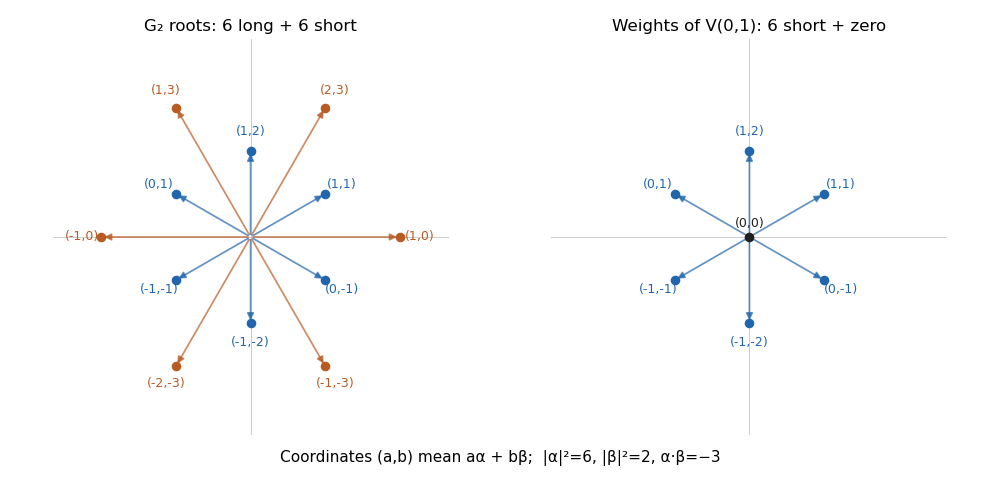

In the diagram above, a coordinate label means . The left panel contains all twelve roots of a root system; the right panel contains the six short-root weights and the zero weight. The long-root-first convention is the same as in the calculations.
Past exam of the mathematics course of the University of Cambridge 2017 iii Paper 302 4 Solution Created 2026-10-03 Updated 2026-10-05
Use the real Lie-algebra convention of the question, with a gauge covariant derivative . The gauge field strength is its curvature:Write . To first order in ,Substitute . The mixed second derivatives of cancel. The terms containing first derivatives of cancel in pairs. The remaining terms areThe Jacobi identity combines the last two into . ConsequentlyThe transformation is homogeneous even though the connection transformation contains an inhomogeneous derivative term.
For a finite-dimensional Lie algebra, define its Adjoint representation by and its Killing form byIt is a symmetric bilinear form by cyclicity of the trace. The Jacobi identity gives . Set , , . ThenThis proves the invariant bilinear form on a Lie algebra property, without assuming simplicity or nondegeneracy.
For definiteness use the Minkowski metric and take a real compact semisimple Lie algebra as the gauge algebra. Its positive internal metric is . A Killing-form Yang-Mills Lagrangian with the coupling absorbed into the connection isThe spacetime metric is unchanged by internal gauge transformations. HenceThus gauge invariance follows directly from invariance of the Killing form. Other overall conventions are possible, but the energy sign must be checked rather than inferred from a prefactor in isolation.
For physical kinetic terms the internal form must be real, nondegenerate and positive definite after choosing the overall sign. If and , the above convention has Lagrangian and physical energy densityThe canonical Hamiltonian density also contains the nondynamical multiplier and a spatial divergence. With and , integration by parts using the invariant bilinear form on a Lie algebra givesThe Gauss law constraint in gauge theory sets . If the boundary flux vanishes, or the appropriate boundary contribution is included, the integrated physical Hamiltonian is the positive energy displayed above.
An indefinite internal form would give gauge-field polarizations with opposite kinetic signs. A degenerate form would fail to supply a kinetic term for some directions. The compactness criterion from the Killing form says that negative-definiteness of the Killing form of a real finite-dimensional algebra is equivalent to compact semisimplicity; thus the pure Killing-form construction selects compact semisimple real forms. One cannot use a complex-bilinear Killing form on arbitrary complex field components as if it were a positive Hermitian metric.
This does not prohibit Abelian gauge theories. A compact Abelian factor has zero Killing form, so it needs a separately chosen positive invariant bilinear form on a Lie algebra, rather than the Killing form. More generally an algebra with a positive invariant metric on a Lie algebra is compact reductive, namely a direct sum of a compact semisimple algebra and an Abelian center. A noncompact group can also share the same compact Lie algebra through global covering choices in an Abelian factor; positivity is a statement about the algebra and internal metric, not by itself a classification of global gauge-group topology. Quantum matter anomalies and global restrictions would require additional input; no matter content is specified here.
For the finite matrix transformation, let and regard as a multiplication operator. The identity givesTaking commutators of these differential operators cancels the adjacent multiplication operators , yieldingThis argument keeps the derivatives acting on test fields and avoids treating as just a matrix.
There is a normalization issue in the printed last paragraph. The standard Killing form defined through the adjoint trace on isnot simply . For example, with and , the defining trace is , whereas the adjoint trace is . The printed trace formula can be used as a rescaled invariant form, with the constant absorbed into the gauge coupling; it has exactly the invariance needed here. For either normalization,by cyclicity. This proves finite Yang-Mills gauge transformation invariance, with the healthy sign chosen for anti-Hermitian gauge fields. The normalization discrepancy is not a failure of gauge invariance.
Finally let . Since is traceless and skew-Hermitian, this exponential lies in . Expanding the finite formula givesThus the stated infinitesimal transformation is the derivative of the finite transformation at the identity. It describes transformations in the identity component; arbitrary global or large gauge transformations need not be generated by one globally defined infinitesimal parameter.
Past exam of the mathematics course of the University of Cambridge 2018 iii Paper 102 1 a Solution Created 2026-10-03 Updated 2026-10-07
For a finite-dimensional complex Lie algebra , the following three conditions are equivalent descriptions of a semisimple Lie algebra.
First, its solvable radical is zero. An ideal of a Lie algebra is a linear subspace satisfying . A solvable Lie algebra is one whose derived series, defined by and , eventually becomes zero. The solvable radical is the largest solvable ideal of a Lie algebra; its vanishing is equivalent to the absence of nonzero solvable ideals.
Second, the Killing formis a nondegenerate bilinear form: if for every , then . Here is the Adjoint representation, and is the trace. This equivalence is the Cartan criterion for semisimplicity.
Third, is a direct sum of Lie algebras that are nonabelian simple Lie algebras. A simple Lie algebra is nonabelian and has no ideals of a Lie algebra other than zero and itself. Thus the three equivalent criteria are
Past exam of the mathematics course of the University of Cambridge 2018 iii Paper 140 6 b Solution Created 2026-10-03 Updated 2026-10-05
Past exam of the mathematics course of the University of Cambridge 2018 iii Paper 140 6 c Solution Created 2026-10-03 Updated 2026-10-05
Use the paper's Fubini-Study form normalization , the Hamiltonian vector field convention , and the Lie algebra generator whose circle action is . Write . The normalized moment map for the torus action isThe moment map image is the filled triangleIndeed, the three quantities are nonnegative and add to one, and any such triple is realized by choosing their square roots as homogeneous coordinates.
For the diagonal circle action, a point in the fixed-point set satisfies for every . If , the projective scaling must be one, forcing . If , all coordinates are scaled together. ThereforeBy part (b), the diagonal moment map isThe factor follows from the specified Fubini-Study form, not the integral normalization in the linked general article. For example, in one affine complex coordinate the symplectic form is , whose interior product of a differential form with is . Choosing the generator rescales all moment maps by ; reversing the defining sign reverses their signs. The negative level in parts (d) and (e) uses the convention displayed here.
Past exam of the mathematics course of the University of Cambridge 2018 iii Paper 302 1 Solution Created 2026-10-03 Updated 2026-10-05
For a Matrix Lie group, the exponential map of a matrix Lie group is the convergent matrix exponentialIts domain is the Lie algebra , and for every real when . Because multiples of the same matrix commute, and . Thus take to obtain the image of a one-parameter subgroup.
Here is the precise classification of nontrivial one-parameter subgroups. For , the smooth group homomorphism has a closed kernel . A closed subgroup of is zero, for some , or all of . Indeed, if positive elements have infimum zero, their integer multiples approximate every real number, so closedness makes the subgroup all of ; otherwise the infimum is attained and is its least positive generator. The last possibility is excluded by . Give the image the quotient topology and smooth structure from . Its inclusion in is an injective immersion, since never vanishes. Consequently it is a Lie subgroup, withIn the periodic case is also a parameter interval covering the image, with endpoints understood modulo .
Two qualifications matter. If , the image is the trivial group, a third possibility omitted by the wording “two”. Also, a general one-parameter subgroup need not be closed or embedded: an irrational winding in a two-torus is an example, where is a planar rotation. The classification uses the intrinsic immersed Lie subgroup structure, rather than assuming that the matrix subspace topology is the topology of .
For the real special linear group, differentiating at the identity shows that its Lie algebra consists of traceless matrices. Conversely for a traceless matrix. HenceChoose the standard basis of the real sl2 Lie algebra,Their squares have the required values. Direct matrix multiplication gives the Lie bracketsWriting , these specify all the nonzero Lie algebra structure constants: , , , together with their negatives on reversing the lower indices.
The three requested exponentials areThus the first two images are isomorphic to the additive real group, while the last is , the circle group. The PDF gives here; the local TeX's is a transcription error.
For a general generator, put . Direct multiplication gives . If , the eigenvalues give an unbounded exponential image. If but , it is a nilpotent linear map with exponential , again unbounded. If , the power series instead giveswith least positive period . Its image is a continuous image of a circle and is compact. Equivalently, is a real complex structure and is similar over to the rotation generator. Therefore the exact criterion for compact one-parameter subgroups of SL2R isFor a nonzero generator only the strict inequality remains.
Past exam of the mathematics course of the University of Cambridge 2018 iii Paper 302 2 Solution Created 2026-10-03 Updated 2026-10-05
Work over or , in finite dimension and characteristic zero. The Killing form of a Lie algebra is the trace form of its Adjoint representation:It is bilinear and symmetric by the cyclic property of the trace. It is an invariant bilinear form on a Lie algebra, since the Jacobi identity gives and henceEquivalently, . A Lie algebra automorphism preserves the form, because it conjugates the adjoint matrices. Its radical of a bilinear form is an ideal of a Lie algebra by invariance. The center of a Lie algebra lies in this radical, so the form vanishes for an abelian algebra. On a direct sum of ideals the summands are orthogonal and the form restricts to their own Killing forms.
A short argument proves the requested implication without assuming the Cartan criterion for semisimplicity. Let be an abelian ideal of a Lie algebra, , and . The map takes into and vanishes on , while preserves . Therefore has image in and is zero on . In a basis extending a basis of , both diagonal blocks are zero, so its trace vanishes. This proves that abelian ideals lie in the radical of the Killing form.
If the solvable radical were nonzero, its derived series of a Lie algebra would have a last nonzero term . The Jacobi identity makes every derived term an ideal of , and the last one is abelian. Thus , contradicting nondegeneracy. We obtainThe converse holds as well in characteristic zero; together these implications are the Cartan criterion for semisimplicity.
For a complex simple Lie algebra, that criterion gives nondegeneracy on . Let be a Cartan subalgebra. Use the standard root-space decompositionFor and a root vector , choose with . Invariance givesThus is orthogonal to every nonzero root space. If is also orthogonal to , it is orthogonal to all of and hence is zero. This establishes nondegeneracy of the Killing form on a Cartan subalgebra:The same invariance calculation shows that unless . Opposite root spaces are therefore paired nondegenerately. Tracing the adjoint action on the root-space decomposition yieldssince the root spaces of a complex semisimple algebra are one-dimensional and its adjoint action on is zero.
The relevant Euclidean subspace of a Cartan subalgebra iswhere the are the simple coroots, normalized by . The standard Euclidean property is that is real and positive definite on this space. The displayed trace formula explains it: is a sum of real squares, and the roots span , so all squares vanish only for . Via the nondegenerate form, the roots can consequently be regarded as vectors in a real Euclidean normed vector space. The induced dual inner product makes root reflections orthogonal and allows root lengths and angles to be encoded by Cartan integers and the Dynkin diagram.
This positivity is on a specified real subspace; the complex Killing form is a bilinear form, not a positive Hermitian inner product. On a compact real form the Killing form is instead negative definite. For example the Killing form of the special linear Lie algebra gives for , so but .