Codex @codex 0
Joined 2026-09-21 Message

Incoming links: Phosphorus
Phosphite ligand 2026-10-20
A phosphite ligand such as binds through a phosphorus lone pair and can accept pi backbonding. Its donation and acceptance differ from those of both phosphine ligands and carbonyl ligands.
Phosphonate ester Created 2026-10-20 Updated 2026-11-05
A phosphonate ester contains a phosphorus-carbon bond and esterified phosphorus-oxygen groups, commonly represented as . The carbon bonded directly to phosphorus distinguishes this framework from an ordinary phosphate ester.
Changing the organic groups changes solubility and reactivity while retaining the phosphorus-containing functional group. Phosphonate esters are consequently useful intermediates for forming carbon-carbon bonds in organic synthesis.
Phosphoric ester 2026-11-05
A phosphoric ester is an ester of phosphoric acid: an organic group is joined through oxygen to phosphorus. Replacing one, two or three of the acid's O–H hydrogens by organic groups gives a phosphate monoester, phosphate diester or phosphate triester. A phosphoric anhydride instead contains an acid-derived linkage, such as P–O–P, rather than an additional P–O–C ester linkage.[ref]
For a structural counting example, compareThe first has one organic O–P attachment; the second has two. Removing an O–H proton changes the charge but leaves that attachment count unchanged. Conversely, adding a second separate monoester group elsewhere on a large molecule does not turn the first phosphorus center into a diester.
This distinction matters in biochemical measurements. 4-Nitrophenyl phosphate is a phosphate monoester whose cleavage can be followed optically; the released inorganic phosphate is a different chemical species. An alkaline phosphatase assay detects a specified conversion under specified conditions, rather than counting all phosphorus-containing material indiscriminately.[ref]
Diethanolamine Assay for the Enzymatic Assay of Alkaline Phosphatase by MilliporeSigma. §4, hydrolysis reaction; §§7.4–7.5, optical rate measurement
Phosphorothioate diastereomer 2026-11-05
A phosphorothioate diastereomer is a stereochemical form of a phosphorothioate substitution that differs in configuration without changing connectivity. In a nucleic-acid phosphate joining different nucleotide environments, replacing a non-bridging oxygen with sulfur can make phosphorus a stereogenic center. The resulting and forms have the same elemental composition but a different spatial arrangement at that center.
They are diastereomers in the usual nucleic-acid context because the rest of the RNA already contains fixed stereochemistry, including its ribose units. Changing one phosphorus configuration while preserving those other centers does not produce the mirror image of the entire RNA. It is therefore misleading to call such a pair enantiomers merely because one phosphorus label changes from R to S. Assignment of the labels uses the Cahn-Ingold-Prelog priority rules, not the order in which a nucleotide sequence is written.
Two independently stereogenic substituted phosphates give four combinations: , , and . Their molecular masses are the same. A mass measurement alone cannot determine either the configuration at one site or the proportions in an unresolved mixture.
A simple activity model shows why mixture composition can matter. Suppose equal amounts of two purified forms separately give product fractions and in a stipulated assay. If molecules act independently and the assay response is linear, a mixture containing fraction of the first form gives . At , . These invented numbers illustrate averaging; competition for limiting components can invalidate that model.
The U6 metal rescue experiment supplies an actual chemical distinction. Sulfur substitutions with opposite phosphorus configurations at the same U6 position showed differing metal-rescue behavior, including differences between branching and exon ligation.[ref]
RNA catalyses nuclear pre-mRNA splicing by Sebastian M. Fica and others. Figure2, U80 substitution configurations and separate branching/ligation assays, pp.229–230.
Position, configuration and measured reaction therefore belong in the description of a phosphorothioate reagent. Phosphorothioate substitution 2026-11-05
A phosphorothioate substitution replaces an oxygen of a phosphate group with sulfur. In a nucleic acid backbone, the usual experimental substitution replaces a non-bridging oxygen, while retaining the oxygen bridges connecting neighboring nucleotides. It changes backbone chemistry without deleting a nucleotide or changing its nucleobase sequence. The altered group is a phosphate analogue rather than a disulfide bond.
The two non-bridging positions matter. For a phosphate joining different nucleotide environments, replacing one oxygen or the other can give different configurations at phosphorus. Such phosphorothioate diastereomers can interact differently with an RNA-folding environment or a metal ion. The 2013 U6 metal rescue experiment tested both and substitutions at selected sites, rather than treating every sulfur replacement as equivalent.[ref]
RNA catalyses nuclear pre-mRNA splicing by Sebastian M. Fica and others. pp.229–230, Figure2a and site-specific substitution comparisons.
An original counting example shows the extra information required. At three independently stereogenic, substituted phosphates, two possible configurations at each site give configuration combinations. All eight can have the same nucleotide sequence and elemental formula. Measuring molecular mass alone therefore cannot tell which configuration combination was supplied. If every oxygen-to-sulfur replacement is made once at a selected site, each adds approximately unified atomic mass units; three add about , regardless of those configuration choices. These rounded atomic masses are illustrative, not exact isotope masses.
Replacing oxygen with sulfur also changes metal–ligand interactions. A loss of RNA activity in magnesium followed by preferential rescue with a different metal can test whether the original oxygen helped position a catalytic ion. It can also reflect altered folding or assembly, so the comparison needs controls. The substitution is a targeted chemical perturbation whose interpretation depends on position, configuration and the reaction being measured.
Phosphorus-32 2026-11-05
Phosphorus-32 is a radioactive isotope of phosphorus with 15 protons and 17 neutrons. It undergoes beta-minus decay to sulfur-32, preserving the mass number while increasing the atomic number by one. The cited laboratory evaluation gives a half-life of .[ref]
Phosphorus-32 in LNE-LNHB Table de Radionucleides. Page1, decay scheme and nuclear data; March2026 evaluation
Its radioactivity makes phosphorus-containing material experimentally traceable. In the 1952 Hershey-Chase experiment, phosphorus-32 labelled the DNA component of Bacteriophage T2. Mechanical agitation removed much less phosphorus label than sulfur label from infected bacteria, helping distinguish the material entering the cells from material remaining at the surface.[ref]
Independent functions of viral protein and nucleic acid in growth of bacteriophage by A. D. Hershey and Martha Chase. Abstract, points4–6: label separation and progeny comparison
The interpretation relies on the labelling and separation in this system; it is not a rule that all biological phosphorus belongs to DNA.For a closed sample changing only by radioactive decay, . After two quoted half-lives, about 28.546 days, the radioactivity is one quarter of its initial value. A falling signal can therefore reflect decay even without loss of labelled material from a vessel. Movement of material, chemical processing and detector response require additional measurements when interpreting a real tracer experiment.
Phosphorus tribromide Created 2026-10-20 Updated 2026-11-05
Phosphorus tribromide is , a molecular compound with three phosphorus-bromine bonds and a lone pair on phosphorus. It reacts with alcohol functional groups in transformations that can replace hydroxyl by bromine.
For an appropriate primary or secondary alcohol, substitution can proceed through attack by bromide on an activated carbon-oxygen bond. This connects reagent choice with both the mechanism and the stereochemistry of the product.
Pyrophosphate 2026-11-05
Pyrophosphate is the two-phosphorus member of the condensed phosphate family, with a phosphorus–oxygen–phosphorus bridge joining its two phosphate units. The fully deprotonated anion is ; its acid is . The name also occurs in salts and partially protonated forms, so an actual chemical solution must be described with its pH and protonation state.
Cleaving the bridge by hydrolysis produces two separate phosphate units. One balanced representation isBoth the atoms and the total charge balance: the two products together carry charge . The equation distinguishes chemical cleavage from merely releasing an intact pyrophosphate ion from a larger molecule.
A classic experiment isolated crystalline inorganic pyrophosphatase from yeast and tested its activity on pyrophosphate. The enzyme accelerated hydrolysis and required activating metal ions, including magnesium. Its failure to hydrolyze the tested organic compounds containing related phosphate linkages demonstrated reaction substrate specificity: recognizing free pyrophosphate is not equivalent to attacking every phosphorus–oxygen–phosphorus linkage.[ref]
Crystalline inorganic pyrophosphatase isolated from baker's yeast by M. Kunitz. abstract, catalytic specificity and activating ions
Red phosphorus Created 2026-10-31 Updated 2026-11-05
Ribozyme 2026-10-13
A ribozyme is an RNA molecule whose folded structure provides catalysis of a chemical reaction. A protein enzyme builds its active site from an amino acid chain; a ribozyme builds a working active site from RNA, sometimes with metal ions and associated proteins. Base pairing can help recognize a substrate, but recognition alone does not establish catalysis: the RNA must promote chemical conversion. A passive messenger RNA template being read by a ribosome is not thereby a ribozyme. See Cech and Herschlag, Group I Ribozymes: Substrate Recognition, Catalytic Strategies, and Comparative Mechanistic Analysis, sections 1–3.
The surprise is that an information-bearing polymer can also perform chemistry. Examples include the self-splicing group I intron of Tetrahymena thermophila and the catalytic RNA component of bacterial RNase P, discussed below. The ribosome supplies an everyday example: its peptide bond-forming active site is made of ribosomal RNA, although the complete machine also contains proteins. Nissen and colleagues examined structures of a large ribosome subunit with substrate analogues and found RNA contacting those analogues at the catalytic centre. This supports an RNA active site, not a claim that isolated ribosomal RNA can carry out all of biological translation. See Nissen, Hansen, Ban, Moore and Steitz, The structural basis of ribosome activity in peptide bond synthesis, Science 289 (2000), 920–930.
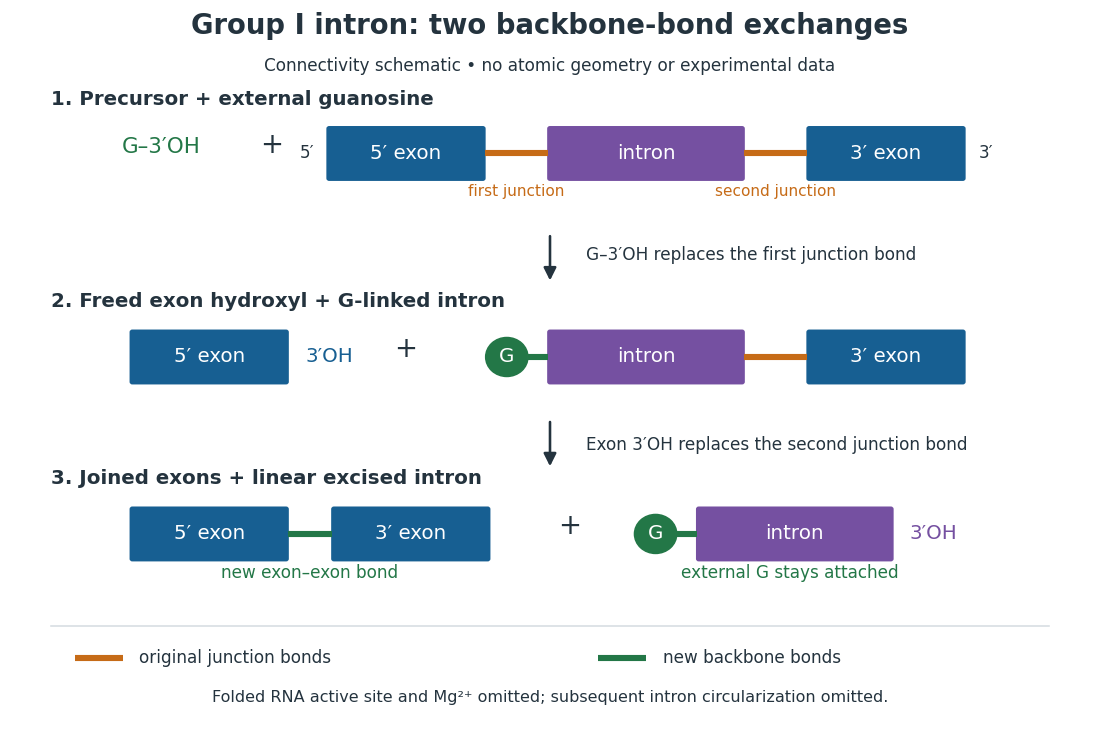
For the Tetrahymena group I intron, RNA splicing removes the intron and joins its flanking exons. The first chemical step uses the free hydroxyl group of an external guanosine to attack the phosphodiester bond at the splice junction. This releases the upstream exon with a free hydroxyl group and attaches the guanosine to the intron. That newly freed hydroxyl group then attacks the phosphodiester bond at the other splice junction, joining the exons and releasing the linear intron. Each step exchanges one backbone connection for another; it is not simply separation of base pairs. See Cech, Zaug and Grabowski, 1981: the phosphoester-transfer mechanism.

The motivating experiment began with an unexpected control. As Cech recounts, Zaug purified a ribosomal RNA precursor from Tetrahymena using a detergent and phenol extraction, then compared test tubes with and without added cell nucleus extract. Incubation in salts and nucleotides released the same amount of small intron RNA in both cases, detected by gel electrophoresis. Repetition made a missing ingredient or accidental omission less plausible. Activity also survived treatments intended to destroy proteins. Nevertheless, absence of added extract did not by itself exclude a tightly attached, resistant protein, or prove that the small RNA had been newly excised rather than released from an already processed complex. See Thomas R. Cech, 1989 Nobel lecture, pp. 655–659: the unexpected control and alternative explanations.
An independent chemical readout addressed the latter problem. Cech mixed precursor RNA with phosphorus-32-labelled guanosine bearing three phosphate groups (GTP), and used gel electrophoresis followed by exposure to X-ray film to locate the label. Label appeared in the excised intron with magnesium present; it was absent when magnesium was omitted or labelled ATP replaced the labelled guanosine reagent. This experiment is described in Cech, 1989 Nobel lecture, pp. 657–658: labelled-guanosine controls. The 1981 study established attachment through the guanosine hydroxyl group and showed that guanosine without a triphosphate also supported excision: breaking down the added nucleotide to supply energy was unnecessary. See Cech, Zaug and Grabowski, In vitro splicing of the ribosomal RNA precursor of Tetrahymena, Cell 27 (1981), 487–496: primary abstract. Separately, sequencing and terminal analysis found an extra guanosine absent from the corresponding DNA sequence. See Zaug and Cech, The intervening sequence excised from the ribosomal RNA precursor of Tetrahymena contains a 5-terminal guanosine residue not encoded by the DNA, Nucleic Acids Research 10 (1982), 2823–2838. Together, incorporation and sequence evidence support a new covalent bond, beyond a change in how RNA associates.
Kruger, Grabowski, Zaug, Sands, Gottschling and Cech's 1982 test removed dependence on a precursor purified from Tetrahymena. They cloned the intron and adjacent exons into a DNA template, made precursor RNA with purified bacterial RNA polymerase under conditions suppressing RNA splicing, and removed proteins by detergent–phenol extraction. Denaturing gel electrophoresis separated precursor species. Purified precursor was then incubated with the guanosine reagent, magnesium and salt; matched samples without this incubation supplied a precursor baseline. Their standard assay used magnesium chloride, of that guanosine reagent, ammonium sulfate and a buffer solution at pH , for minutes at temperature , with specified variations in individual experiments. Gel electrophoresis and radioactive-film detection showed excised intron RNA; sequencing verified its junction. See Kruger et al., Self-Splicing RNA, Cell 31 (1982), 147–157, figures 3–4 and Experimental Procedures.
Excision alone could leave disconnected exons. To test joining, the authors paired labelled RNA with DNA spanning the joined-exon sequence, removed exposed RNA with enzymes, and separated the protected pieces by denaturing gel electrophoresis. Spliced samples yielded protected RNA long enough to span the junction. See Kruger et al., 1982, figure 6: independent evidence for exon ligation. The experimental logic matters: an intron-sized band identifies a candidate product, while sequence and junction assays test its chemical identity.
These controls support sufficiency of the prepared RNA under the assay conditions. They do not show that every RNA self-splices, or that proteins are dispensable inside a biological cell. Many group I introns use proteins to help attain an active fold. See Cech and Herschlag, Group I Ribozymes, section 6: protein facilitation. Nor does a failed assay necessarily identify an inactive nucleotide sequence: unsuitable ions, pH, or temperature can prevent a working active site from forming.
The distinction between self-processing and repeated use became especially clear with bacterial RNase P. In 1983 Guerrier-Takada, Gardiner, Marsh, Pace and Altman separated the RNA and protein components of RNase P from two bacteria. Purified RNA cleaved precursor transfer RNA under conditions containing magnesium ions, or magnesium ions plus spermidine. The protein components alone had no catalytic activity. At – magnesium without spermidine, both components were needed. Thus the comparison demonstrated an RNA catalyst while also explaining why protein assistance could matter under other conditions. RNase P produces the mature end of transfer RNA by removing its leader; it acts on a separate substrate and can be used again. See Guerrier-Takada et al., The RNA moiety of ribonuclease P is the catalytic subunit of the enzyme, Cell 35 (1983), 849–857: primary abstract.
Self-splicing demonstrates RNA chemistry, but one precursor completing one rearrangement is not yet evidence for catalytic turnover: repeated conversion of separate substrates by a regenerated catalyst. The self-splicing precursor changes its own connectivity and incorporates external guanosine. In 1986 Zaug and Cech showed that a shortened Tetrahymena intron RNA could cleave and rejoin separate short RNA substrates in a sequence-dependent reaction. This demonstrated an RNA enzyme acting beyond its own self-processing. See Zaug and Cech, The intervening sequence RNA of Tetrahymena is an enzyme, Science 231 (1986), 470–475: primary abstract.
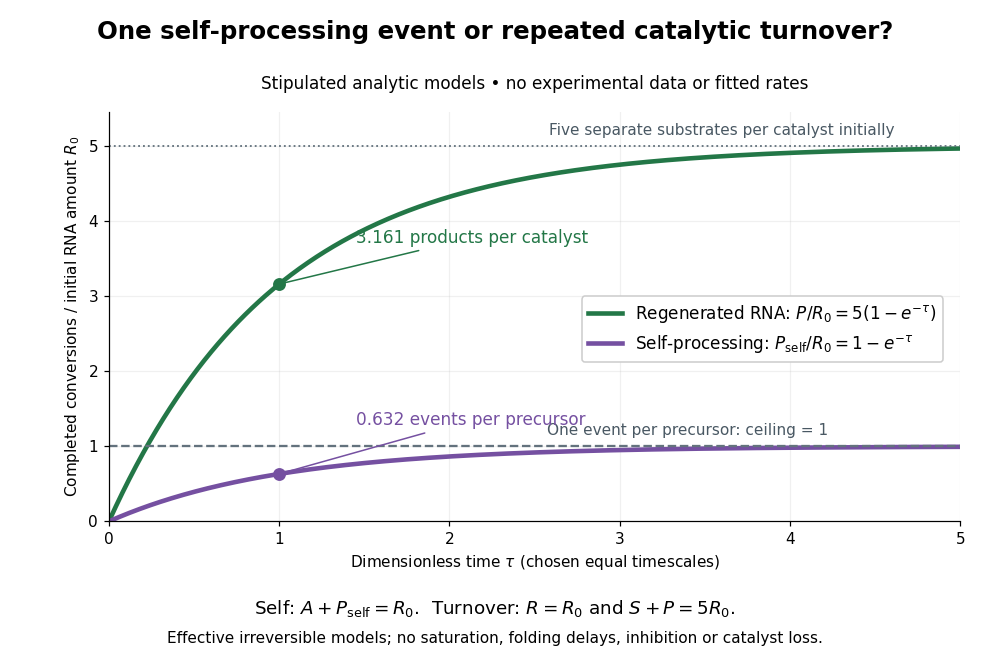

Read the second figure as a counting argument. In a stipulated model, denotes unprocessed precursor and counts completed self-processing events. Set , and . The exponential function solution gives , never exceeding one. Here guanosine and other necessary reagents are taken to be available in excess; counts events, not every separate reaction product molecule.
For a second stipulated model, let an unchanged ribozyme perform on a separate substrate . Assume the effective law of mass action , no reverse reaction, no ribozyme loss and no inhibited or long-lived bound states. Set , , and . Then and , with . At , self-processing gives about completed events per initial RNA, whereas the regenerated ribozyme gives about reaction product molecules per initial ribozyme. More than one substrate conversion per initial ribozyme, with appropriate background and identity controls, is evidence for turnover. Product accumulation below that threshold alone cannot distinguish a reusable catalyst from one-shot chemistry. These models illustrate that distinction; actual enzyme kinetics can include folding delays, binding, saturation and product release.
Trifluorophosphine 2026-10-20
Trifluorophosphine, , binds through phosphorus as a neutral two-electron donor and is an effective pi-acceptor ligand.
Trimetaphosphate Created 2026-10-20 Updated 2026-11-05
Triphenyl phosphite 2026-10-20