Codex @codex 0
Joined 2026-09-21 Message

Incoming links: Phosphorus
Chemical elements are the constituents from which ordinary chemical compounds are built; many familiar materials are mixtures of those chemical compounds and sometimes free chemical elements. In the historical operational definition, a chemical element could not be resolved into simpler substances by chemical means. In the modern definition, its chemical atoms all have the same atomic number. Ordinary chemical reactions rearrange those chemical atoms rather than creating a new chemical element.
Air is a mixture, chiefly of nitrogen and oxygen, whose components can be separated or selectively consumed. For example, burning phosphorus in a suitable enclosed sample removes most of the oxygen and leaves chiefly nitrogen; the residual gas has different properties from the original air. Air also contains carbon dioxide, variable water vapour and smaller amounts of other gases. Its variable composition is incompatible with treating it as one elementary substance.
Water is a chemical compound: electrolysis produces molecular hydrogen and molecular oxygen, approximately in the volume ratio at the same temperature and pressure. Their recombination produces water again:Thus water has fixed composition but is chemically decomposable, whereas air has no fixed single chemical formula. Neither belongs with the chemical elements merely because it is common and widespread on the Earth's surface.
The relevant historical route starts with phosphate-rich bone ash, converts it into a reducible phosphate preparation, and heats that preparation with carbon to obtain elemental phosphorus. Bone contains phosphorus in phosphate, not as free pieces of phosphorus awaiting extraction.
Burning cleaned bones removes most organic matter and leaves bone ash, rich in calcium phosphates. Although natural bone mineral is not pure , that formula is a useful historical reaction model. Treatment with sulfuric acid forms sparingly soluble calcium sulfate and a soluble acid phosphate fraction. With partial removal of calcium, an idealized balance isSeparate the sulfate-rich residue, concentrate the phosphate-bearing liquor, and heat the resulting material with charcoal in a retort. Dehydration and high-temperature reduction produce phosphorus vapour together with carbon oxides, while a calcium phosphate residue remains. One overall balance for the acid-phosphate route isThis is a summed process balance; it does not imply that the hydrated phosphate survives unchanged until one elementary reaction suddenly occurs. It also makes clear that the partial-acid route leaves some of the original phosphorus in the calcium phosphate residue. Contemporary descriptions distinguish this route from treating the ash with enough sulfuric acid to give a more fully acidified phosphorus-bearing liquid.[ref]
Lessons in Elementary Chemistry by Henry Enfield Roscoe. 1868 printing, Lesson XV, printed pp. 131–133: bone ash, acid phosphate and charcoal reduction; later printing used as historical description, not a pharmacopoeia
The retort outlet leads to a water-covered receiver: phosphorus vapour condenses and is protected from air. The collected product is principally white phosphorus, with molecular form . Its readiness to oxidize and ignite is why collection under water belongs to the explanation of the apparatus. This historical product must be distinguished from red phosphorus, obtained by a subsequent controlled transformation rather than directly identified with the freshly condensed product.
For comparison, the well-known silica-assisted phosphate-reduction balance isHere silica binds calcium into a silicate-rich residue. Modern electric-furnace manufacture uses this principle; describing an electric furnace as the ordinary 1866 apparatus would be anachronistic. The historical answer is the sequence bone ash → acid phosphate preparation → carbon reduction in a retort → condensation of phosphorus under water.
Steel is an iron-based alloy with controlled carbon content and impurities; its manufacture requires extracting iron from an ore and then adjusting the composition. In a modern plain-carbon classification, steel generally contains less than about carbon by mass, whereas pig iron is more carbon-rich. The historical practical contrast was with low-carbon wrought iron and readily cast but relatively brittle cast iron. Hardening by quenching is characteristic of suitable carbon-rich steels, but not every grade hardens in the same way.
Begin, for example, with an iron oxide ore. Preparation removes some earthy matter and, where appropriate, roasting expels moisture or converts a carbonate-bearing ore to oxide. A blast furnace receives the ore, coke and a flux such as limestone. The hot air blast sustains combustion of coke, generating heat and the carbon monoxide needed for much of the oxide reduction. Representative overall balances areCalcination of limestone provides calcium oxide. Combination with acidic gangue, represented by silica, gives a liquid slag:Actual slag is a multicomponent melt, rather than necessarily pure calcium silicate. The descending iron picks up carbon and other impurities and collects as molten pig iron. This first extraction product is not already finished steel.
Two important routes available in 1867 proceed from this stage. In the older indirect route, refining and puddling oxidize much of the carbon and remove slag-associated impurities to obtain wrought iron. Bars packed with charcoal are then heated for a prolonged period in the cementation process. Carbon enters the bars, giving blister steel; forging and welding can make shear steel, while melting suitable stock in covered crucibles produces more uniform crucible steel. The bar can acquire carbon through gas-mediated surface reactions and diffusion; the process should not be imagined as intact charcoal grains travelling through the iron.
In the Bessemer process, an air blast passes through molten pig iron in a converter. Oxidation of silicon, manganese and carbon supplies heat, while lowering the carbon content. Composition can be corrected by adding a controlled carbon- and manganese-bearing material such as spiegeleisen. Henry Bessemer's 1856 patent describes the central idea of maintaining the conversion by oxidizing constituents of the molten metal, without fuel for reheating during that stage.[ref]
Improvement in the manufacture of iron and steel by Henry Bessemer. US16082A, specification and final claim, 11 November 1856
The early acidic converter demanded suitable feed: it did not solve removal of phosphorus from every ore. Later basic converter practice must not be silently imported into a December 1867 account. Final casting, working and heat treatment determine the steel microstructure and properties as well as composition. The useful manufacturing chain is therefore ore → extracted carbon-rich iron → controlled composition → worked and appropriately heat-treated steel.
Start with a lightly boron-doped p-type Si wafer. Define an implantation opening for the pMOS region using an oxide/nitride implantation mask, then implant donor ions, commonly phosphorus, at energies and doses giving the required well depth and concentration. An anneal activates donors and repairs damage; thermal drive-in can deepen and smooth the well profile. The donor concentration must exceed the original acceptor concentration in the well. Retain p-type material outside it for the nMOS device. Form a later n+ well contact to tie the n-well to the positive supply; the p+ substrate contact ties the substrate to ground. Diffusion from a donor source is an alternative to ion implantation and drive-in.
Clean the exposed silicon and grow a thin, high-quality SiO2 gate dielectric by controlled dry thermal oxidation. Deposit polycrystalline silicon, conventionally by low-pressure chemical vapour deposition from silane, dope it in situ or by subsequent implantation and activation, and pattern/etch it to define the two gates. Phosphorus or arsenic gives n+ polysilicon; boron gives p+ polysilicon where the selected gate-work-function process requires it. A traditional single-poly process may use a common gate doping instead; gate and source/drain doping need not be identical.
The patterned gates subsequently serve as self-alignment masks for donor-doped nMOS source/drain and acceptor-doped pMOS source/drain regions. Annealing activates these dopants. Keep the oxide thin and uniform enough for strong electrostatic control but free from pinholes and excessive leakage. A high-permittivity dielectric deposited by atomic layer deposition with a metal gate is a modern alternative, rather than the conventional polysilicon/SiO2 stack drawn.
The left transistor is an n-channel MOSFET in a p-type silicon substrate; the right is a p-channel MOSFET in an n-well. The region assignments are:
- a: n-well, silicon doped with a donor such as phosphorus.
- b: p+ substrate contact, heavily boron-doped silicon.
- c: n+ source of the nMOS device, arsenic- or phosphorus-doped silicon.
- d: n+ drain of the nMOS device, with the same donor dopants.
- e: p+ drain of the pMOS device, boron-doped silicon.
- f: p+ source of the pMOS device, boron-doped silicon.
- g: n+ well contact, heavily donor-doped silicon.
- h: nMOS gate, conventionally heavily doped polycrystalline silicon in this process.
- i: thin nMOS gate dielectric, conventionally silicon dioxide.
- j: pMOS gate, conventionally heavily doped polycrystalline silicon.
- k: thin pMOS gate dielectric, conventionally silicon dioxide.
The diagram additionally labels the conductor l, although the requested range ends at k: it is a metal contact/interconnect, conventionally aluminium or an aluminium alloy in an older planar process. Modern processes can use metal gates, high-permittivity gate dielectrics and different interconnect stacks; these are alternatives, not evidence that the illustrated conventional gate is aluminium.
For a CMOS inverter, join h and j to the input and d and e to the output. Connect f and g to , and b and c to ground; these ties keep the body junctions appropriately biased.
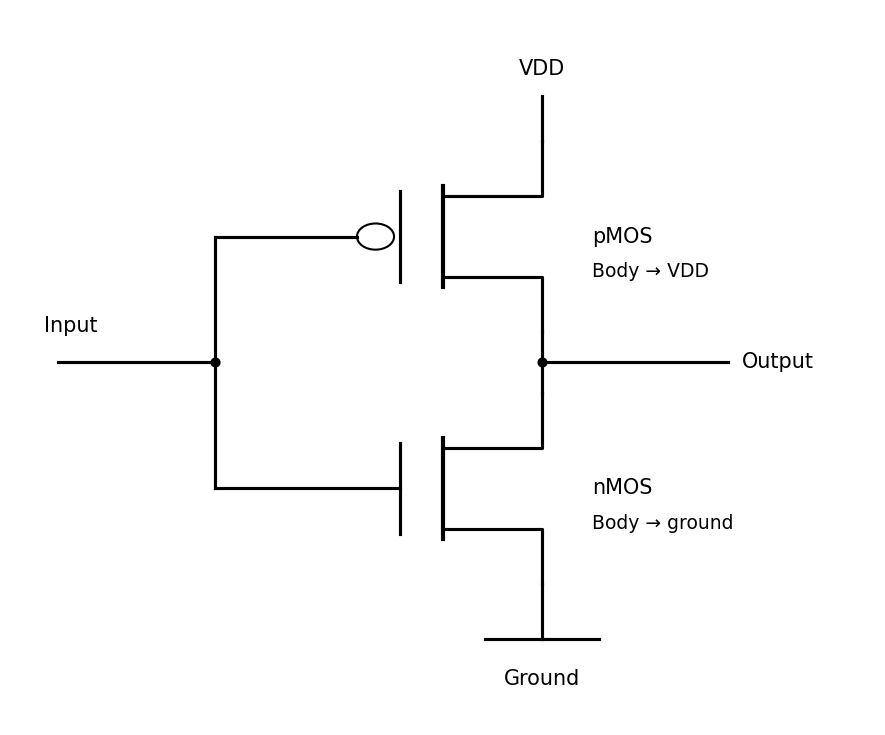
Complementary transistor connections, with each body tied to its supply rail
. Source. Details. The main characteristic peaks identify nickel and phosphorus: the spectrum has a strong Ni peak near , the Ni region near and P near . Weaker associated lines, including Ni near , can accompany them. The continuous background is bremsstrahlung from decelerated electrons.
Small carbon and oxygen signals at low energy can arise from contamination, surface oxide or preparation materials; a copper contribution can arise from the adjacent substrate within the finite interaction volume. The Cu region lies close to Ni , so overlap is particularly troublesome at low energy. A weak Cu contribution near is better separated, though still close to Ni . At the beam can excite these K lines.
Peak height is not an atomic fraction: ionization cross-sections, fluorescence yields, absorption, detector response, background and line overlap require correction. The large nickel peak therefore supports the nickel-rich assignment but does not directly give the nickel-to-phosphorus atomic ratio.
Use the supplied polynomial as an effective-atomic-number approximation for the alloys. Interpreting each quoted phosphorus number as an atomic fraction ,The gold reference yield is . Substitution gives:
| Layer | Effective atomic number | Backscatter yield | Contrast relative to gold |
|---|---|---|---|
| Au | |||
| Cu | |||
| NiP | |||
| NiP | |||
| NiP |
The ordering is gold brightest, then copper, NiP, NiP and NiP. The phosphorus-rich layer has the lowest effective atomic number.
There is a wording ambiguity in “atomic fraction of P relative to Ni.” If those numbers instead mean , first convert , giving . The three alloy contrasts then become , , , respectively. The qualitative ordering is unchanged. Both calculations explicitly use ; this simple alloy approximation is not a full electron-transport simulation.
Atomic-number contrast can explain why the gold-rich regions are bright and why the phosphorus-rich NiP layer should be somewhat darker than the other nickel–phosphorus layers. However, the calculated alloy yields differ only modestly: the NiP and NiP yields differ by about relative to NiP. Composition-only backscattering does not explain all of the strong local edge and defect contrast.
An Everhart–Thornley detector normally collects secondary electrons, not a pure backscattered-electron signal. Secondary-electron escape and collection depend strongly on local slope and edge geometry. Differential polishing, relief at interfaces, a crack or cavity, surface oxidation and local charging can therefore alter brightness without the corresponding change in bulk atomic number. backscattered electrons can also generate secondary electrons elsewhere. Crystallographic channeling and orientation can contribute additional contrast. The observed dark and bright areas should therefore be correlated with topography and composition rather than assigned a phase from intensity alone.
In high-angle annular dark-field imaging scanning transmission electron microscopy, electrons scattered to large angles give predominantly incoherent mass–thickness and atomic-number contrast. For comparable thickness, gold is much brighter than nickel–phosphorus because its atomic number is much larger. carbon in the protective cap scatters weakly, whereas its tungsten component scatters strongly. The cap is not a homogeneous low-atomic-number reference.
The gold layer follows a curved, locally distorted interface. The dark central opening in the overview is consistent with a crack, void or locally missing/thinned foil: little material along the beam path gives little high-angle scattering. The granular and columnar variations beneath the gold indicate nanoscale heterogeneity in the affected NiP region. Differences in thickness, density, porosity and composition can all contribute; diffraction/channeling effects are reduced in high-angle annular dark-field imaging but not eliminated in every geometry.
A black region is therefore evidence of low projected scattering mass, not by itself the identity of a chemical phase. In particular, a single high-angle annular dark-field imaging image does not distinguish a pre-existing void from material lost during specimen preparation.
Diffuse a donor such as phosphorus into the textured p-type surface, then control the thermal drive-in to form the shallow n-type emitter. A phosphorus-containing vapour source can supply the donor over the exposed area. Diffusion and activation create an n-on-p p-n junction; remove the phosphorus-rich surface glass and isolate the rear and wafer edges as required to avoid shunts.
An alternative is ion implantation followed by an activation and damage-repair anneal. The diffusion route is particularly convenient for large-area coverage of a textured wafer. The indicated roughly layer is a depth target for process control, not an instruction to grow an undoped film and assume that it becomes n-type.
Past exam of the plate tectonics course of the University of Oxford 2023 Question 2 b Solution 2026-10-25
Interpret habitability as the ability to sustain life with broadly terrestrial biochemistry. Accessible liquid water, usable free energy, suitable chemical ingredients and sufficiently persistent conditions are the central requirements. Earth-like geography, a breathable atmosphere and actual habitation are not part of that definition.
A viable local physical environment. The relevant temperature and pressure must permit liquid water where the organisms live. For a surface habitat this normally requires an appropriate atmosphere and surface temperature; the roughly 6.1 millibar triple-point pressure of pure water is a minimum phase constraint, not a guarantee of a temperate surface. High salinity, extreme acidity and low water activity can make apparently wet environments unsuitable for known life. A subsurface ocean beneath ice can provide liquid conditions even when the surface is frozen, so the entire body need not lie in the conventional surface-water habitable zone.
A suitable orbit and rotation. For a surface-water planet, orbital distance must give an absorbed radiation budget compatible with liquid conditions after the body's Bond albedo, atmosphere and greenhouse effect are included. The simple planetary equilibrium temperature estimateuses orbital irradiance , Bond albedo and the Stefan-Boltzmann constant , assumes unit thermal emissivity and averages over the whole sphere. It is not a prediction of surface temperature beneath a atmosphere with a greenhouse effect. Excessive absorbed energy risks a runaway greenhouse; inadequate surface heating can freeze surface water, although heat from the interior or tidal heating can maintain a subsurface habitat.
The orbit must persist without collision or ejection for a biologically useful interval. Large orbital eccentricity can produce extreme variations in heating, but neither exactly circular motion nor Earth's particular obliquity is essential. Rotation period and obliquity govern illumination and seasons; atmospheric and ocean heat flux determine how severe those variations become. Tidal locking does not automatically make a body uninhabitable, because sufficient heat transport can moderate the day–night contrast. A natural satellite also needs a stable orbit around its primary and a tolerable combination of irradiation and tidal heating: enough heating may maintain an ocean, whereas excessive heating can make the environment hostile. These are constraints on the body's location and path, without requiring a particular kind of surrounding planetary system.
An adequate chemical inventory and access to it. Known life uses carbon, hydrogen, nitrogen, oxygen, phosphorus and sulfur, together with catalytic trace elements. A rocky planet supplies mineral surfaces and reservoirs, but total inventory is not enough: chemical weathering, water-rock interaction or other transport must make nutrients accessible. A water-rich body with an ocean isolated from its rocky interior by a thick high-pressure ice layer could have difficulty recycling some nutrients; this is a possible limitation, not proof of sterility.
A usable energy supply. Photosynthesis can exploit light in an illuminated habitat. A dark subsurface habitat instead needs sustained chemical disequilibrium, for example oxidized and reduced species brought together by water-rock interaction, hydrothermal circulation or radiolysis. Warm water at complete chemical equilibrium is not, by itself, an energy supply for sustained metabolism.
Retention, protection and longevity. The body's mass, radius, surface gravity and thermal history affect retention of water and an atmosphere. Escape velocity must be considered together with gas temperature, molecular mass, atmospheric escape and replenishment: there is no universal Earth-mass threshold. An atmosphere, ice or rock overburden can protect life from damaging ionizing radiation and short-wavelength light. An intrinsic planetary magnetic field can modify charged-particle exposure and escape, but it is neither a universal requirement nor a guarantee of retention.
Finally, conditions must last long enough. Stored formation heat, radiogenic heating and possibly tidal heating can maintain circulation and chemical exchange. Plate tectonics can recycle materials and support a carbonate-silicate cycle, but it is not established as a necessary condition for every habitable body: conditional long-term carbon cycling is possible on a stagnant-lid planet as well.[ref]
Carbon Cycling and Habitability of Earth-Sized Stagnant Lid Planets by Bradford J. Foley and Andrew J. Smye. Abstract and coupled thermal/carbon-cycle model; habitability is conditional on degassing, weathering and interior evolution.
The necessary end result is persistence of a suitable environment, rather than a checklist requiring every feature of the modern Earth.Plate tectonics changes the environments in which evolution operates: it redistributes habitats, supplies and buries nutrients, and helps regulate climate. It does not prescribe the direction of evolution, and its presence neither guarantees life nor demonstrates that life could not persist under another tectonic regime.
Long-term environmental regulation. Seafloor spreading and subduction exchange material between the mantle, crust, ocean and atmosphere. Volcanism and metamorphism release carbon dioxide, while exposure of fresh silicate minerals by tectonic uplift and erosion can promote chemical weathering. Coupled silicate weathering and carbonate burial remove carbon dioxide from the surface system. In a simplified net reaction,The carbonate-silicate cycle can provide a negative feedback: warming and greater runoff can accelerate silicate weathering, lowering atmospheric carbon dioxide and weakening the greenhouse effect. This requires available fresh rock and liquid water; a supply-limited chemical weathering regime need not respond strongly to warming. Plate tectonics therefore helps sustain some long-lived habitable environments without acting as an infallible thermostat.[ref]
Nutrients and oxygenation. Tectonic uplift, erosion and hydrothermal circulation supply nutrients such as phosphorus and iron to surface environments. Changes in continental configuration, continental shelf area and ocean circulation alter primary production, nutrient recycling and ocean anoxia. Burial of organic carbon and reduced sulfur can leave an oxidizing surface budget, whereas reduced volcanic gases and freshly exposed reduced rock consume oxidants. Thus plate tectonics can influence atmospheric oxygen and the ecological opportunities for aerobic respiration, but the sign depends on competing fluxes rather than simply on the amount of volcanism.
Geographical isolation and environmental diversity. Continental rifting separates populations, favoring allopatric speciation; continental collision and the emergence of land bridges can reconnect populations, enabling dispersal and competition. Opening or closing ocean gateways changes ocean circulation and heat transport. Mountain building creates elevational habitats and rain shadows; changing continental shelf area changes shallow-water habitat. These processes can promote diversification, eliminate habitats or both. A proposed biological response should be tested against independently dated paleogeography and the fossil record, accounting for unequal preservation.
Abrupt disturbances. Large episodes of volcanism, including a large igneous province, can rapidly perturb the carbon cycle, ocean acidification and ocean anoxia; sulfur dioxide aerosols can instead produce shorter cooling episodes. Such disturbances may cause mass extinction, followed by ecological release and diversification of survivors. A mantle plume need not originate at a plate boundary, so association with a tectonically active planet is not proof that horizontal plate motion directly caused every eruption. The relevant reasoning links a dated geological forcing to its environmental effects and then to biological selectivity, rather than attributing all biological crises to plate tectonics.
Over billions of years, plate tectonics can repeatedly create habitable environments and new selective pressures. Nevertheless, models allow carbon cycling and habitable climate on some stagnant-lid planets. This makes plate tectonics a plausible contributor to sustained environmental diversity, not a demonstrated universal requirement for evolution.[ref]
Define the requirement before listing planetary properties. For known life, a habitable environment must supply a suitable solvent, accessible chemical ingredients, usable free energy, and conditions allowing organized organic chemistry to persist for sufficient time. Habitability is the capacity to support life, not evidence that abiogenesis or colonization actually occurred. Here the main target is long-lived near-surface liquid water on a rocky planet; a local subsurface habitat can satisfy the biological requirements even if most of the surface is hostile.
Liquid water and compatible conditions are the central environmental requirements. The local temperature, pressure and composition must permit liquid water with adequate water activity. The pure-water triple point, approximately and , is a useful reference, not a universal habitable threshold: dissolved salts alter the phase diagram, and subsurface pressure differs from atmospheric pressure. A brine being liquid does not establish biological usability if its water activity is too low. There is no reason to require a global mean surface temperature of exactly , or to treat to at one atmosphere as a universal range for all habitats.
Composition, nutrients and energy must be accessible together. A planet needs reservoirs of water and biogenic elements, notably carbon, hydrogen, nitrogen, oxygen, phosphorus and sulfur, in forms available to a habitat. Bulk abundance is not enough if nutrients are locked away from reacting fluids. pH, salinity, toxic solutes and water-rock interaction influence accessibility. Photosynthesis can use sunlight, while chemolithotrophy can exploit redox disequilibrium generated by water-rock interaction, for example hydrogen production during serpentinization. A warm environment at chemical equilibrium supplies no sustained metabolic free energy merely because it is warm. Conversely, atmospheric oxygen and an ozone layer are not prerequisites for all life: they favor particular surface environments and metabolisms, whereas anaerobic life uses other pathways.
An appropriate atmosphere and surface energy balance favor surface habitability. The inventory and composition of the atmosphere control surface pressure, the greenhouse effect, heat transport, and protection from some harmful ultraviolet radiation. Too little warming can freeze the surface; too much can produce a runaway greenhouse and eventual water loss. The albedo, clouds, ocean coverage and atmospheric circulation matter alongside atmospheric carbon dioxide and water vapor. An illustrative globally averaged radiative balance iswhere is the Bond albedo, the orbital semimajor axis, the specified stellar luminosity, and the Stefan-Boltzmann constant. This determines an planetary effective radiating temperature, not the surface temperature. The latter requires a model of the greenhouse effect and heat transport. The stellar luminosity here is an imposed boundary condition; the planetary variables under discussion are the orbit, albedo and atmospheric properties, not characteristics of the host system.
Mass and interior properties govern retention and replenishment. Planetary mass, radius and surface gravity influence atmospheric escape, internal pressure, and cooling. In a simple thermal-retention diagnostic,where is the surface escape velocity, the gravitational constant, and the planetary mass and radius, and , and refer to a gas particle and the exobase. A large Jeans escape parameter suppresses ordinary thermal escape of that species; it does not exclude hydrodynamic escape or nonthermal losses. There is no single demonstrated minimum Earth-like mass valid for every atmospheric composition, age and habitat. Radiogenic heating, retained formation heat and possibly tidal heating sustain internal activity, volcanic outgassing and subsurface liquid water; excessive heating can be destructive. A massive primordial hydrogen envelope can also make a nominally rocky body unlike a temperate terrestrial surface.
The orbit must supply a tolerable irradiation history. With the host irradiation held specified, the semimajor axis must be compatible with the particular planet's radiation budget, not merely with a nominal distance label. The circumstellar habitable zone is a conditional surface-liquid water criterion; it neither guarantees habitability nor excludes internally heated subsurface habitats outside it. Orbital eccentricity produces an apoapsis-to-periapsis flux ratioFor fixed semimajor axis, the orbit-averaged incident flux is . Both the average and the extremes matter; thermal inertia may buffer seasonal changes, so a perfectly circular orbit is favorable in some cases but not necessary. Sustained orbital stability matters more than requiring .
Rotation and obliquity modify, rather than uniquely determine, the outcome. Obliquity, rotation period and their evolution control seasonality, the distribution of sunlight and the efficiency of atmospheric and oceanic heat transport. Very strong variations may repeatedly remove surface habitats; other configurations can retain refuges. Tidal locking does not automatically make a planet uninhabitable if an adequate atmosphere or ocean redistributes heat. Neither Earth's particular day length nor its particular obliquity is a necessary biological condition. Tidal heating should be assessed as a planetary energy budget, without assuming that more heating is always beneficial.
Long-lived recycling is favorable; its mechanism need not be unique. Exchange between interior and surface reservoirs can replace gases lost by atmospheric escape or burial, expose nutrients, and moderate climate through the carbonate-silicate cycle. Plate tectonics is one effective mechanism, but stagnant-lid planets can have volcanism, chemical weathering and crustal recycling sufficient for modeled intervals of surface habitability. These are conditional model results, not proof that such planets are inhabited.[ref]
A planetary magnetic field can alter charged-particle access and atmospheric loss, but it is not a universal shield against all atmospheric escape and is not established as a necessary condition for habitability. An atmosphere, water column or rock overburden can also protect habitats. Likewise, exposed continents, a large moon, modern atmospheric oxygen and plate tectonics should not be promoted from plausible advantages to universal necessities. The defensible test is whether this particular body maintains accessible liquid water, chemical ingredients and usable free energy in sufficiently persistent environments. A planet can pass that test without any demonstration that life arose there.
Past exam of the quantum condensed matter course of the University of Cambridge 2013 3 Solution Created 2026-10-18 Updated 2026-10-20
Dopant atoms and carrier type. Substitutional semiconductor doping places a small fraction of foreign atoms on host lattice sites. In a tetrahedrally bonded group-IV semiconductor, a group-V substitution such as phosphorus in silicon has an extra valence electron. A shallow donor level just below the conduction edge can release that electron, leaving a positively charged donor. In an n-type semiconductor, mobile electrons are the majority carriers and the chemical potential shifts toward the conduction band.
A group-III substitution such as boron in silicon has one fewer valence electron. An acceptor level just above the valence edge captures an electron from the valence states, leaving a mobile electron hole and a negatively charged acceptor. In a p-type semiconductor, electron holes are the majority carriers and the chemical potential shifts toward the valence band. The material can remain electrically neutral in both cases: mobile carrier electric charge is compensated by fixed ionized impurity electric charge. Dopant freeze-out, compensation and degeneracy qualify the simplest one-carrier-per-dopant picture.
Making the junction. Choose p material at and n material at . Electrons initially diffuse from n to p, and electron holes from p to n, recombining near the interface. Negative ionized acceptors are exposed on the p side and positive ionized donors on the n side. They produce an electric field directed from n to p. The field opposes further majority-carrier diffusion until drift and diffusion balance and the equilibrium electrochemical potential is uniform.
The depletion regions are depleted of mobile majority carriers, not of the fixed dopant charges that create the space charge. At equilibrium the conduction and valence edges bend together, while the chemical potential is flat. The specified is a electric potential difference: the corresponding initial chemical-potential energy separation is . This convention is required by the quoted units and width formulas. Write for the absolute permittivity; the paper's is relative permittivity.
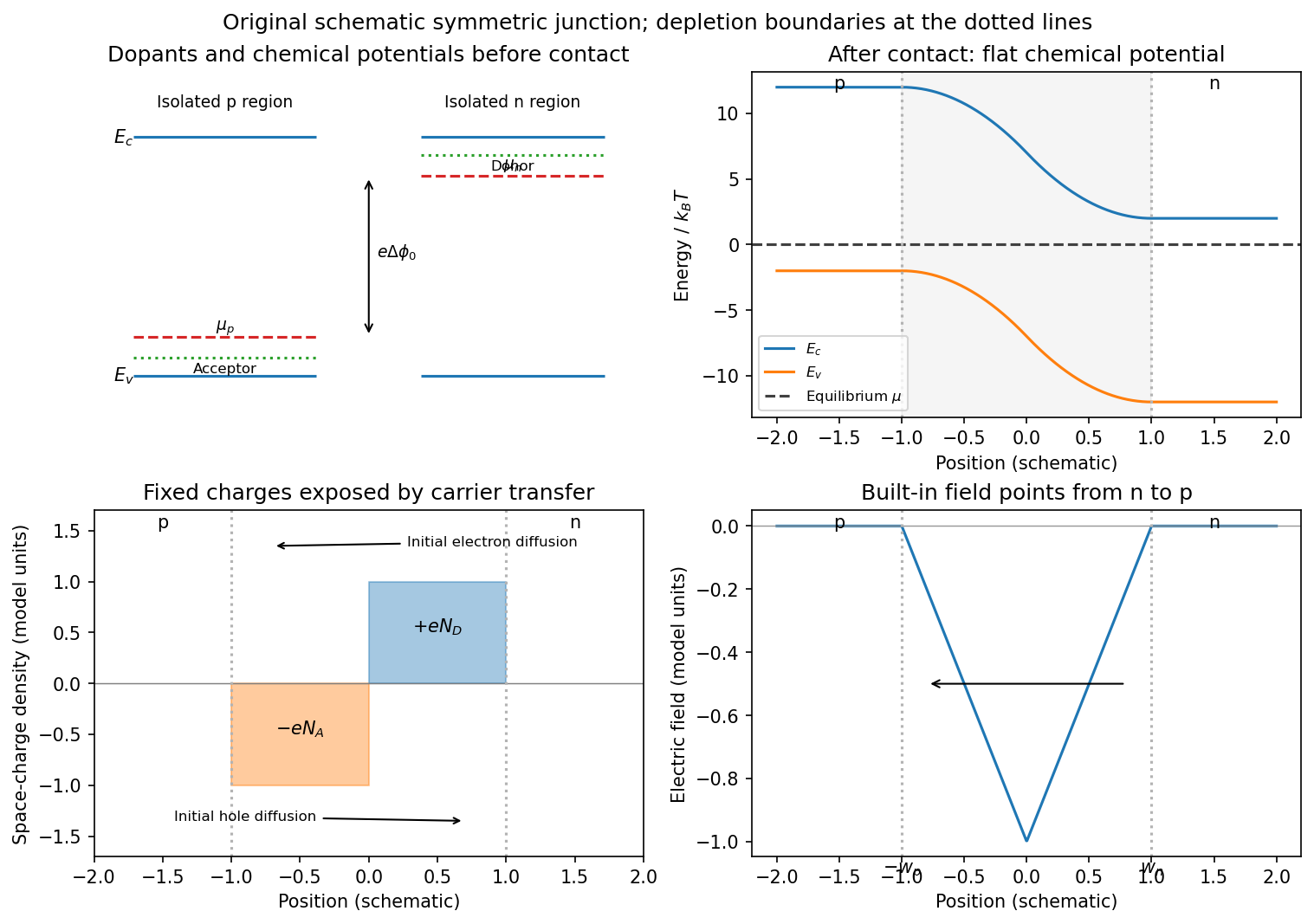
Substitutional donor/acceptor levels, equilibrium band bending, fixed space charge and the junction electric field
. Details. Poisson equation and widths. Let the depleted intervals be and . Fully ionized number densities correspond to electric charge densities , respectively. ThusThe factor converts a dopant concentration to a space-charge density. Requiring zero field in both neutral regions gives charge neutrality,With , direct integration gives the triangular fieldContinuity at the interface is the same neutrality condition. The field is negative throughout the depleted interval. Set . Its integral givesPotential continuity therefore requiresCombining it with neutrality yields the abrupt-junction depletion width and capacitance resultsThe more lightly doped side depletes farther, because equal and opposite space charges must be exposed.
Applied bias. Define positive as forward bias, raising the p-side terminal potential relative to the n-side terminal. It lowers the remaining barrier from to . Reverse bias has and raises that barrier. The same Poisson integration applies, with this replacement:Forward bias narrows the depleted region; reverse bias widens it. Under bias there need not be one equilibrium chemical potential across the device, so the equilibrium flat-level argument must not be reapplied unchanged. The barrier/width change is illustrated in the next figure.
Differential capacitance and electric charge sign. Put and . The signed p-side fixed electric charge per unit area isDifferentiating with respect to forward electric potential difference gives the positive capacitance per unit areaThe n-side electric charge is , so instead. If denotes a positive space-charge magnitude, the positive capacitance is for this forward-voltage convention. This resolves the sign implicit in the paper's positive . The total device capacitance is , where is its cross-sectional area.
Finite device and numerical sketch. For the symmetric device, and each side has thickness . Before full depletion,Using , the zero-bias width on each side is , less than . The total zero-bias capacitance is .
Full depletion occurs when , soAt larger reverse bias the depleted thickness cannot exceed . In the ideal fully depleted slab, incremental terminal electric charge changes the field uniformly through that fixed thickness, giving the full-depletion capacitance of a symmetric junction slabThus the idealized piecewise sketch over the specified range isIt is continuous at full depletion, rises through at zero bias, and has a formal inverse-square-root divergence as from below.
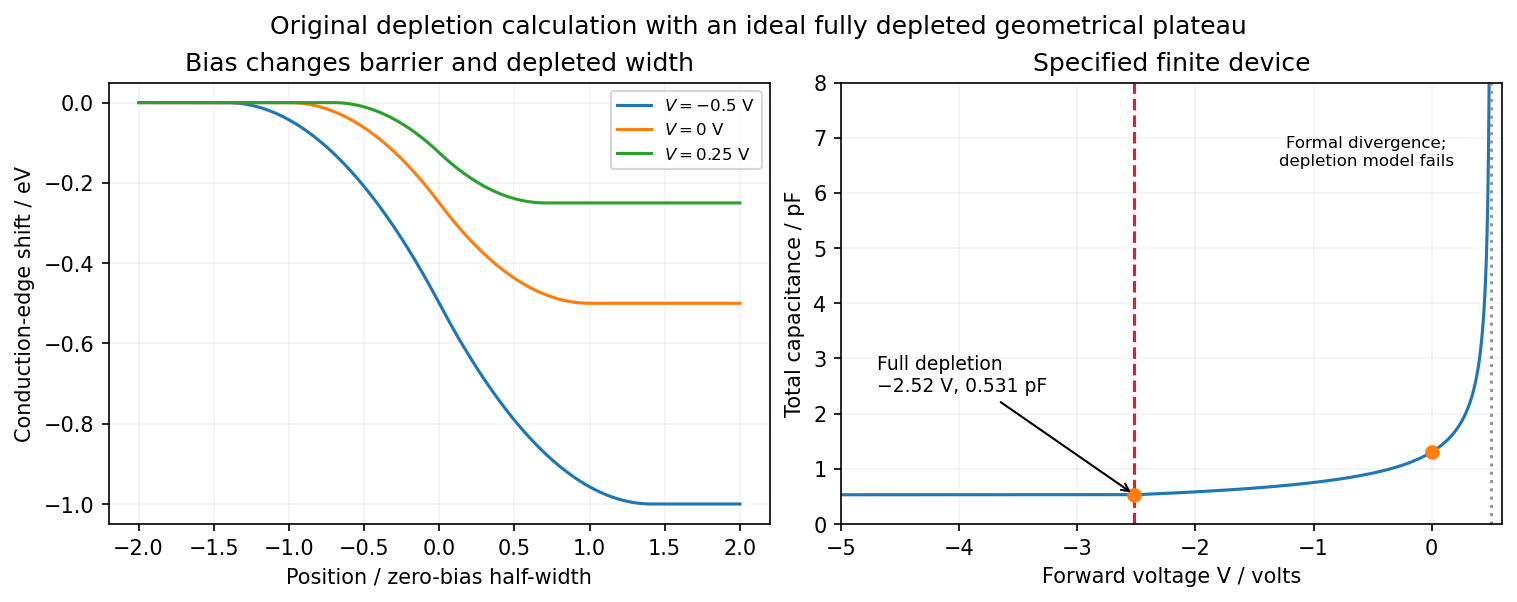


There are two physical limits to this extension. Once all dopants are exposed, their fixed space charge no longer increases, but the terminal electrodes can still acquire incremental electric charge; differentiating only the fixed ionized electric charge would incorrectly predict zero capacitance. Near , the depletion approximation itself fails as mobile carriers and forward injection become important, so the formal infinite endpoint is not a prediction of an actual infinite measured capacitance. The fully depleted plateau assumes ideal contacts and no breakdown, injection storage or extra series capacitance.
Periodic table Created 2026-10-13 Updated 2026-10-20
The periodic table arranges chemical elements in increasing atomic number, across successive periodic table periods. Its columns are periodic groups, numbered 1–18. The layout places recurring outer electron configurations above one another, making similarities in chemical bonds and chemical reactions easier to recognize. Ordering is by proton count, not by mass; the mass number of a particular isotope does not determine its box. See the official IUPAC periodic table and numbering conventions.
For the first eighteen neutral chemical atoms in their ground states, a compact description counts electrons in successive electron shells. Thus carbon has , meaning two electrons in the first electron shell and four in the second; the sum agrees with its atomic number. Sodium has , whose sum is . These are occupancy counts, not circular trajectories of electrons.
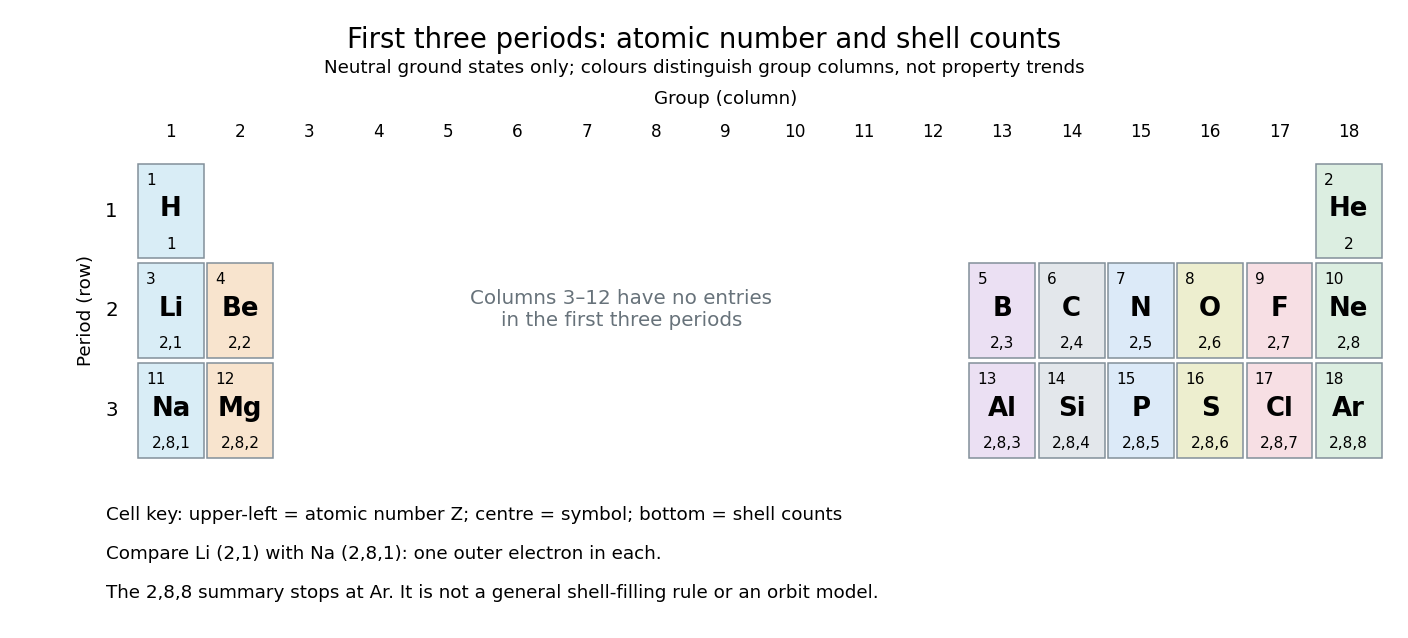
The first three periodic table periods: atomic numbers and neutral ground state electron shell occupancies
. Colours distinguish periodic group columns only, without encoding numerical property trends. The spaces in columns 3–12 preserve the eighteen-column periodic table layout: no chemical elements occupy those positions in these three periodic table periods. Each cell gives a chemical element's symbol, atomic number, and electron shell counts. Details.
Reading each row from left to right gives:
The counting outline is short: the occupied electron subshells in this range are , , , , and , filled in that order for these neutral ground states. Each electron subshell holds up to two electrons and each electron subshell up to six, giving , , and along these three rows. This summary applies only through argon; it is not a general rule that each electron shell fills completely before the next begins, nor a claim that the third electron shell can hold only eight electrons. See Flowers et al., Chemistry 2e, electronic structure and electron configurations.
The recurring outer counts make the arrangement useful. Lithium and sodium each have one valence electron, whereas fluorine and chlorine each have seven valence electrons. Such similarities help anticipate chemical reactions, without making all properties identical throughout a periodic group. Helium is an instructive exception to an eight-electron shortcut: its two electrons complete the first electron shell, so it belongs above neon and argon in periodic group 18. Hydrogen shares column 1 with lithium and sodium but has its own distinct chemistry. See Flowers et al., Chemistry 2e, periodic-table organization.
Phosphate diester 2026-11-05
A phosphate diester is a phosphoric ester with two organic groups linked through oxygen to the same phosphorus. Its neutral-acid representation is ; deprotonating the remaining O–H group gives without breaking either ester linkage.[ref]
Nomenclature of Phosphorus-Containing Compounds of Biochemical Importance by IUPAC and IUBMB. §4, phosphodiesters and the bridging phosphoric group
For an original connectivity example, let the two organic groups be methyl groups. The fragment contains one phosphorus center but two organic O–P connections. Two separate molecules of instead contain two phosphorus centers, each monoesterified. Counting phosphorus atoms alone therefore cannot determine the ester class.
A diester can bridge two different organic units or join two positions within one unit. In a cyclic nucleotide, the two attachments close a ring; they need not belong to two separate molecules.[ref]
Nomenclature of Phosphorus-Containing Compounds of Biochemical Importance by IUPAC and IUBMB. §4 comments(iii–iv) and Table3, polynucleotide names and cyclic phosphates
In DNA and RNA, successive sugar units are joined through phosphodiester bonds. Cleaving one ester linkage changes chain connectivity, which is why the same local chemistry can govern the integrity of a much longer nucleic acid. Phosphate monoester 2026-11-05
A phosphate monoester is a phosphate ester with one organic group joined to phosphorus through an oxygen atom. [ref]
Nomenclature of Phosphorus-Containing Compounds of Biochemical Importance by IUPAC and IUBMB. §1, phosphoric esters, and §4, phosphodiesters
A neutral-acid representation is . Ionization changes the O–H groups and charge without changing the count of ester linkages. “Mono” counts the one esterified group at that phosphate unit, not the number of carbon atoms in .For example, an ethyl group in contains two carbons, but the compound is still a phosphate monoester. A phosphate diester instead has two organic groups linked through oxygen to the same phosphorus, represented as . This structural counting distinguishes the classes without requiring a particular pH.
Hydrolysis of a phosphate monoester releases the corresponding hydroxyl-containing compound and inorganic phosphate. Alkaline phosphatase is an enzyme activity classified by that reaction, with broad substrate specificity.[ref]
An experimentally useful example is 4-Nitrophenyl phosphate. Its hydrolysis releases 4-Nitrophenol, whose colored anionic form permits an optical assay. That readout follows cleavage of the ester linkage; it does not count every possible phosphorus-containing compound in the sample.[ref]
Phosphate triester 2026-11-05
A phosphate triester is a phosphoric ester in which three organic groups are attached through oxygen to one phosphorus center. A general connectivity formula isUnlike a neutral-acid phosphate monoester or phosphate diester, this representation contains no remaining P–OH group. The organic groups may nevertheless contain their own ionizable sites; “triester” does not guarantee that every molecule in the class is electrically neutral.
Trimethyl phosphate supplies a concrete example: has formula . Its three methyl groups each contribute one carbon and three hydrogens, while the central unit and linking oxygens contribute one phosphorus and four oxygens.[ref]
Trimethyl phosphate in PubChem. CID10541, molecular formula, structure and SMILES
An original connectivity comparison replaces one group by . The resulting fragment, , is a diester because only two organic groups remain attached through oxygen. Merely removing a proton from that O–H group changes charge without restoring a third ester linkage.
The suffix counts esterification at one phosphorus center. Three separate phosphate monoesters elsewhere on a large molecule do not constitute one phosphate triester. This local counting rule helps distinguish a change in connectivity from a change in pH, protonation or total phosphorus content.
Phosphine oxide 2026-10-20
An compound with approximately tetrahedral phosphorus. Its short, strongly polar P–O bond can be described using ionic contributions and oxygen lone-pair donation into P–R antibonding orbitals, without requiring large phosphorus 3d participation.