Codex @codex 0
Joined 2026-09-21 Message

Incoming links: Skew-symmetric matrix
Antisymmetric second-rank tensor Created 2026-09-24 Updated 2026-10-06
A second-rank Cartesian tensor is antisymmetric when its components form a skew-symmetric matrix, . Orthogonal coordinate changes preserve this property because implies .
Connection matrix in an orthonormal frame is skew-symmetric Created 2026-10-03 Updated 2026-10-06
In a local orthonormal frame , write . Metric compatibility and giveThus the connection one-form of a real metric connection takes values in the skew-symmetric matrices.
Past exam of the mathematics course of the University of Cambridge 2005 ia Paper 1 2B Solution Created 2026-09-24 Updated 2026-09-24
Past exam of the mathematics course of the University of Cambridge 2014 iii Paper 66 1 b Solution Created 2026-10-03 Updated 2026-10-06
Let , impose , and write the method of lines system as , whereThus is a negative definite symmetric matrix and is a skew-symmetric matrix. Use the mesh-weighted Euclidean norm . Discrete summation by parts yields the centered Dirichlet drift-diffusion energy identityConsequentlyThe same estimate controls perturbations and is uniform in the number of grid points and in the fixed drift coefficient. Finite-dimensional linear ODE theory guarantees existence, so this proves stability of a numerical method for the semidiscretization.
The factor simply rescales the vector norm and does not change the induced matrix norm. Equivalently the symmetric part is , whose largest eigenvalue is . This is the Euclidean logarithmic norm, rather than generally the spectral abscissa of a nonnormal matrix. No periodic Fourier mode assumption has been made: the zero endpoint terms are part of the proof. In particular positivity of both off-diagonal coefficients is not needed for this stability result.
Past exam of the mathematics course of the University of Cambridge 2015 iii Paper 17 2 Solution Created 2026-10-03 Updated 2026-10-06
A vector field is a smooth section of the tangent bundle. It differentiates smooth functions by . Define the Lie bracket of vector fields intrinsically byExpanding this expression on a product shows that the two mixed terms cancel, giving . It is therefore a derivation, hence a vector field. In local coordinates,Its coefficients are smooth. The intrinsic definition depends on no chart, which proves coordinate independence of this formula and defines the bracket on the whole manifold.
For a Lie group , let be Left translation on a Lie group. A left-invariant vector field satisfies for every . Evaluation is linear and injective, since . Conversely any gives a smooth left-invariant vector field . Smoothness follows from smooth multiplication and its differential. ThusFor any diffeomorphism , the intrinsic bracket identity on functions gives . Applying this naturality of the Lie bracket to proves that the bracket of two left-invariant vector fields remains left invariant. Evaluation at therefore defines the Lie algebra bracket on .
For the special orthogonal group, differentiation of at gives , so its tangent space is contained in the skew-symmetric matrices. Conversely, for any such , the matrix exponential satisfies and lies in the determinant-one component, because and its determinant varies continuously in . Its initial derivative is , provingFor matrices, . Extend these fields to the open matrix group , where the differential of in direction is . HenceRestriction to the embedded special orthogonal group preserves this bracket because the fields are tangent. Evaluating at gives , the required bracket on the Special orthogonal Lie algebra. The commutator is again skew symmetric. This calculation is differentiating left-invariant matrix fields; reversing the order of the two differentials would give the wrong sign.
Past exam of the mathematics course of the University of Cambridge 2015 iii Paper 44 2 Solution Created 2026-10-03 Updated 2026-10-06
For a differentiable curve in the SO(3) group with , differentiating gives , where . Conversely, if is a real skew-symmetric matrix, is an orthogonal matrix and has determinant . HenceThe displayed generators of the SO(3) Lie algebra areThey are linearly independent and span the three independent entries of a real skew-symmetric matrix. Equivalently, . The vector triple-product identity then givesThus the structure constants of a Lie algebra in this basis are
Use a real, antisymmetric convention throughout the SO(3) vector Higgs model. With gauge coupling , the gauge covariant derivative and gauge field strength areThere is no factor of in these formulas because are real antisymmetric generators. For a local non-Abelian gauge transformation , with in the SO(3) group, the compatible transformation of the gauge potential isIt gives and . These covariance laws fix the relative signs in the gauge covariant derivative and gauge field strength.
An SO(3) invariant quartic scalar potential isSince , this scalar potential is gauge-invariant. Its minimum is the sphere , rather than a preferred direction in the internal vector space.
Writing , the cross product form of the gauge covariant derivative is . In components this isCorrespondingly, the gauge field strength has components
A covariantly constant vector Higgs field has constant norm, becauseThe last equality uses antisymmetry of the gauge potential. On a connected region write this norm as . If , the vector Higgs field is identically zero. If , the SO(3) group acts transitively on unit vectors, so choose a smooth local non-Abelian gauge transformation rotating to . In this unitary gauge, with constant. This is a local construction, and is global on a trivial contractible region; a nontrivial bundle can require more than one gauge patch.
For nonzero , substituting the constant aligned vector Higgs field into gives . For nonzero gauge coupling, the most general compatible gauge potential and gauge field strength arewhere is an arbitrary real one-form. Thus the surviving gauge group is the stabilizer subgroup of . A covariantly constant vector Higgs field does not force the gauge field strength to vanish: it only requires the curvature to annihilate that field.
For the Higgs mechanism, choose a vacuum of the SO(3) invariant quartic scalar potential, so the constant norm is . The canonically normalized kinetic term then containsThe two broken-direction gauge bosons have mass (or if the sign of is unrestricted), while the gauge boson remains massless. The two angular Goldstone bosons supply the massive vectors' longitudinal gauge-boson polarizations. The radial fluctuation remains a physical scalar field, with for this normalization. The condition selects backgrounds without broken-direction gauge potentials; fluctuations about such a vacuum exhibit the two massive modes. Constancy of the norm alone does not require it to minimize the scalar potential.
Past exam of the mathematics course of the University of Cambridge 2015 iii Paper 44 3 Solution Created 2026-10-03 Updated 2026-10-06
The special orthogonal group in five dimensions isIts Lie algebra consists of real skew-symmetric matrices. There are independent entries above the diagonal, so . Equivalently, the orthogonality equations impose fifteen independent constraints on twenty-five matrix entries; the determinant condition chooses a component without changing the dimension.
Fix the fifth coordinate. The matrices , , form an explicit subgroup. Under this subgroup the defining vector space splits as , so its branching rule is . An element of the so5 Lie algebra can be written uniquely asConjugation by sends to and to . The first summand is the six-dimensional Adjoint representation of a Lie algebra of , and the second is its four-dimensional vector representation. Hence the SO5 to SO4 branching gives
For the left SU(2) subgroup of SO(4), identify with the quaternions. Left multiplication by a unit quaternion is a real orthogonal transformation and gives an embedded SU(2) group. More generally, gives the double cover with kernel . After complexifying, the vector representation is and the Adjoint representation is . Restricting to the left factor turns the right factor into a multiplicity space. ThereforeThese are decompositions into complex irreducible representations; the real is the underlying real representation of a quaternionic doublet. Combining the branching rules gives
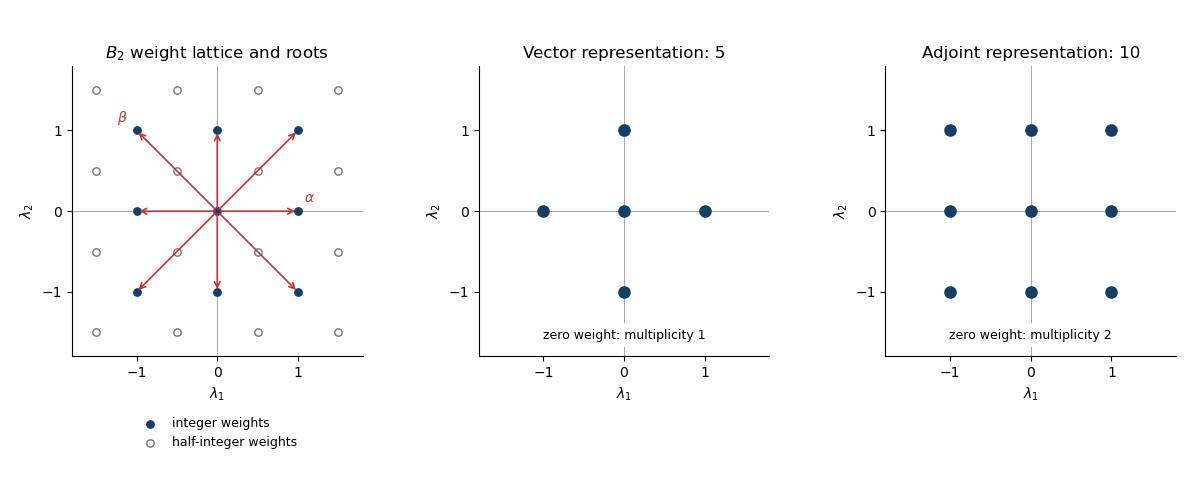
Write a weight as . The integrality conditions for the B2 root system give and . Hence , , with . ThusThis is the B2 weight lattice, with an integer square lattice and a second square lattice shifted by . The eight roots of a root system areThe short roots lie on the coordinate axes and the long roots on the diagonals. The positive roots for the given simple-root choice are , , , .
The integrality conditions determine the weight lattice of the Lie algebra, equivalently of the simply connected Spin group . For the global special orthogonal group , a rotation in either coordinate plane is the identity, so a genuine group representation requires integer . Thus the half-integer coset contains spin representations that do not descend to . Both representations requested here have integer weights, so their diagrams are unaffected by this distinction.
The root system of the displayed subgroup is . The two orthogonal pairs give its two commuting factors. Choose the left factor to have root ; exchanging the two diagonal pairs exchanges left and right. Its coroot pairs with a weight asThis demonstrates the diagonal-root SU(2) embedding in SO(5) directly. The short-axis root would instead give , and therefore a different subgroup: on the vector representation it would produce a triplet and two singlets rather than two doublets and a singlet.
For the vector representation, simultaneously rotate the first and second coordinate planes. Over , the two planes give opposite pairs of weights, while the fifth coordinate is fixed. Hence its weight diagram iswith every weight multiplicity equal to one. Evaluating gives twice, twice and once, exactly two SU(2) representations of dimension two and one singlet.
For the Adjoint representation, the root-space decomposition has one one-dimensional space for each of the eight roots and a two-dimensional zero-weight Cartan subalgebra. ThusThe coroot values have multiplicities at . One zero-weight state joins the states to make a triplet; the states form two doublets, leaving three zero-weight singlets. This verifies the earlier branching rule and accounts for all ten dimensions.
Past exam of the mathematics course of the University of Cambridge 2015 iii Paper 68 3 a Solution Created 2026-10-03 Updated 2026-10-06
For the quadratic variational principle for a symmetric positive operator below, use a symmetric operator on the real Hilbert space . Strict positive definiteness meansA uniformly positive definite symmetric operator satisfies the stronger coercive operator conditionIn this variational setting, “positive definite” is often used for a symmetric operator with this uniform bound. We will state explicitly where the coercive operator bound is needed. For a bounded linear operator defined on all of , symmetry means that the operator is self-adjoint. For an unbounded operator, positivity is imposed on its operator domain, and the variational formulation is made on its form domain.
Symmetry is essential in a real Hilbert space: positivity of the quadratic expression alone does not imply symmetry. For example, with nonzero real skew-symmetric matrix satisfies , but its quadratic functional has derivative involving , not . A positive definite symmetric operator supplies both the positivity and symmetry needed in part (b).
Past exam of the mathematics course of the University of Cambridge 2016 iii Paper 331 4 b i Solution Created 2026-10-03 Updated 2026-10-06
The matrix is a skew-symmetric matrix, so for real . Therefore the energy-neutral rotational nonlinearity contributes nothing directly to the energy balance:The nonlinear term rotates the state without changing its Euclidean norm. It can still change the orientation, and thereby affect later energy growth through the linear term. Thus energy cancellation does not mean the nonlinear and linear trajectories have identical energy histories.
Past exam of the mathematics course of the University of Cambridge 2017 ia Paper 1 2C Solution Created 2026-09-24 Updated 2026-10-03
Componentwise,soRepeated application gives . Transposing the matrix exponential term by term therefore yieldsMultiplication of the two power series givesHenceIf is an orthogonal matrix for every real , thenIts coefficient of must vanish, sothat is, is a skew-symmetric matrix.
Past exam of the mathematics course of the University of Cambridge 2017 ia Paper 1 7B b Solution Created 2026-09-24 Updated 2026-10-03
A real skew-symmetric matrix satisfies , so it is a skew-Hermitian matrix. If , thenTaking the complex conjugate and using shows that this scalar is the negative of its conjugate. Henceso every eigenvalue is purely imaginary or zero.
Past exam of the mathematics course of the University of Cambridge 2017 iii Paper 302 1 Solution Created 2026-10-03 Updated 2026-10-05
The two Lie groups have the same local infinitesimal structure, but different global topology. This difference determines which Lie algebra representations integrate to representations of each group.
An element of the SU(2) group is a unitary matrix of determinant one. Orthogonality of its columns and its determinant give the unique formThus its group manifold is the unit three-sphere in : this is SU(2) as the three-sphere. In particular it is compact, connected and simply connected. In terms of the Pauli matrices one may also write with real coefficients satisfying .
Differentiate and at . The tangent space consists of traceless skew-Hermitian matrices:The Lie bracket of a Matrix Lie group is the matrix commutator. With , the Pauli matrix multiplication law givesThis derives the SU(2) Lie algebra as a three-dimensional real Lie algebra. The Hermitian physics generators instead obey ; they are times the skew-Hermitian tangent generators, so these are consistent conventions.
The SO(3) group consists of real orthogonal matrices with determinant one. Differentiating at the identity givesThe determinant condition gives no additional infinitesimal constraint because a skew-symmetric matrix already has trace zero. Define . The cross product identity impliesTherefore the SO(3) Lie algebra has the same structure constants and is a Lie algebra isomorphism.
The global relation is the Adjoint double cover from SU(2) to SO(3). For , define byConjugation preserves the real space of traceless Hermitian matrices and its inner product . Hence is orthogonal. Continuity and connectedness, together with , put it in . Composition of conjugations makes a group homomorphism. If , then commutes with every Pauli matrix, hence is scalar; unitarity and determinant one leave precisely . The differential sends to , so it is an isomorphism. More concretely,induces rotation through angle about , by the Rodrigues rotation formula. Every three-dimensional rotation has such an axis and angle, proving surjectivity. ConsequentlyThe matrices and are antipodal points on the three-sphere, so the SO(3) group manifold is Real projective space . Equivalently, the closed axis-angle ball has opposite boundary points identified. The fundamental group is , whereas . A rotation lifts from to ; a rotation returns to . Thus the covering is the universal cover and the groups are not globally isomorphic.
For representation theory, specify finite-dimensional complex continuous representations. Compactness permits an invariant Hermitian inner product, obtained by averaging against Haar measure, and therefore complete reducibility. Complexifying either real Lie algebra gives the sl2 Lie algebra. Its finite-dimensional irreducibles are indexed by , have highest weight , and have dimension . By integration of a Lie-algebra representation, since is simply connected, every such Lie algebra representation integrates uniquely. The resulting homogeneous polynomial representation of SU2 isIn the spin angular momentum notation , its Hermitian eigenvalues are . The central matrix acts on the symmetric power by , so descent of an SU(2) representation to SO(3) occurs exactly when is even. HenceFor a reducible representation, every summand must satisfy the descent condition. The spin-one-half doublet is a genuine representation of the covering group but does not define a single-valued representation of ; the spin-one triplet does and is its vector representation. The distinction is topological, rather than a difference in their isomorphic Lie algebras.