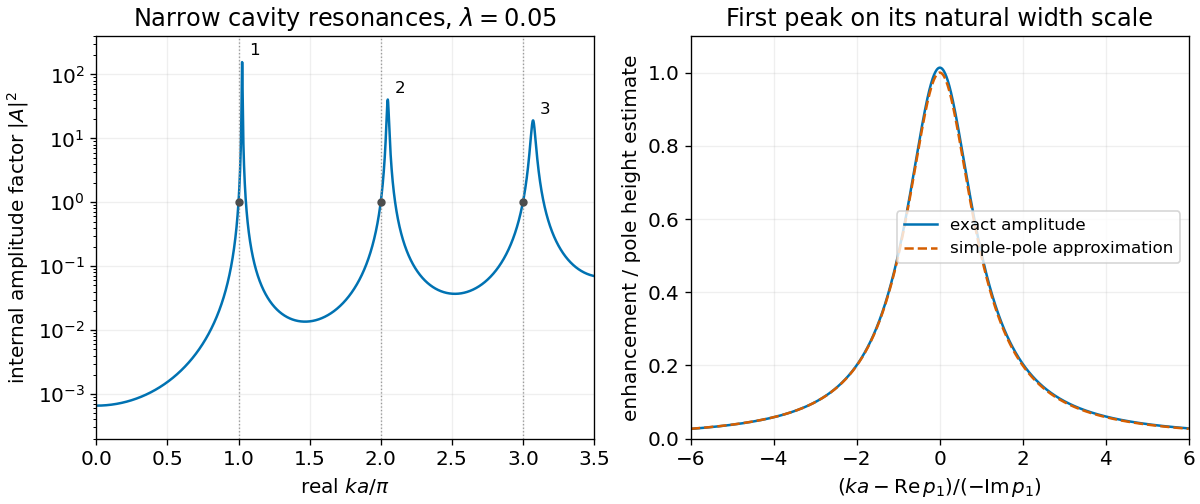
For real , taking the modulus squared of the amplitude gives the half-line delta-well amplitude enhancement
The supplied resonance poles have real parts and negative imaginary parts for fixed low at .[ref] Linearizing the denominator at a simple pole gives
Thus the sketch has narrow, tall peaks with a locally Lorentzian line shape, just above positive integer multiples of . Their half-widths are , and the leading peak heights are . In this fixed-low-mode approximation, increasing broadens and lowers the peaks. Exactly at , the value is one. At zero it has the finite limit for .
The peaks represent long-lived standing waves between the wall and the attractive delta potential. Despite the source's transmission-coefficient terminology, is an internal amplitude factor and can exceed one. The interior probability current is zero, and the reflected probability current equals the incident magnitude; the hard wall passes no transmitted flux.
The supplied confinement criterion alone fixes a product, not a unique current or machine size. Choose a representative ion density . Then
For to , the same criterion gives to . These are illustrative density choices, not additional source data.
For a current estimate, assume a large-aspect-ratio circular tokamak with major radius , minor radius , toroidal field and edge tokamak safety factor . The geometrical winding relation and Ampère's law give
For the stated assumptions,
so toroidal plasma currents of order megaamperes are a natural scale. As a consistency check at , quasineutral singly charged heavy hydrogen has total thermal pressure . With , , so the assumed magnetic pressure exceeds the thermal pressure. The particular current depends on geometry and field-line pitch; it cannot be inferred from the confinement product alone.
A purely toroidal magnetic field is stronger on the inner side of the torus and its field lines are curved. The resulting magnetic gradient drift and curvature drift move ions and electrons vertically in opposite directions. Charge separation can then produce an electric field whose E-cross-B drift moves the plasma across the nominal toroidal confinement region. Closing field lines into circles therefore does not by itself guarantee confinement.
A tokamak combines a strong externally produced toroidal field with a poloidal field supplied largely by toroidal plasma current. Field lines wind helically around nested magnetic flux surfaces. A particle following a field line samples different vertical and radial parts of the torus, so the systematic displacements associated with the toroidal geometry can compensate over its orbit rather than accumulating as in the pure-toroidal case. The poloidal field also provides the magnetic structure needed for force balance. This improves confinement but does not eliminate all orbit losses or transport: trapped particles, collisions, turbulence and magnetohydrodynamic instabilities remain important. Maintaining the plasma current and suitable field-line winding is part of the confinement problem.
Seek a constant transverse guiding-centre drift whose magnetic Lorentz force balances the applied force. Define
Since , the vector triple-product identity gives . Writing therefore reduces the full equation to , the ordinary gyromotion equation. Its transverse orbit is circular in the drifting frame, so
Averaging over a gyroperiod removes the transverse oscillatory velocity and leaves this drift, together with any constant parallel velocity. For an electric force , this becomes the charge-independent drift; a charge-independent force instead gives opposite drift directions for opposite charge signs.
Take . The magnetic Lorentz force gives
Thus , while is constant. Integrating the transverse velocity gives a circle of radius about a fixed guiding centre; adding gives a helical motion in a uniform magnetic field. The magnetic force does no work, so the speed and kinetic energy remain constant. The handedness reverses with the sign of . If the helix degenerates to a circle; if it is a straight line parallel to the field.
For a sinusoidal laser field of peak amplitude , an electron's peak nonrelativistic quiver speed is . Choose the one-component electron thermal speed . The vacuum-equivalent laser intensity is , so the onset occurs at
Using as the thermal-speed convention doubles this estimate; its order of magnitude is the physical content. Once the quiver is comparable to the thermal speed, a collision rate computed for an undriven thermal distribution is no longer adequate.
Relativistic motion begins when the normalized field is of order one. Thus
The ratio checks the separation of the two regimes. These estimates use peak field and cycle-averaged vacuum intensity. The small refractive-index and interface-transmission corrections in this underdense plasma change only the few-percent prefactor, below the accuracy intended here.
Use collisional inverse bremsstrahlung in a weakly coupled, unmagnetized plasma. The specified density is , and . The electron Debye length is , the plasma frequency is , and the laser angular frequency is . Thus : the plasma is underdense and a propagating wave exists.
Estimate as the larger of the classical Coulomb-deflection length and the electron quantum length . Both are about here, giving . With the usual thermal collision convention,
The factor follows from .[ref]
The weakly collisional Drude model gives for fields proportional to . Expanding at yields a real refractive index and intensity attenuation coefficient
Consequently the intensity e-folding absorption length is
i.e. of order a centimetre. Taking a Coulomb logarithm between about 5 and 10 gives roughly –. The electric-field amplitude decay length is twice this intensity length. This estimate assumes a uniform slab thick enough to define an absorption length and neglects gradients, nonlinear quiver heating and other absorption mechanisms.
Define the plasma parameter here as the number of electrons in an electron Debye sphere,
Some texts instead use , or its inverse as a coupling parameter. A weakly coupled collective plasma has ; fluctuations from individual nearby particles are small compared with the collective description.
A Coulomb collision means the cumulative deflection or relaxation produced by many small-angle encounters, not necessarily a hard contact between two particles. The Coulomb logarithm summarizes the impact-parameter range, with of order . A process is collisionless when its timescale is much shorter than the appropriate collisional relaxation time, or its length scale is much smaller than a corresponding mean free path. It still contains collective interactions.
For fully ionized ions of charge , a thermal electron–ion momentum-relaxation rate has the scaling
up to numerical factors depending on the Debye-sphere and collision-time conventions. More explicitly, the Maxwellian rate used below gives , or . Specifying this factor prevents mixing a small coupling parameter with a large Debye-sphere population.[ref]
The electron Debye length is the scale over which a weak electrostatic disturbance is screened. Take the ions as an immobile neutralizing background and the electrons as an isothermal Boltzmann distribution. For a small potential ,
Poisson's equation then becomes away from the perturbing source, with
A test charge has a screened potential proportional to . For fully static screening with mobile ions, inverse squared Debye lengths from all species add; the displayed expression is the electron scale used below.
The electron plasma frequency is the natural collective oscillation frequency when electrons are displaced from a nearly fixed ion background. Displace a uniform electron fluid by along a slab normal. The charge separation produces the restoring electric force on an electron. Hence and
It sets a response time and the cold unmagnetized electromagnetic cutoff frequency. These collective effects arise from long-range electric fields, even when individual binary collisions are infrequent.
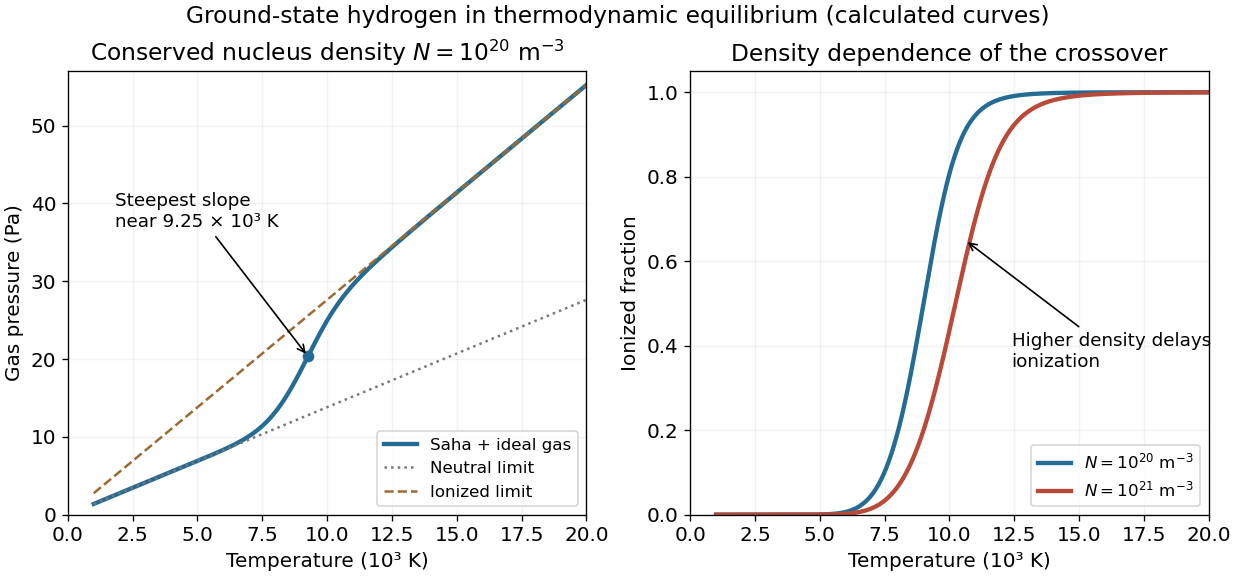
Increasing the conserved nucleus density to multiplies the low-temperature neutral-gas slope and high-temperature ionized-gas slope by ten. However, at a fixed intermediate temperature, is smaller, so a smaller fraction is ionized. The curved transition therefore moves to higher temperature; the new graph is not simply ten times the old graph throughout the crossover.
At a fixed chosen ionization fraction, must increase tenfold. Locally this requires
which is of order in this region. Directly evaluating the same Saha equation at moves the maximum pressure slope from about to . The two asymptotic slopes still have ratio two, because each hydrogen nucleus still contributes one particle when neutral and two when fully ionized.
Let be the conserved number density of hydrogen nuclei, whether ionized or bound, and the ionization fraction. The ideal gas pressure counts neutral atoms, free protons and free electrons:
At low temperature and . Heating through the ionization region increases the particle count as well as their thermal energy, giving a steeper rise. At high temperature , so and the asymptotic slope is twice the low-temperature slope. There is a smooth ionization crossover, not a pressure discontinuity.
The held graph is legible. Representative readings are and , with readout uncertainties of roughly – and about . They give on the neutral branch and on the ionized branch, respectively. Both are consistent with
The error is a conservative graph-reading estimate, not a fitted experimental confidence interval.
For that density, the Saha equation gives at , at , and at . Differentiating the ionization relation gives
The calculated maximum slope occurs near , consistent with the source's visibly steepest region at roughly . This checks the actual slope rather than identifying it without justification with exactly half ionization.
Taking the neutral ground-state gas as the zero of internal binding energy, the matter energy density is translational kinetic energy plus ionization energy:
At , with , these terms are about and , giving
Rest energies are excluded. A separate equilibrium radiation field, if the gas were in a blackbody cavity, would add its own radiation energy density; it is not part of this gas-only estimate.
Figure 1.
Calculated hydrogen pressure and ionization crossover at two conserved nucleus densities
. Details.
Assume ideal, nondegenerate particles in local thermodynamic equilibrium, ground-state atomic hydrogen, no molecules, and a common temperature. Let be the thermal de Broglie wavelength. Choose zero energy for a separated stationary proton and electron, so a neutral atom has ground-state energy . The classical chemical potentials are
Chemical equilibrium for requires . Rearranging gives
Including electron and proton spin degeneracy, , and when hyperfine splittings are neglected. Hence the statistical factor is one. Also , so . Charge neutrality gives , and therefore
This is the specified ground-state Saha equation. Keeping excited atomic partition functions or a different spin-counting convention can change a prefactor, so its convention must be stated rather than silently adding a factor of two. The left side has dimensions of a number density, not a dimensionless electron-to-neutral ratio.
Use the initial equal-concentration, zero-potential reference, or equivalently quote component changes relative to the initial electrochemical equilibrium. At , with ,
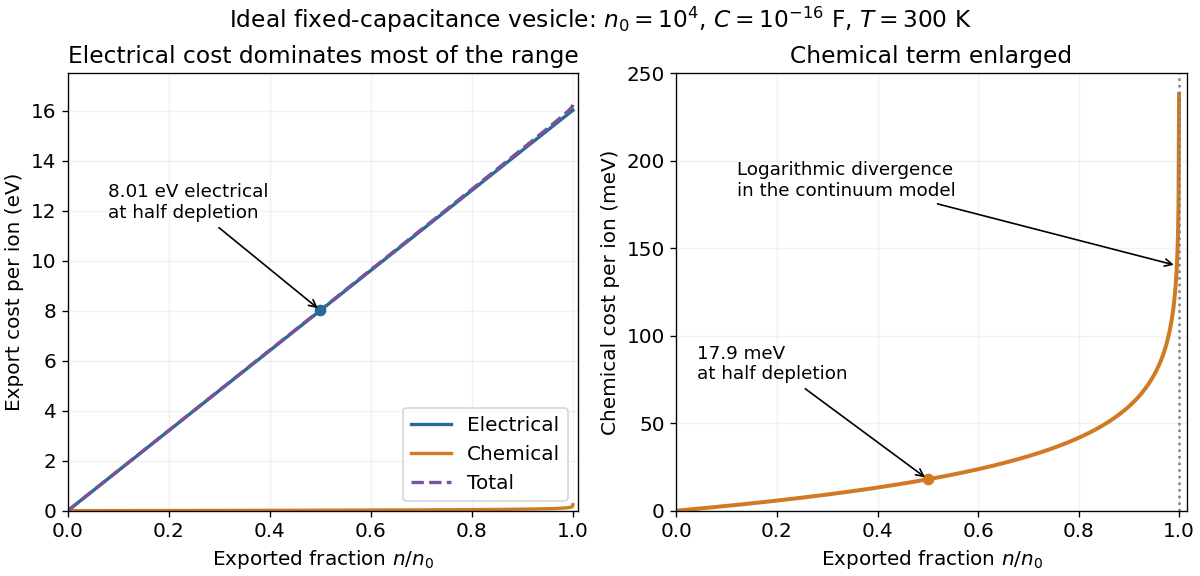
At room temperature , the chemical component is
The electrical cost dominates by about . The associated change in membrane potential is . Such a large voltage is a consequence of the ideal fixed-capacitance, perfectly impermeable model; an actual lipid membrane would not generally remain intact and nonconducting over this entire extrapolation.
The electrical component is a straight line through zero, . The chemical component, , starts at zero, increases convexly, and diverges as because the remaining internal concentration vanishes. Their sum lies above both: nearly electrical over most of the stated range, but eventually diverging with the chemical term. For a nonzero initial equilibrium potential, the separate absolute electrical and chemical components have opposite constant offsets; the total curve and the quoted changes remain the same. The final few ions require a discrete-particle treatment rather than a literal continuum divergence.
Figure 1.
Electrical, chemical and total sodium export costs in the ideal vesicle model
. Details.
Use number concentrations and write the electrochemical potential of a sodium ion as . Define the inward sodium-motive force as available work per positive charge for transport from outside to inside. With ,
Its negative is the signed inward free-energy cost per charge; stating this direction removes a common sign ambiguity.
Long-open sodium channels establish electrochemical equilibrium, . This does not generally require equal concentrations: impermeant counterions can support a nonzero equilibrium membrane potential. Let . For a large fixed-concentration external reservoir, after pumping ions out, and . The sodium export cost from a capacitive vesicle for exporting another ion is
The initial-equilibrium relation was used in the last step. The first term is the incremental electrical cost and the second is the change in chemical cost from their initial balanced values.
If the intended initial reference is uncharged with and , then and the requested form in the listed variables is
That equal-concentration reference is an additional assumption. For example, and also give zero initial sodium flux, but a different ion inventory. Thus the open-channel condition alone cannot determine from . If concentrations are molar rather than number densities, use the corresponding Avogadro constant conversion and for molar free energies. Treating the capacitor charge discretely gives a charging-energy increment rather than the differential ; the distinction is negligible for the thousands of ions used next.
Cells interconvert several forms of free energy. Chemical concentration differences and the chemical potentials of metabolites can drive reactions, including ATP hydrolysis. The usable free-energy difference is that between reactants and products under the actual cellular conditions; breaking a chemical bond alone does not release energy without the rest of the reaction. Oxidation-reduction reactions transfer electrons down an electrochemical potential difference and can drive ion pumping in an electron transport chain. Light absorption can create excited states and charge separation in photosynthesis, eventually supporting chemical synthesis.
An electrochemical gradient stores free energy in both an ion concentration difference and a membrane potential. Chemiosmosis couples downhill ion flow to ATP synthesis by chemiosmosis; ATP-powered pumps can run the conversion the other way. Molecular motors and other mechanochemical enzymes convert chemical free energy into mechanical work or elastic strain, while ion gradients can also power transport and rotary motion. These couplings conserve total energy but dissipate some free energy as heat. Equilibrium thermal fluctuations alone cannot sustain directional work without a maintained nonequilibrium resource.
Under the simplest interpretation, each spot contains two equally bright, independently bleaching green fluorescent protein emitters. Losing one halves the fluorescence and losing the other removes it. A stable protein dimer carrying one active label per subunit is consistent with this result. The conclusion is two active emitters in the observed spot; it does not by itself rule out unresolved coincident proteins, incomplete fluorescent maturation or blinking. Permanent membrane binding makes loss by dissociation less plausible, but lateral motion out of the observation region would still need experimental control.[ref]
Let their independent photobleaching times be . Then has rate , while the memoryless remaining lifetime has rate and mean , matching the stated single-emitter calibration. The two-emitter photobleaching completion time is the maximum, not one single exponential and not a sum of two equal-rate exponential variables. Its cumulative distribution function is
Differentiating gives its probability density function:
with zero density for . It integrates to one, and its mean is . This uses two active fluorophores at the start of observation, constant illumination and independent irreversible bleaching with the calibrated rate.
The excitation rate in the weak, unsaturated fluorescence regime is proportional to the time-averaged squared electric field amplitude. Thus the illumination profile relevant to excitation is
The amplitude decay length is twice the intensity decay length. This profile is often called the evanescent excitation intensity; it does not imply a propagating normal energy flux through an ideal lossless totally reflecting interface.
Total internal reflection fluorescence microscopy restricts excitation to a shallow layer adjacent to the glass, typically on the scale of hundreds of nanometres for visible wavelengths and suitable angles. Fluorophores near the basal cell membrane are excited while much of the cytoplasm and bulk solution remain dark. The resulting reduction in out-of-focus fluorescence and autofluorescence improves the signal-to-background ratio for individual molecules, allows camera-based parallel observation, and reduces unnecessary excitation of deeper regions. Its limitation is the same selectivity: it does not image arbitrary molecules deep inside a cell. This near-interface selectivity was directly demonstrated in cell–substrate contact imaging.[ref]
Let the interface be , with glass at and water at , and choose parallel to the incident beam's tangential component. Define as the vacuum wavenumber, with glass and water refractive indices and . Continuity of phase along the interface fixes . In water, the dispersion relation is , so above the critical angle,
Choose the positive imaginary part because a field growing exponentially into the water would be unphysical. The evanescent field in total internal reflection is therefore
It propagates in phase parallel to the interface but decays normally. Here is the transmitted field amplitude at the interface; relating it to the incident amplitude requires the appropriate polarization-dependent Fresnel equations. If the symbol instead denotes the incident glass wavenumber, replace every vacuum in the formula by ; equivalently and . This states the wavenumber convention left implicit in the source.
The protein primary structure is the ordered protein sequence along a polypeptide, from its N-terminus to its C-terminus. In cells, information in a DNA coding sequence is copied into messenger RNA by transcription. During translation, the ribosome reads successive three-base codons; transfer RNA molecules match these by their anticodons and supply the corresponding amino acids. The genetic code is degenerate: different codons can encode the same amino acid. A start establishes the reading frame and a stop terminates translation. Peptide bonds link the amino acids into the backbone, leaving chemically different side chains. Thus the sequence specifies the order of side-chain interactions, rather than a literal coordinate list for the folded molecule.
Protein secondary structure describes local backbone arrangements. An alpha helix is stabilized by a regular pattern of backbone hydrogen bonds, typically between the carbonyl of residue and the amide of residue . Beta sheets assemble extended strands through inter-strand hydrogen bonding, with parallel or antiparallel strand orientations. Turns and loops connect these elements; not every region belongs to a helix or sheet. The peptide bond is approximately planar, while backbone torsion angles provide conformational freedom subject to steric restrictions.
Protein tertiary structure is the complete three-dimensional organization of one chain, often arranged into protein domains. Protein quaternary structure describes the organization of multiple chains in an assembly. Soluble globular proteins often bury nonpolar side chains and expose polar ones; membrane proteins can instead expose hydrophobic surfaces to the surrounding lipid. Other stabilizing interactions include hydrogen bonds, electrostatic interactions, Van der Waals forces and sometimes covalent disulfide bonds. These competing contributions define active sites, binding pockets and mechanically useful structures; folded proteins are dynamic ensembles, not perfectly rigid objects.
The connection from sequence to structure is thermodynamic and kinetic. Folding usually decreases the chain's conformational entropy, but favorable interactions and changes in solvent entropy, including the hydrophobic effect, can lower the total Gibbs free energy. Under suitable conditions the native ensemble is favored over unfolded alternatives. A change in sequence can therefore change the balance of accessible conformations and alter folding or function. Reversible refolding of a denatured protein in an appropriate environment demonstrates that the sequence can contain the information needed for its native structure.[ref]
The environment is part of the specification: temperature, pH, ionic conditions, ligands and post-translational modifications matter. Molecular chaperones can prevent aggregation and help chains escape kinetic traps without providing a residue-by-residue structural template. Some sequences are intrinsically disordered proteins or disordered regions, and some require partners for a stable fold. Thus primary structure strongly constrains structure, but does not guarantee one unique rigid shape independent of conditions.

Pinned article: Introduction to the OurBigBook Project

Welcome to the OurBigBook Project! Our goal is to create the perfect publishing platform for STEM subjects, and get university-level students to write the best free STEM tutorials ever.
Everyone is welcome to create an account and play with the site: ourbigbook.com/go/register. We belive that students themselves can write amazing tutorials, but teachers are welcome too. You can write about anything you want, it doesn't have to be STEM or even educational. Silly test content is very welcome and you won't be penalized in any way. Just keep it legal!
We have two killer features:
  1. topics: topics group articles by different users with the same title, e.g. here is the topic for the "Fundamental Theorem of Calculus" ourbigbook.com/go/topic/fundamental-theorem-of-calculus
    Articles of different users are sorted by upvote within each article page. This feature is a bit like:
    • a Wikipedia where each user can have their own version of each article
    • a Q&A website like Stack Overflow, where multiple people can give their views on a given topic, and the best ones are sorted by upvote. Except you don't need to wait for someone to ask first, and any topic goes, no matter how narrow or broad
    This feature makes it possible for readers to find better explanations of any topic created by other writers. And it allows writers to create an explanation in a place that readers might actually find it.

    Figure 1.
    Screenshot of the "Derivative" topic page
    . View it live at: ourbigbook.com/go/topic/derivative
  2. local editing: you can store all your personal knowledge base content locally in a plaintext markup format that can be edited locally and published either:
    This way you can be sure that even if OurBigBook.com were to go down one day (which we have no plans to do as it is quite cheap to host!), your content will still be perfectly readable as a static site.
    Figure 5. . You can also edit articles on the Web editor without installing anything locally.
    Video 3.
    Edit locally and publish demo
    . Source. This shows editing OurBigBook Markup and publishing it using the Visual Studio Code extension.

  3. https://raw.githubusercontent.com/ourbigbook/ourbigbook-media/master/feature/x/hilbert-space-arrow.png
  4. Infinitely deep tables of contents:
    Figure 6.
    Dynamic article tree with infinitely deep table of contents
    .
    Descendant pages can also show up as toplevel e.g.: ourbigbook.com/cirosantilli/chordate-subclade
All our software is open source and hosted at: github.com/ourbigbook/ourbigbook
Further documentation can be found at: docs.ourbigbook.com
Feel free to reach our to us for any help or suggestions: docs.ourbigbook.com/#contact