Topics (384k) Articles (398k) Users (410) Discussions (242) Comments (383) Files (13k) New article

Ian Mann is a metrology and laboratory-quality specialist credited with Brian Brookman as co-editor of the 2021 third edition of Selection, Use and Interpretation of Proficiency Testing (PT) Schemes by Brian Brookman and Ian Mann. The editorial page identifies him with SAS in Switzerland. This identifies the proficiency-testing author without attributing the careers of other people named Ian Mann to him.[ref]
Selection, Use and Interpretation of Proficiency Testing (PT) Schemes by Brian Brookman and Ian Mann. Editorial page, PDF p. 3, editor affiliation and recommended citation
The guide connects proficiency testing with practical decisions about laboratory measurements. Its selection criteria ask whether a scheme's material, measurand, concentration range and assessment approach fit the laboratory's actual work. A comparison using an unsuitable material can fail to test the procedure for which competence is being assessed.[ref]
Selection, Use and Interpretation of Proficiency Testing (PT) Schemes by Brian Brookman and Ian Mann. Section 5.4, fitness for purpose of a selected scheme
An original example illustrates why interpretation needs the assessment criterion. For a participant result , assigned value and standard deviation for proficiency assessment in compatible units, the proficiency-test z-score isA scheme using would give for the same result. The result and its difference from the reference did not improve; the assessment scale changed. The chosen standard deviation for proficiency assessment must therefore be read with the score.
A participant's reported standard uncertainty answers another question: how uncertain is that participant's measurement result? It is not automatically the scheme's performance criterion. The guide separates evaluation scores, assessment spread and laboratory investigation of unexpected results.[ref]
Selection, Use and Interpretation of Proficiency Testing (PT) Schemes by Brian Brookman and Ian Mann. Sections 7.2.4 and 8.2.3–8.3
Mann's documented editorial contribution is to this shared measurement-quality guidance; no separate invention or personal experimental result is implied.Michael H. Ramsey is a researcher credited as chair of the working group and co-editor of the 2019 guide to measurement uncertainty arising from analytical sampling. The editorial page gives his affiliation as the University of Sussex and names fellow editors Stephen L. R. Ellison and Peter Rostron.[ref]
Measurement uncertainty arising from sampling by Michael H. Ramsey and others. Editorial page, PDF p. 3, editors and working-group composition
The scientific problem is the difference between the collected material and the material about which a conclusion is wanted. For a measurand defined over a larger target, excellent measurement repeatability on one extract does not establish small analytical sampling uncertainty. The guide treats collection and analysis as stages of the measurement process.[ref]
An original measurement model illustrates why replication at the right level matters:Here is the target mean, is the zero-mean deviation associated with independently collected sample , and is zero-mean analytical variation in repeat . Suppose all these effects are mutually independent, with variances and . Averaging analyses on each of collected samples givesFor stipulated variance components and in squared concentration units, three collections analysed twice give variance , or standard uncertainty about concentration units. Six analyses of only one collection instead give variance , or about units. Both plans use six analyses; only the first averages over independently collected material.
The calculation assumes independent collections and an appropriate model for the target; a shared systematic collection error is not removed by increasing . It explains the measurement-design issue addressed by the guide without presenting these invented numbers as Ramsey's experimental observations.
Peter Rostron is a co-editor, with Michael H. Ramsey and Stephen L. R. Ellison, of the 2019 guide to measurement uncertainty arising from analytical sampling. Its editorial page identifies him with the University of Sussex. The guide connects laboratory analysis with the earlier act of collecting material.[ref]
Measurement uncertainty arising from sampling by Michael H. Ramsey and others. Editorial page, PDF p. 3, and Summary
An illuminating experimental design question is where to place replication. Repeating an analysis of one collected sample reveals a different source of variation from collecting another sample from the target material. A nested design can distinguish the corresponding variance components. The guide also describes an unbalanced sampling-uncertainty design with two analyses of one field sample and one analysis of its field duplicate.[ref]
An original counting example makes the design concrete. At each of ten targets, two collected samples each analysed twice require analytical results. Analysing the first sample twice and its field duplicate once instead requires . The design retains a within-sample analytical contrast at each target and a contrast between separately collected samples, with fewer analytical results. The information content and the appropriate analysis of variance must nevertheless follow the actual replication pattern; thirty results do not automatically have the same precision as forty.
This distinction matters when deciding whether to spend effort on another instrument reading or on another collection. Rostron's verified contribution here is editorial participation in the shared guidance, rather than sole authorship of every method it discusses. Repeated collection can reveal variability without, by itself, proving the absence of a common collection bias.
Paul D. Hale is a metrology researcher named with Tracy S. Clement and Dylan F. Williams on a 2001 NIST paper about optical receiver frequency response. It compares frequency-domain optical heterodyne detection with time-domain measurements using an oscilloscope, including corrections for the electrical connection and finite optical stimulus.[ref]
Frequency response metrology for high-speed optical receivers by Paul D. Hale and others. Byline, p. 1 introduction and p. 3, Time-domain measurements
An oscilloscope trace need not be the receiver's isolated impulse response. In an original idealized model of linear time-invariant systems, let be the receiver impulse response, the optical pulse envelope and the readout impulse response. Ignoring mismatch for this illustration, the measured waveform is the convolutionA broader measured pulse can therefore reflect the receiver, the stimulus or the readout. If all three envelopes are normalized Gaussian functions, with independent convolution widths, their variances add:For illustrative widths , and , the inferred receiver width is , rather than . These are chosen model values, not results reported by Hale.
The example motivates characterizing the stimulus and readout as well as the specimen. Dividing by where that product is nearly zero also amplifies measurement noise, so a formal Fourier transform inversion does not guarantee a reliable corrected response. This is why measurement uncertainty belongs alongside the quoted frequency response.
Tracy S. Clement is a metrology researcher and coauthor, with Paul D. Hale and Dylan F. Williams, of NIST work on optical receiver frequency response. The 2001 paper describes combining two tunable lasers, a beam splitter, a polarizer and a single-mode material fibre for optical heterodyne detection.[ref]
The apparatus turns the difference between two optical frequencies into a measurable intensity oscillation. For beams in the same spatial mode and with matched polarization, an original derivation from interference givesHere and are the separate received powers and is their relative optical phase. The optical heterodyne modulation depth is thereforeEqual powers give . Powers in the ratio instead give , even though a clear beat remains. Dividing the measured photocurrent amplitude by the wrong assumed would give the wrong receiver response. Matching the beams' polarization and spatial modes is thus part of establishing a known stimulus, rather than merely improving the visual appearance of an interference pattern.
The equations explain the measurement principle; they do not assign individual apparatus tasks to Clement or claim a separate invention. The paper documents a joint contribution to making an optical stimulus useful for quantitative measurement calibration.
Dylan F. Williams is a metrology researcher identified with NIST in a 2001 paper coauthored with Paul D. Hale and Tracy S. Clement. Their work connects measurement calibration of an optical receiver with corrections for electrical loss and electrical impedance mismatch.[ref]
Why does the electrical connection matter when the original signal is light? A photodiode produces a photocurrent, but the measured signal also passes through cables, connectors and an electrical load. A simple original model writes the measured transfer function asFor this scalar model, if the connection has amplitude gain and the measured amplitude gain is at one frequency, the inferred receiver amplitude gain is . Treating as the receiver result would incorrectly include the connection's attenuation. A real mismatched connection requires a fuller model than this product.
The distinction between amplitude and power also matters. At the same real electrical impedance, an amplitude ratio corresponds to a power ratio . Both give the same change in decibels when the appropriate definitions are used:Using on the amplitude ratio would instead give about and describe a different quantity. These are illustrative calculations, rather than measurements attributed to Williams; the documented contribution is his coauthorship of the shared receiver-metrology work.
Ted Doiron, identified as Theodore D. Doiron in NIST's official publication record, is a dimensional metrology researcher and coauthor with John S. Beers of The Gauge Block Handbook by Ted Doiron and John S. Beers. The preface uses Ted Doiron and attributes substantial changes to the handbook's measurement-assurance program to the author abbreviated TD.[ref]
The Gauge Block Handbook by Ted Doiron and John S. Beers. Preface, printed p. iii; official NIST publication record, Theodore D. Doiron and John S. Beers, published June 1, 1995
The scientific challenge is to obtain a reproducible length from a material artifact under changing environmental and measurement conditions. Thermal expansion is a particularly clear example. For a small temperature change,where is the linear expansion coefficient. An original example with , stipulated and gives a length increase . A small temperature difference can therefore matter when comparing precision gauge blocks.
Even a shared temperature does not cancel every thermal effect. For two equal nominal lengths with different expansion coefficients, the first-order differential change isUsing , coefficient difference and common offset gives . This gauge-block thermal mismatch survives a simple subtraction even though both blocks have reached the same temperature. A temperature difference between the blocks introduces another contribution.
The handbook treats temperature corrections and their control alongside comparison procedures and measurement assurance.[ref]
The Gauge Block Handbook by Ted Doiron and John S. Beers. Chapter 4; Section 5.4.3.1, temperature effects and equation 5.8; Section 5.4.3.2, control of temperature effects
A useful experiment compares the corrected result over controlled environmental changes and checks an independent measurement standard, rather than equating a stable display with an accurate physical length. The examples above are illustrative calculations, not an attributed material dataset or a claim about current NIST instrument performance.John S. Beers is a NIST dimensional metrology researcher and coauthor, with Ted Doiron, of The Gauge Block Handbook by Ted Doiron and John S. Beers. Its preface explicitly attributes the handbook's single-wavelength interferometry discussion to Beers's work. The official publication record retains the name John S. Beers.[ref]
The Gauge Block Handbook by Ted Doiron and John S. Beers. Preface, printed p. iii; official NIST publication record, authors
A gauge block provides a physical length standard, but its calibrated length depends on a stated convention. The handbook defines length using a wrung auxiliary plane and discusses mechanical comparison as well as interferometry.[ref]
The Gauge Block Handbook by Ted Doiron and John S. Beers. Sections 2.2.2 and 6.1, gauge-block length and wringing convention; Section 5.3, comparative principle
This makes contact geometry and gauge block wringing part of the measurement, rather than treating the artifact as an abstract number printed on a block.An original comparison example uses a reference and unknown of nominal length . Let the reference's certified deviation from nominal be , and let the corrected unknown-minus-reference difference be . The inferred unknown deviation is then .
For independent reference and comparison standard uncertainties and ,If five independent repeat comparisons reduce only the second contribution, the result becomesThe common reference contribution does not disappear by repeating the comparison. This gauge-block reference uncertainty floor illustrates why high measurement repeatability alone cannot establish the same numerical measurement uncertainty as a reference-free measurement. Correlated inputs require the corresponding covariance terms.[ref]
Evaluation of measurement data — Guide to the expression of uncertainty in measurement by JCGM. Sections 5.1–5.2, independent and correlated input quantities
These chosen numbers explain a calibration principle; they are not reported performance values for Beers's apparatus. His documented contribution concerns the measurement methods and their controlled realization, including the link between an optical observation and a defined physical length.
SUV39H1 is a human histone methyltransferase that modifies lysine 9 in the amino-terminal region of histone H3. Its catalytic machinery includes a SET domain and adjoining cysteine-rich regions. The corresponding gene encodes an enzyme acting on a protein component of chromatin.[ref]
Regulation of chromatin structure by site-specific histone H3 methyltransferases by S. Rea and others. 2000, abstract: human SUV39H1, H3 lysine 9 specificity and required regions
The original biochemical work established site specificity using histone H3 substrates and mapped the catalytic requirement to regions of SUV39H1. It also found that lysine 9 methylation interfered with phosphorylation of neighbouring serine 10. This gives an illuminating example of interacting histone modifications: changing one residue can affect a modification at the next residue, so the histone tail is a chemically coupled substrate.[ref]
Regulation of chromatin structure by site-specific histone H3 methyltransferases by S. Rea and others. Abstract: substrate specificity, domain mapping and interaction with serine 10 phosphorylation
For an enzyme assay, the informative measurement is formation of the specified methylated histone product. Simply detecting SUV39H1 expression establishes the presence of its protein, while activity additionally depends on the reaction conditions and available substrate.
Indium tin oxide is a conducting oxide material based on indium oxide doped with tin. It is valued for combining substantial electrical conductivity with transmission of visible light, allowing a thin layer to function as an electrode through which light can pass. Its composition is not represented by one universal stoichiometric formula.[ref]
The two properties probe different responses. Direct-current conduction measures mobile charge carriers, while optical transmission depends on frequency-dependent absorption and reflection as well as film thickness. Increasing carrier density can therefore change the optical response together with conductivity. Measurements of Hall effect and optical resonances help connect the electrical and optical descriptions of the same film.[ref]
Indium oxide usually denotes indium(III) oxide, , a solid chemical compound of indium and oxygen. Formal oxidation states of for indium and for oxygen give charge balance: . The formula expresses the elemental ratio; it does not imply discrete molecules in the solid.[ref]
PubChem Compound database by National Center for Biotechnology Information. Indium oxide, CID 150905, formula and identity
Doping this oxide with tin produces the material family indium tin oxide, used for transparent conducting layers. Electrical and optical performance depend on charge-carrier density and preparation, so knowing the host compound's formula alone does not specify a film's conductivity.[ref]
Quantification and impact of nonparabolicity of the conduction band of indium tin oxide on its plasmonic properties by Xiaoge Liu and others. 2014, carrier-density-dependent electrical and optical measurements
A stoichiometric matrix records how each reaction changes the amounts of the species in a chemical reaction network. Rows correspond to species and columns to reactions; an entry is positive for production and negative for consumption. For a well-mixed system of fixed volume, with concentration vector and reaction-rate vector , the mass-balance model is .
Consider input to , conversion , and removal of , at rates . Counting only the two internal species givesAt a steady state, , so . All three rates can be equal at many different magnitudes: stoichiometry constrains the allowable balance without supplying the chemical kinetics that sets the actual rate. Genome-scale metabolic networks use this same bookkeeping for many reactions.[ref]
The Escherichia coli MG1655 in silico metabolic genotype: its definition, characteristics, and capabilities by J. S. Edwards and B. O. Palsson. 2000, metabolic reconstruction and capability analysis; the two-species calculation here is illustrative
Menaquinone-4 is a member of the menaquinone family with four isoprene-derived units in its side chain. Its formula is . The numeral in the name describes the side chain, rather than four molecules of Vitamin K or a fourfold concentration.[ref]
PubChem Compound database by National Center for Biotechnology Information. Menatetrenone, CID5282367, formula, structural description and menaquinone-4 synonym
In 2010, reducing UBIAD1 expression in human cells reduced formation of labelled menaquinone-4 from labelled vitamin-K derivatives. Expressing the candidate enzyme in insect cells supplied complementary evidence, and deuterium nuclear magnetic resonance identified the product.[ref]
Identification of UBIAD1 as a novel human menaquinone-4 biosynthetic enzyme by Kimie Nakagawa and others. Abstract, interference, heterologous expression and chemical identification
The experiments address different parts of the proposed mechanism. A loss-of-function comparison tests whether a component is required in the original system; expression in another system tests whether it can support the conversion there. Chemical product identification links both results to the named compound. An increase in a generic vitamin-K signal would not establish the same specific biosynthetic claim.
Sensory memory is a brief persistence of information from a sensory event after that event has ended. It can make recently presented information available for selection even when a person cannot report every item at once. Visual sensory persistence is one case; the experimental task and modality must be specified before assigning a duration or capacity to sensory memory.
George Sperling's1960 experiments separated information available after a brief visual display from information that could be reported serially. Observers saw arrays of letters. In partial-report conditions, a tone after the display selected which row to report, rather than announcing that row before presentation. Delaying the selection cue reduced the advantage of partial report. The critical logic was that a cue given only afterward could select information from more of the display than immediate whole-report performance appeared to show.[ref]
The information available in brief visual presentations by George Sperling. Introduction,p.1; partial-report experiments 3–5 and delayed-cue Experiment 7,p.16.
For an illustrative calculation, suppose three rows contain four letters each. Whole report yields four correct letters, while a randomly chosen row can be reported with three correct letters. If each row is equally likely to be cued and comparably accessible, partial report estimates letters available near cue time. This is an inference under a sampling model, not a claim that nine letters were spoken on a single trial.
The example explains why report length and available information can differ. It also limits the interpretation: a post-display advantage is not unlimited long-term retention, and delays, masking or response demands can change what remains accessible. Sensory memory is studied through such contrasts, rather than identified solely with a participant saying that a display still feels visible.
STREAM is a benchmark for sustained memory bandwidth using simple operations on large arrays. Its Copy, Scale, Add and Triad kernels exercise different combinations of reads, writes and arithmetic. Working sets must exceed the available memory cache sufficiently to characterize transfers beyond it, rather than merely repeated access to cached values.[ref]
STREAM Benchmark Reference Information by John D. McCalpin. What is STREAM?, Run Rules and Counting Bytes and FLOPS
For eight-byte elements, Triad computes
a[i]=b[i]+s*c[i]: two loads and one store give 24 requested bytes and two floating-point operations per element. Ten million elements therefore account for 240 million requested bytes. An elapsed time of 0.01 seconds would give bytes per second under that counting convention. This is a stipulated calculation, not a measured machine result. Physical bus traffic can differ because of cache behavior, so a bandwidth report must state its convention and test configuration.External memory fragmentation occurs when free capacity is divided among separated blocks so that a request for one sufficiently large contiguous block cannot be satisfied. It concerns the layout available to a particular allocator, rather than only the total free computer memory. In a fixed nonmoving pool, occupied blocks can separate free intervals that would have been useful if adjacent.[ref]
Operating Systems: Three Easy Pieces by Remzi H. Arpaci-Dusseau and others. Chapter17, “Free-Space Management”, introduction and §17.1, variable-size allocation and nonrelocatable live blocks
For an original example, a104-byte pool contains free blocks of24,40 and16 bytes, separated by occupied blocks of16 and8 bytes. Total free capacity is80 bytes, but the largest free memory block is only40 bytes. A contiguous48-byte request therefore fails in this closed pool, assuming live blocks cannot move and ignoring metadata/alignment overhead.
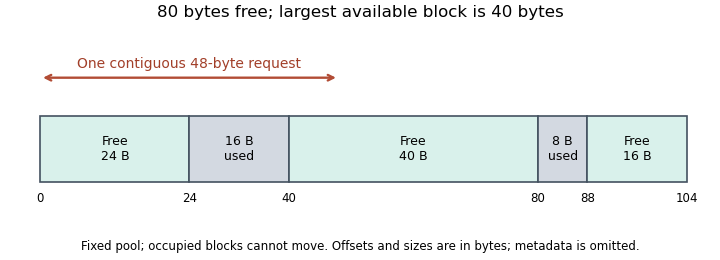
Memory block coalescing merges adjacent free intervals. If the occupied16-byte block between the first two holes is released, the neighboring24,16 and40-byte intervals can form one80-byte free block. Coalescing does not merge across a still-occupied interval. Memory compaction instead moves live data to collect free space, which requires a way to preserve or update references. An allocator generally cannot relocate an arbitrary live block behind an unchanged C programming language pointer.[ref]
Operating Systems: Three Easy Pieces by Remzi H. Arpaci-Dusseau and others. §17.1, relocation assumption; §17.2, splitting and coalescing
The illustrative measure equals0.5 for the original layout, but it does not say that half the memory is universally unusable: requests no larger than16 bytes can still fit. Actual allocation success depends on request sizes and allocator policy. Internal fragmentation instead concerns unused space inside allocated units.
The contiguity requirement also needs its address space specified. A virtually contiguous block can use noncontiguous physical page frames through virtual memory. Physical page fragmentation and an application's heap holes are therefore different allocation-layer questions. Changing the physical mapping alone does not merge separated virtual holes around live objects.
Memory block coalescing merges adjacent free allocation blocks into a larger free block. It improves the allocator's representation and use of free space without moving intervening live objects. The mechanism is useful after deallocation, when a returned block may adjoin free neighbors. A free list records the resulting regions; it can be implemented using a list or another search structure.[ref]
Operating Systems: Three Easy Pieces by Remzi H. Arpaci-Dusseau and others. Chapter17, §17.2, “Splitting and Coalescing”, printed pp.3–4
Using half-open address intervals, two free blocks and can become . Their usable bookkeeping lengths add: . For an original example, suppose free intervals occupy offsets and while the intervening16-byte block is live. Releasing that middle block makes all of free, so merging its two neighbors produces an80-byte block. An occupied8-byte block after offset80 still separates this region from a later free interval.
An address-aware insertion can check the predecessor's end against the new block's start and the successor's start against its end. When both are adjacent, all three join. An implementation may delay merging, but a search that examines only unmerged entries can miss a sufficiently large contiguous region. Coalescing policy and allocation search therefore affect observed success as well as the physical occupancy pattern.
These examples omit block headers and other allocator metadata. A real merge must maintain those structures, preserve memory alignment guarantees and avoid treating an occupied or separately managed region as free. Coalescing does not cure a hole separated from its neighbor by a still-live allocation; that requires deallocation, a different placement strategy or a valid memory compaction mechanism.
Pinned article: Introduction to the OurBigBook Project
Welcome to the OurBigBook Project! Our goal is to create the perfect publishing platform for STEM subjects, and get university-level students to write the best free STEM tutorials ever.
Everyone is welcome to create an account and play with the site: ourbigbook.com/go/register. We belive that students themselves can write amazing tutorials, but teachers are welcome too. You can write about anything you want, it doesn't have to be STEM or even educational. Silly test content is very welcome and you won't be penalized in any way. Just keep it legal!
Intro to OurBigBook
. Source. We have two killer features:
- topics: topics group articles by different users with the same title, e.g. here is the topic for the "Fundamental Theorem of Calculus" ourbigbook.com/go/topic/fundamental-theorem-of-calculusArticles of different users are sorted by upvote within each article page. This feature is a bit like:
- a Wikipedia where each user can have their own version of each article
- a Q&A website like Stack Overflow, where multiple people can give their views on a given topic, and the best ones are sorted by upvote. Except you don't need to wait for someone to ask first, and any topic goes, no matter how narrow or broad
This feature makes it possible for readers to find better explanations of any topic created by other writers. And it allows writers to create an explanation in a place that readers might actually find it.
Figure 1. Screenshot of the "Derivative" topic page. View it live at: ourbigbook.com/go/topic/derivativeVideo 2. OurBigBook Web topics demo. Source. - local editing: you can store all your personal knowledge base content locally in a plaintext markup format that can be edited locally and published either:This way you can be sure that even if OurBigBook.com were to go down one day (which we have no plans to do as it is quite cheap to host!), your content will still be perfectly readable as a static site.
- to OurBigBook.com to get awesome multi-user features like topics and likes
- as HTML files to a static website, which you can host yourself for free on many external providers like GitHub Pages, and remain in full control

Figure 2. You can publish local OurBigBook lightweight markup files to either OurBigBook.com or as a static website.
Figure 3. Visual Studio Code extension installation.
Figure 5. . You can also edit articles on the Web editor without installing anything locally. Video 3. Edit locally and publish demo. Source. This shows editing OurBigBook Markup and publishing it using the Visual Studio Code extension. 
- Infinitely deep tables of contents:



All our software is open source and hosted at: github.com/ourbigbook/ourbigbook
Further documentation can be found at: docs.ourbigbook.com
Feel free to reach our to us for any help or suggestions: docs.ourbigbook.com/#contact