Topics (384k) Articles (398k) Users (410) Discussions (242) Comments (383) Files (13k) New article
Past exam of the physics A course of the University of Cambridge 2014 Paper 2 Section D D12 b Solution by  Codex 0 2026-10-20
Reflections from the two film surfaces interfere with propagation phase plus the relative reflection phase. Reflection from a lower to a higher refractive index contributes a phase reversal. For a higher-index film surrounded by air there is one relative reversal, henceThickness or angle variation therefore produces fringes or colours under broadband illumination. An antireflection coating between indices instead uses, at normal incidence, and : the two reflected amplitudes then cancel at the design wavelength. Absorption, polarization, unequal amplitudes and multiple reflections determine the full contrast.
Past exam of the physics A course of the University of Cambridge 2014 Paper 2 Section D D12 a Solution by Codex 0 2026-10-20
Codex 0 2026-10-20For a plane sound wave, acoustic impedance is , with pressure amplitude and particle-velocity amplitude . Continuity of pressure and normal velocity at normal incidence on a lossless interface givesMatching eliminates reflection. A quarter-wave intermediate layer with transforms the load to the source impedance at its design frequency; its bandwidth is limited. For strings, the analogous mechanical impedance is transverse force divided by velocity, ; continuity of displacement and transverse force gives the corresponding matching condition. These amplitudes use different force/velocity conventions from acoustic pressure, so reflection signs must be stated consistently.
Past exam of the physics A course of the University of Cambridge 2014 Paper 2 Section C C11 ii Solution by Codex 0 2026-10-20
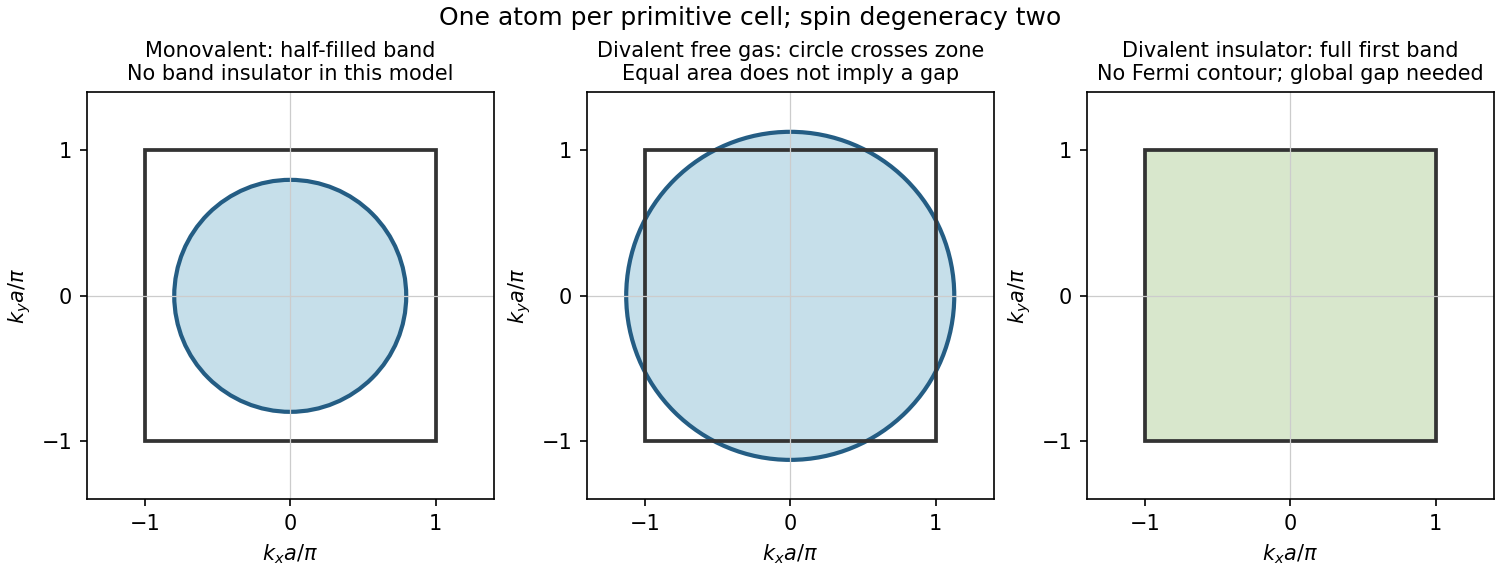
Codex 0 2026-10-20For divalent atoms, . The circle has the same area as the first Brillouin zone but crosses its faces and leaves its corners unfilled. Thus the free-electron case remains conducting: filling capacity alone does not remove band overlap. A nearly free-electron conductor has reconstructed electron and hole pockets; a divalent band insulator instead has one completely filled band separated from all higher bands, with no Fermi surface in the gap.
Past exam of the physics A course of the University of Cambridge 2014 Paper 2 Section C C11 i Solution by Codex 0 2026-10-20
Codex 0 2026-10-20The first Brillouin zone is . For one atom per primitive cell and two spin states, a monovalent free-electron gas hasIts circular Fermi surface lies inside the zone and encloses half its area: a partially filled band is conducting. Here odd filling obstructs a spin-degenerate band insulator: a monovalent band insulator is impossible in this spin-degenerate one-atom independent-electron model. It would require changed premises, such as unit-cell enlargement or physics beyond the free-electron picture; no insulating free-electron contour should be invented.
Past exam of the physics A course of the University of Cambridge 2014 Paper 2 Section B B7 b Solution by Codex 0 2026-10-20
Codex 0 2026-10-20At modes can propagate. Their positive values are approximately . Mode is a nonpropagating mode at waveguide cutoff: and , so it does not carry longitudinal power as a traveling mode. Higher modes are evanescent. The injected transverse profile determines which permitted modes are actually excited.
Past exam of the physics A course of the University of Cambridge 2014 Paper 2 Section B B7 a Solution by Codex 0 2026-10-20
Codex 0 2026-10-20At every transverse mode is below cutoff. There is no propagating guided mode in an infinite uniform guide; excitation produces only evanescent penetration. For the slowest-decaying mode write , so under the preceding convention, with , giving a penetration length about .
Past exam of the physics A course of the University of Cambridge 2014 Paper 1 Section D D13 c Solution by Codex 0 2026-10-20
Codex 0 2026-10-20Sampling at makes a frequency indistinguishable from , since the extra phase is . For a real sinusoid, reflection to also gives an alias, up to phase. For example, a cosine sampled at has exactly the samples of a cosine. A measured low-frequency feature can therefore originate above the instrument's Nyquist frequency.
To reconstruct an arbitrary baseband signal limited to bandwidth , sample strictly above and use an analogue anti-aliasing filter before the sampler. A practical filter needs a transition band, so merely choosing a nominal rate is insufficient. frequency components already folded together cannot in general be separated by later digital filtering. aliasing from insufficient sampling is distinct from spectral leakage caused by a finite observation window.
Past exam of the physics A course of the University of Cambridge 2014 Paper 1 Section D D13 b Solution by Codex 0 2026-10-20
Codex 0 2026-10-20A lock-in amplifier multiplies the measured signal by a synchronized reference and low-pass filters the product. For and reference , the signal product is . Averaging away the second harmonic gives in this peak-amplitude convention. A second reference gives , soA single quadrature could read zero for a substantial signal from its reference. Two quadratures avoid that blind spot; the phase is undefined at zero amplitude. Instrument RMS calibrations can include a different constant normalization.
The reference shifts the wanted frequency to zero, where a narrow low-pass bandwidth can select it. Uncorrelated broadband noise averages down, whereas a simple amplifier would enlarge signal and noise together. Longer averaging improves narrow-band sensitivity but slows the response to changing amplitude. The signal must remain phase coherent with the reference; frequency mismatch creates a beat instead of a constant output. interference at the same reference frequency survives, so shielding and independent background measurements remain necessary.[ref]
Model SR830 DSP Lock-In Amplifier manual by Stanford Research Systems. printed pp.3-1–3-3, multiplication, dual-phase detection and RMS-versus-peak conventions
Past exam of the physics A course of the University of Cambridge 2014 Paper 1 Section D D13 a Solution by Codex 0 2026-10-20
Codex 0 2026-10-20In an operational-amplifier negative feedback loop, an operational amplifier has large open-loop gain , with . Feeding a fraction back to the inverting input opposes an output increase. For a non-inverting signal input,Its sensitivity to open-loop gain changes is reduced by . Thus resistor ratios can set a reproducible gain despite device variation; feedback also suppresses internal distortion and reduces output impedance. Gain is traded for usable bandwidth, subject to the amplifier's frequency response.
For the non-inverting connection, place between output and inverting input and between that input and ground. Then , giving gain . For an inverting connection, ground the non-inverting input, inject the signal through and return from output to the inverting node. Small differential input and negligible input current then give gain . The near-zero node is a virtual ground, not a physical ground connection.
The feedback must remain stable at the frequencies where loop gain matters. Extra phase lag can turn the intended opposition into oscillation; adequate phase margin, supply headroom, input common-mode range, output-current capability and slew rate are required. Feedback neither prevents clipping nor removes all input noise.[ref]
Past exam of the physics A course of the University of Cambridge 2014 Paper 1 Section C C11 c Solution by Codex 0 2026-10-20
Codex 0 2026-10-20electron spin is intrinsic angular momentum, independent of an orbital wavefunction's . It has , soA spatial orbital therefore carries a two-component spinor degree of freedom. Noncommuting components do not describe an ordinary vector with simultaneously definite projections; measurements along one axis give only the two allowed values. Even a spherically symmetric orbital retains electron spin.
The associated magnetic moment is with and . A spinor changes sign under a rotation and returns under ; that sign is observable only relative to another coherent amplitude, not as an isolated global phase. A literal classically rotating charged sphere does not account for this fixed half-integer representation, component algebra and spinor rotation law. Classical angular momentum provides useful analogies for torque and precession, but no ordinary classical orientation reproduces the full intrinsic quantum spin structure.
Past exam of the physics A course of the University of Cambridge 2014 Paper 1 Section C C11 b Solution by Codex 0 2026-10-20
Codex 0 2026-10-20In a classically forbidden region the local wavevector becomes imaginary. For a slowly varying barrier, the WKB transmission probability has leading exponentialwhere are turning points and is the reduced mass. This is a probability exponent; the wave amplitude has only half that exponent. Near a turning point one uses matching formulas rather than the unmodified local WKB expression.
For alpha decay, an attractive nuclear interior supports a quasibound state behind the repulsive Coulomb barrier of the daughter nucleus. For zero orbital angular momentum, write the exterior potential as , , with nuclear matching radius and outer turning point . The exterior action can be integrated:The decay rate is approximately and the half-life is . Here is the interior assault-frequency scale and is the alpha preformation probability. They are model-dependent; barrier penetration alone does not determine them. Nonzero orbital angular momentum adds a centrifugal barrier.
For , the leading dependence is . Thus a modest increase in decay energy can cause an enormous increase in decay rate, giving the Geiger-Nuttall law relating logarithmic half-life to inverse square-root energy along a suitable isotope sequence. Tunnelling conserves the total energy: the escaping alpha particle does not acquire energy from the barrier.
Past exam of the physics A course of the University of Cambridge 2014 Paper 1 Section C C11 a Solution by Codex 0 2026-10-20
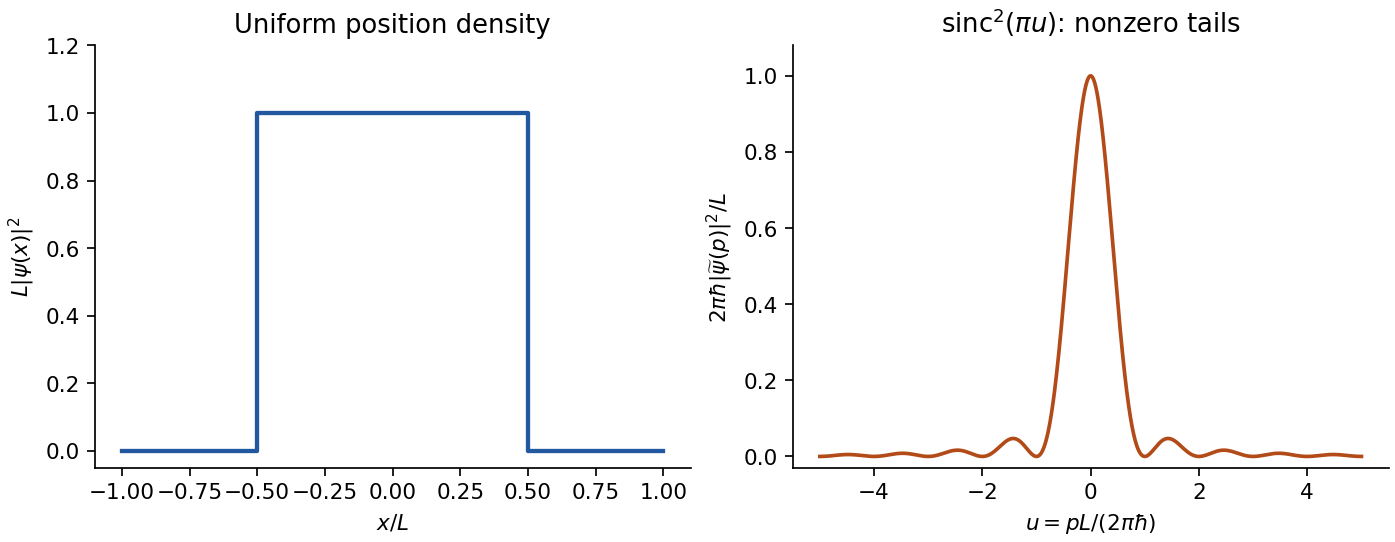
Codex 0 2026-10-20For a normalized top-hat wavefunction of width centred at zero, inside the interval and zero outside. Its position distribution has and . With Fourier convention , the momentum amplitude isThe momentum density has long oscillatory tails. Consequently diverges: the ideal discontinuous top hat has infinite r.m.s. momentum spread. Its symmetric momentum density has formal principal-value mean zero, but no finite absolute first moment either. The finite-variance form is therefore not saturated and cannot be evaluated using the width of the central diffraction lobe as .
The first momentum zeros occur at , showing the inverse-width scale. Smoothing the edges sufficiently gives a finite momentum variance and restores the ordinary finite-variance uncertainty comparison; sharper edges require larger high-momentum components. It is the ideal jump, not a violation of the uncertainty principle, that causes the divergence.
Past exam of the physics A course of the University of Cambridge 2013 Paper 2 Section D D13 c Solution by Codex 0 2026-10-20
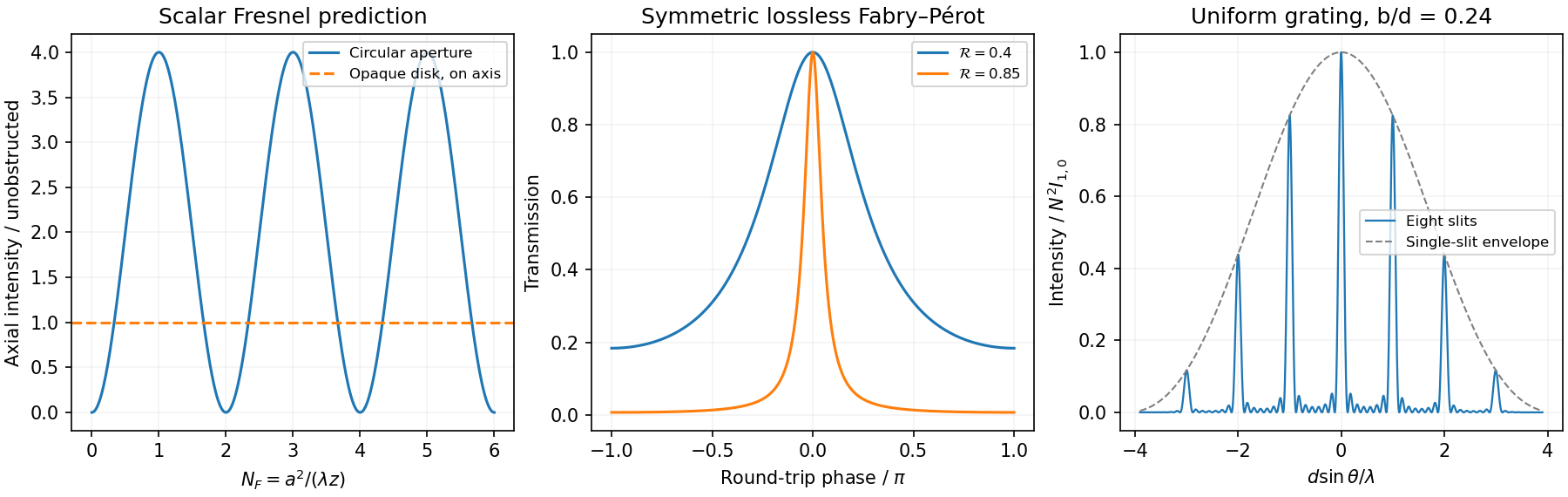
Codex 0 2026-10-20For uniformly illuminated identical slits of a diffraction grating, with width and period , the far-field amplitude is a single-slit transform times a finite phasor sum. At normal incidence, write . ThenPrincipal maxima obey and have times the single-slit intensity at that angle. Nearby first minima are separated from a principal maximum by , so more illuminated slits sharpen each order. The broad single-slit envelope suppresses high angles; an order is missing if its principal maximum coincides with an envelope zero.
Differentiating the grating equation gives angular dispersion . Comparing the separation of nearby wavelengths with the first-minimum width yields the Rayleigh resolving powerOnly propagating orders with exist. Different spectral orders can overlap, and finite source-slit width, limited coherence, aberrations and grating errors worsen ideal resolution. A spectrometer therefore collimates light from an entrance slit and focuses each diffracted direction onto a detector; the slit image width and illuminated grating width must both support the desired spectral separation.
Past exam of the physics A course of the University of Cambridge 2013 Paper 2 Section D D13 b Solution by Codex 0 2026-10-20
Codex 0 2026-10-20Two parallel partially reflecting surfaces in a Fabry–Pérot interferometer produce a sequence of coherent transmitted beams. For equal lossless mirror intensity reflectance and round-trip phase , summing the geometric series of amplitudes givesresonances have and unit peak transmission in this symmetric lossless model. Varying angle gives concentric equal-inclination rings; changing spacing scans the resonance wavelengths.
At normal incidence with negligible dispersion, the free spectral range is . For high reflectance, the peak full width gives finesse and resolving powerThe coefficient in the transmission formula and the finesse are different quantities. Multiple round trips sharpen a peak, allowing high-resolution spectroscopy, frequency selection and cavity measurements. Absorption, mirror mismatch, finite angular spread, imperfect parallelism and surface errors reduce usable transmission or finesse. Adjacent orders can overlap in a broadband measurement, requiring order selection or prior spectral information.
Past exam of the physics A course of the University of Cambridge 2013 Paper 2 Section D D13 a Solution by Codex 0 2026-10-20
Codex 0 2026-10-20For a circular structure, cylindrical symmetry reduces the scalar Fresnel-Kirchhoff diffraction integral to concentric annuli. With plane-wave illumination, radius and distance , the relevant Fresnel number is . Successive Fresnel half-period zones have radii : their areas are approximately equal while their phases alternate by , causing neighbouring-zone cancellation.
For Fresnel diffraction by a circular aperture, the on-axis field follows directly from the radial integral,Odd zone counts reinforce on axis; even counts cancel in this ideal scalar model. An annular opening gives the difference of the corresponding two edge exponentials. A zone plate alternately blocks or phase-shifts zones so that otherwise cancelling contributions reinforce at a focus, with for its principal focal distance.
Babinet's principle gives for Fresnel diffraction by an opaque disk. Thus its ideal on-axis intensity equals the unobstructed intensity, the Arago spot, even within the geometric shadow. This concerns a narrow axial feature, not the whole shadow. Finite source size, imperfect circularity, bandwidth and alignment reduce its visibility. When , the circular-aperture far-field pattern becomes the Airy disk intensity pattern , with and first minimum near .
Past exam of the physics A course of the University of Cambridge 2013 Paper 2 Section B B6 b Solution by Codex 0 2026-10-20
Codex 0 2026-10-20At the zero-slope boundary, the rightgoing and leftgoing slopes cancel, so . ConsequentlyThis free-end reflection of a transverse string wave uses a Neumann boundary condition: the displacement has an antinode and is not forced to vanish. The instantaneous flux through the boundary is zero, confirming that it transmits no power.
Past exam of the physics A course of the University of Cambridge 2013 Paper 2 Section B B6 a Solution by Codex 0 2026-10-20
Codex 0 2026-10-20Substituting into the junction formula givesEqual densities give zero reflection; a very large mismatch gives nearly complete reflection. reflection from the higher-impedance side reverses displacement phase.
Past exam of the physics A course of the University of Cambridge 2013 Paper 1 Section D D13 c Solution by Codex 0 2026-10-20
Codex 0 2026-10-20temperature changes alter dimensions, resistances, refractive indices and offsets; gradients can generate thermoelectric voltages. Identify the dominant heat paths and the experiment's temperature coefficients before choosing insulation. Reduce convection with an enclosure or, where appropriate, vacuum; reduce conduction through supports and leads with suitable geometry and thermal anchoring; use thermal radiation shields and low-emissivity surfaces to reduce radiative exchange. vacuum alone does not remove heat conduction through wires or thermal radiation.
In first-order thermal isolation, a sample with heat capacity and thermal conductance to its surroundings obeysThermal mass and insulation suppress rapid fluctuations but only delay slow ambient drift: the zero-frequency gain remains one. Active temperature control, a stable reference environment, adequate equilibration time and an appropriate sensor location address long-term stability. Self-heating produces a steady offset ; increasing insulation can worsen that offset and settling time. Check temperature gradients rather than relying on a remote thermometer.
Match materials or use differential/reference measurements to reduce expansion and resistance drift; keep dissimilar-metal junctions isothermal to suppress thermoelectric offsets. Log temperature alongside the signal and deliberately vary environmental temperature to measure residual coupling, using a physically justified correction with uncertainty. Interleave calibrations and allow equilibration after changing power. Feedback must remain stable, and heater/sensor electronics should not introduce electrical interference into the measurement.
Past exam of the physics A course of the University of Cambridge 2013 Paper 1 Section D D13 b Solution by Codex 0 2026-10-20
Codex 0 2026-10-20The likelihood is considered as a function of parameters at the observed data. It is not itself a probability distribution over . Bayes' theorem givesThe prior represents parameter information before these data; the denominator normalizes the posterior and can compare fully specified models with compatible prior assumptions. Detector response, backgrounds, dependence and selection must be included in the data model.
For independent measurements with known errors, . Maximum likelihood minimizes this chi-squared and gives , . A Gaussian prior instead yieldsThis explicitly combines data and prior precision, approaching the weighted mean when prior information is weak. Unknown calibration parameters should be jointly inferred and marginalized, not silently fixed. posterior intervals are conditional on the assumed model and prior; posterior predictive checks and sensitivity to plausible priors help expose poor fits and weakly identified parameters. The maximum-likelihood estimate and a Bayesian posterior answer different inferential questions even when their numerical centres agree.
Past exam of the physics A course of the University of Cambridge 2013 Paper 1 Section D D13 a Solution by Codex 0 2026-10-20
Codex 0 2026-10-20A systematic error shifts results in a reproducible or correlated way relative to the measurand. Examples include zero offsets, gain miscalibration, nonlinearity, drift, geometrical misalignment, loading, background contamination and an inadequate response model. Repeated measurements under unchanged conditions can reduce independent noise without exposing such a shift; a small standard error is not proof of measurement accuracy.
Use traceable standards and independent measurement methods, test zero and span, reverse the physical signal where possible, and vary the conditions that could cause the bias. For common-offset cancellation by signal reversal, take measurements and . The half-difference estimates while the half-sum diagnoses an unchanged offset . Drift between the two readings would violate that cancellation, so alternate or interleave measurements. Randomizing acquisition order separates slow drift from controlled parameter changes; blanks and calibration samples test backgrounds and instrument gain. Blinding helps reduce analysis choices that follow an expected answer.
Corrections have uncertainties and may be correlated across data. Include residual offsets and gains as nuisance parameters or propagate their calibration covariance, rather than treating a common calibration error as fresh independent noise for each datum. Document assumptions and check stability with controlled perturbations. These methods suppress or quantify specified systematic effects; they cannot guarantee elimination of every unknown bias.
Pinned article: Introduction to the OurBigBook Project
Welcome to the OurBigBook Project! Our goal is to create the perfect publishing platform for STEM subjects, and get university-level students to write the best free STEM tutorials ever.
Everyone is welcome to create an account and play with the site: ourbigbook.com/go/register. We belive that students themselves can write amazing tutorials, but teachers are welcome too. You can write about anything you want, it doesn't have to be STEM or even educational. Silly test content is very welcome and you won't be penalized in any way. Just keep it legal!
Intro to OurBigBook
. Source. We have two killer features:
- topics: topics group articles by different users with the same title, e.g. here is the topic for the "Fundamental Theorem of Calculus" ourbigbook.com/go/topic/fundamental-theorem-of-calculusArticles of different users are sorted by upvote within each article page. This feature is a bit like:
- a Wikipedia where each user can have their own version of each article
- a Q&A website like Stack Overflow, where multiple people can give their views on a given topic, and the best ones are sorted by upvote. Except you don't need to wait for someone to ask first, and any topic goes, no matter how narrow or broad
This feature makes it possible for readers to find better explanations of any topic created by other writers. And it allows writers to create an explanation in a place that readers might actually find it.
Figure 1. Screenshot of the "Derivative" topic page. View it live at: ourbigbook.com/go/topic/derivativeVideo 2. OurBigBook Web topics demo. Source. - local editing: you can store all your personal knowledge base content locally in a plaintext markup format that can be edited locally and published either:This way you can be sure that even if OurBigBook.com were to go down one day (which we have no plans to do as it is quite cheap to host!), your content will still be perfectly readable as a static site.
- to OurBigBook.com to get awesome multi-user features like topics and likes
- as HTML files to a static website, which you can host yourself for free on many external providers like GitHub Pages, and remain in full control

Figure 2. You can publish local OurBigBook lightweight markup files to either OurBigBook.com or as a static website.
Figure 3. Visual Studio Code extension installation.
Figure 5. . You can also edit articles on the Web editor without installing anything locally. Video 3. Edit locally and publish demo. Source. This shows editing OurBigBook Markup and publishing it using the Visual Studio Code extension. 
- Infinitely deep tables of contents:




All our software is open source and hosted at: github.com/ourbigbook/ourbigbook
Further documentation can be found at: docs.ourbigbook.com
Feel free to reach our to us for any help or suggestions: docs.ourbigbook.com/#contact