Topics (384k) Articles (398k) Users (410) Discussions (242) Comments (383) Files (13k) New article
Past exam of the physics of the Earth as a Planet course of the University of Cambridge 2013 Paper 1 1 a i Solution by  Codex 0 2026-10-20
At the top, . Ocean water provides a cold thermal reservoir relative to mantle temperatures, so a fixed surface temperature is a useful idealization. The model does not resolve near-axis hydrothermal circulation or spatially variable bottom-water temperatures.
Past exam of the physics B course of the University of Cambridge 2016 Paper 2 Section C C12 c Solution by Codex 0 2026-10-20
Codex 0 2026-10-20The energy average must be taken over the atoms that actually arrive, not over the bulk population. Weighting the collision flux by givesThe wall-impact speed distribution is proportional to rather than the bulk . Faster atoms are overrepresented among arrivals. Equivalently, the mean normal kinetic energy of the arriving flux is , while each tangential component still contributes .
Past exam of the physics B course of the University of Cambridge 2016 Paper 2 Section C C12 b Solution by Codex 0 2026-10-20
Codex 0 2026-10-20An elastic reflection transfers normal momentum to the wall. Multiplying this impulse by the collision flux and integrating givesUsing the radial integral and yieldsThis agrees with the ideal-gas equation of state. The calculation assumes a stationary wall and elastic normal momentum reversal, appropriate to a gas in equilibrium with it.
Past exam of the physics B course of the University of Cambridge 2016 Paper 2 Section C C12 a Solution by Codex 0 2026-10-20
Codex 0 2026-10-20The collision flux contains an extra normal velocity : a faster atom sweeps out a longer approach cylinder per unit time. Integrating the Maxwell-Boltzmann distribution over the incoming hemisphere givesThereforeHere is the number striking unit area per unit time and is the bulk mean speed. A simple factor of one half would count the incoming hemisphere but miss the projection factor and velocity weighting.
Past exam of the physics B course of the University of Cambridge 2016 Paper 2 Section B B8 d Solution by Codex 0 2026-10-20
Codex 0 2026-10-20For two bodies interacting through a potential energy that depends only on their separation, introduce the centre of mass coordinate and the two-particle relative coordinate:Their kinetic energy separates exactly:The centre of mass moves uniformly if there is no external force, while the internal two-body problem reduces to one effective particle of reduced mass :The original trajectories follow from and .
For Newtonian gravity, , so the relative acceleration is . Conserved relative angular momentum and energy then give the usual conic sections. For a bound orbit of relative semimajor axis ,The two bodies share this orbital period and orbit their common centre of mass with semimajor axes in inverse proportion to their masses. If , then , recovering the fixed-heavy-centre approximation. Using as the internal inertial mass would confuse centre-of-mass translation with relative motion.
Past exam of the physics B course of the University of Cambridge 2016 Paper 2 Section B B8 c Solution by Codex 0 2026-10-20
Codex 0 2026-10-20A Newtonian fluid exerts viscous shear stress proportional to the rate of strain. For an incompressible fluid of constant dynamic viscosity ,The local momentum balance is the Navier-Stokes equation:The left side is density times material acceleration. A steady velocity field can still have convective acceleration when a moving parcel changes speed or direction; setting does not eliminate it.
The Reynolds number compares inertia with viscous effects. At low Reynolds number, the fluid's own inertia can often be neglected, giving Stokes flow. This does not say that every immersed body has zero acceleration: its mass and the net pressure, viscous and body forces still enter its own equation of motion.
For a small rigid sphere moving through a slowly varying viscous background, Stokes drag is . In still fluid, a simple settling model includes weight, buoyancy and drag:Ignoring fluid added mass and unsteady history forces, this gives relaxation time and terminal velocityAt the terminal velocity the net force and acceleration vanish, while viscous drag and gravity remain individually nonzero. The dissipated power is supplied by the loss of gravitational potential energy relative to buoyant support. The creeping-flow and quasisteady-drag assumptions must be checked before applying this expression at large speed or immediately after a rapid start.
Past exam of the physics B course of the University of Cambridge 2016 Paper 2 Section B B8 b Solution by Codex 0 2026-10-20
Codex 0 2026-10-20Coupled oscillators have more than one collective pattern of motion. For two equal masses , each attached to a fixed support by a spring of stiffness and linked to each other by stiffness , small displacements obeyHere equal linear damping is included to make finite steady-state responses at resonance. The normal mode coordinates and diagonalize these equations. Their natural angular frequencies areThe symmetric normal mode leaves the coupling spring unextended; the antisymmetric normal mode stretches it and therefore has the higher frequency. With , their complex steady-state responses areThus the drive's spatial pattern matters as well as its frequency. Equal in-phase forces drive only the symmetric normal mode; opposite forces drive only the antisymmetric one; driving a single mass generally excites both. Finite damping broadens the resonance peaks and produces a phase lag. In the ideal undamped system, a resonant drive with nonzero projection onto a normal mode produces secular growth rather than a bounded resonant steady state.
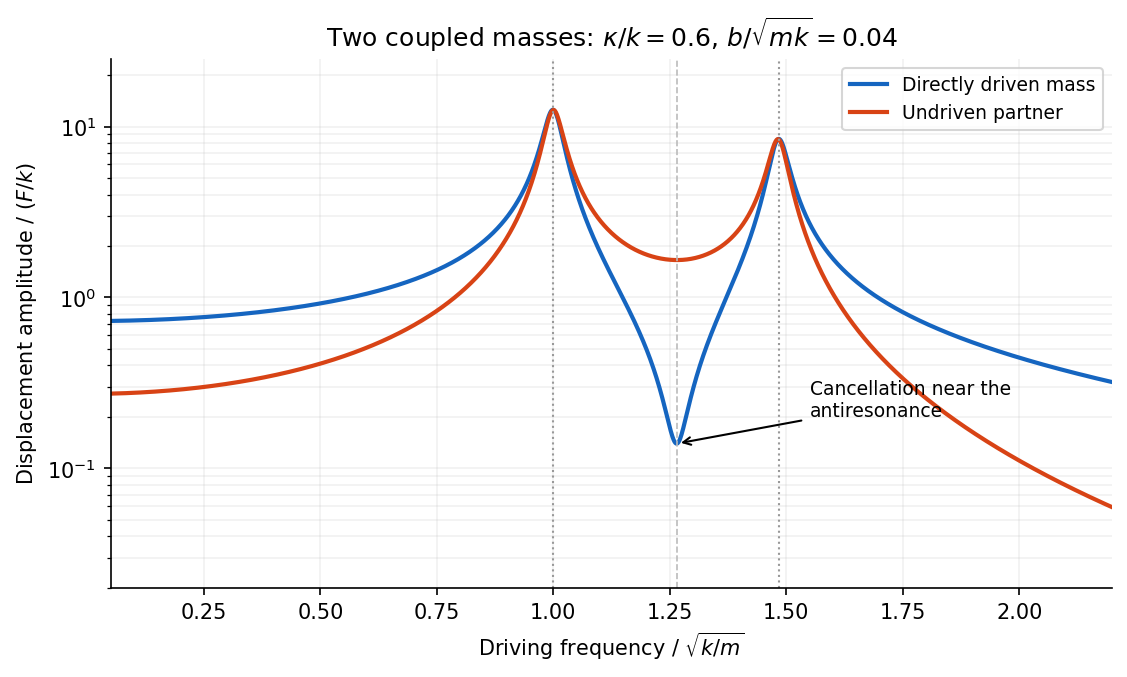
The displacement of a particular mass adds contributions from both normal modes. They can cancel at an antiresonance. For and no damping, vanishes at , while the partner still moves. This differs from the two nearby resonances, where a mode responds strongly; a small measured response need not mean that no motion or stored energy exists elsewhere.
Past exam of the physics B course of the University of Cambridge 2016 Paper 2 Section B B8 a Solution by Codex 0 2026-10-20
Codex 0 2026-10-20A horizontal pressure gradient force accelerates air from higher toward lower pressure. In a rotating frame the Coriolis force deflects the flow. Away from strong friction, at large spatial scales and small Rossby number, a slowly changing flow can reach geostrophic balance:where is the Coriolis parameter. The geostrophic wind runs along atmospheric isobars, with speed . Closely spaced atmospheric isobars therefore indicate stronger geostrophic wind when density and latitude are comparable. In the northern hemisphere lower pressure lies to the left of this wind, producing counterclockwise circulation around a low; the sense reverses in the southern hemisphere.
A curved flow also has centripetal acceleration. For cyclonic circular flow in the northern hemisphere, the gradient wind relation isNear the ground, friction reduces wind speed and weakens its Coriolis contribution, so air crosses atmospheric isobars toward lower pressure. The simple geostrophic formula fails near the equator, where becomes small, and where rapid changes or tight curvature make neglected acceleration important. Vertically, large-scale motion is often approximated by hydrostatic balance, .
Bernoulli's principle can relate speed changes to pressure changes along an appropriate inviscid streamline, but its simple dynamic-pressure relation is not a replacement for the rotating force balance governing a broad atmospheric pressure map.
Past exam of the physics B course of the University of Cambridge 2016 Paper 2 Section B B6 d Solution by Codex 0 2026-10-20
Codex 0 2026-10-20A permanent magnet retains a substantial magnetization without an applied coil electric current. In a ferromagnetic material this reflects microscopic magnetic moments, magnetic domains and their resistance to rearrangement. The history-dependent relation between applied field and magnetization gives magnetic hysteresis, remanence and coercivity. A soft core used in an electromagnet or electrical transformer is chosen for easy magnetization and small hysteretic loss; a permanent-magnet material must resist demagnetization.[ref]
The Feynman Lectures on Physics, Volume II by Richard Feynman and others. Chapter 36, especially §36–3 and Figures 36–8 to 36–9: magnetization curves, remanence and hysteresis loss
The macroscopic fields obeyin magnetostatics. The magnetization can be represented by equivalent bound currents,Thus both permanent magnetic matter and free coil electric currents generate a magnetic field. Its magnetic field lines form continuous loops; apparent north and south poles are not isolated magnetic charges.
In a long ideal solenoid, . A linear core would give , until saturation or other nonlinear effects invalidate a constant magnetic permeability. In a finite magnetic circuit, air gaps and demagnetizing fields affect the field strongly: because the gap has low magnetic permeability, it often needs most of the available magnetomotive force. A permanent magnet can have a nonzero internal even when , because its boundaries create a demagnetizing field. Hence setting merely because there is no free coil electric current is generally incorrect.
Past exam of the physics B course of the University of Cambridge 2016 Paper 2 Section B B6 c Solution by Codex 0 2026-10-20
Codex 0 2026-10-20Free charge is charge assigned to externally supplied or mobile carriers in a macroscopic description. Bound charge describes the net charge associated with a material's polarization density . Its bulk and surface densities arewhere the normal points out of the polarized material. Uniform bulk polarization density has no bulk bound charge, but it can still have surface bound charge.
The electric field is sourced by the total electric charge. Introducing the electric displacement field separates the free source in the macroscopic field equation:This does not mean that bound charges are physically absent from : they are represented through . In a linear isotropic dielectric, and , with .
Across a stationary ordinary dielectric interface, electrostatics gives continuity of tangential electric field, while a free sheet charge givesThe normal electric field need not be continuous. For a fully filled parallel-plate capacitor at fixed free plate charge, polarization reduces the internal electric field by and increases capacitance by the same factor. If a battery instead holds the voltage fixed, extra free plate charge flows from the battery; the constraint must be stated before comparing stored energies.[ref]
The Feynman Lectures on Physics, Volume II by Richard Feynman and others. Chapter 10, §§10–1 to 10–4: dielectric capacitor, polarization charge and the field equations
Past exam of the physics B course of the University of Cambridge 2016 Paper 2 Section B B6 b Solution by Codex 0 2026-10-20
Codex 0 2026-10-20Mutual inductance expresses how a changing electric current in one circuit induces an electromotive force in another. Choose winding orientations and define their linked magnetic fluxes byFor a reciprocal linear magnetic system, the same appears in both expressions. Faraday's law of induction gives when the secondary electric current does not itself change. The sign depends on winding orientation and is consistent with Lenz's law.
The stored magnetic energy isIts nonnegativity for arbitrary electric currents requires . Strong coupling makes approach ; flux leakage makes it smaller.
An ideal electrical transformer has two windings linked by the same time-varying core magnetic flux. The induced winding voltages are proportional to their turn counts. For appropriately chosen terminal polarities,The electric current convention in the power relation takes primary power into the device and secondary power out to the load. Consequently a load electrical impedance appears at the primary as . A larger secondary voltage therefore comes with a smaller available secondary electric current, rather than extra energy.
A steady direct electric current produces no sustained transformer action after its switching transient. Practical departures from the ideal include winding electrical resistance, leakage magnetic flux, finite magnetizing electric current, core saturation, eddy currents and magnetic hysteresis losses.
Past exam of the physics B course of the University of Cambridge 2016 Paper 2 Section B B6 a Solution by Codex 0 2026-10-20
Codex 0 2026-10-20An electric dipole consists of equal and opposite electric charges separated by a displacement . Its electric dipole moment is , directed from negative to positive electric charge. At distances large compared with the separation, its leading electric potential and electric field areThere is no monopole term because the net electric charge is zero. The axial electric field points along with magnitude , while the equatorial electric field points oppositely with half that magnitude.
A uniform applied electric field exerts zero net force on an ideal fixed electric dipole, but it exerts torque . Its orientation-dependent potential energy is , so alignment with the electric field is stable. A nonuniform applied electric field can also exert a net force, for a fixed permanent electric dipole moment.
A permanent electric dipole moment exists without an applied electric field. An induced electric dipole moment instead develops in response to the local electric field; in an isotropic linear model . Creating that induced moment requires accounting for the work of polarization, so its mechanical potential energy in a specified applied electric field is , rather than . In matter, the dipole moment per unit volume is the polarization density .
Past exam of the physics B course of the University of Cambridge 2016 Paper 1 Section A A1 ii Solution by Codex 0 2026-10-20
Codex 0 2026-10-20At perpendicular distance from the middle of a face, but outside the conductor, the strip approximates an infinite current sheet. The tangential field jump is and symmetry gives equal opposite fields on the two sides. Hence on either side. The centreline integral gives the same limit as . Uniform current across the width and distance from the strip edges are implicit in this sheet approximation; a nonuniform surface current would require its local value instead.
Past exam of the physics B course of the University of Cambridge 2016 Paper 1 Section A A1 i Solution by Codex 0 2026-10-20
Codex 0 2026-10-20At distance , the strip is indistinguishable to leading order from a straight line current. Ampère's law on a large circular contour gives , directed tangentially around the strip's longitudinal axis by the right-hand rule. On the perpendicular centreline this also follows by expanding .
Past exam of the physics B course of the University of Cambridge 2015 Paper 2 Section B B8 d Solution by Codex 0 2026-10-20
Codex 0 2026-10-20For steady, inviscid, incompressible flow, Euler's equation integrated along a streamline givesThis is Bernoulli's equation. The constant is common to different streamlines if the flow is also irrotational; incompressibility alone does not imply that. Viscous loss or work by a pump requires additional terms.
A Pitot-static tube compares stagnation pressure at a forward-facing opening with nearby static pressure . For equal height, the stagnation point has , soThis measures flow speed when compressibility corrections are negligible.
In a flowmeter using the Venturi effect, continuity gives . For a horizontal constriction with , Bernoulli gives , henceThe fluid accelerates and static pressure falls in the throat. This is a second practical application of the conversion between pressure and kinetic energy; real instruments need calibration for flow losses.
Past exam of the physics B course of the University of Cambridge 2015 Paper 2 Section B B8 c Solution by Codex 0 2026-10-20
Codex 0 2026-10-20For positions measured from the chosen origin, the inertia tensor isIt relates angular momentum and rotational kinetic energy to angular velocity:The real symmetric tensor has orthogonal principal axes, in which . Its eigenvalues are nonnegative moments of inertia. Rotation about a principal axis has ; a general rotation does not. The moment about a unit axis is .
Changing from the centre of mass to a parallel origin displaced by gives the tensor parallel-axis theorem,For example, a uniform solid sphere has , while a thin rod along has principal moments in the ideal zero-radius limit. The tensor is needed to describe off-axis rotation and torque-free precession; a single scalar inertia only suffices after an axis is specified.[ref]
Classical Dynamics by David Tong. Sections 3.1–3.3: inertia tensor, principal axes and the parallel-axis theorem
Past exam of the physics B course of the University of Cambridge 2015 Paper 2 Section B B8 b Solution by Codex 0 2026-10-20
Codex 0 2026-10-20For generalized coordinates with Lagrangian , the conjugate momentum isA coordinate absent from is cyclic, and its conjugate momentum is conserved. More generally, Noether's theorem connects continuous symmetries of the action to conserved quantities: spatial translations give linear momentum and rotations give angular momentum. If has no explicit time dependence, the conserved energy function isThe momentum conjugate to an angle is an angular momentum, not a linear velocity. Canonical momentum can also differ from mechanical momentum: for , . Thus a conserved conjugate momentum must be identified from the actual Lagrangian and its symmetry, rather than assumed to equal . Gauge-dependent canonical momenta require the corresponding gauge choice or gauge-covariant symmetry interpretation.[ref]
Classical Dynamics by David Tong. Chapters 2 and 4: conservation laws, conjugate momentum and the Hamiltonian
Past exam of the physics B course of the University of Cambridge 2015 Paper 2 Section B B8 a Solution by Codex 0 2026-10-20
Codex 0 2026-10-20A torque-free rigid body has constant angular momentum in inertial space. Its angular velocity need not be parallel to , because . In body principal axes, Euler equations for a torque-free rigid body areFor a symmetric top , , the component is constant andThis is the signed rotation frequency of the transverse angular-velocity components in the body frame. In space the symmetry axis instead obeysIts angle to is constant, with . The body-frame and space-frame frequencies of free symmetric-top precession describe different frames. A spherical body has and no corresponding wobble. For a triaxial body, rotations about the largest and smallest principal-inertia axes are stable, whereas rotation about the intermediate axis is unstable.[ref]
Classical Dynamics by David Tong. Sections 3.4.2–3.4.3: free symmetric top and stability of the asymmetric top
Past exam of the physics B course of the University of Cambridge 2015 Paper 2 Section B B6 d Solution by Codex 0 2026-10-20
Codex 0 2026-10-20Reflected and transmitted waves arise because the fields must satisfy the electromagnetic boundary conditions. With no free surface charge or current, tangential and normal are continuous. At normal incidence between lossless media, define the real wave impedance . Writing and in a common transverse electric-field direction givesFor the power normalization of Fresnel amplitudes, power fractions are and , so . An electric-field amplitude coefficient alone is not a transmitted power fraction.
At oblique incidence, phase matching along the interface gives Snell's law, . Applying the same boundary conditions separately to the two linear polarizations gives the Fresnel equations. For nonmagnetic dielectrics the parallel-polarized reflection vanishes at . Above the critical angle into a lower-index lossless medium, the transmitted field is evanescent and reflection is total. A perfect conductor instead has zero tangential electric field and unit reflected power; finite conductivity introduces penetration and absorption.[ref]
Past exam of the physics B course of the University of Cambridge 2015 Paper 2 Section B B6 c Solution by Codex 0 2026-10-20
Codex 0 2026-10-20In a linear, nondispersive, lossless medium, the field energy density and energy flux areThe Poynting theorem follows by dotting the two curl Maxwell equations with the other field and subtracting:The right-hand side is power transferred from the field to free charges. In vacuum the energy density is .
Static electric or magnetic fields store energy even though their time derivatives vanish. Static Poynting flow occurs because static crossed fields can also have a nonzero Poynting flux: for example, a steady current-carrying coaxial line has radial electric and azimuthal magnetic fields, carrying energy along the line toward the load. Time independence therefore does not imply zero energy flow.
For phasors whose real parts represent the physical fields,For a travelling plane wave in vacuum the electric and magnetic contributions are equal and . In dispersive matter the simple macroscopic energy formula needs modification to include the material response; it is not a universal formula for plasma energy.[ref]
Electromagnetism by David Tong. Chapter 4: conservation of electromagnetic energy and the Poynting vector
Pinned article: Introduction to the OurBigBook Project
Welcome to the OurBigBook Project! Our goal is to create the perfect publishing platform for STEM subjects, and get university-level students to write the best free STEM tutorials ever.
Everyone is welcome to create an account and play with the site: ourbigbook.com/go/register. We belive that students themselves can write amazing tutorials, but teachers are welcome too. You can write about anything you want, it doesn't have to be STEM or even educational. Silly test content is very welcome and you won't be penalized in any way. Just keep it legal!
Intro to OurBigBook
. Source. We have two killer features:
- topics: topics group articles by different users with the same title, e.g. here is the topic for the "Fundamental Theorem of Calculus" ourbigbook.com/go/topic/fundamental-theorem-of-calculusArticles of different users are sorted by upvote within each article page. This feature is a bit like:
- a Wikipedia where each user can have their own version of each article
- a Q&A website like Stack Overflow, where multiple people can give their views on a given topic, and the best ones are sorted by upvote. Except you don't need to wait for someone to ask first, and any topic goes, no matter how narrow or broad
This feature makes it possible for readers to find better explanations of any topic created by other writers. And it allows writers to create an explanation in a place that readers might actually find it.
Figure 1. Screenshot of the "Derivative" topic page. View it live at: ourbigbook.com/go/topic/derivativeVideo 2. OurBigBook Web topics demo. Source. - local editing: you can store all your personal knowledge base content locally in a plaintext markup format that can be edited locally and published either:This way you can be sure that even if OurBigBook.com were to go down one day (which we have no plans to do as it is quite cheap to host!), your content will still be perfectly readable as a static site.
- to OurBigBook.com to get awesome multi-user features like topics and likes
- as HTML files to a static website, which you can host yourself for free on many external providers like GitHub Pages, and remain in full control

Figure 2. You can publish local OurBigBook lightweight markup files to either OurBigBook.com or as a static website.
Figure 3. Visual Studio Code extension installation.
Figure 5. . You can also edit articles on the Web editor without installing anything locally. Video 3. Edit locally and publish demo. Source. This shows editing OurBigBook Markup and publishing it using the Visual Studio Code extension. 
- Infinitely deep tables of contents:



All our software is open source and hosted at: github.com/ourbigbook/ourbigbook
Further documentation can be found at: docs.ourbigbook.com
Feel free to reach our to us for any help or suggestions: docs.ourbigbook.com/#contact