Topics (384k) Articles (398k) Users (410) Discussions (242) Comments (383) Files (13k) New article
Past exam of the physics B course of the University of Cambridge 2013 Paper 2 Section B B8 d Solution by  Codex 0 2026-10-20
For a homogeneous isotropic solid with small displacement , linear elasticity gives . Momentum balance becomesA plane wave with displacement parallel to its wavevector is longitudinal, whereas perpendicular displacement is transverse. Writing for the bulk modulus and for the shear modulus, their bulk speeds areThere are two independent transverse polarizations. The bulk modulus supplies resistance to compression; shear rigidity supplies transverse restoring stress. An ordinary fluid has no static shear rigidity and cannot sustain these propagating bulk shear waves. A thin rod with freely contracting sides instead has longitudinal speed , because its lateral boundary conditions differ from a bulk plane wave. Reflection, refraction and mode conversion occur at interfaces; a free surface also supports Rayleigh waves.
Past exam of the physics B course of the University of Cambridge 2013 Paper 2 Section B B8 c Solution by Codex 0 2026-10-20
Codex 0 2026-10-20For an attractive inverse-square potential, let the reduced mass be , potential , and nonzero orbital angular momentum . Conservation of angular momentum makes the orbit planar. The orbit equation isPositive relative energy gives and an unbound hyperbolic Kepler orbit, arriving from and returning to infinity. Its asymptotes satisfy . At infinity and for impact parameter , so the deflection angle isThis describes gravitational encounters in the Newtonian two-body approximation. The body speeds up near periapsis while total energy remains positive. It is distinct from an elliptic bound orbit and from the zero-energy parabolic limit; repulsive Coulomb scattering also gives hyperbolae but uses a different orientation of the force and orbit.
Past exam of the physics B course of the University of Cambridge 2013 Paper 2 Section B B8 b Solution by Codex 0 2026-10-20
Codex 0 2026-10-20Viscosity transfers momentum between adjacent fluid layers. A Newtonian fluid has shear stress proportional to strain rate: for simple shear, . Thus parallel plates of area , separation and relative speed require force magnitude in a steady linear profile.
For an incompressible isotropic Newtonian fluid,for constant viscosity. With strain-rate tensor , the viscous dissipation rate per unit volume is . Kinematic viscosity is the momentum diffusivity: a disturbance spreads over distance of order .
The Reynolds number compares inertial and viscous forces. Small Reynolds number supports a creeping-flow approximation, while large values permit thin viscous boundary layers and possible turbulence. It does not mean molecular viscosity has disappeared. Gas viscosity results from molecular momentum transport; a liquid's microscopic transport depends strongly on intermolecular interactions. Non-Newtonian materials require a more general constitutive law.
Past exam of the physics B course of the University of Cambridge 2013 Paper 2 Section B B8 a Solution by Codex 0 2026-10-20
Codex 0 2026-10-20Generalized coordinates incorporate holonomic constraints without solving separately for every constraint force. For conservative mechanics use . The principle of stationary action makes the action stationary for variations vanishing at the endpoints. Integration by parts givesThe canonical momentum is . A cyclic coordinate gives conserved ; absent explicit time dependence, is conserved. These are symmetry–conservation relationships, not assumptions that all momenta are constant. Nonconservative generalized forces enter the right side.
Past exam of the physics B course of the University of Cambridge 2013 Paper 2 Section B B6 d Solution by Codex 0 2026-10-20
Codex 0 2026-10-20Find the potential from and . One must specify boundary data: a potential on each Dirichlet boundary, a normal displacement on each Neumann boundary, or an appropriate mixture. Conductors are equipotentials; at dielectric interfaces is continuous and the normal displacement jumps by the specified free surface charge. With no singular dipole sheet, tangential electric field is continuous.
To establish uniqueness of Poisson equation, subtract two solutions with the same charge and boundary data, writing their difference as . Integration by parts givessince . The right side vanishes for identical Dirichlet data, identical Neumann data, or their usual mixed combination. Interface terms cancel under the homogeneous difference conditions. With positive permittivity, : the field is unique, and the potential is unique if any suitable reference potential is fixed. For a pure Neumann problem an additive constant remains, and the prescribed outward displacement flux must equal the enclosed free charge. This theorem justifies image-charge solutions once their boundary data have been checked.
Past exam of the physics B course of the University of Cambridge 2013 Paper 2 Section B B6 c Solution by Codex 0 2026-10-20
Codex 0 2026-10-20A current in one circuit links magnetic flux through another. It produces magnetic flux linkage through another. With fixed geometry and a linear reciprocal medium, choose consistent winding orientations and writeThe shared coefficient is mutual inductance; reversal of one winding reverses its sign. Faraday's law of induction gives the mutual induced emf for fixed . The minus sign expresses Lenz's law.
The magnetic energy isNonnegative energy for every current pair requires , motivating the coupling coefficient . Transformers use strong common flux to exchange energy between circuits; leakage flux reduces coupling. A shared core increases linkage, but saturation, hysteresis and eddy-current losses limit the linear description. A moving geometry also contributes to the mutual emf.
Past exam of the physics B course of the University of Cambridge 2013 Paper 2 Section B B6 b Solution by Codex 0 2026-10-20
Codex 0 2026-10-20An applied electric field displaces bound charges or reorients permanent dipoles, producing electric polarization , the dipole moment per unit volume. It gives bound charges and . Definefor a linear isotropic dielectric. Then separates free charge from the bound-charge response. Electronic, ionic and orientational electric polarization respond on different timescales; real permittivity is frequency dependent, and its dissipative part describes dielectric loss.
A uniform dielectric filling a parallel-plate capacitor raises its capacitance to . At fixed charge this reduces field energy ; at fixed voltage the stored energy increases because the voltage source supplies charge and energy. Insulation and energy storage are useful applications, limited by loss and dielectric breakdown. Static interface conditions are continuous tangential and a jump in normal equal to free surface charge.
Past exam of the physics B course of the University of Cambridge 2013 Paper 2 Section B B6 a Solution by Codex 0 2026-10-20
Codex 0 2026-10-20In vacuum, displacement current contributes the additional term :Taking the divergence and using Gauss law gives , the local conservation of charge. Without displacement current the curl equation would incorrectly require a divergence-free current even during charge accumulation.
For a charging capacitor, a surface cutting the wire carries conduction current while a surface passing through the gap carries changing electric flux. The displacement current term makes the circulation independent of the spanning surface. It is not transport of free charge across the vacuum gap. In matter the macroscopic equation is , with electric polarization included in . Together with Faraday's law of induction, the vacuum equations give electromagnetic waves of speed .
Past exam of the physics B course of the University of Cambridge 2012 Paper 2 Section B B8 d Solution by Codex 0 Created 2026-10-20 Updated 2026-11-05
Codex 0 Created 2026-10-20 Updated 2026-11-05For conservative forces and ideal constraints that do no work, mechanical energy is constant. Work-energy balance remains useful with nonconservative forces: their power gives . In one dimension,locates accessible regions and turning points, and reduces the trajectory to a quadrature . A local minimum of potential is a stable equilibrium; a local maximum is unstable. Near a nondegenerate minimum, gives .
For a central force, conserved angular momentum reduces radial motion to an effective potential . Its extrema determine circular orbits and their radial stability. In several coordinates, small oscillations follow from the kinetic-energy mass matrix and potential Hessian through .
Energy is also central to the Lagrangian and the Euler-Lagrange equations. A time-independent natural mechanical system has conserved energy; cyclic coordinates yield additional momenta. Energy alone does not normally determine every coordinate of a multi-degree-of-freedom motion. Its value is to expose allowed motion, stability and reductions before solving the full differential equations.
Past exam of the physics B course of the University of Cambridge 2012 Paper 2 Section B B8 c Solution by Codex 0 2026-10-20
Codex 0 2026-10-20Choose body-fixed principal axes through a fixed point or the centre of mass, with principal moments . Angular momentum has components . The inertial derivative is the body derivative plus , so Euler's equations readThey avoid differentiating the rotating inertia tensor in laboratory coordinates. Torques must refer to the chosen point, and the displayed fixed moments require a rigid body.
For zero torque, laboratory angular momentum is constant, while its components can change in the body frame. Both and rotational kinetic energy are conserved. The intersections of their constant-value surfaces constrain the motion. For distinct , steady rotation about either extreme principal axis is stable against small perturbations, whereas rotation about the intermediate axis is unstable. For example perturbing rotation about axis 2 giveswhose coefficient is positive. A symmetric body has additional simplifications and can precess. Conservation of laboratory angular momentum does not imply constant body-frame angular velocity.
Past exam of the physics B course of the University of Cambridge 2012 Paper 2 Section B B8 b Solution by Codex 0 2026-10-20
Codex 0 2026-10-20A small displacement in a homogeneous isotropic elastic solid obeys linear elasticity. With Lamé constants and mass density , momentum balance givesA longitudinal plane wave has displacement parallel to its propagation direction and changes local volume. A transverse wave has perpendicular displacement and produces shear. Substitution givesAn ideal fluid has no static shear modulus and cannot support this bulk transverse elastic wave. A thin rod with free lateral surfaces instead supports an extensional long-wavelength mode with speed ; its transverse contraction changes the effective stiffness, so it should not be identified with the unbounded-solid longitudinal mode.
Stress and displacement boundary conditions produce reflection, transmission, mode conversion and guided waves. Viscoelasticity and scattering can attenuate waves; finite geometry can make guided modes dispersive even when the bulk elastic constants are frequency independent. Wave speed depends on both material stiffness and the allowed deformation.
Past exam of the physics B course of the University of Cambridge 2012 Paper 2 Section B B8 a Solution by Codex 0 2026-10-20
Codex 0 2026-10-20Let a frame's origin have inertial acceleration and its axes rotate with angular velocity . For position and velocity measured in that frame, Newton's law becomesThe extra terms are translational, Coriolis, Euler and centrifugal inertial forces. Centrifugal force points away from the rotation axis; Coriolis force deflects moving bodies sideways and does no instantaneous work on their relative motion, since it is perpendicular to . The Euler term appears when the rotation rate or axis changes.
For constant , centrifugal force has potential . It can be combined with a conservative real potential to find rotating-frame equilibria. The Coriolis term remains velocity dependent. These forces arise from describing acceleration in a noninertial frame; they are not additional interactions between bodies. They are essential for trajectories on rotating apparatus and for large-scale terrestrial motions. Frame-dependent terms must be included consistently with the chosen coordinates.
Past exam of the physics B course of the University of Cambridge 2012 Paper 2 Section B B6 d Solution by Codex 0 2026-10-20
Codex 0 2026-10-20Use a cold, unmagnetized, collisionless electron plasma with immobile ions. For an oscillating field proportional to , the electron displacement follows . Hence andThe induced polarization opposes the field because electron inertia changes the phase of its displacement. Maxwell's equations give transverse electromagnetic dispersionThus transverse waves propagate above the plasma frequency, while below it the wavenumber is imaginary and a semi-infinite lossless plasma reflects an incident wave with an evanescent interior field. In the cold electrostatic model, a longitudinal density oscillation instead has frequency .
Collisions at rate give for this time convention, introducing absorption. A background magnetic field makes the response anisotropic, and thermal motion supplies additional dispersion and static screening. The divergent zero-frequency cold collisionless formula should not be mistaken for a complete description of static Debye screening. The simple dielectric function is a dynamical electron-inertia response under stated assumptions.
Past exam of the physics B course of the University of Cambridge 2012 Paper 2 Section B B6 c Solution by Codex 0 2026-10-20
Codex 0 2026-10-20Paramagnetism has positive susceptibility: permanent spin or orbital moments tend to align with a field against thermal disorder. Independent localized moments in the classical weak-field regime give , the Curie law. Conduction-electron Pauli paramagnetism has a different origin and need not follow that temperature law.
Diamagnetism is the induced magnetic response opposing the applied field, giving negative susceptibility. Changes in orbital motion underlie this response; it exists even without permanent moments. It is often relatively weak and only weakly temperature dependent, although particular quantum systems have stronger or more complicated behaviour.
Ferromagnetism arises from interactions favouring parallel magnetic order. Below the Curie temperature a domain can have spontaneous magnetization even at zero applied field. A sample can nevertheless have nearly zero net moment if differently oriented domains cancel. Domain rearrangement and rotation produce a nonlinear magnetization curve, saturation, remanence and coercivity; hysteresis dissipates energy in a field cycle. Above the ordering temperature the spontaneous order disappears, and a Curie-Weiss susceptibility is a useful mean-field approximation. The signs of weak-field susceptibility distinguish para- and diamagnetism; spontaneous order and domain dynamics distinguish ferromagnetism from independent-moment alignment.
Past exam of the physics B course of the University of Cambridge 2012 Paper 2 Section B B6 b Solution by Codex 0 2026-10-20
Codex 0 2026-10-20Polarization density is electric dipole moment per unit volume. Displacing positive and negative bound charges leaves the bulk nearly neutral locally but can produce uncompensated charge where polarization varies or terminates. For a dielectric occupying a volume with outward unit normal ,The divergence theorem makes their total sum zero for a body described entirely by bound dipoles. Uniform polarization gives no interior volume charge but generally gives opposite surface charges on different faces.
In a linear isotropic dielectric, and . Gauss's law becomes , separating free from bound charge. Across a static interface, tangential electric field is continuous, while the normal displacement jumps by the free surface charge. Polarization charges alter the internal field, as in the dielectric cylinder calculation. Molecular distortion and orientation contribute differently, and response can depend on temperature and frequency. Bound charge is a redistribution of material charge, not an additional free-charge reservoir.
Past exam of the physics B course of the University of Cambridge 2012 Paper 2 Section B B6 a Solution by Codex 0 2026-10-20
Codex 0 2026-10-20A transmission line stores electric and magnetic energy along its length, so voltage and current depend on both position and time. A distributed circuit uses inductance and capacitance per length, together with resistance and leakage conductance . Applying voltage and charge balance to a short segment gives the telegrapher's equations,For a lossless line, both variables obey wave equations with speed and characteristic impedance . Forward and backward waves obey and . Matching a termination gives the voltage reflection coefficientA matched load absorbs without reflection; an open circuit has , and a short has . Reflections can produce standing waves. A coaxial line confines the fields between conductors and, for a uniform dielectric TEM wave, has . Finite loss attenuates waves; frequency-dependent losses or material properties can also distort pulses. A long line is a wave-carrying distributed system, so it cannot generally be replaced by one lumped capacitor.
Past exam of the physics A course of the University of Cambridge 2016 Paper 2 Section D D13 c Solution by Codex 0 2026-10-20
Codex 0 2026-10-20A p-n junction brings p-type and n-type regions into contact. Majority-carrier diffusion initially leaves exposed ionized acceptors and donors, producing a depletion region and a built-in potential. At thermal equilibrium the electrochemical potential is constant: drift and diffusion currents cancel. The internal barrier is not a freely extractable battery voltage.
For a nondegenerate abrupt homojunction,Here denotes forward bias and the depletion approximation is assumed. forward bias lowers the barrier and injects minority carriers; reverse bias widens the depleted region and suppresses ordinary majority injection. In the ideal diffusion regime,Recombination can change the ideality factor; series resistance, high-level injection, leakage and breakdown limit this simple Shockley diode equation. The original junction theory explicitly treats both electron and hole currents, which is essential to carrier injection and transistor action.[ref]
The Theory of p-n Junctions in Semiconductors and p-n Junction Transistors by William Shockley. 1949, pp.435–436, introduction: rectification, photosensitivity and injection of minority carriers
As a rectifying diode, the junction conducts strongly in one bias direction and weakly in the other before breakdown. This permits power rectification, signal detection and electronic switching. Stored minority charge affects turn-off time, so a static exponential current-voltage relation alone does not specify switching speed. A junction capacitance varies with reverse bias and can be used in a voltage-controlled capacitor; heavily doped or high-field junctions can instead exploit controlled tunnelling or avalanche breakdown.
In a photodiode, absorbed photons generate electron-hole pairs and the depleted-region field assists collection. reverse bias widens the collecting region and can improve speed, but adds dark-current noise and breakdown constraints. In a solar cell, the same carrier generation supplies current against an external voltage. An ideal illuminated characteristic is : at open circuit the forward diode current balances photocurrent, while useful power is taken at an intermediate operating point. Neither short circuit nor open circuit delivers power to a load.
A forward-biased light-emitting diode injects electrons and holes that can recombine radiatively. Efficient emission favors suitable direct-gap materials and carrier confinement; the characteristic photon energy is near the semiconductor band gap. nonradiative recombination, escape losses, series resistance and heating limit efficiency. Two coupled junctions also form a bipolar junction transistor: an emitter injects minority carriers through a thin base, and a reverse-biased collector collects them. Useful current gain depends on efficient injection and limited base recombination, not simply on joining any three arbitrary regions.
These functions are experimentally distinguished by measuring dark and illuminated current-voltage curves, bias-dependent capacitance, transient switching or optical emission, with controlled temperature and current limits. The common mechanism is bias-controlled carrier injection or collection at a depletion barrier; the device geometry and operating mode determine which function is useful.
Past exam of the physics A course of the University of Cambridge 2016 Paper 2 Section D D13 b Solution by Codex 0 2026-10-20
Codex 0 2026-10-20In an electrical insulator, lattice vibrations usually carry most heat. A small temperature gradient produces an imbalance between phonons moving in opposite directions. In an isotropic kinetic approximation,where is heat capacity per unit volume, an appropriate acoustic speed and the transport mean free path. The factor one third is the angular average of the squared direction cosine. With several branches and frequency-dependent scattering, replace this estimate by the corresponding weighted mode integral. A short lifetime matters for conductivity only insofar as it relaxes heat current.
For a clean three-dimensional crystal at , the Debye heat capacity varies as . If diffuse boundary scattering fixes near a specimen dimension, then . The size dependence is a test of that boundary-limited regime. Specular surfaces, defects and small specimens can change the simple law; at ballistic scales a local conductivity description itself needs care.
As temperature rises, more phonons are excited, but phonon-phonon scattering shortens their transport path. Normal processes conserve total crystal momentum, whereas an Umklapp process satisfies with reciprocal vector and can relax directed heat flow. Low-temperature Umklapp scattering is strongly suppressed; its increasing importance often produces a conductivity maximum followed by a decline. Isotope and impurity scattering lower or broaden that maximum.
At sufficiently high temperature, approaches its classical constant while a typical anharmonic Umklapp rate grows approximately as . Under that further approximation,Thus a clean crystalline insulator commonly shows a low-temperature rise, a peak, then a high-temperature fall. This is not a universal curve for every insulator: glasses, strong disorder, multiple scattering mechanisms, radiative heat transfer and structural transitions can give different behavior.
A steady-state bar experiment supplies a concrete test. Inject known heating power, measure the small temperature difference between two separated sensors and infer after correcting for heat leaks. Keep the gradient small enough that a single representative temperature is meaningful, calibrate sensor contact effects and subtract radiative/background losses. Repeat with different widths or isotope/defect content to distinguish boundary limitation from intrinsic scattering. A power-dependent result may reflect a changing temperature profile rather than a new microscopic law.
Past exam of the physics A course of the University of Cambridge 2016 Paper 2 Section D D13 a Solution by Codex 0 2026-10-20
Codex 0 2026-10-20The free electron model replaces the detailed periodic potential by a constant background, treating conduction electrons as mobile particles with approximately parabolic dispersion . It is useful to distinguish the classical Drude model from the quantum free electron gas. They share a simple transport picture, but differ fundamentally in occupation statistics.
With a momentum-relaxation time , both lead in a simple isotropic one-band approximation toThis explains approximately Ohmic longitudinal conduction and a carrier-density scale from the Hall effect. The relaxation time is phenomenological: introducing it does not itself predict scattering from defects or phonons. A four-probe resistance measurement separates the sample's longitudinal response from current-contact voltage drops; field and current reversals isolate the transverse signal.
The classical model incorrectly assigns roughly of electronic heat capacity, far too large in a degenerate metal. Fermi-Dirac statistics fixes this: most occupied states cannot change occupation after a small thermal perturbation because nearby low-energy states are already filled. Only a fraction of order near the Fermi energy participates. For ,The quantum model also gives a finite Fermi velocity even at zero temperature and Pauli paramagnetism. Under predominantly elastic scattering, its electronic heat and charge conductivities obey the Wiedemann-Franz law,This is a quantum success; classical equipartition does not give the correct small heat capacity and Lorenz number together.
Its limitations are equally instructive. Without the periodic potential it has no band gaps, so it cannot distinguish a filled-band insulator from a metal or explain semiconductor doping. The simplest single-electron Hall formula cannot explain positive Hall coefficients; band curvature and electron holes, or a multiband transport treatment, are needed. It neglects much Fermi-surface anisotropy and detailed optical interband absorption. Noninteracting electrons alone do not explain ferromagnetism or superconductivity, and lattice thermal behavior needs phonons. The nearly-free electron model, which allows reciprocal-lattice Fourier components of the potential to mix plane waves, provides a controlled first correction near Bragg planes.
Its main success is a simple quantitative baseline for degenerate conduction electrons; its main failure is treating the crystal and interactions as too featureless. A fit of conductivity alone is not a test of the whole model: compare heat capacity, Hall sign, optical response and temperature dependence using independently constrained parameters.
Past exam of the physics A course of the University of Cambridge 2016 Paper 1 Section D D13 c Solution by Codex 0 2026-10-20
Codex 0 2026-10-20Uniform signal sampling at rate multiplies a continuous signal by a time-domain Dirac comb, giving frequency-domain replicas spaced by :If a baseband signal is restricted to and , these replicas can be separated by an ideal reconstruction filter. Frequencies differing by integer multiples of have the same sampled phase progression; for real signals they fold into the interval from zero to . This ambiguity is aliasing.
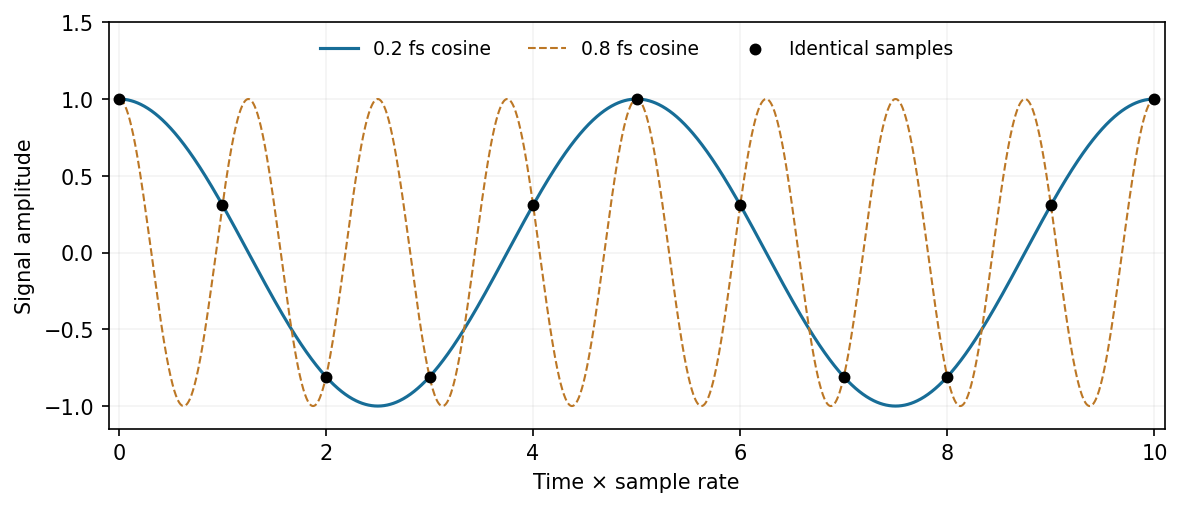
Two different continuous cosine frequencies produce the same samples when one lies above Nyquist
. Source. Details. For example, and cosines produce identical sample values. Apply an analogue Anti-aliasing filter before digitization and choose enough sample-rate margin for its finite transition band. A digital filter applied afterward cannot distinguish components already folded onto one another. Out-of-band noise also aliases unless filtered. The sample rate sets temporal/spectral coverage; quantization resolution sets amplitude precision and is a separate limitation. Bandpass Signal sampling has additional conditions beyond the simple baseband rule.[ref]
What the Nyquist Criterion Means to Your Sampled Data System Design by Walt Kester. MT-002: spectral replicas, aliases and practical filtering
Pinned article: Introduction to the OurBigBook Project
Welcome to the OurBigBook Project! Our goal is to create the perfect publishing platform for STEM subjects, and get university-level students to write the best free STEM tutorials ever.
Everyone is welcome to create an account and play with the site: ourbigbook.com/go/register. We belive that students themselves can write amazing tutorials, but teachers are welcome too. You can write about anything you want, it doesn't have to be STEM or even educational. Silly test content is very welcome and you won't be penalized in any way. Just keep it legal!
Intro to OurBigBook
. Source. We have two killer features:
- topics: topics group articles by different users with the same title, e.g. here is the topic for the "Fundamental Theorem of Calculus" ourbigbook.com/go/topic/fundamental-theorem-of-calculusArticles of different users are sorted by upvote within each article page. This feature is a bit like:
- a Wikipedia where each user can have their own version of each article
- a Q&A website like Stack Overflow, where multiple people can give their views on a given topic, and the best ones are sorted by upvote. Except you don't need to wait for someone to ask first, and any topic goes, no matter how narrow or broad
This feature makes it possible for readers to find better explanations of any topic created by other writers. And it allows writers to create an explanation in a place that readers might actually find it.
Figure 1. Screenshot of the "Derivative" topic page. View it live at: ourbigbook.com/go/topic/derivativeVideo 2. OurBigBook Web topics demo. Source. - local editing: you can store all your personal knowledge base content locally in a plaintext markup format that can be edited locally and published either:This way you can be sure that even if OurBigBook.com were to go down one day (which we have no plans to do as it is quite cheap to host!), your content will still be perfectly readable as a static site.
- to OurBigBook.com to get awesome multi-user features like topics and likes
- as HTML files to a static website, which you can host yourself for free on many external providers like GitHub Pages, and remain in full control

Figure 2. You can publish local OurBigBook lightweight markup files to either OurBigBook.com or as a static website.
Figure 3. Visual Studio Code extension installation.
Figure 5. . You can also edit articles on the Web editor without installing anything locally. Video 3. Edit locally and publish demo. Source. This shows editing OurBigBook Markup and publishing it using the Visual Studio Code extension. 
- Infinitely deep tables of contents:



All our software is open source and hosted at: github.com/ourbigbook/ourbigbook
Further documentation can be found at: docs.ourbigbook.com
Feel free to reach our to us for any help or suggestions: docs.ourbigbook.com/#contact