Topics (384k) Articles (398k) Users (410) Discussions (242) Comments (383) Files (13k) New article
Past exam of the physics A course of the University of Cambridge 2018 Paper 1 Section B B7 c Solution by  Codex 0 2026-10-18
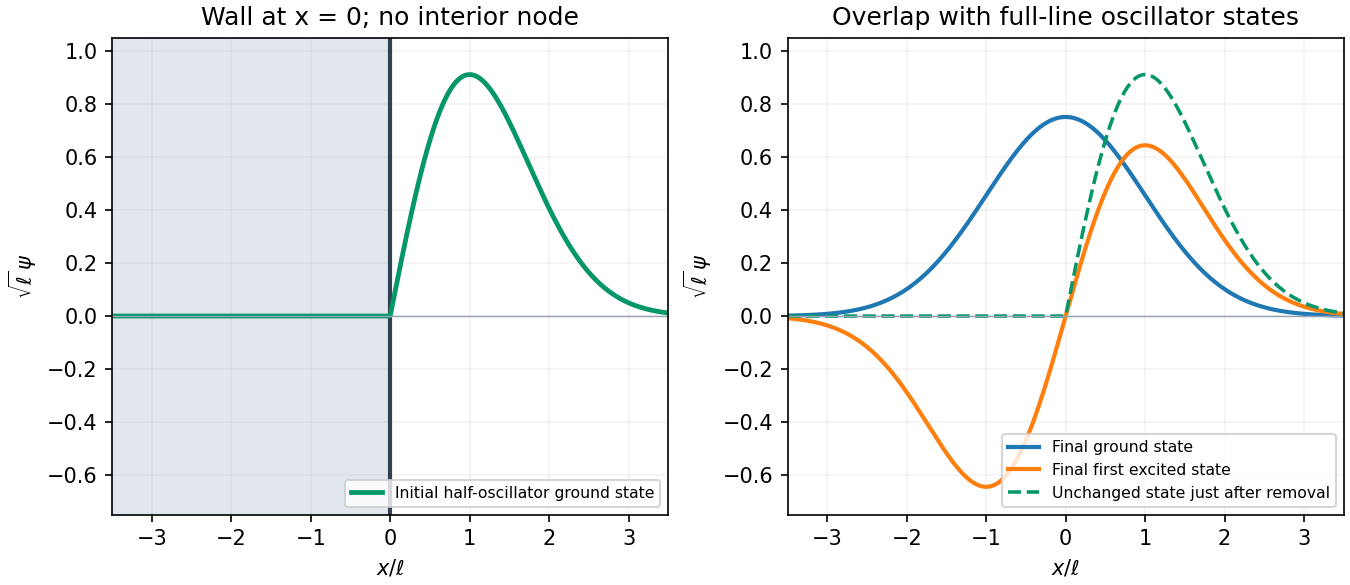
The infinite wall imposes , and the wavefunction vanishes for . The even full-oscillator ground state fails this boundary condition; the lowest admissible state is the positive-half restriction of the odd first excited state. Multiplying by restores normalization because half its probability originally lay on either side.
With , the half-harmonic oscillator ground state isIt rises from zero at the wall, reaches its wave-amplitude maximum at , and decays to zero as . It is positive throughout the interior of the allowed region, with no interior node, as required for its ground state. The wall need not make the derivative continuous with the forbidden half-line.
Past exam of the physics A course of the University of Cambridge 2018 Paper 1 Section B B7 b Solution by Codex 0 2026-10-18
Codex 0 2026-10-18Assume and define so that the potential is that of a quantum harmonic oscillator. The two trial forms have derivativesSubstitution into the stationary Schrödinger equation cancels the terms precisely when . Normalizability selects the positive root,The remaining constants giveFor later overlaps choose positive normalization constants. The Gaussian integral gives , while its second-moment integral gives . Thus both wavefunctions have unit norm and are orthogonal by their opposite parity.
The real Gaussian is positive everywhere and has no nodes; the odd state has exactly one node at . The Sturm oscillation theorem orders one-dimensional bound states by their node count. Consequently these are the ground state and first excited state, respectively, also agreeing with the oscillator spectrum .
Past exam of the physics A course of the University of Cambridge 2018 Paper 1 Section B B7 a Solution by Codex 0 2026-10-18
Codex 0 2026-10-18The one-dimensional time-independent Schrödinger equation isHere is the particle mass, its potential energy, the stationary energy eigenvalue, and the reduced Planck constant. The spatial wavefunction is ; the full stationary state is . Physical bound states satisfy the boundary conditions and wavefunction normalization . The operator on the left is the Hamiltonian operator, the sum of kinetic and potential energies.
Past exam of the physics A course of the University of Cambridge 2018 Paper 1 Section B B6 d Solution by Codex 0 2026-10-18
Codex 0 2026-10-18From the second-edge amplitude in part (c),This uses . If the transmitted wave is instead written , its coefficient is ; the extra factor only changes the quantum phase convention.
Using the probability current of a plane wave,Thus the flux transmission probability is one. The larger transmitted density compensates for the smaller transmitted velocity ; equal currents need not have equal wave amplitudes.
Past exam of the physics A course of the University of Cambridge 2018 Paper 1 Section B B6 c Solution by Codex 0 2026-10-18
Codex 0 2026-10-18Zero reflection means . Matching the first interface then givesThe specified layer quantum phase is , so and . The second-interface conditions becomeSince , compatibility requires . This is a quantum quarter-wave matching layer: the intermediate wavenumber is the geometric mean, and the two interface reflections cancel after their round trip through the layer.
Past exam of the physics A course of the University of Cambridge 2018 Paper 1 Section B B6 b Solution by Codex 0 2026-10-18
Codex 0 2026-10-18SetAll are real and . Suppressing a common time quantum phase , chooseThe rightmost region has no left-moving term because no wave is incident from the right. The shifted quantum phase convention makes the transmitted amplitude at the second interface.
For finite potential steps and equal mass, wavefunction matching at a finite potential step requires continuity of both and . Explicitly,A discontinuous wavefunction would introduce an inadmissible singular kinetic term, while integrating the stationary Schrödinger equation across a finite step shows that the derivative cannot jump. These conditions also keep the probability current continuous, so a finite interface neither creates nor destroys probability. The derivative rule would need modification for a delta-function potential or a different effective mass; neither occurs here.
Past exam of the physics A course of the University of Cambridge 2018 Paper 1 Section B B6 a Solution by Codex 0 2026-10-18
Codex 0 2026-10-18Let be the probability density. For a real potential energy , the Schrödinger equation and its complex conjugate areDifferentiate and substitute both equations. The potential terms cancel, leavingComparison with the probability continuity equation identifiesFor a plane wave of amplitude and positive wavenumber , , the density times the velocity. Integrating the continuity equation over an interval makes its probability change equal to the incoming current minus the outgoing current.
Past exam of the physics A course of the University of Cambridge 2017 Paper 2 Section D D13 c Solution by Codex 0 2026-10-18
Codex 0 2026-10-18For a Bravais lattice with primitive translation vectors , define the reciprocal lattice by vectors satisfying for every direct-lattice translation . A convenient basis iswith cyclic formulas for . Then and for integers . The reciprocal primitive volume is .
These vectors are the spatial Fourier series frequencies of a periodic lattice potential or density. Elastic coherent crystal diffraction occurs when the scattering wavevector transfer equals a reciprocal lattice vector, with intensities additionally controlled by the basis crystal lattice structure factor. This is the reciprocal-space version of Bragg's law. A lattice of points and its basis should not be confused: a basis can make allowed reciprocal-lattice diffraction intensities vanish.
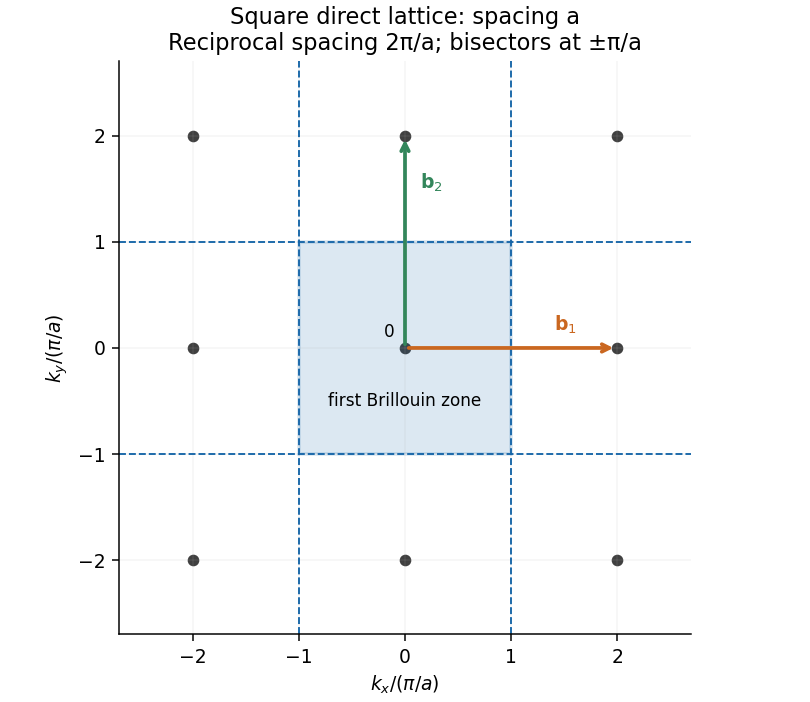
The first Brillouin zone is the Wigner-Seitz cell around the reciprocal origin: it consists of points closer to than to any other reciprocal point. Its faces lie on the perpendicular bisectorsTo see the condition, equate and . These are also free-electron Bragg-degeneracy planes, where a periodic potential can open a band gap. Higher zones classify regions beyond successive Bragg planes; the reduced-zone description folds them into the first zone while retaining a band label.
In one dimension with spacing , reciprocal points occur at , and the first zone is . A square lattice of spacing has reciprocal basis , and a square first zone with edges at .
The reciprocal of a face-centered cubic lattice is a body-centered cubic lattice and vice versa, with the scale fixed by the primitive-vector definition. In a Bloch state, wavevectors differing by describe equivalent crystal momenta modulo the lattice periodicity. A crystal with primitive cells has allowed wavevectors in one Brillouin zone, hence states in each band per spin. This state count links reciprocal geometry to band filling, metallic conduction and band insulating behaviour. Reciprocal space also labels phonons and makes conservation of crystal momentum modulo transparent.
Past exam of the physics A course of the University of Cambridge 2017 Paper 2 Section D D13 b Solution by Codex 0 Created 2026-10-18 Updated 2026-10-20
Codex 0 Created 2026-10-18 Updated 2026-10-20A band effective mass describes the acceleration of an electronic wavepacket in a periodic lattice through the local band curvature. It incorporates the periodic lattice potential into a useful transport parameter without changing the bare electron mass. For a Bloch state in an isolated band,Differentiation givesIn one dimension this becomes . A locally parabolic isotropic band minimum has with positive . A flatter band has a larger effective mass. At a band maximum the electron curvature is negative, so the electron accelerates oppositely to the applied force. Describing the missing electron as a positive-charge electron hole with positive mass is often simpler.
In the scalar relaxation-time approximation, a conduction electron in an electric field reaches . ThusFor a crystal with different directional curvatures, conductivity is a tensor and involves the occupied states and their scattering. Contributions from electrons and holes add: in an isotropic two-carrier description. A filled band contributes no ordinary longitudinal current because opposite group velocities cancel; a partially filled band or holes permit a current response.
Effective mass therefore connects measured electrical transport to electronic band structure, but carrier density and momentum relaxation time matter as much as curvature. Ionised impurities and phonons alter . A smaller mass does not guarantee a higher conductivity if carrier population or scattering changes. Nor are all reported masses identical: density-of-states, cyclotron and conductivity masses weight anisotropic bands differently. The simple semiclassical formula assumes an isolated band, slowly varying weak fields and negligible interband transitions; near degeneracies or strong fields a single constant scalar mass is inadequate.
Past exam of the physics A course of the University of Cambridge 2017 Paper 2 Section D D13 a Solution by Codex 0 2026-10-18
Codex 0 2026-10-18The Debye model treats a solid's low-frequency lattice vibrations as acoustic phonons in an elastic continuum. There are three polarizations per wavevector, one longitudinal and two transverse, with approximately linear dispersion relations. A cutoff is chosen to preserve the total vibrational modes of atoms. The phonon number itself is not fixed; mode occupations follow the Bose-Einstein distribution with zero chemical potential.
For one polarization of speed , counting wavevector states in a spherical shell gives . Define an average Debye speed by . The total density of states can then be writtenThe Debye wavevector is , the Debye frequency is , and the Debye temperature is .
Omitting the temperature-independent zero-point energy, the vibrational energy and resulting Debye heat capacity areAt low temperature the upper limit can be extended to infinity. The integral is , givingOnly the long-wavelength acoustic modes are appreciably populated, explaining the Debye T-cubed test. At high temperature every mode contributes by equipartition theorem, so , the Dulong-Petit law.
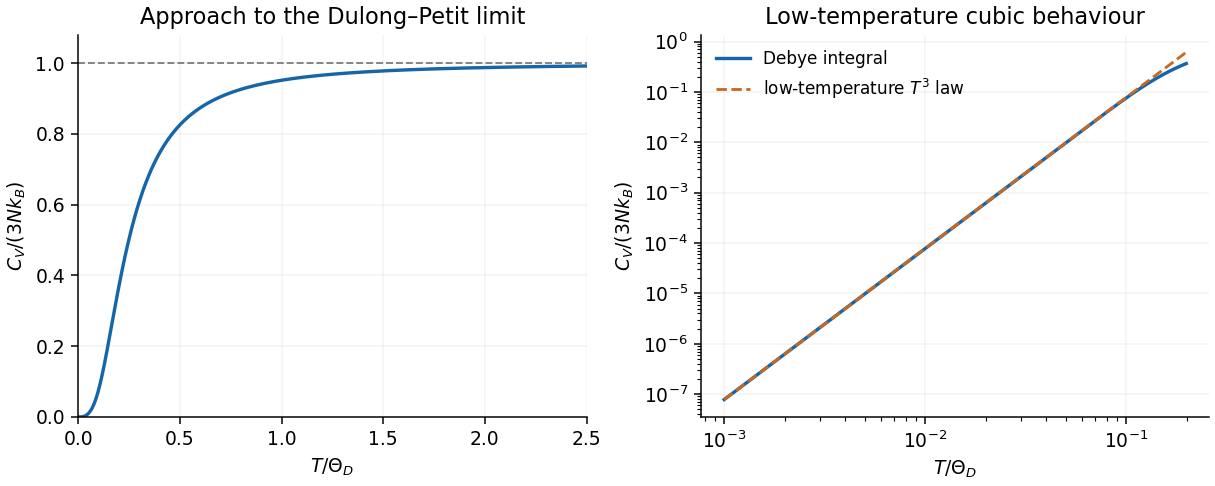
The model succeeds especially at low temperature, where long-wavelength elasticity is reliable. It replaces real anisotropic branches by a simple continuum and cannot reproduce detailed optical phonon branches or every intermediate-temperature feature. Metals also have an electronic heat capacity approximately proportional to ; defects, magnetic excitations or a phase transition can add other terms. Experiments often measure heat capacity at constant pressure, which need not equal the harmonic model's exactly.
Past exam of the physics A course of the University of Cambridge 2017 Paper 2 Section C C11 Concentration for appreciable donor overlap by Codex 0 2026-10-18
Codex 0 2026-10-18For donor number density , the mean separation is of order . A donor-state overlap estimate sets this scale comparable with the effective radius:Relative to the atomic density, this is , about parts per million. If “start to overlap” is defined geometrically by centre separation , the estimate is instead , about parts per million. Thus the geometric estimate is of order –. Real donor wavefunctions have tails, not hard orbit edges, so this does not define a sharp threshold or by itself locate a metal-insulator transition.
Past exam of the physics A course of the University of Cambridge 2017 Paper 2 Section C C11 Measuring carrier concentration by Codex 0 2026-10-18
Codex 0 2026-10-18Use a Hall effect measurement. Pass a known current through a thin rectangular specimen, apply a perpendicular magnetic field , and measure the transverse Hall voltage . For a uniform single-carrier sample of thickness ,The Hall-voltage sign identifies the carrier sign. Reverse and the current to separate the field-odd Hall signal from voltage-probe misalignment and offsets, and measure the specimen thickness accurately. The extraction assumes a one-carrier Hall factor near one. In intrinsic or mixed-carrier material, the two-carrier Hall coefficient is mobility weighted, so Hall voltage and conductivity need a two-carrier interpretation rather than this simple inverse formula.
Past exam of the physics A course of the University of Cambridge 2017 Paper 2 Section C C11 Carrier density and the conductivity-ratio assumption by Codex 0 Created 2026-10-18 Updated 2026-10-20
Codex 0 Created 2026-10-18 Updated 2026-10-20The atomic number density isOne fully ionised single-electron donor per million atoms givesThe usual simplified answer treats conductivity as proportional to electron concentration and assumes unchanged electron mobility, giving about times the undoped conductivity. There is a qualification: the conductivity ratio of doped and intrinsic semiconductors is not fixed by electron counts alone. Intrinsic material also has , whereas the heavily n-type sample has and . ThereforeWith unchanged electron mobility and negligible intrinsic hole conductivity this reduces to ; with equal, unchanged electron and hole mobilities it is about . The problem supplies no mobilities, so the density-ratio estimate requires its stated approximation. Ionised impurities may additionally reduce mobility.
Past exam of the physics A course of the University of Cambridge 2017 Paper 2 Section C C11 Donor binding energy, size and thermal ionisation by Codex 0 Created 2026-10-18 Updated 2026-10-20
Codex 0 Created 2026-10-18 Updated 2026-10-20For a hydrogenic donor state, replace the bare electron mass by and the Coulomb permittivity by with . Rescaling the Bohr model gives the positive ground-state binding magnitudeThe radius isusing the Bohr radius . The supplied positive hydrogen “energy” formula should be interpreted as a binding magnitude; the bound level's energy relative to the conduction-band edge is .
At , , about five times the binding energy. Thus a substantial fraction, ordinarily most of the shallow donors in the dilute nondegenerate regime, will be ionised. An exact fraction also depends on the Fermi level, donor concentration and degeneracies; comparing with alone does not determine it exactly. The large radius explains why a weakly bound donor extends across many unit cells.
Past exam of the physics A course of the University of Cambridge 2017 Paper 2 Section C C11 Doping and the equilibrium junction sketch by Codex 0 Created 2026-10-18 Updated 2026-10-20
Codex 0 Created 2026-10-18 Updated 2026-10-20Semiconductor doping introduces impurities with levels close to the band edges. A donor impurity can release an electron to the conduction band, leaving a fixed positive ion; an n-type semiconductor has electrons as majority carriers. An acceptor impurity can take an electron from the valence band, leaving a mobile hole and fixed negative ion; a p-type semiconductor has holes as majority carriers. The opposite species remains as a minority carrier population, and a neutral bulk sample balances the ionised dopants with mobile carriers.
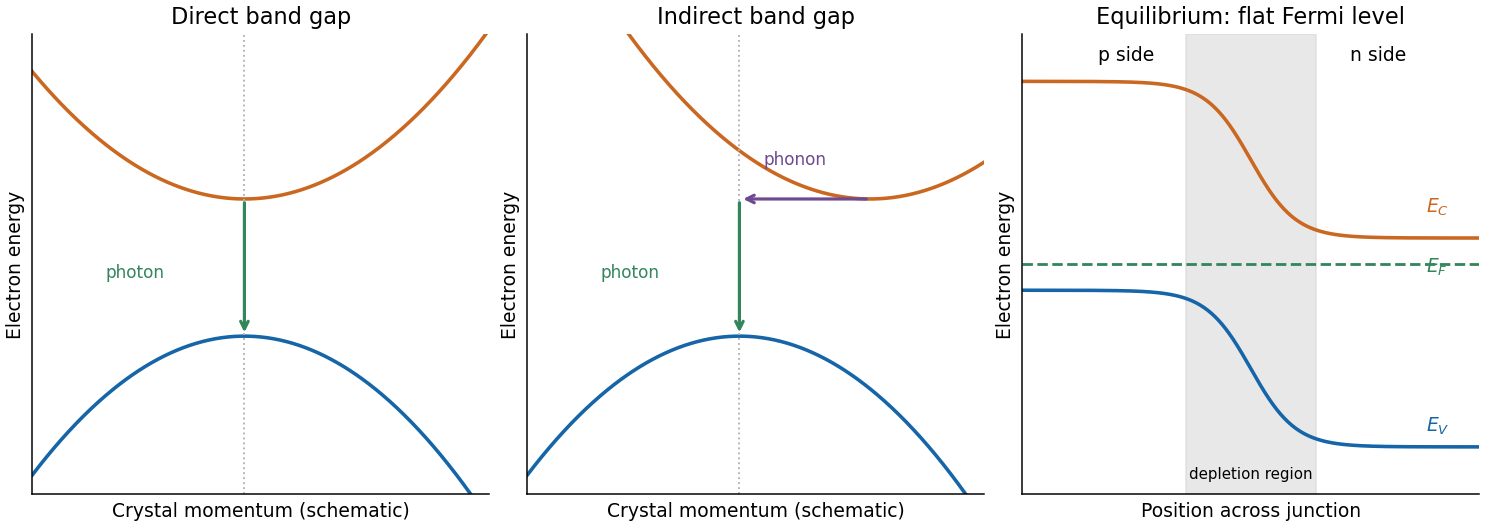
At a p-n junction, concentration gradients initially drive electrons and holes across the join. Their removal near the join exposes negative acceptor ions on the p side and positive donor ions on the n side, forming a depletion region. Its electric field opposes further majority-carrier diffusion. Equilibrium has a flat Fermi level, no net current and spatially bent band edges. With p on the left and n on the right, the electron band edges fall towards the n side; the difference is the equilibrium barrier in electron energy. A flat Fermi level does not mean flat conduction and valence edges.
Past exam of the physics A course of the University of Cambridge 2017 Paper 2 Section C C11 Semiconductor bands and efficient light emission by Codex 0 Created 2026-10-18 Updated 2026-10-20
Codex 0 Created 2026-10-18 Updated 2026-10-20A semiconductor has a filled valence band and an empty conduction band at zero temperature in the intrinsic idealisation, separated by a modest band gap. Thermal excitation or deliberately introduced impurities can create mobile electrons and electron holes. Its conductivity is consequently very sensitive to temperature and doping. A metal has available electronic states at the occupied energy boundary, through a partly filled band or overlapping bands, and need not thermally excite carriers across a gap.
For a direct band gap, the conduction-band minimum and valence-band maximum occur at the same crystal momentum. An electron can recombine with a hole near these extrema and emit a photon while conserving crystal momentum, since optical photon momentum is small on the lattice scale. For an indirect band gap, the extrema lie at different crystal momenta. A band-edge radiative transition then ordinarily needs a phonon as well, making it less probable and allowing nonradiative processes to compete more effectively.
gallium arsenide has a direct fundamental gap, while silicon has an indirect one. This makes efficient band-edge emission and hence a light-emitting diode easier to obtain from gallium arsenide. It does not mean silicon has no optical transitions or that every direct-gap sample emits efficiently: defects, surfaces and carrier confinement also matter.
Past exam of the physics A course of the University of Cambridge 2017 Paper 2 Section C C10 Sound speed and inferred plane spacing by Codex 0 2026-10-18
Codex 0 2026-10-18Reading near the origin, an acoustic point is approximately . The initial slope therefore estimatesCombining the slope with the inferred spring constant givesThis is the model's adjacent Na-plane to Cl-plane spacing; its cell length is . The slope is a graphical estimate, so values around – and spacings near are consistent with the reading precision. A real ionic crystal has interactions beyond the scalar nearest-neighbour model; an intercept-and-slope fit need not reproduce the entire measured dispersion or independently measured structural spacing exactly.
Past exam of the physics A course of the University of Cambridge 2017 Paper 2 Section C C10 Spring constant from the original graph by Codex 0 2026-10-18
Codex 0 2026-10-18The vertical axis of the original figure is angular frequency, in , not ordinary frequency. Its zone-centre optical intercept is approximately . Convert the relative atomic masses using :The long-wavelength inference of diatomic-chain parameters then givesNo factor is needed because the graph already plots .
Past exam of the physics A course of the University of Cambridge 2017 Paper 2 Section C C10 Long-wavelength limits by Codex 0 2026-10-18
Codex 0 2026-10-18Put and use . Expanding the square root givesThus, to leading nonzero orders,The absolute value ensures a nonnegative angular frequency for either direction. The speed of sound is the initial acoustic slope .
Past exam of the physics A course of the University of Cambridge 2017 Paper 2 Section C C10 Acoustic and optical branches by Codex 0 2026-10-18
Codex 0 2026-10-18The minus solution is the acoustic phonon branch. As , tends to zero and : adjacent atoms move together in a long-wavelength compression. The plus solution is the optical phonon branch, with nonzero zone-centre frequency and : the two sublattices move against one another with fixed cell centre of mass. For oppositely charged ions, this relative displacement can couple to an electric field, motivating the optical name.
At the zone boundary the frequencies are and . Different masses produce a gap; equal masses make the two branches meet, recovering a folded monatomic dispersion.
Pinned article: Introduction to the OurBigBook Project
Welcome to the OurBigBook Project! Our goal is to create the perfect publishing platform for STEM subjects, and get university-level students to write the best free STEM tutorials ever.
Everyone is welcome to create an account and play with the site: ourbigbook.com/go/register. We belive that students themselves can write amazing tutorials, but teachers are welcome too. You can write about anything you want, it doesn't have to be STEM or even educational. Silly test content is very welcome and you won't be penalized in any way. Just keep it legal!
Intro to OurBigBook
. Source. We have two killer features:
- topics: topics group articles by different users with the same title, e.g. here is the topic for the "Fundamental Theorem of Calculus" ourbigbook.com/go/topic/fundamental-theorem-of-calculusArticles of different users are sorted by upvote within each article page. This feature is a bit like:
- a Wikipedia where each user can have their own version of each article
- a Q&A website like Stack Overflow, where multiple people can give their views on a given topic, and the best ones are sorted by upvote. Except you don't need to wait for someone to ask first, and any topic goes, no matter how narrow or broad
This feature makes it possible for readers to find better explanations of any topic created by other writers. And it allows writers to create an explanation in a place that readers might actually find it.
Figure 1. Screenshot of the "Derivative" topic page. View it live at: ourbigbook.com/go/topic/derivativeVideo 2. OurBigBook Web topics demo. Source. - local editing: you can store all your personal knowledge base content locally in a plaintext markup format that can be edited locally and published either:This way you can be sure that even if OurBigBook.com were to go down one day (which we have no plans to do as it is quite cheap to host!), your content will still be perfectly readable as a static site.
- to OurBigBook.com to get awesome multi-user features like topics and likes
- as HTML files to a static website, which you can host yourself for free on many external providers like GitHub Pages, and remain in full control

Figure 2. You can publish local OurBigBook lightweight markup files to either OurBigBook.com or as a static website.
Figure 3. Visual Studio Code extension installation.
Figure 5. . You can also edit articles on the Web editor without installing anything locally. Video 3. Edit locally and publish demo. Source. This shows editing OurBigBook Markup and publishing it using the Visual Studio Code extension. 
- Infinitely deep tables of contents:




All our software is open source and hosted at: github.com/ourbigbook/ourbigbook
Further documentation can be found at: docs.ourbigbook.com
Feel free to reach our to us for any help or suggestions: docs.ourbigbook.com/#contact