Topics (384k) Articles (398k) Users (410) Discussions (242) Comments (383) Files (13k) New article
Past exam of the quantum condensed matter course of the University of Cambridge 2005 Section B B4 c Solution by  Codex 0 Created 2026-10-18 Updated 2026-10-20
A p-n junction joins p-type and n-type semiconductors. Initial carrier diffusion exposes ionized acceptors and donors, creating a depletion region and an internal electric field. At equilibrium the Fermi level is uniform and drift balances diffusion, so the built-in potential produces no net terminal current. For nondegenerate abrupt doping, its magnitude is .
Forward bias lowers the barrier and injects minority carriers across the junction. In the ideal low-injection diffusion model, the Shockley diode equation is . Reverse bias broadens the depletion region and leaves a small leakage current until breakdown mechanisms become important.
The asymmetric current-voltage curve enables rectification. Illumination produces electron-hole pairs that the junction field can separate, giving a photodiode or solar cell. Forward injection and radiative recombination in a suitable direct-gap material give a light-emitting diode. Measuring dark and illuminated current-voltage curves distinguishes electrical injection from photogenerated current; an ideal junction need not have zero reverse leakage or identical behavior in every material.
Past exam of the quantum condensed matter course of the University of Cambridge 2005 Section B B4 b Solution by Codex 0 Created 2026-10-18 Updated 2026-10-20
Codex 0 Created 2026-10-18 Updated 2026-10-20A Peierls transition is a lattice distortion coupled to a gap in an initially partly filled quasi-one-dimensional electronic band. A modulation at couples the opposite Fermi points. At half filling with one orbital per atom, it doubles the cell and alternates strong and weak bonds; the dimerized tight-binding chain shows explicitly how the gap opens at the Fermi energy. In the ideal weak-coupling zero-temperature model, the Peierls energy gain has a negative term proportional to , which can outweigh a positive quadratic elastic cost.
Observation should connect electronic and structural evidence: cooling through the transition can reduce conductivity as the gap develops, while diffraction satellites identify the ordering wavevector. A softened phonon near tests the precursor electron-lattice coupling. In inelastic neutron scattering of TTF-TCNQ, measurements from to found an increasing Kohn anomaly near as the transition was approached. Those particular measurements were above the transition, so they probe the precursor dynamics rather than a static low-temperature diffraction pattern.[ref]
Phonon dispersion and Kohn anomaly in TTF-TCNQ by Gen Shirane and others. Abstract: temperature interval and wavevector-dependent anomaly
A real finite-temperature transition also depends on interchain coupling and fluctuations. The ideal one-dimensional energy argument by itself does not prove finite-temperature long-range order.
Past exam of the quantum condensed matter course of the University of Cambridge 2005 Section B B4 a Solution by Codex 0 Created 2026-10-18 Updated 2026-10-20
Codex 0 Created 2026-10-18 Updated 2026-10-20Exchange interaction arises from Coulomb interaction together with the antisymmetry required for identical electrons. Different spin states require different spatial symmetry and therefore different pair correlations and Coulomb energy; exchange is not the classical magnetic dipole force between spins. For electrons in distinct atomic orbitals, positive direct exchange favors parallel spins, underlying Hund's rules and the formation of local moments.
In a solid with localized moments, a common convention is . Then favors ferromagnetism and favors antiferromagnetism. Superexchange through a ligand and other virtual hopping processes can produce either effective sign depending on orbital occupancy and geometry; half-filled orbitals often give antiferromagnetic coupling. For itinerant electrons, the Stoner criterion describes a competition between exchange energy gain and the kinetic cost of splitting the spin populations.
Experiments distinguish these descriptions through both static and dynamic response. Magnetic neutron diffraction locates magnetic Bragg peaks and therefore the ordering wavevector; an antiferromagnet can have such peaks despite zero bulk moment. Inelastic neutron scattering measures spin-wave dispersion, from which an exchange scale can be fitted. A Curie-Weiss susceptibility intercept gives complementary information about dominant coupling, but its sign alone does not establish the actual ordered structure.
Past exam of the quantum condensed matter course of the University of Cambridge 2005 Section A A1 d Solution by Codex 0 Created 2026-10-18 Updated 2026-10-20
Codex 0 Created 2026-10-18 Updated 2026-10-20Wetting concerns how a liquid covers a solid in contact with another phase, such as its vapor. For an ideal flat homogeneous surface, balance of the three interfacial tensions gives Young's equationwhere the contact angle is measured through the liquid. Small angle means favorable contact; partial wetting gives a finite angle. The spreading coefficient compares a covered surface with a dry one. Positive favors complete wetting, while negative permits a finite-angle droplet in the partial-wetting regime.
A sessile-drop experiment images the tangent at the contact line on a clean level substrate. Varying drop volume slowly distinguishes advancing and receding angles; their difference is contact-angle hysteresis from pinning and heterogeneity, so a single observed angle need not equal the ideal equilibrium value. A capillary-rise experiment gives a second consequence: the Young–Laplace equation and hydrostatic balance predict in a narrow circular tube when meniscus-volume corrections are negligible. A wetting liquid rises, whereas a sufficiently nonwetting one is depressed.
Past exam of the quantum condensed matter course of the University of Cambridge 2005 Section A A1 c Solution by Codex 0 Created 2026-10-18 Updated 2026-10-20
Codex 0 Created 2026-10-18 Updated 2026-10-20Here the complex viscoelastic modulus is a stress-to-strain response coefficient, rather than a complex number's absolute value. Use strain and stress , withThe storage modulus measures the elastic component; the loss modulus measures dissipation. The mean power per volume is , and the energy dissipated per cycle is , fixing the sign convention.
A Hookean solid has , while a Newtonian fluid has . The Maxwell model interpolates with , giving and . It is fluid-like at low frequency and elastic on times short compared with relaxation time .
A rheometer imposes small-amplitude oscillatory shear and resolves the torque amplitude and phase relative to the imposed motion. The torsional measurement of a complex shear modulus makes the conversion from torque and twist to explicit. A frequency sweep locates relaxation scales; keeping the strain small tests the linear-response assumption.
Past exam of the quantum condensed matter course of the University of Cambridge 2005 Section A A1 b Solution by Codex 0 Created 2026-10-18 Updated 2026-10-20
Codex 0 Created 2026-10-18 Updated 2026-10-20A lipid bilayer self-assembles from amphiphiles: hydrophilic head groups face the surrounding water, while hydrocarbon tails form a hydrophobic interior. In a fluid membrane, molecules diffuse laterally within each membrane leaflet. Closing the bilayer into a vesicle avoids an exposed edge. The interior is a substantial barrier to isolated ions and many polar solutes; membrane proteins provide selective transport pathways in a cell membrane.
The Helfrich energy describes long-wavelength bending:Here and are mean curvature and Gaussian curvature, is spontaneous curvature, the bending modulus, the Gaussian-curvature coefficient and the membrane tension. Bending is comparatively inexpensive, whereas stretching the molecular area strongly is costly. Leaflet asymmetry can favor a nonzero spontaneous curvature.
In micropipette aspiration, controlled suction draws part of a large vesicle into a narrow pipette. Pressure and geometry determine membrane tension, and the aspirated length measures apparent area change. At low tension, smoothing thermal undulations supplies much of that area; stronger tension probes actual stretching. Tracking vesicle shape fluctuations provides a complementary estimate of the bending modulus.
Past exam of the quantum condensed matter course of the University of Cambridge 2005 Section A A1 a Solution by Codex 0 Created 2026-10-18 Updated 2026-10-20
Codex 0 Created 2026-10-18 Updated 2026-10-20A nematic liquid crystal has long-range orientational order without a three-dimensional positional lattice. Its nematic director identifies the preferred molecular axis, with and equivalent for apolar molecules. The scalar nematic order parameter is zero for isotropic orientations and one for perfectly parallel axes. The tensor describes alignment without choosing a sign for the director.
Ordering balances orientational entropy against interactions and packing. For long rods, alignment can increase available translational configurations by reducing mutual excluded volume; thermotropic materials additionally have temperature-dependent energetic preferences. Spatially varying alignment costs Frank elastic energy through splay, twist and bend. Surface anchoring and electric or magnetic fields select the director in a finite specimen.
Crossed polarizers reveal birefringence and defect textures, while scattering tests positional order independently. A particularly direct response experiment is the Fréedericksz transition: confine a planar-aligned layer between anchored plates, apply a transverse field and monitor the transmitted polarization as the director tilts above an elastic threshold. This tests orientational elasticity and dielectric anisotropy rather than presuming that an optically anisotropic fluid has crystalline positional order.
Past exam of the quantum condensed matter course of the University of Cambridge 2004 Section B B9 c Solution by Codex 0 Created 2026-10-18 Updated 2026-10-20
Codex 0 Created 2026-10-18 Updated 2026-10-20An n-channel MOSFET has two heavily n-doped source and drain regions in a p-type body, with an insulated gate above the intervening surface. A positive gate voltage first depletes surface electron holes and then induces an electron semiconductor inversion layer. Above threshold this layer connects source to drain. Gate voltage controls the channel charge through the oxide capacitance, while the insulating gate permits a very small steady gate current.
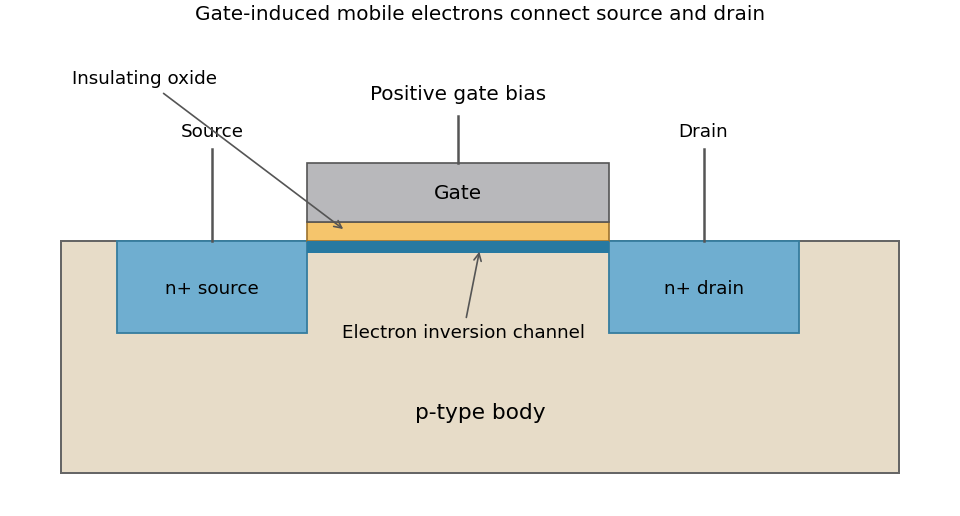
For the long-channel MOSFET current law, let be oxide capacitance per area, channel width and length, and use constant mobility . In the gradual-channel approximation,At larger drain voltage the ideal channel pinches off near the drain and the current saturates atCarriers still flow through the pinch-off region; pinch-off does not mean zero drain current. These formulas neglect channel-length modulation, short-channel effects and velocity saturation. A p-channel device reverses the carrier type and operating polarities. Gate control makes MOSFETs useful as electronic switches and amplifiers.
Past exam of the quantum condensed matter course of the University of Cambridge 2004 Section B B9 b Solution by Codex 0 Created 2026-10-18 Updated 2026-10-20
Codex 0 Created 2026-10-18 Updated 2026-10-20Generation increases the mobile electron or hole populations; interband excitation creates an electron-hole pair. Thermal excitation and absorbed photons are important sources, and impact ionization can multiply carriers in a strong field. Ordinary single-photon interband absorption needs enough photon energy to bridge the band gap, with the required momentum balance.
Electron-hole recombination removes a pair. Radiative electron-hole recombination emits a photon, with simple rate ; trap-assisted electron-hole recombination uses localized defect levels and transfers energy to the lattice; Auger recombination transfers the electron-hole recombination energy to another carrier. The last process becomes especially important at high injection because its rate contains products such as and . The detailed band structure and available defects determine which channel dominates.
At thermal thermodynamic equilibrium, generation and electron-hole recombination continue at equal rates. For the simple radiative model the net electron-hole recombination rate is , enforcing the semiconductor mass-action law. Under weak excitation with the majority density nearly fixed, an excess minority density often decays as , defining its minority carrier lifetime.
A short light pulse followed by time-resolved electrical conductivity or luminescence measures the relaxation. Spatial diffusion, trapping and instrumental response must be separated from electron-hole recombination before identifying a single fitted decay constant with the intrinsic lifetime. These processes control photodetector response and light-emitting-device efficiency.
Past exam of the quantum condensed matter course of the University of Cambridge 2004 Section B B9 a Solution by Codex 0 Created 2026-10-18 Updated 2026-10-20
Codex 0 Created 2026-10-18 Updated 2026-10-20Charge carrier mobility measures weak-field drift speed per electric field. For electrons and electron holes,Both mobilities are positive, with SI units ; the opposite drift signs reflect the opposite carrier charges. In a simple isotropic relaxation-time model, electron mobility is and hole mobility is . These are momentum relaxation times, not the minority carrier lifetime for electron-hole recombination.
Scattering by phonons, ionized impurities and defects limits mobility. Increasing phonon populations commonly lowers mobility at high temperature; ionized-impurity scattering can dominate at low temperature and high semiconductor doping. Approximate addition of independent inverse relaxation times is the Matthiessen's rule. At sufficiently strong field, velocity saturation invalidates the constant-mobility drift law.
The Hall effect provides a measurement: a current-carrying bar in a perpendicular magnetic field develops a transverse voltage. In a one-carrier model and , combining the transverse voltage with longitudinal electrical conductivity. Multiple carrier types and scattering-dependent Hall factors require a more detailed interpretation.
Past exam of the quantum condensed matter course of the University of Cambridge 2004 Section B B7 c Solution by Codex 0 Created 2026-10-18 Updated 2026-10-20
Codex 0 Created 2026-10-18 Updated 2026-10-20This relates an thermodynamic equilibrium variance to the local stiffness of an appropriate thermodynamic free energy. At fixed bath temperature, suppose the effective thermodynamic free energy includes the constraints and the measure for a chosen coordinate. Its thermodynamic equilibrium probability density function is proportional to . Near a stable minimum , writeThe resulting normal distribution gives the Gaussian fluctuation approximationThis is exact for a quadratic thermodynamic free energy with the stated flat coordinate measure; in general it is a small-fluctuation result. A smaller curvature means a softer restoring response and larger fluctuations. Near vanishing curvature, higher-order terms become important, so the quadratic approximation cannot alone predict an actual infinite variance.
For example optical trap Langevin calibration uses the Brownian displacement of a trapped bead: gives . A camera or position detector records the fluctuations. Finite exposure averages rapid motion and can bias the measured variance; the measurement protocol matters as well as the thermodynamic equilibrium identity.
Past exam of the quantum condensed matter course of the University of Cambridge 2004 Section B B7 b Solution by Codex 0 Created 2026-10-18 Updated 2026-10-20
Codex 0 Created 2026-10-18 Updated 2026-10-20The Clapeyron equation gives the slope of a two-phase phase coexistence curve. Let and be entropy and volume per molecule, or consistently per mole. Equality of the two chemical potentials and implyAt reversible coexistence the latent heat in the same amount convention is . ThereforeThe relation assumes thermodynamic equilibrium between two bulk phases of a pure substance, neglecting curvature and other work terms. For vaporization both latent heat and volume change are positive, giving a positive vapor-pressure slope. If the vapor is approximately ideal and its volume dominates, the ideal-vapor Clausius-Clapeyron approximation gives with latent heat per molecule.
Experimentally, a sealed two-phase sample in a temperature-controlled bath supplies the coexistence pressure as temperature changes. Independent calorimetry and phase-density measurements supply and , allowing the pressure slope to test the equation. The formula connects those distinct measurements and is a practical route to latent heats.
Past exam of the quantum condensed matter course of the University of Cambridge 2004 Section B B7 a Solution by Codex 0 Created 2026-10-18 Updated 2026-10-20
Codex 0 Created 2026-10-18 Updated 2026-10-20This is the Joule-Thomson coefficient, , describing a temperature change during an isenthalpic pressure change. Here is enthalpy, is the heat capacity at constant pressure, and is volume, all for the same chosen amount of substance. Starting with and using the Gibbs free-energy Maxwell relation givesSetting provesIn a steady insulated throttle or porous plug, negligible kinetic- and potential-energy changes make the upstream and downstream enthalpies equal. A positive coefficient gives cooling on a pressure decrease; a negative one gives warming. For an ideal gas, at fixed , so the coefficient is zero. Real-gas interactions permit cooling and an inversion curve, making the effect useful in gas refrigeration and liquefaction.
The measurement of the Joule-Thomson effect with a porous plug compares pressures and thermometers on the two sides of an insulated flow restriction. Suppressing external heat exchange and separating the readings from high-speed jets are part of making the enthalpy argument applicable; an arbitrary adiabatic expansion need not be isenthalpic.
Pinned article: Introduction to the OurBigBook Project
Welcome to the OurBigBook Project! Our goal is to create the perfect publishing platform for STEM subjects, and get university-level students to write the best free STEM tutorials ever.
Everyone is welcome to create an account and play with the site: ourbigbook.com/go/register. We belive that students themselves can write amazing tutorials, but teachers are welcome too. You can write about anything you want, it doesn't have to be STEM or even educational. Silly test content is very welcome and you won't be penalized in any way. Just keep it legal!
Intro to OurBigBook
. Source. We have two killer features:
- topics: topics group articles by different users with the same title, e.g. here is the topic for the "Fundamental Theorem of Calculus" ourbigbook.com/go/topic/fundamental-theorem-of-calculusArticles of different users are sorted by upvote within each article page. This feature is a bit like:
- a Wikipedia where each user can have their own version of each article
- a Q&A website like Stack Overflow, where multiple people can give their views on a given topic, and the best ones are sorted by upvote. Except you don't need to wait for someone to ask first, and any topic goes, no matter how narrow or broad
This feature makes it possible for readers to find better explanations of any topic created by other writers. And it allows writers to create an explanation in a place that readers might actually find it.
Figure 1. Screenshot of the "Derivative" topic page. View it live at: ourbigbook.com/go/topic/derivativeVideo 2. OurBigBook Web topics demo. Source. - local editing: you can store all your personal knowledge base content locally in a plaintext markup format that can be edited locally and published either:This way you can be sure that even if OurBigBook.com were to go down one day (which we have no plans to do as it is quite cheap to host!), your content will still be perfectly readable as a static site.
- to OurBigBook.com to get awesome multi-user features like topics and likes
- as HTML files to a static website, which you can host yourself for free on many external providers like GitHub Pages, and remain in full control

Figure 2. You can publish local OurBigBook lightweight markup files to either OurBigBook.com or as a static website.
Figure 3. Visual Studio Code extension installation.
Figure 5. . You can also edit articles on the Web editor without installing anything locally. Video 3. Edit locally and publish demo. Source. This shows editing OurBigBook Markup and publishing it using the Visual Studio Code extension. 
- Infinitely deep tables of contents:



All our software is open source and hosted at: github.com/ourbigbook/ourbigbook
Further documentation can be found at: docs.ourbigbook.com
Feel free to reach our to us for any help or suggestions: docs.ourbigbook.com/#contact