Topics (384k) Articles (398k) Users (410) Discussions (242) Comments (383) Files (13k) New article

A restriction enzyme cleaves DNA at or near recognized sequence patterns. Many type II systems produce reproducible fragments useful in genetic engineering, while a corresponding DNA modification system protects the host sequence. Different recognition patterns and cut positions can produce blunt ends or single-stranded overhangs. Thus recognition specificity and the physical end structure are separate properties important for assembling DNA fragments. [ref]
An enzyme inhibitor lowers an enzyme's reaction rate. In reversible enzyme inhibition, reducing free inhibitor concentration can restore activity; slow release can make this difficult to distinguish experimentally from irreversible inactivation. Competitive inhibition and mixed inhibition describe different changes in enzyme kinetics; pure noncompetitive inhibition is a special case of mixed inhibition, not a name for every inhibitor that binds away from an active site.[ref]
Symbolism and Terminology in Enzyme Kinetics (Recommendation 1981) by Nomenclature Committee of the International Union of Biochemistry. Symbolism and Terminology in Enzyme Kinetics, recommendation 1981, sections 6.1 and 6.4: reversibility and the ambiguity of non-competitive
The useful question is how adding substrate changes the inhibition. The model below connects binding to a measurable reaction rate, predicts when more substrate can overcome inhibition, and supplies examples for comparison with an enzyme inhibition initial-rate assay. Its inhibition constants are explicitly defined; neither a binding cartoon nor one reduced reaction rate by itself determines a mechanism.
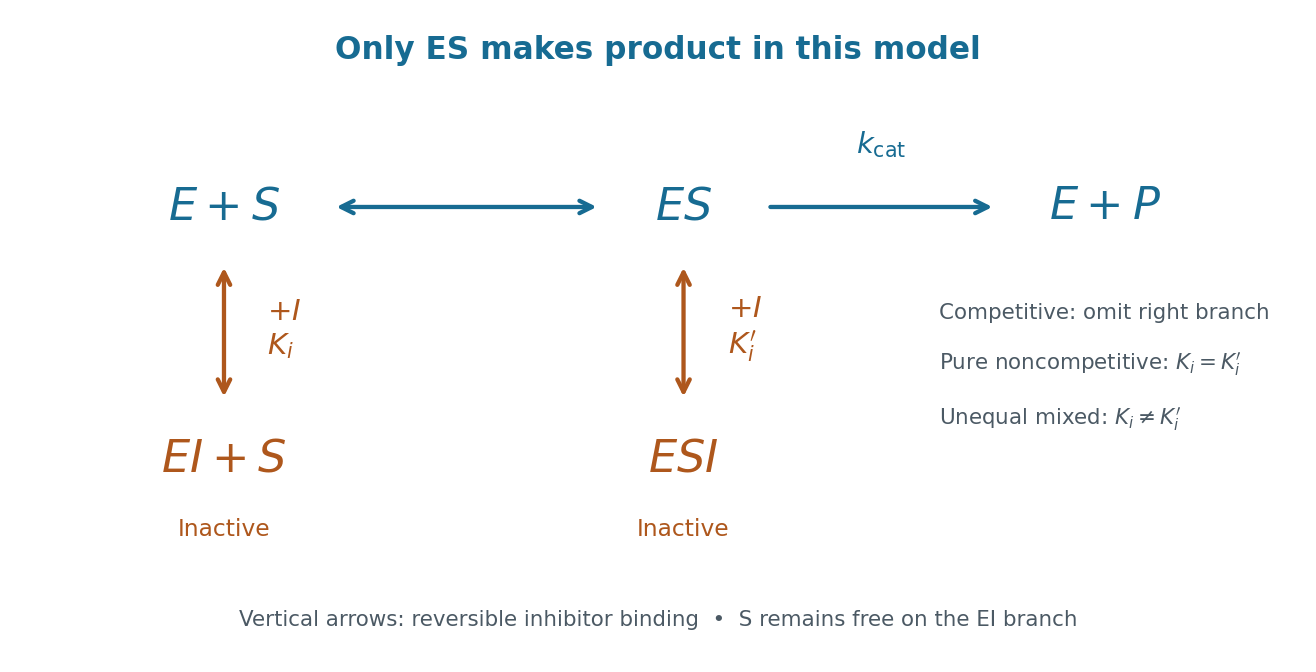
Reversible enzyme inhibition: which bound states can form?
Original branching scheme for a single substrate. is free enzyme, free substrate, free inhibitor, the productive enzyme-substrate complex, and and inactive complexes. Reversible vertical arrows show inhibitor binding and release. In competitive inhibition the right-hand inhibitor-binding branch is absent. Pure noncompetitive inhibition retains both branches with equal inhibition constants; general mixed inhibition permits unequal constants. The drawing specifies populations and allowed steps, not an atomic binding-site geometry. Details.A protease catalyses hydrolysis of peptide bonds in proteins or peptides. Different proteases recognize different sequences or structures, and some cut within a chain while others remove terminal residues. Digestion, signalling activation and controlled protein degradation all use this chemistry. The sequence specificity of chymotrypsin, for example, differs from indiscriminate breakdown of every peptide bond. [ref]
Trypsin is a serine protease: an enzyme that performs proteolysis by catalysing peptide bond hydrolysis. It preferentially cuts on the C-terminus side of lysine and arginine amino acid residues, leaving the selected amino acid residue in the preceding fragment.[ref]
Trypsin from bovine pancreas, DPCC Treated (T1005) - Product Information Sheet (Sigma-Aldrich). Trypsin from bovine pancreas, DPCC Treated, T1005 product information sheet, p. 1: Product Description, serine-protease family and C-terminal cleavage specificity
The bond being broken is the backbone amide linkage, rather than the lysine or arginine amino acid side chain. A formal connectivity equation for hydrolysis isHere and stand for the connected portions of the original peptide. Actual terminal protonation and electric charge depend on pH; the equation displays connectivity. Water supplies the elements needed to form the two new ends, while the enzyme is regenerated.
Selective cutting turns an unwieldy protein into shorter peptides, making peptide mapping useful for comparing proteins. In cell culture, trypsin also helps detach adherent biological cells: the HeLa culture viability experiment provides a concrete example of its use and subsequent stopping of proteolysis. The same enzyme can therefore serve both chemical analysis and preparation of a biological cell suspension.
Pyruvate kinase catalyzes phosphate transfer from phosphoenolpyruvate to ADP, producing pyruvate and ATP in glycolysis.
A scientist who studies insects. An entomologist can connect observations of development, behavior or population change with questions in physiology, ecology, agriculture or disease transmission.
Electroneutrality means that positive and negative charges balance on the length scale under consideration. For a bulk electrolyte with ionic concentrations and charge numbers , the approximation is .
A solution containing sodium and sulfate ions therefore needs twice as many singly charged sodium ions as doubly charged sulfate ions if these are its only ions. Local charge separation still occurs near an electrode in an electric double layer. Thus bulk electroneutrality does not mean that every microscopic region is neutral, and it should not be imposed pointwise when modeling a charged interface.
A solar eclipse occurs when the Moon passes in front of the Sun for an observer on Earth. The same event appears different from different locations: an observer in the umbra sees totality, while an observer in the penumbra sees only part of the solar disk covered.
If the Moon's apparent angular diameter is too small to cover the Sun, the central alignment produces an annular eclipse instead. The comparison is between apparent sizes, which depend on both physical size and Euclidean distance. During totality the normally overwhelming solar disk is hidden, exposing the much fainter solar corona and allowing observations of nearby background stars.[ref]
Types of Solar Eclipses by NASA. Total, annular and partial eclipse sections: apparent size, observer location and the visibility of the corona
An azeotrope has equal coexisting liquid and vapor compositions: . Ordinary fractional distillation cannot cross this composition boundary at fixed pressure; more packing does not remove it. A constant head temperature therefore does not establish a pure chemical substance.[ref]
Distillation introduction. Chem2O06 Laboratory Manual by McMaster University; Liquids that Form Azeotropes, constant-temperature mixtures and limits on separation
The stipulated model has throughout , so it has no interior azeotrope and cannot represent this limit.McMaster University's 1997/98 laboratory manual compares simple distillation and fractional distillation using charges of each of cyclohexane and p-xylene. Part B uses a round-bottom flask and a fractionating column. The protocol specifies a boiling chip, a heating mantle on a ring support, and the top of the thermometer bulb midway in the opening toward the laboratory condenser. Heating is adjusted for roughly one drop per second. Students record head temperature every collected, up to , and plot both runs against collected volume on the same axes.[ref]
Experiment 3 procedures. Chem2O06 Laboratory Manual by McMaster University; Parts A–B, Figure 3.5 position instruction, and Recording of Results
Charge, atmospheric operation, and collection rate provide comparison conditions; the fractionating column is changed. A sharper separation of temperature regions would support improved fractionation. It would not directly measure product mole fractions or prove purity. The manual distinguishes collected volume from composition and states that this pair forms no azeotrope. No student dataset is supplied here, and the constant-relative volatility example is not assigned to these liquids.[ref]
Experiment 3 procedures. Chem2O06 Laboratory Manual by McMaster University; Recording of Results, distinction between temperature–volume and temperature–composition plots; comparison questions
Consider a nonreacting two-component mixture processed into just two products, with no losses or unaccounted inventory. Let be feed, distillate, and bottoms amount of substance values in moles, and let be their component-A mole fractions. These are whole-stream compositions; is not automatically the instantaneous equilibrium vapor composition above the pot. Total and component balances giveThe component-B balance follows by subtracting the second equation from the first. Eliminating gives, for ,Nonnegative product amounts require between and . For an original stipulated feed , , , and ,Check the component inventories:The distillate contains a fraction of the original component A, despite its higher mole fraction . This distinction between composition and recovery is useful when deciding how much enriched product to collect. These balances determine neither temperatures, heat input, nor the number of equilibrium stages; they do not prove that the specified products are attainable in a particular fractionating column.
For a two-component mixture, let be component A's mole fraction in the liquid and its mole fraction in the coexisting vapor. At interior compositions, define the relative volatility of A with respect to B by the ratio of composition odds:Thus means A is enriched in the vapor, while means . Solving this definition givesHere a constant relative volatility is a stipulated model of vapor-liquid equilibrium, not a measured property of a named chemical solution. Real relative volatility can vary with composition, temperature, and pressure. The relation specifies no absolute temperature scale: even fixing does not determine a boiling-temperature curve or a heat requirement.
Fractional distillation brings rising vapor into contact with descending liquid in a fractionating column. Packing supplies contact area; it does not act as a sieve for individual molecules. Repeated exchange can enrich the rising vapor in the more volatile component. Some condensed liquid returns downward as reflux, rather than all being withdrawn as distillate.[ref]
Distillation by Hong Kong University of Science and Technology. Introduction, paragraphs on reflux and plates, trays or packing
An equilibrium stage is an idealization of this contact. A real fractionating column has finite contact time and imperfect wetting and mixing; its length is not automatically a count of equilibrium stages. Product withdrawal and reflux affect the separation together. Thus the repeated ideal-stage enrichment example illustrates the composition advantage of repeated equilibration, but supplies neither a column design nor a specified reflux requirement.[ref]
Distillation efficiency. Hyper-TVT by ETH Zurich; §5.6 Efficiency, equilibrium versus actual plates and flow-dependent efficiency
In simple distillation, pot vapor passes directly to the laboratory condenser. An initial small condensate sample can approximate vapor-liquid equilibrium with the current pot liquid. Removing enriched distillate depletes the pot's more volatile component. A collected fraction averages the changing condensate composition, rather than preserving the first-drop mole fraction.[ref]
Distillation introduction. Chem2O06 Laboratory Manual by McMaster University; A Mixture of Ideal Liquids, discussion of first and later fractions
A laboratory condenser removes heat from vapor so that it becomes liquid. In distillation, the downstream laboratory condenser makes collectable distillate. Complete condensation, without loss or reaction, preserves the entering vapor's overall component mole fractions; cooling alone does not give another enrichment step. Partial condensation can instead leave two streams of different composition, requiring both vapor-liquid equilibrium and a distillation material balance.
Pinned article: Introduction to the OurBigBook Project
Welcome to the OurBigBook Project! Our goal is to create the perfect publishing platform for STEM subjects, and get university-level students to write the best free STEM tutorials ever.
Everyone is welcome to create an account and play with the site: ourbigbook.com/go/register. We belive that students themselves can write amazing tutorials, but teachers are welcome too. You can write about anything you want, it doesn't have to be STEM or even educational. Silly test content is very welcome and you won't be penalized in any way. Just keep it legal!
Intro to OurBigBook
. Source. We have two killer features:
- topics: topics group articles by different users with the same title, e.g. here is the topic for the "Fundamental Theorem of Calculus" ourbigbook.com/go/topic/fundamental-theorem-of-calculusArticles of different users are sorted by upvote within each article page. This feature is a bit like:
- a Wikipedia where each user can have their own version of each article
- a Q&A website like Stack Overflow, where multiple people can give their views on a given topic, and the best ones are sorted by upvote. Except you don't need to wait for someone to ask first, and any topic goes, no matter how narrow or broad
This feature makes it possible for readers to find better explanations of any topic created by other writers. And it allows writers to create an explanation in a place that readers might actually find it.
Figure 1. Screenshot of the "Derivative" topic page. View it live at: ourbigbook.com/go/topic/derivativeVideo 2. OurBigBook Web topics demo. Source. - local editing: you can store all your personal knowledge base content locally in a plaintext markup format that can be edited locally and published either:This way you can be sure that even if OurBigBook.com were to go down one day (which we have no plans to do as it is quite cheap to host!), your content will still be perfectly readable as a static site.
- to OurBigBook.com to get awesome multi-user features like topics and likes
- as HTML files to a static website, which you can host yourself for free on many external providers like GitHub Pages, and remain in full control

Figure 2. You can publish local OurBigBook lightweight markup files to either OurBigBook.com or as a static website.
Figure 3. Visual Studio Code extension installation.
Figure 5. . You can also edit articles on the Web editor without installing anything locally. Video 3. Edit locally and publish demo. Source. This shows editing OurBigBook Markup and publishing it using the Visual Studio Code extension. 
- Infinitely deep tables of contents:



All our software is open source and hosted at: github.com/ourbigbook/ourbigbook
Further documentation can be found at: docs.ourbigbook.com
Feel free to reach our to us for any help or suggestions: docs.ourbigbook.com/#contact