Topics (384k) Articles (398k) Users (410) Discussions (242) Comments (383) Files (13k) New article

A materials scientist studies how composition, structure and processing determine a material's properties. The relevant scales can range from atomic defects and dislocations to grains, interfaces and bulk components. For example, changing grain size can alter strength while also changing ductility or high-temperature behaviour. Microscopy, diffraction, mechanical testing and thermodynamic models provide complementary evidence. The goal is to connect a reproducible structural change to a measured property, rather than merely assigning one fixed property value to a material name.
Tensile testing measures the response of a specimen to an axial pulling force. A tensile modulus experiment uses the initial proportional response to infer Young's modulus.
For a modern chosen example, the National Institute of Standards and Technology lists neutral magnesium atomic masses , , and , with reference isotopic abundances , , and . They describe the isotopes with mass numbers 24, 25, and 26, respectively.[ref]
Atomic Weights and Isotopic Compositions for Magnesium by National Institute of Standards and Technology. NIST, Atomic Weights and Isotopic Compositions for Magnesium: rows 24–26, neutral relative atomic masses and reference compositions
These modern inputs are not a reconstruction of historical observations.Use the dimensionless mass-to-charge ratio coordinate . For the illustration only, approximate ion masses by the neutral atomic masses. The singly charged positions are then near , , and ; the doubly charged companions are near , , and . The neutral-to-ion correction already given above is essential at higher accuracy. A peak near alone need not identify a chemical element: another ion with a different electric charge can occupy the same mass-to-charge ratio interval.
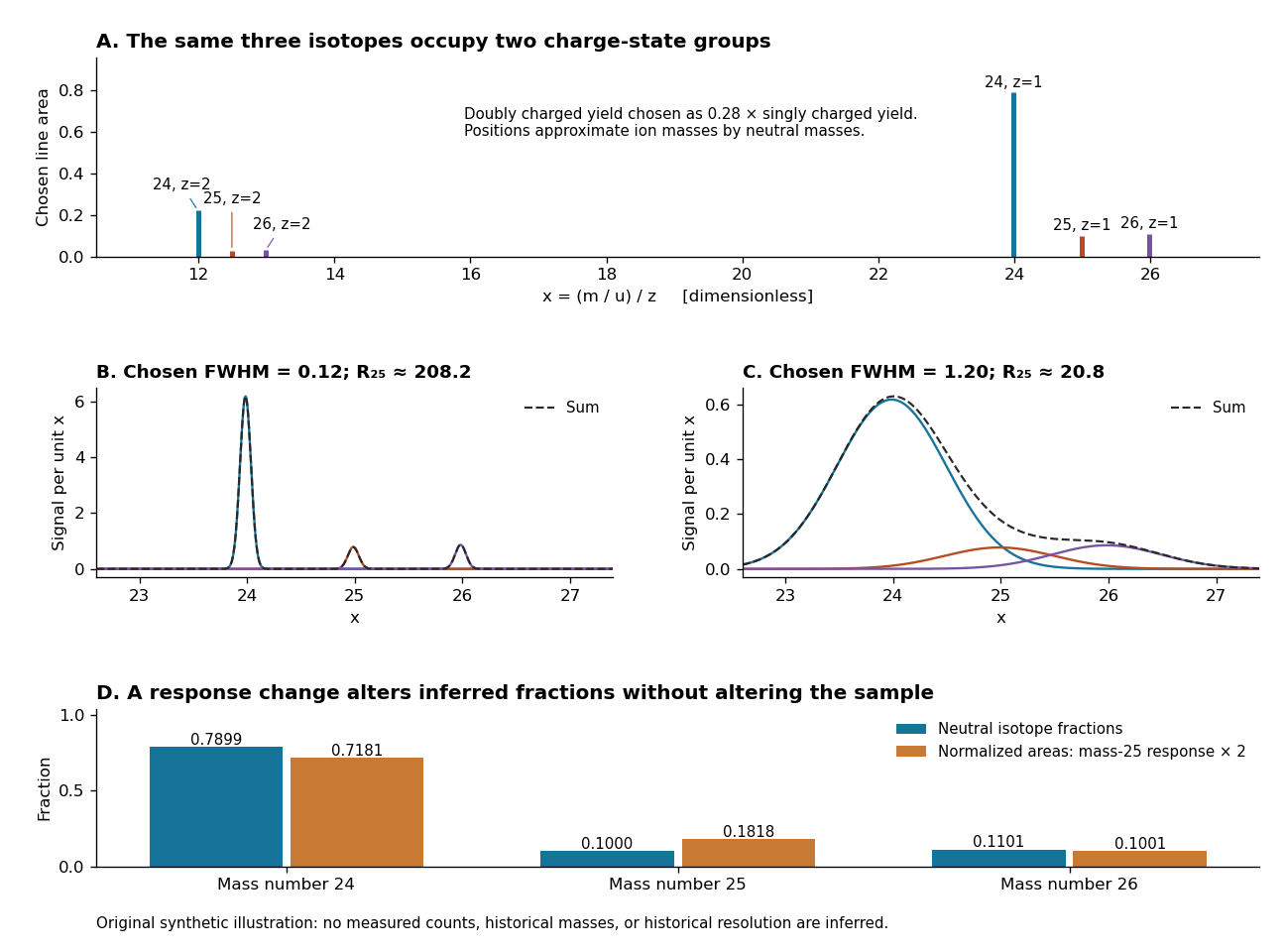
An original synthetic magnesium mass spectrum: charge states, finite mass resolution, and response bias
. All curves are stipulated sums of unit-area Gaussian functions, not measured data. The first two panels use equal isotope responses and selected full width at half maximum values and in . The last panel keeps the reference isotopic abundances fixed but multiplies the mass-25 response by two, then normalizes the areas. Neutral atomic masses approximate ion masses; charge-state yields are chosen independently, and no historical intensity or resolving-power claim is made. Details.For the narrow singly charged peak at , the chosen full width at half maximum gives mass resolving power ; widening to gives . Adjacent isotope spacings here are approximately one unit in . Peaks are visibly separated in the first chosen profile and overlap strongly in the second. A small uncertainty in a fitted peak centre would not by itself make the overlapping components resolved.
Even integrated peak areas need a response model. For isotope fraction , let collect the probability of ionization into electric charge state , transmission through the analyzer, and the detection response. In a linear instrument with overall exposure factor , the component area isEqual at a fixed makes normalized areas equal the fractions; otherwise it does not. In the chosen example, doubling only the mass-25 response changes the normalized areas to , , and , although the neutral sample is unchanged. Photographic darkening introduces another possible nonlinearity: neither line darkness nor peak height is a universal measure of neutral isotopic abundance. Calibration of position and calibration of intensity answer different questions. Matched standards, a known electric charge assignment, and a response correction make isotope analysis useful; a visually impressive set of peaks alone does not supply those controls.
Reuse the velocity selector analysis in the Thomson charge-to-mass experiment, but now send positive ions with into a separate magnetic analyzer. The selector fields and give . If the analyzer field is perpendicular to the selected velocity, its gyroradius givesfor a semicircular return to the entrance plane. The displayed impact separation is a diameter. This formula is linear in at fixed selected speed; the fixed-electric potential difference model above instead gives . They impose different experimental conditions.
For a chosen example, take , , and . Thus . Approximating an ion mass by and setting gives and . Here denotes the unified atomic mass unit. These are stipulated teaching inputs, not a reported Aston measurement or an exact magnesium atomic mass.
A finite accepted speed range broadens the radius distribution. At fixed and , . At fixed electric charge and mass, gives for a small kinetic energy spread. A one-percent kinetic energy spread therefore produces roughly a half-percent radius spread before other broadening is included. Its width convention must be specified before converting that statement into a mass resolving power.
Accelerator mass spectrometry uses ion acceleration and particle identification to count rare isotopes relative to abundant ones. For radiocarbon dating, it measures carbon-14 directly rather than waiting to count its beta decays.
Welding joins materials by producing local coalescence, using heat, pressure or both, with or without added filler. Fusion welding melts a joint region; solid-state methods can join without bulk melting. The surrounding heat-affected zone can change microstructure and properties even where material did not melt. Shrinkage and restraint can create residual stresses, while pores or incomplete bonding can weaken a joint. A welded structure must therefore be evaluated through the joint geometry and altered material regions, not just the parent material's nominal strength.
A scientific collaboration, not an individual person.
Official award records: www.nobelprize.org/prizes/lists/all-nobel-prizes-in-physics/
Gel electrophoresis through polyacrylamide under conditions that suppress nucleic acid folding; suitable sequencing conditions resolve adjacent nucleotide lengths.
Starch gel electrophoresis uses a starch-based gel to separate material in an electric field. The IgG chain reduction experiment uses it to compare polypeptide chains.
A gel band is a localized population of stained or otherwise detected molecules with sufficiently similar migration in one sample lane. One visible gel band need not contain only one nucleotide sequence. Two different linear DNA fragments of 375 base pairs can occupy the same unresolved gel band; equal migration supplies size evidence under suitable conditions, not a sequence determination.
Fluorescence from a bound stain can support an estimate of DNA quantity, but suitable staining and detector response matter.[ref]
Five Main Nucleic Acid Gel Electrophoresis Steps by Thermo Fisher Scientific. Step 4, Sample visualization, Fluorescent dyes: relation between fluorescence and bound nucleic acid
For a quantitative model with equal staining response per unit mass, background-subtracted, integrated fluorescence satisfies . This requires an unsaturated detector and a common proportionality constant ; visual peak brightness alone does not supply .
The amount of substance is , where is molar mass. For double-stranded DNA with approximately equal average mass per base pair, is proportional to length , so is proportional to . In a constructed example, equal integrated signals from 250-base pair and 1000-base pair gel bands imply approximately equal masses but four times as many short DNA molecules. Conversely, equal numbers of those DNA molecules would give about four times the signal for the longer fragments in this model. Neither conclusion follows from darkness in a schematic drawing.
A particle beam is a directed stream of particles prepared for transport, interaction or detection. A molecular beam can contain neutral chemical atoms or molecules; an accelerator beam can contain charged electrons, protons or ions. Its direction, energy spread, spatial distribution and particle flux describe different aspects of the preparation.
A source, direction-selecting apertures or focusing elements, a transport region and a detector perform separate tasks. For a charged beam, electric fields can change its energy and magnetic fields can bend its trajectory through the Lorentz force. A neutral atomic beam requires interactions appropriate to its neutral constituents. A vacuum reduces unwanted collisions along either transport path, but it does not itself make every particle's speed equal.
A particle accelerator increases the kinetic energy of charged particles through the work of an electric field. A single electric potential difference gives an energy gain of magnitude to a particle of electric charge crossing in the accelerating direction. Reusing a smaller electric potential difference many times can give a much larger final kinetic energy without requiring the whole apparatus to withstand the equivalent single voltage. A magnetic field can return the particles to the accelerating region: magnetic forces do no work, but they make repeated energy gains possible. The cyclotron turns this separation between bending and acceleration into a particularly elegant machine.
A DNA ligase is an enzyme that joins appropriately juxtaposed DNA ends by forming phosphodiester bonds.
The pyruvate dehydrogenase complex converts pyruvate into acetyl-CoA, releasing carbon dioxide and reducing NAD+ to NADH. Several catalytic components and enzyme cofactors couple decarboxylation, group transfer and oxidation within one assembly. It links glycolysis to the citric acid cycle, so control of the complex regulates the entry of carbohydrate-derived carbon into oxidative metabolism. A shared reaction intermediate can be passed between component active sites rather than diffusing freely through the cell. [ref]
An acid phosphatase catalyses hydrolysis of phosphate esters under acidic conditions; its lysosomal enzyme latency supplied evidence for lysosomes.
An acid hydrolase is an enzyme that catalyses hydrolysis most effectively under acidic conditions; lysosomes contain multiple kinds.
Pinned article: Introduction to the OurBigBook Project
Welcome to the OurBigBook Project! Our goal is to create the perfect publishing platform for STEM subjects, and get university-level students to write the best free STEM tutorials ever.
Everyone is welcome to create an account and play with the site: ourbigbook.com/go/register. We belive that students themselves can write amazing tutorials, but teachers are welcome too. You can write about anything you want, it doesn't have to be STEM or even educational. Silly test content is very welcome and you won't be penalized in any way. Just keep it legal!
Intro to OurBigBook
. Source. We have two killer features:
- topics: topics group articles by different users with the same title, e.g. here is the topic for the "Fundamental Theorem of Calculus" ourbigbook.com/go/topic/fundamental-theorem-of-calculusArticles of different users are sorted by upvote within each article page. This feature is a bit like:
- a Wikipedia where each user can have their own version of each article
- a Q&A website like Stack Overflow, where multiple people can give their views on a given topic, and the best ones are sorted by upvote. Except you don't need to wait for someone to ask first, and any topic goes, no matter how narrow or broad
This feature makes it possible for readers to find better explanations of any topic created by other writers. And it allows writers to create an explanation in a place that readers might actually find it.
Figure 1. Screenshot of the "Derivative" topic page. View it live at: ourbigbook.com/go/topic/derivativeVideo 2. OurBigBook Web topics demo. Source. - local editing: you can store all your personal knowledge base content locally in a plaintext markup format that can be edited locally and published either:This way you can be sure that even if OurBigBook.com were to go down one day (which we have no plans to do as it is quite cheap to host!), your content will still be perfectly readable as a static site.
- to OurBigBook.com to get awesome multi-user features like topics and likes
- as HTML files to a static website, which you can host yourself for free on many external providers like GitHub Pages, and remain in full control

Figure 2. You can publish local OurBigBook lightweight markup files to either OurBigBook.com or as a static website.
Figure 3. Visual Studio Code extension installation.
Figure 5. . You can also edit articles on the Web editor without installing anything locally. Video 3. Edit locally and publish demo. Source. This shows editing OurBigBook Markup and publishing it using the Visual Studio Code extension. 
- Infinitely deep tables of contents:



All our software is open source and hosted at: github.com/ourbigbook/ourbigbook
Further documentation can be found at: docs.ourbigbook.com
Feel free to reach our to us for any help or suggestions: docs.ourbigbook.com/#contact