Topics (384k) Articles (398k) Users (410) Discussions (242) Comments (383) Files (13k) New article
For a connected compact Lie group with maximal torus , the map , , has the displayed real Jacobian determinant. Choose an invariant inner product and identify the tangent space of with . Translation of the derivative at to the identity gives . Each pair of opposite roots of a root system corresponds to a real two-plane on which the determinant is . The torus direction has determinant one. Normalized quotient and Haar measures have matching volume constants because the Riemannian submersion gives . The map covers regular elements times, giving the Weyl integration formula with conjugacy averaging for general functions.
The toric divisor class sequence identifies the divisor class group with via . Choose integers with ; then represents its positive generator . This is an ample Q-Cartier divisor: for the local Cartier data of on the chart omitting ray is , which satisfies the strict toric ampleness criterion. The generator need not itself be a Cartier divisor; for example the positive generator on has Cartier index two.
For reservoir head above a broad crest, negligible approach velocity, constant reduced gravity, and no head loss, hydraulic control gives and the displayed discharge. Reflecting the vertical coordinate gives the same result for a light layer escaping beneath a lowered roof. An orifice discharge coefficient is a separate closure and should not be silently inserted into this inviscid weir law.
Majorana neutrino mass from the Weinberg operator by  Codex 0 Created 2026-10-14 Updated 2026-11-05
For the gauge-singlet composite , the interaction is electroweak gauge-invariant. At the Higgs field vacuum, , giving . The Grassmann variation of a chiral Majorana mass term therefore identifies the mass parameter as , with physical mass . The dimension-five interaction has a coupling of mass dimension minus one. Under lepton number phase rotation, its two terms acquire factors , so it violates continuous lepton number by two units. It is an effective extension of the minimal renormalizable Standard Model.
Integrate the pressure-gradient term in the weighted stellar pulsation Rayleigh quotient by parts, with regular centre and zero surface pressure. Writing uses and gives the displayed expression. Thus radial instability requires somewhere in the positive-pressure interior. A constant trial function gives , so strict radial stability requires this weighted integral to be positive, in particular somewhere. When throughout, constant is an exact zero-frequency homologous mode: the star is marginal, rather than strictly stable. Local threshold crossings alone do not determine stability for a mixed profile; the full Rayleigh-Ritz variational principle does.
Here the graph has vertices and edges. The bound is a deliberately loose canonical paths Poincare bound, sufficient for polynomial mixing time when both activity and reciprocal activity are polynomially bounded. Order the alternating graph paths and cycles of canonically. Convert each component from initial matching in a graph to final matching in a graph by moving an unmatched endpoint using exchanges; open a cycle with one deletion and finish it with one addition.
At an intermediate matching in a graph , the complementary encoding is a matching in a graph away from the active component and has at most two degree-two vertices. Remove at most two edges to obtain a matching in a graph . Record those edges and one bit selecting the initial alternating colour on the active component. For a fixed directed transition this data reconstructs , , the active component and its ordering, and then ; common edges are . There are at most auxiliary records per .
If , then . The transition capacity is at least , and the path length is at most . Summing over the injective encodings proves the displayed path congestion bound.
For an oriented lattice basis with , write . These differences are constant because is periodic. Integrating zeta around a fundamental cell gives the displayed relation by its one simple pole of residue one. Oddness and the logarithmic derivative then give . This fixes both the sign and the exponent convention in sigma-product constructions.
For , all frequencies satisfy . At , the increment is . If , the first terms have and contribute at least , while the remaining tail has magnitude at most . This proves a lower modulus of continuity bound of order for small . The inverse theorem for trigonometric approximation supplies the matching upper bound because the positive lacunary trigonometric series has .
The three nonzero half-period classes make the odd derivative of the Weierstrass elliptic function vanish. Their values are distinct: two equal values would force at least four zeros for a function with only one double pole. Thus they are three distinct roots of , whose monic discriminant gives the displayed factor. This lattice discriminant differs by from the normalized modular discriminant for the lattice .
A half-wave plate reverses the relative sign of the two components. For initial linear polarization at angle to the fast axis, the outgoing line is at modulo . The input therefore rotates by .
A quarter-wave plate gives a quarter-cycle phase retardation. Equal transmitted wave amplitudes initially in linear polarization at become circular polarization; unequal wave amplitudes generally give elliptical polarization. Reversing the sign reverses the traversal of the same circle.
For the overlapping monochromatic wave components, let be the thickness and the vacuum wavelength. Define using the slow and fast refractive indices. With complex amplitude convention , the accumulated slow-minus-fast phase difference isThis is the optical path difference expressed as a wave phase. It is a signed accumulation convention; with the opposite time convention the sign reverses. The outgoing polarization of an electromagnetic wave depends on modulo . Here the positive slow-minus-fast differs from the signed principal-index used in the parent birefringence entry when .
For an original worked example, stipulate at and a uniform thickness . These are design assumptions, not measured material data. The optical path difference is , soIt is a quarter-wave plate. At the same wavelength and refractive indices, doubling to gives , a half-wave plate. A thickness increase changes by , or ; retaining the same birefringence at would instead give for the plate. Real refractive indices also vary with wavelength, so this last calculation explicitly neglects optical dispersion.
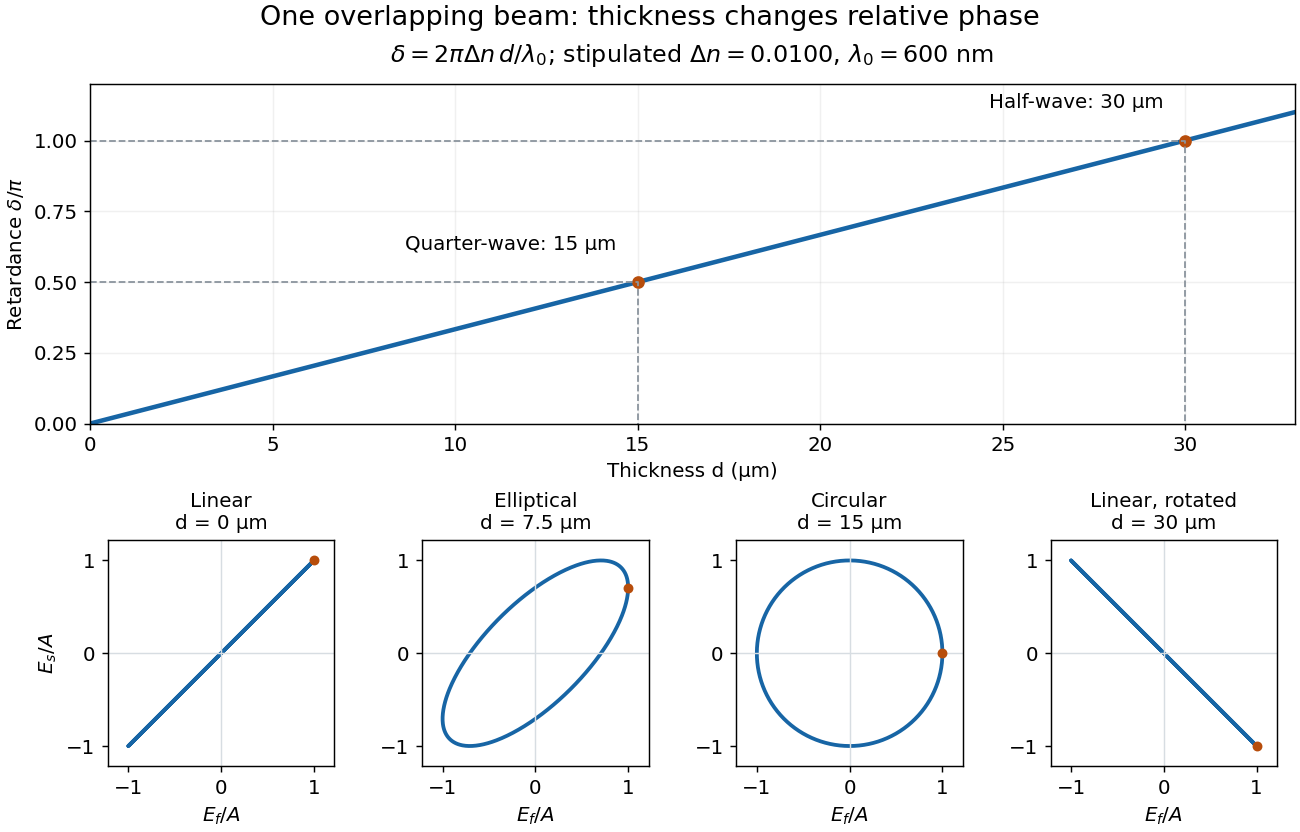
Phase retardation grows with thickness while overlapping components change polarization of an electromagnetic wave
. The stipulated , model gives quarter-wave and half-wave thicknesses of and . Insets trace the normalized electric field at a fixed point for equal fast/slow wave amplitudes, with and . The intermediate ellipse, circle and rotated line require no spatial beam separation. Details.For these equal transmitted wave amplitudes, orthogonal projection onto a polarizer crossed with the initial linear polarization gives a simple independent readout. After removing a common wave phase, the component complex amplitudes are proportional to ; orthogonal projection onto gives . Squaring its modulus yields : zero at , one half at , and one at . This assumes ideal polarizers, negligible specular reflection and wave absorption, overlapping components and stable relative wave phase. It measures a periodic function of phase retardation, so one brightness measurement cannot determine the thickness uniquely.
Hard thresholding keeps detail coefficients whose magnitude exceeds a prescribed threshold and sets the rest to zero, while retaining the coarse approximation coefficients. Soft thresholding instead uses . The simultaneous wavelet coefficient noise bound motivates thresholds of order in a normalized Gaussian regression model with at most order details. This is a nonlinear selection rule: coefficients can be removed individually rather than discarding an entire finest resolution.
For the stipulated Klein-Gordon packet velocities, take the original normalized spectral amplitudewith and . Here is the width of the spectral amplitude, not the standard deviation of its squared magnitude. Initially , a Gaussian function multiplying a carrier wave. Taking gives a real solution of the Klein-Gordon equation with the corresponding initial velocity. The tiny negative- tail is retained in this exact integral; the statement that it is mainly right-going is a narrow-spectrum approximation, not a claim of strictly positive wavenumbers.
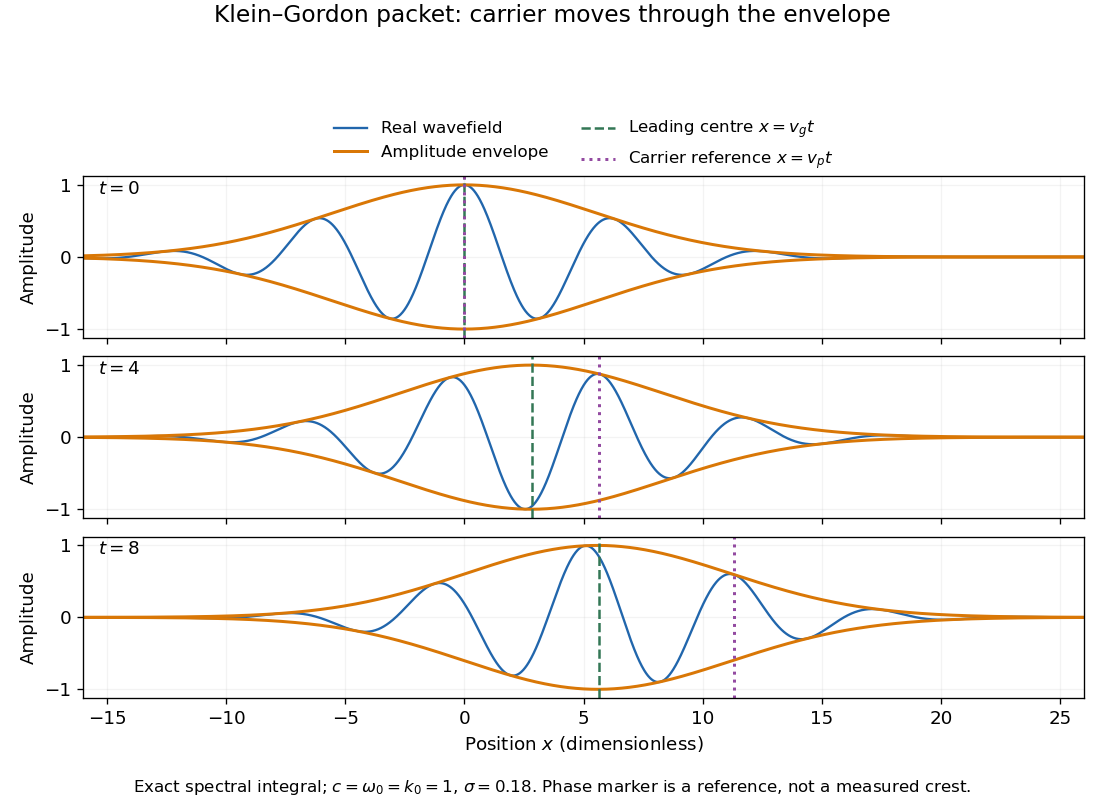
Original Klein-Gordon packet evolution: exact spectral integral, slower envelope and carrier phase reference
. Details. The dimensionless figure uses and at . Blue curves are , orange bounds are , and the marked carrier wave reference is ; it need not be a crest of the full wavefield. The dashed envelope-centre reference is a leading approximation. These are calculated curves, not experimental records. The exact dispersion relation makes the packet slightly asymmetric; a quadratic approximation predicts symmetric broadening about .
The first-order Taylor expansion translates the initial wave envelope without changing its shape. Retaining curvature instead givesThe distinction between translation and curvature-driven spreading is the same one exposed by the Gaussian pulse calculation in Pulse Propagation by Richard Fitzpatrick (equations 9.8–9.18). Its first-order approximation is not an assertion that a dispersive packet keeps its shape indefinitely.
Evaluating the quadratic Gaussian integral gives the original approximationand henceHere is the amplitude width: the standard deviation of the normalized intensity is . The peak falls as the packet widens, while stays constant. This conserved integral is not the complete physical wave energy of the Klein-Gordon equation.
Rigid translation requires . The quadratic approximation can allow that quantity to be order one, but still requires the accumulated neglected cubic wave phase to be small over the appreciable spectrum, for example . This sufficient check controls only the stated three-width spectral window; the Gaussian tails must also be negligible at the required accuracy. Higher derivatives or very long times require returning to the exact spectral integral. The width is therefore a controlled local approximation; it neither predicts front velocity nor establishes a universal identity between group velocity and information velocity.
A carrier wave is the rapid reference oscillation in a modulated wave. In the narrow-packet representation , choose near the centre of the frequency spectrum and on its dispersion relation. Its constant-wave phase reference moves at phase velocity . This reference need not coincide with a local maximum of the complete real wavefield when the wave envelope varies. Moving the reference shifts some slow wave phase into without changing .
A wave envelope is a slowly varying wave amplitude multiplying a rapidly oscillating carrier wave. For a complex wavefield , its nonnegative amplitude envelope is ; the complex can also encode a slowly varying wave phase. This choice distinguishes the amplitude envelope from a signed modulation factor, such as the cosine factor in a two-tone superposition. A slowly varying wave envelope is useful when the carrier's wavelength and period are short compared with its variation scales. Strong overlap between distinct packets or a broad frequency spectrum can spoil a unique carrier-envelope interpretation.
Consider an equilibrium ice-water wall line plume with volume flux per unit span , ice volume fraction , liquid salinity , and temperature . The positive coefficient is the slope magnitude of a linear liquidus; ambient liquid has salinity and temperature . Use equal reference densities and equal specific heat capacities in the thermodynamic bookkeeping, and let be the latent heat of fusion per unit mass.
When entrainment only adds that reference liquid and no crystals or heat escape, the excess enthalpy and salt fluxes are conserved:Combining them gives . Eliminating with the salt relation yieldsThus the leading dilute-crystal balance is . More precisely, this limit requires both and ; cancellation in the source combination can invalidate it even at small .
This conserved leading ice flux can drive a self-similar ice-bearing wall plume. Suspended frazil ice also changes buoyancy in ice-shelf plume models, whose additional crystal-growth, deposition and pressure effects need their own balances.[ref]
A glacier supplies fresh meltwater at speed to a rising wall line plume whose buoyancy is dominated by salinity. With one entraining edge, entrainment coefficient , volume flux and negligible wall stress, and . Enthalpy and salt balances give and . If latent heat dominates and entrainment dominates the volume supply, integration from a virtual origin and power-law balance give the displayed width and speed. The temperature and salinity deficits are and , both proportional to . The approximation is a far-field plume solution, not a solution at the virtual origin.
Invariant measures of the two-dimensional voter model by Codex 0 Created 2026-10-14 Updated 2026-11-05
Codex 0 Created 2026-10-14 Updated 2026-11-05In a nearest-neighbor voter model on the square lattice, any two ancestral coalescing random walks meet almost surely. For an invariant probability measure of a Markov process, the disagreement probability is constant in time but bounded by the vanishing probability of noncoalescence. Hence every pair of sites agrees almost surely. Countability concentrates the measure on the two constant configurations; both are absorbing state, so every mixture of their Dirac measures is invariant. Translation invariance need not be assumed.
If the initial one-spin set is finite on the square lattice, voter-model duality gives . The transition probabilities tend to zero on this infinite square lattice; their Fourier transform also proves this decay by dominated convergence. A union bound on any finite set of observation sites then proves weak convergence of probability measures to the all-zero point mass in the product topology.
Pinned article: Introduction to the OurBigBook Project
Welcome to the OurBigBook Project! Our goal is to create the perfect publishing platform for STEM subjects, and get university-level students to write the best free STEM tutorials ever.
Everyone is welcome to create an account and play with the site: ourbigbook.com/go/register. We belive that students themselves can write amazing tutorials, but teachers are welcome too. You can write about anything you want, it doesn't have to be STEM or even educational. Silly test content is very welcome and you won't be penalized in any way. Just keep it legal!
Intro to OurBigBook
. Source. We have two killer features:
- topics: topics group articles by different users with the same title, e.g. here is the topic for the "Fundamental Theorem of Calculus" ourbigbook.com/go/topic/fundamental-theorem-of-calculusArticles of different users are sorted by upvote within each article page. This feature is a bit like:
- a Wikipedia where each user can have their own version of each article
- a Q&A website like Stack Overflow, where multiple people can give their views on a given topic, and the best ones are sorted by upvote. Except you don't need to wait for someone to ask first, and any topic goes, no matter how narrow or broad
This feature makes it possible for readers to find better explanations of any topic created by other writers. And it allows writers to create an explanation in a place that readers might actually find it.
Figure 1. Screenshot of the "Derivative" topic page. View it live at: ourbigbook.com/go/topic/derivativeVideo 2. OurBigBook Web topics demo. Source. - local editing: you can store all your personal knowledge base content locally in a plaintext markup format that can be edited locally and published either:This way you can be sure that even if OurBigBook.com were to go down one day (which we have no plans to do as it is quite cheap to host!), your content will still be perfectly readable as a static site.
- to OurBigBook.com to get awesome multi-user features like topics and likes
- as HTML files to a static website, which you can host yourself for free on many external providers like GitHub Pages, and remain in full control

Figure 2. You can publish local OurBigBook lightweight markup files to either OurBigBook.com or as a static website.
Figure 3. Visual Studio Code extension installation.
Figure 5. . You can also edit articles on the Web editor without installing anything locally. Video 3. Edit locally and publish demo. Source. This shows editing OurBigBook Markup and publishing it using the Visual Studio Code extension. 
- Infinitely deep tables of contents:




All our software is open source and hosted at: github.com/ourbigbook/ourbigbook
Further documentation can be found at: docs.ourbigbook.com
Feel free to reach our to us for any help or suggestions: docs.ourbigbook.com/#contact