Topics (384k) Articles (398k) Users (410) Discussions (242) Comments (383) Files (13k) New article
A simple bivector can be expressed as one exterior product of two vectors. Changing the pair need not change its area element: for every scalar , by bilinearity and . This operation shears the represented parallelogram while preserving its oriented area.
Every bivector in a real vector space of dimension at most three is simple, but this fails in dimension four. For an ordered basis , considerThe two components describe independent coordinate planes. Their square iswhereas because the factors repeat. Thus this cannot be one simple bivector. Over the real numbers in dimension four, the converse also holds: a nonzero bivector with is simple. The nonzero factor two is important; that criterion cannot be applied unchanged in characteristic two.
For the decreasing front connecting to , the balanced stationary travelling-wave reduction of a reaction-diffusion system has first integral . Choosing the negative derivative gives and hence . This logistic profile remains an exact travelling wave when the reaction parameter differs from : using , its derivative is , and the wave equation is satisfied for . Thus the speed changes with the potential bias while the shape, apart from translation, does not.
Excursion weights of a reflected birth-death chain by  Codex 0 Created 2026-10-14 Updated 2026-11-05
Consider an irreducible Birth-death chain on . At zero let and . At , let and , with . DefineIn the recurrent case, is the expected number of visits to during a cycle started at zero, counting times . The initial visit gives . Each upward crossing of an edge before the return is paired with a downward crossing, giving and the product formula. Tonelli's theorem then gives . Consequently the recurrent chain is positive recurrent exactly when this sum is finite, and its Stationary distribution is .
The finiteness criterion also rules out transience without assuming recurrence in advance. Put and . Then . If , then , so and . The birth-death scale-function hitting formula therefore implies recurrence. This separates stationary occupation weights from the inverse-direction scale weights , which serve different purposes.
Period-two martingale corrector for a birth-death chain by Codex 0 Created 2026-10-14 Updated 2026-11-05
Codex 0 Created 2026-10-14 Updated 2026-11-05For a birth-death chain on the integers with right/left probabilities depending on parity , define . It is a harmonic function for a Markov chain exactly whenequivalently . The correction is bounded. Stopping this martingale at boundaries gives a lower exit Probability tending to as , even though the original position need not be a Martingale.
// Target: markov-process.bigb
The interior equation for a harmonic function for a Markov chain on the integers gives . Positive scale increments satisfy . For absorbing boundaries , the lower exit Probability from isThis satisfies the harmonic equation and the boundary values and therefore is the hitting probability. For parity-dependent probabilities, with ; geometric sums distinguish rightward, balanced and leftward escape.
// Target: markov-process.bigb
For a nearest-neighbour Markov chain on with positive right-step probabilities in its interior, let and be their minimum. From every interior state, at most consecutive right steps reach , with Probability at least . The Markov property then gives for the first boundary hitting time. Thus is almost surely finite and has finite expectation, regardless of the holding probability of a Markov chain at each interior state.
// Target: probability-theory.bigb
Let , and let the be decreasing symmetric sets containing the identity element with . If and their dyadic costs sum to at most for , split the ordered word at an edge crossing its half-cost point. The words on either side each have cost at most . Induction on word length puts both side words in , while the middle edge also belongs to . Their threefold product lies in . This controls the short-chain collapse that would otherwise make a path-distance construction degenerate.
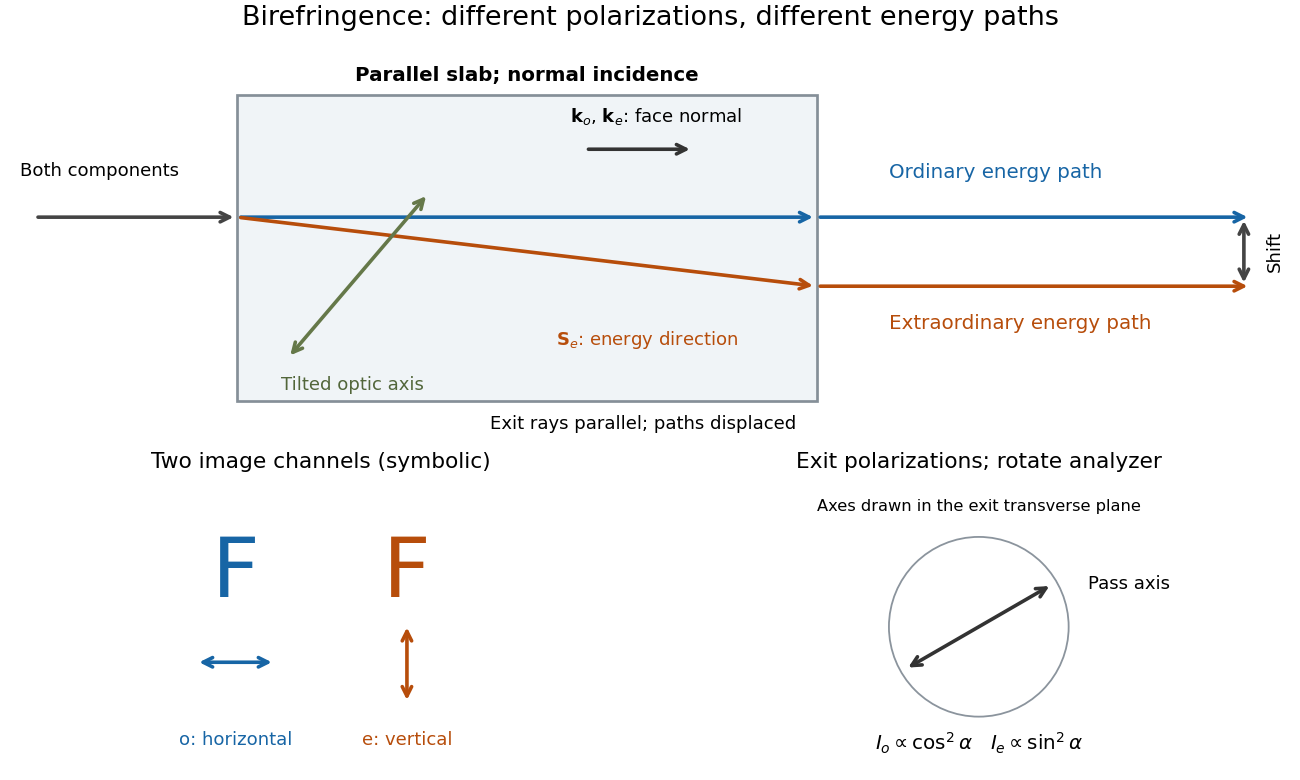
A waveplate uses birefringence to change polarization of an electromagnetic wave through phase retardation. Its fast axis has the smaller refractive index, hence the larger phase velocity; its slow axis has the larger index. Consider normal incidence with the optic axis in the plate face, so both components follow the same straight path. A linear polarization at to these axes excites equal wave amplitudes.
A complementary experiment uses two sheet polarizers with a cellophane sheet between them. First cross the polarizers and remove the sheet: the field is dark. Insert and rotate the sheet about the beam: light returns at intermediate orientations, but extinction recurs at two perpendicular orientations. The sheet has changed the polarization of an electromagnetic wave, without requiring a resolved double image. With white light, different wavelengths can produce different transmitted colors.[ref]
The Feynman Lectures on Physics, Volume I by Richard Feynman and others. I §33–3, Fig. 33–3 and the paragraphs describing removal, rotation and white-light colors of cellophane
. Brightness alone does not establish circular polarization: an ideal rotating linear polarizer also gives orientation-independent light intensity for unpolarized light.A transparent, nonmagnetic linear anisotropic dielectric is uniaxial when two principal permittivities agree. With the optic axis along , its permittivity tensor has the displayed diagonal matrix form. Here and are principal refractive indices at a specified frequency; is not the extraordinary wave's index in every direction.[ref]
Place a clear calcite specimen on a transparency bearing printed words on an overhead projector. The projected readout is two copies of the lettering. Put a rotatable linear polarizer after the specimen: suitable orientations suppress one copy or the other. These are the actual apparatus and observations in the University of Iowa demonstration.[ref]
Polarization - Calcite & Iceland Spar by University of Iowa, Department of Physics and Astronomy. Demonstration 6H35.15, Equipment and Procedure: crystals, polarizers, printed overhead transparency, two sets of words and selective extinction; final note on natural defects
For a useful control, remove the specimen while keeping the transparency, projector and screen fixed: the doubling should disappear. Replace it, hold it stationary and rotate only the polarizer; complementary brightness changes distinguish two linear polarizations from an accidental duplicate transparency. These are suggested controls, rather than additional reported measurements. Ideally the two copies obey complementary Malus's law curves, and , with angle measured from the exiting ordinary wave's linear polarization. Unequal maxima do not invalidate the test. Finite polarizer extinction, poor focus and specimen defects limit visibility; image separation alone does not determine either refractive index without the specimen geometry.
The zero-truncated binomial distribution has probabilities for . Its natural parameter is and its cumulant is . mean and variance are and , where . The conditional normalizer depends on , so its likelihood is not proportional to the untruncated likelihood even after a positive observation. At and , its likelihood supremum is at rather than at .
If and is observed, the maximum-likelihood estimate of is zero. A one-sided upper confidence bound solves , so . For large , , giving approximately at 95% confidence. This describes uncertainty after no observed events, rather than proving that the underlying probability is zero. It assumes independent observations with a common event probability; clustered data require a different uncertainty calculation.
For with , the sample binomial proportion is . Its expectation is p and its variance is . The central limit theorem gives a normal approximation when both expected outcome counts are sufficiently large. These moments determine a standard error and model-based control limits.
For fixed plates , no slip, viscosity , yield stress and , force balance gives shear stress . The central plug flow of a yield-stress fluid has half-width . If , the velocity isIt is even in ; its derivative is in the yielded layers and zero in the plug. If , there is no flow. Odd velocity is incompatible with this pressure-driven no-slip solution at nonzero flow.
A subspace is isotropic when the symplectic pairing vanishes between every pair of its vectors. Its binary Pauli labels therefore commute. Nondegeneracy identifies the ambient space with its dual, so the map to is surjective and . Since , it follows that . This explains the maximum number of independent generators of a stabilizer group.
A binary erasure channel marks its failed transmissions with a special output symbol, whereas a binary symmetric channel changes a bit without announcing whether it changed. At the same nominal failure probability , the two communication channels therefore leave different uncertainty. With a fair input, an unerased output determines the input exactly, while the erasure flag leaves one bit of conditional entropy. Thus and for the binary erasure channel. This is the binary case of capacity of a finite-alphabet erasure channel.
For the binary symmetric channel at , neither possible received symbol rules out either input, and . Its channel capacity is only . A receiver benefits from knowing where information was lost, even when the fraction of affected transmissions is the same.
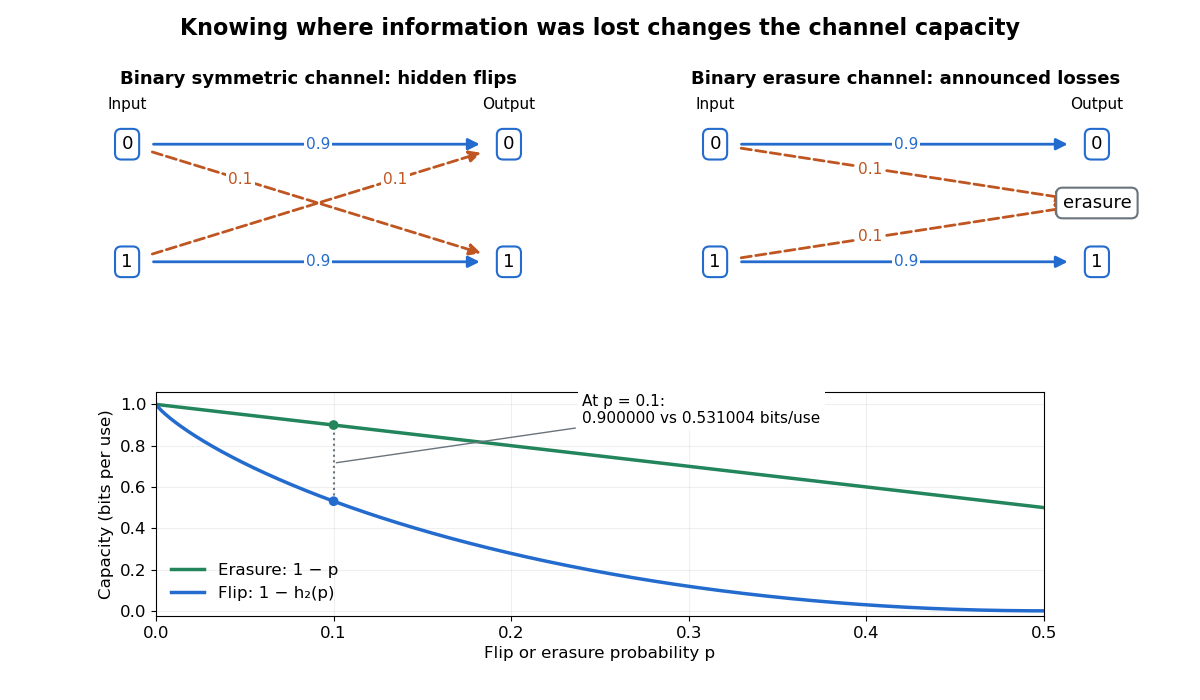
This comparison concerns the specified transition probabilities, rather than a general ordering of every error mechanism. In particular, at , an erasure flag conveys no input information, while deterministic inversion still conveys a full bit. Reporting only an error percentage loses the distinction between hidden corruption, announced loss, and a predictable reversible transformation.
Let for the input bit of a binary symmetric channel with crossover probability . The law of total probability givesConsequently its mutual information isHere specifies the noise and specifies the input bias; they are different choices. At and , the output has , giving and bits. With the same noise and the fair input , the output becomes fair and bits, attaining binary symmetric channel capacity.
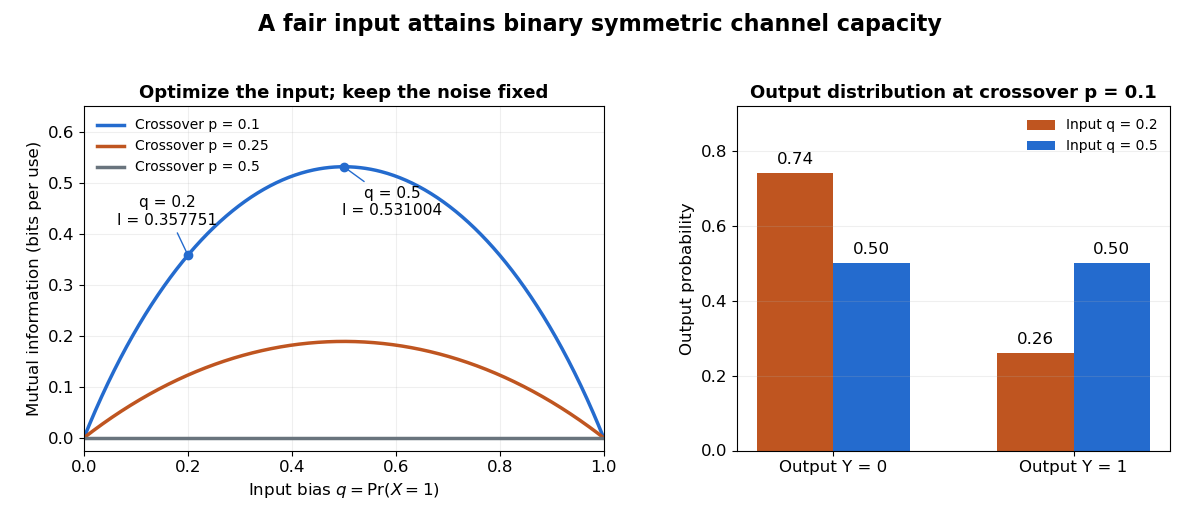
For , binary entropy reaches one only at output mass , and the equation forces . Thus the maximizing input is unique in those cases. For , every input produces the same fair output and zero mutual information, so every input bias is optimal and none transmits information. A fixed input or also carries zero mutual information for every : noise can make its output unpredictable without creating an unknown message to recover.
When the columns of are every nonzero vector in , a nonzero row vector defines a nonzero linear functional . Exactly half the input vectors take value : translation by any vector on which the functional is pairs its zero and one fibres. Removing the zero input removes only a zero value. Thus every nonzero word in the binary simplex code has Hamming weight .
The symplectic group over a finite field is transitive on each of the two quadratic types. The stabilizer of a refinement is its orthogonal group over a finite field. In the displayed parametrization, other refinements of the same type correspond to nonzero singular vectors, and refinements of opposite type to nonsingular vectors. Witt's lemma makes the orthogonal stabilizer transitive on each of these vector sets. Thus both type actions are two-transitive for , and a minus stabilizer is transitive on the plus orbit. For the minus orbit is a singleton.
Generate the binary Markov source by taking independent and identically distributed Bernoulli random variables of parameter , independent of a fair initial bit, and setting . Here is exclusive or. Each is the unpredictable flip decision.
The transformation between and is a bijection. It preserves information entropy, soSending the initial bit and encoding the innovation sequence describes every source word exactly. This does not by itself specify a practical compressor, but it identifies the uncertainty which a prefix code or other lossless source coding method must handle.
For a word with flips among its transitions,There are such words: choose the initial bit and the flip positions. At and , each constant word has probability , whereas an independent fair source gives each word probability . Equal marginal probabilities plainly do not imply equal word probabilities.
Pinned article: Introduction to the OurBigBook Project
Welcome to the OurBigBook Project! Our goal is to create the perfect publishing platform for STEM subjects, and get university-level students to write the best free STEM tutorials ever.
Everyone is welcome to create an account and play with the site: ourbigbook.com/go/register. We belive that students themselves can write amazing tutorials, but teachers are welcome too. You can write about anything you want, it doesn't have to be STEM or even educational. Silly test content is very welcome and you won't be penalized in any way. Just keep it legal!
Intro to OurBigBook
. Source. We have two killer features:
- topics: topics group articles by different users with the same title, e.g. here is the topic for the "Fundamental Theorem of Calculus" ourbigbook.com/go/topic/fundamental-theorem-of-calculusArticles of different users are sorted by upvote within each article page. This feature is a bit like:
- a Wikipedia where each user can have their own version of each article
- a Q&A website like Stack Overflow, where multiple people can give their views on a given topic, and the best ones are sorted by upvote. Except you don't need to wait for someone to ask first, and any topic goes, no matter how narrow or broad
This feature makes it possible for readers to find better explanations of any topic created by other writers. And it allows writers to create an explanation in a place that readers might actually find it.
Figure 1. Screenshot of the "Derivative" topic page. View it live at: ourbigbook.com/go/topic/derivativeVideo 2. OurBigBook Web topics demo. Source. - local editing: you can store all your personal knowledge base content locally in a plaintext markup format that can be edited locally and published either:This way you can be sure that even if OurBigBook.com were to go down one day (which we have no plans to do as it is quite cheap to host!), your content will still be perfectly readable as a static site.
- to OurBigBook.com to get awesome multi-user features like topics and likes
- as HTML files to a static website, which you can host yourself for free on many external providers like GitHub Pages, and remain in full control

Figure 2. You can publish local OurBigBook lightweight markup files to either OurBigBook.com or as a static website.
Figure 3. Visual Studio Code extension installation.
Figure 5. . You can also edit articles on the Web editor without installing anything locally. Video 3. Edit locally and publish demo. Source. This shows editing OurBigBook Markup and publishing it using the Visual Studio Code extension. 
- Infinitely deep tables of contents:




All our software is open source and hosted at: github.com/ourbigbook/ourbigbook
Further documentation can be found at: docs.ourbigbook.com
Feel free to reach our to us for any help or suggestions: docs.ourbigbook.com/#contact