Topics (384k) Articles (398k) Users (410) Discussions (242) Comments (383) Files (13k) New article

Hierholzer's algorithm constructs an Euler circuit by growing closed trails along unused edges and splicing them at shared vertices, as in the Euler circuit criterion. Each edge must have a distinct record. An implementation using adjacency lists, a stack, and a used flag for each edge runs in time, including the connectivity and vertex degree checks. Store both incidences of a self-loop, while marking its single edge record used only once.
With fixed positive scale estimates , this is Euclidean distance in standardized coordinates. It removes marginal units but ignores correlations. Small estimated variances can greatly amplify measurement noise; a zero scale must be handled separately.
A method-of-moments estimator equates selected theoretical moments to corresponding empirical moment estimates and solves for the parameter. For a distribution with mean and variance , the first two raw moment equations give and . Existence, uniqueness and consistency require appropriate identifiability and moment assumptions; unbiased empirical moments do not make nonlinear parameter estimates unbiased. This statistical estimation procedure differs from the method of moments in probability for proving convergence in distribution.
For a sphere of radius and uniform mass density , with no surrounding mass and gravitational potential zero at infinity, the spherical shell theorem gives inside. Matching to the exterior point-mass potential gives . Since , the displayed relation follows for . Exterior shells leave the interior circular speed unchanged but deepen the potential and change the escape velocity; a uniform core alone is insufficient to determine escape.
A spacecraft trajectory is the path traced by a spacecraft's position over time. An unpowered exterior arc can approximate a Kepler orbit; other bodies' gravity, radiation pressure, and propulsion can change it.
Operational evidence comes from reconstructing a spacecraft's motion. A ground antenna transmits a coded signal; the spacecraft returns it. Corrected round-trip time constrains distance, while the Doppler effect of a coherent carrier constrains the line-of-sight relative velocity. NASA's navigation account describes calibration of onboard turnaround delays before launch, calibration of ground delays before use, and corrections for the terrestrial atmosphere. Measurements over multiple stations and epochs constrain the orbit; range and Doppler effect alone do not directly give all transverse motion. Navigators compare a fitted spacecraft trajectory with later tracking and remeasure after propulsion to assess the maneuver. The account identifies radiation pressure and imperfect propulsion as disturbances. This provides practical checks of a dynamical model and its corrections, rather than a laboratory measurement of a universal escape speed. The simple inverse-square potential predicts an unpowered exterior arc; accurate navigation includes additional forces and measurement delays.[ref]
For a circular orbit, gravity supplies centripetal acceleration, giving . ThusA body in a circular orbit is bound despite its continuous free fall. At the same , escape needs twice its kinetic energy per unit mass. An instantaneous forward tangential velocity increment from the circular orbit requires , rather than the full escape speed from rest. In the synthetic example this is exactly .[ref]
13.4 Satellite Orbits and Energy. §13.4, “Circular Orbits” and “Energy in Circular Orbits”: centripetal balance and negative total energy
Escape speed is a coasting threshold, not a required continuously maintained speed or a measure of rocket propellant. A powered vehicle can start at rest and acquire energy gradually. The rocket equation relates an ideal velocity increment to rocket exhaust speed and rocket mass ratio; rocket thrust, drag, and the timing and direction of propulsion affect a real ascent. Rotation also changes the relation between surface-relative velocity and the inertial frame used in the calculation.
Reaching another body is a finite-destination spacecraft trajectory problem. In the synthetic radial example, a launch at reaches while remaining bound. A spacecraft can similarly encounter the Moon on a bound geocentric transfer; actual planning must include the Moon's gravity, target motion, arrival velocity, and any propulsion needed for capture. Escaping Earth alone does not imply escaping the Sun, because the relevant reference frame and attracting mass have changed. The isolated formula describes one gravitational well; a full mission requires more than its scalar threshold.
“Arrives at infinity with zero speed” is an asymptotic statement. For outward radial motion at zero specific orbital energy,Every finite distance takes finite time, but as . There is no instant of rest at an infinitely distant destination. Differentiating the displayed solution gives , independently checking Newton's second law. In the synthetic example, reaching takes exactly . For nonzero specific angular momentum, the Barker equation gives the corresponding infinite-time limit along a parabolic trajectory. Positive-energy escape also takes infinite time to reach infinity; it retains nonzero asymptotic speed.
The same initial distance can lead to strikingly different orbits. Let and launch tangentially in one orbital plane. Then periapsis is the launch point, specific angular momentum is , andwhere is true anomaly. These follow by combining the initial specific orbital energy with the orbital eccentricity relation and the Kepler orbit equation. With and , the initial speeds , , , and give : a circular orbit, an elliptic orbit with apoapsis distance , a parabolic trajectory, and a hyperbolic Kepler orbit. The two open paths have asymptotic speeds zero and respectively. Their different directions at large distance are part of the Kepler orbit, not an extra scalar escape threshold.
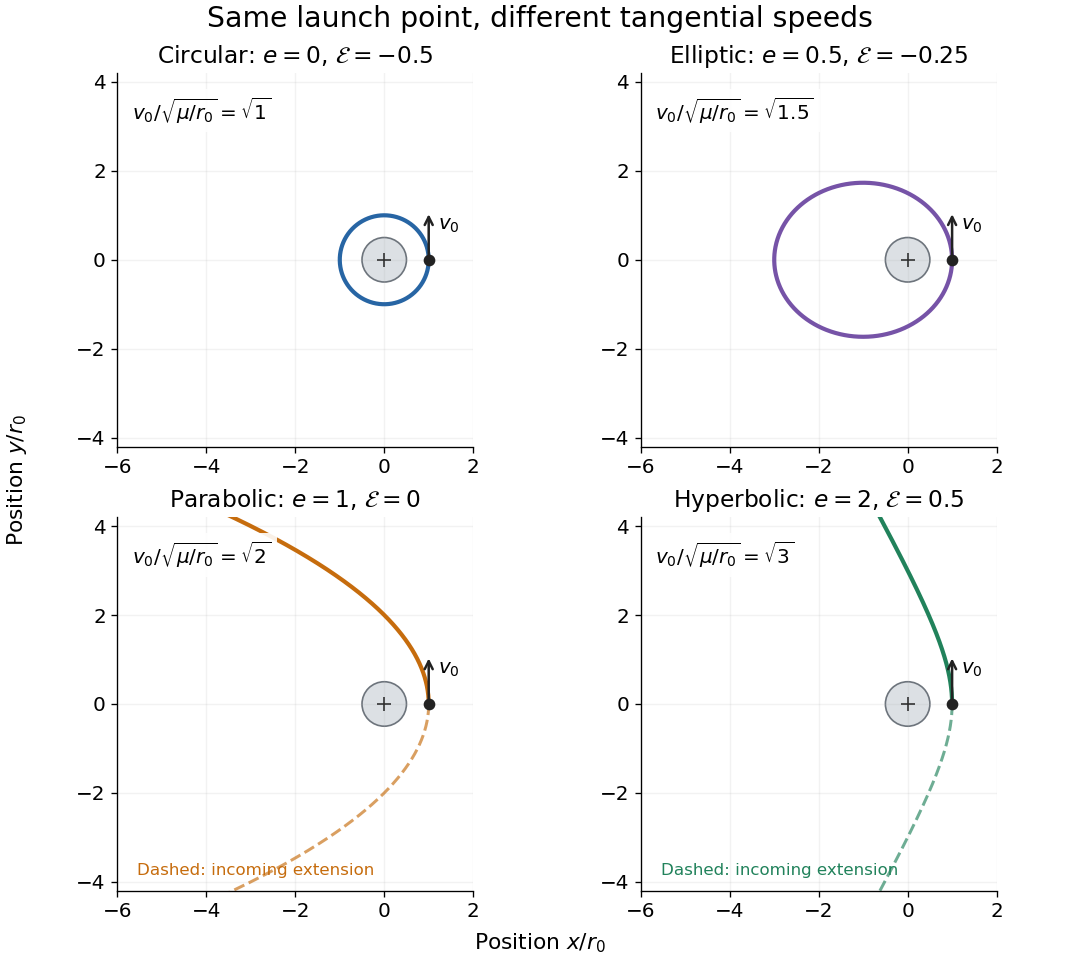
Tangential launches give circular, elliptic, parabolic, and hyperbolic Kepler orbits
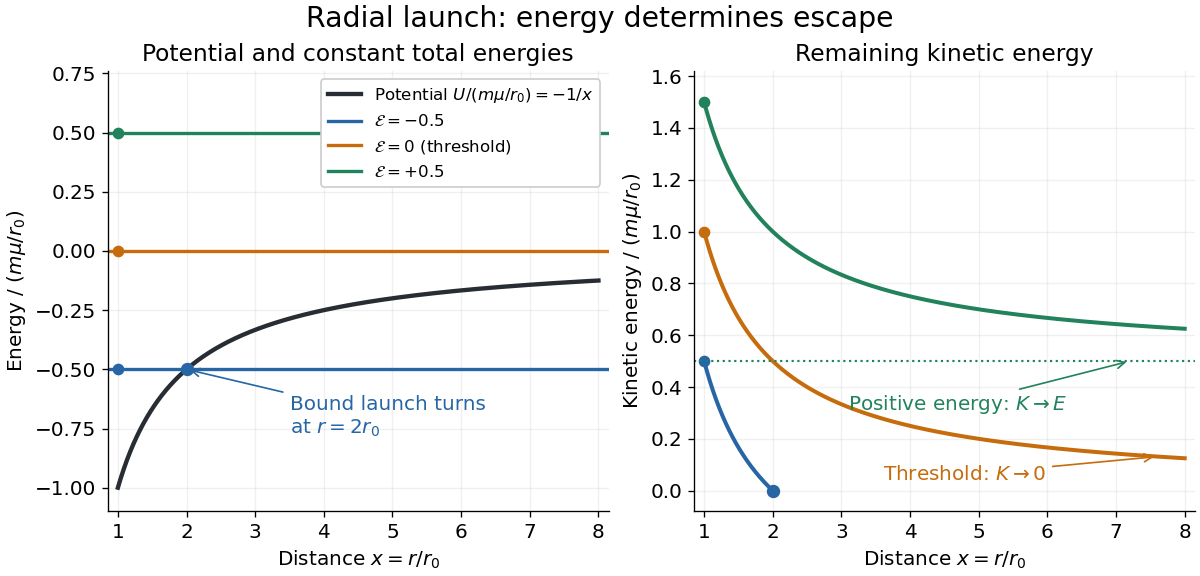
. All panels use equal spatial scales, a fixed attracting centre at the origin, a launch point , and an initially upward velocity. The gray body's radius is stipulated as , so all displayed paths remain exterior. Colored solid curves follow motion after launch; dashed curves on the open orbits are their incoming extensions, not an additional part of the launch. Open curves continue beyond the viewing window. The normalized launch speeds and specific orbital energies are computed from the stated isolated model. Details.Use the synthetic standard gravitational parameter and launch distance . Then escape speed is . Three outward radial launches give exact comparisons: has specific orbital energy and stops outward at ; has zero specific orbital energy; has specific orbital energy and asymptotic speed . The second case has speed at . Doubling divides escape speed by , whereas doubling at fixed multiplies it by . Changing the test particle's mass changes but cancels from the escape speed.
An inviscid fluid with conservative body force, a materially conserved stratifying scalar , and an equation of state making coplanar conserves its Ertel potential vorticity. The stretching of absolute vorticity per unit density cancels the deformation of the scalar gradient; the remaining baroclinic triple product vanishes. In an incompressible density-stratified ideal fluid, choosing the advected density as gives that cancellation directly.
A point is generic for an invariant measure of a continuous map on a compact metric space if the displayed convergence holds for every continuous function . Its empirical probability measures converge against continuous test functions to . The same test-function condition may be used before invariance is known: the telescoping identity for then proves that the limiting Borel probability measure must be invariant. If almost every point is generic for the same measure, continuous approximation of invariant-set indicators proves that this measure is ergodic.
The colors here range over nonzero cardinals. The Erdős-Rado theorem for pairs makes this function total, and target and color monotonicity make it nondecreasing, with . If an uncountable cardinal is closed below itself under , then it is strong limit. Indeed, coloring distinct binary strings of length by their first differing coordinate uses colors and has no monochromatic triangle, so . If also has the tree property, the end-homogeneous tree for any has levels of size below and a cofinal branch; regularity makes one color occur times. Thus . This distinguishes function closure plus the tree property from the tree property alone.
For a coloring of -subsets of an ordinal, route a vertex through the least earlier vertices matching its colors on every -subset of previously chosen ancestors. The path stops when the vertex itself is selected. Common path prefixes agree, yielding a set-theoretic tree; a node at level is determined by its color table on . Along a branch, the color of an -tuple is independent of its last entry. If the domain has size and , levels below have size at most ; counting all those levels forces a branch of length . If the domain is a regular strong-limit cardinal , those levels instead have size below , and the tree property supplies a cofinal branch when needed.
Put for an infinite cardinal . Choose of size , containing all ordinals below , and closed under externally given sequences of length at most . Such a model is built by successive Skolem hull closures, since . For a coloring of with at most colors in , put . Recursively choose for , above all earlier points, so that every earlier -tuple has the same color with as with . There are at most constraints, their code belongs to by closure, and witnesses their consistency. The elementary embedding supplies the required witness in . The resulting sequence is end-homogeneous, providing the induction step in the Erdős-Rado theorem for finite arities.
On for compact Hausdorff , any complete norm making every point evaluation functional continuous is equivalent to the uniform norm. If converges in the new norm to and uniformly to , evaluation gives for every , so the identity map between the two Banach spaces has closed graph. The closed graph theorem and open mapping theorem make the identity and its inverse bounded. Completeness of the proposed norm is essential to this argument.
For equivalent norms and on an infinite-dimensional closed linear subspace , define its relative distortion on a further infinite-dimensional closed linear subspace byThe equivalent norms condition makes the denominator positive and the numerator finite. A Banach space has bounded distortion if one constant works for every such and every among the equivalent norms on : there is a further infinite-dimensional closed linear subspace with . The constant is uniform over renormings and starting subspaces; may depend on both.
This convention is expressed by saying that, for some finite distortion threshold, no subspace is distortable beyond that threshold. A block-subspace formulation additionally assumes a specified Schauder basis and tests further block subspaces; the basis must be stated rather than silently assumed.[ref]
The distortion problem by Edward Odell and Thomas Schlumprecht. Introduction, equation (1.1), and Remark 3.7: bounded distortion means a fixed threshold excludes distortion on every subspace
The ratio is unchanged by multiplying by a positive scalar. Equivalently, on the selected there is such that . For , the distortion is exactly one, not one hundred. Allowing that rescaling is essential: distortion compares relative geometry rather than the arbitrary unit of length.
Relative to a Schauder basis, take the supremum over successive finite intervals whose minima belong to a specified hereditary family , and signs . If this supremum is bounded above by a multiple of the original norm and the family contains all singletons, it gives an equivalent norm. Composing two admitted signed interval projections costs at most a factor of two in this norm: split their nonempty intersections according to which interval supplies the later left endpoint. In each of the two resulting families the minima form a subset of one original list, so heredity preserves admissibility. This estimate lets bounded distortion of a Banach space give a uniform bound independent of the complexity of .
Two norms on a vector space give the same topology if and only if for some positive constants. Indeed, continuity of the identity at zero gives . For , apply this to to obtain . Reverse the roles of the norms for the lower bound. Conversely the two inequalities compare every translated open ball. This proof uses absolute homogeneity of a norm, not finite dimension.
Suppose a finite-horizon market has a strictly positive numéraire and an equivalent measure under which all prices are local martingales. The discounted wealth of a self-financing strategy is a stochastic integral against those prices. If it is bounded below by a deterministic constant, that wealth is a supermartingale: add the lower-bound constant to obtain a nonnegative local martingale, then apply conditional Fatou to a localizing sequence. A zero-cost admissible portfolio therefore has expected discounted terminal wealth at most zero. Nonnegative terminal wealth with positive probability of a strict gain would have strictly positive expectation under the equivalent measure, a contradiction. Thus there is no admissible arbitrage. True martingales are not needed for this implication.
Pinned article: Introduction to the OurBigBook Project
Welcome to the OurBigBook Project! Our goal is to create the perfect publishing platform for STEM subjects, and get university-level students to write the best free STEM tutorials ever.
Everyone is welcome to create an account and play with the site: ourbigbook.com/go/register. We belive that students themselves can write amazing tutorials, but teachers are welcome too. You can write about anything you want, it doesn't have to be STEM or even educational. Silly test content is very welcome and you won't be penalized in any way. Just keep it legal!
Intro to OurBigBook
. Source. We have two killer features:
- topics: topics group articles by different users with the same title, e.g. here is the topic for the "Fundamental Theorem of Calculus" ourbigbook.com/go/topic/fundamental-theorem-of-calculusArticles of different users are sorted by upvote within each article page. This feature is a bit like:
- a Wikipedia where each user can have their own version of each article
- a Q&A website like Stack Overflow, where multiple people can give their views on a given topic, and the best ones are sorted by upvote. Except you don't need to wait for someone to ask first, and any topic goes, no matter how narrow or broad
This feature makes it possible for readers to find better explanations of any topic created by other writers. And it allows writers to create an explanation in a place that readers might actually find it.
Figure 1. Screenshot of the "Derivative" topic page. View it live at: ourbigbook.com/go/topic/derivativeVideo 2. OurBigBook Web topics demo. Source. - local editing: you can store all your personal knowledge base content locally in a plaintext markup format that can be edited locally and published either:This way you can be sure that even if OurBigBook.com were to go down one day (which we have no plans to do as it is quite cheap to host!), your content will still be perfectly readable as a static site.
- to OurBigBook.com to get awesome multi-user features like topics and likes
- as HTML files to a static website, which you can host yourself for free on many external providers like GitHub Pages, and remain in full control

Figure 2. You can publish local OurBigBook lightweight markup files to either OurBigBook.com or as a static website.
Figure 3. Visual Studio Code extension installation.
Figure 5. . You can also edit articles on the Web editor without installing anything locally. Video 3. Edit locally and publish demo. Source. This shows editing OurBigBook Markup and publishing it using the Visual Studio Code extension. 
- Infinitely deep tables of contents:




All our software is open source and hosted at: github.com/ourbigbook/ourbigbook
Further documentation can be found at: docs.ourbigbook.com
Feel free to reach our to us for any help or suggestions: docs.ourbigbook.com/#contact