Topics (384k) Articles (398k) Users (410) Discussions (242) Comments (383) Files (13k) New article
For a finite set and open sets for , the setsform a basis of a topology for the product topology. The empty set intersection is . Each basic open set is a cylinder set; all coordinates outside are free. Arbitrary open sets are unions of these basic tests and need not themselves depend on one fixed finite collection of coordinates.[ref]
Point-Set Topology, Chapter 2: Continuous functions. Proposition 2.2.1, Definition 2.2.2 and Remark 2.2.8: finite-coordinate basis and general open subsets
Why finitely many? Any topology making the projection maps continuous must contain their preimages of open sets, and hence finite set intersections of those preimages. Taking arbitrary unions supplies exactly the product topology. Intersecting two basic cylinder sets still restricts only the finite union of their coordinate sets.
Thinning removes points from a point process according to a retention rule. independent retention with probability changes the intensity measure to . For a Poisson point process, the retained and removed point processes are independent Poisson processes.
Let be probability measures on the real line with characteristic functions . Lévy's continuity theorem says that if converges for every real to a function continuous at zero, then is the characteristic function of a unique probability measure and converges weakly to . Conversely, weak convergence implies pointwise convergence of characteristic functions to the characteristic function of the limit.
The converse follows immediately by testing against the bounded continuous functions . The difficult direction uses continuity at zero to control probability escaping to infinity, and the uniqueness of characteristic functions to identify every subsequential limit. The theorem turns convergence of probability laws into convergence of ordinary functions, which is especially useful when independence makes characteristic functions multiply.
Continuity at zero is essential. For , tends to zero for every nonzero but remains one at . This discontinuous limit is not a characteristic function, and the distributions have no weak probability limit: their mass in every fixed bounded interval tends to zero.
A standard score expresses an outcome as a signed number of standard deviations from a mean , assuming . It is a dimensionless quantity. For a random variable with finite positive variance , has mean zero and variance one; it has a standard normal distribution when has a normal distribution, but centering and scaling alone do not make other probability distributions normal. [ref]
https://ocw.mit.edu/courses/18-05-introduction-to-probability-and-statistics-spring-2022/mit18_05_s22_class06-prep-b.pdf. MIT 18.05, Reading 6b, §5.1: standardization
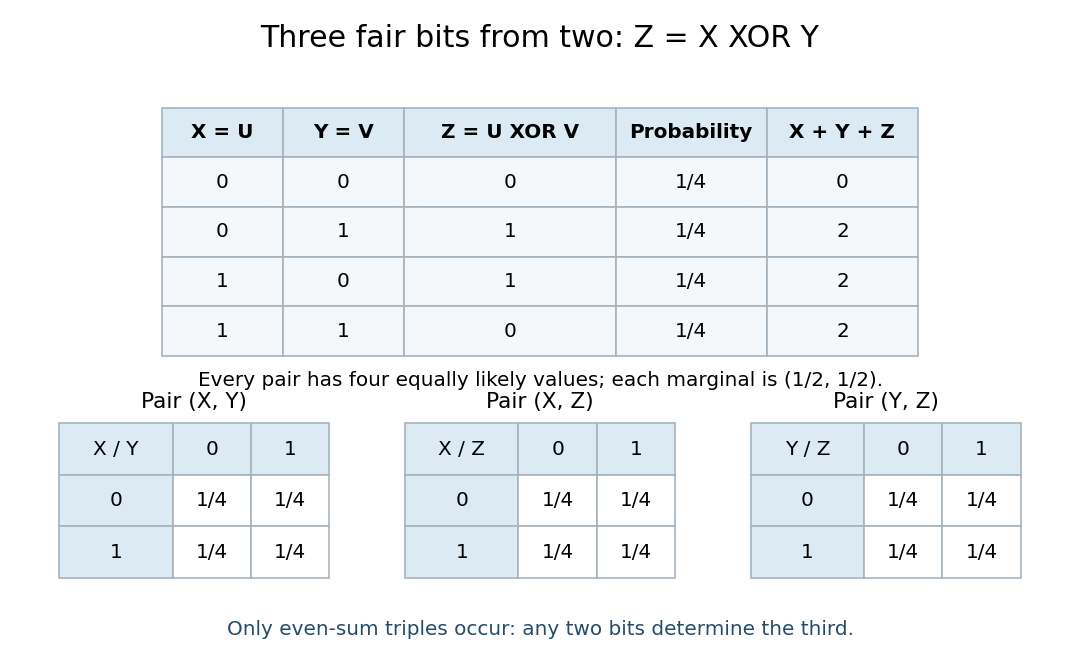
.Pairwise independent events describe a subtle kind of uncertainty: learning that one event occurred leaves each other event's probability unchanged, yet learning that two occurred can reveal a third completely. Checking every pair therefore answers a weaker question than checking the whole collection. The parity construction of pairwise independent bits makes this distinction visible with just four equally likely outcomes.
A family of events is pairwise independent whenIf , this is equivalent to the conditional probability identity . The product definition also handles events of probability zero. Independent events, meaning mutually independent events, require the same product rule for every finite subfamily, including triples. For three events, the three pair equations and the triple equation are four separate requirements. [ref]
https://www.randomservices.org/random/prob/Independence.html. Kyle Siegrist, Random Services: independence of two events and general independence of events
.For a worked example, take independent fair bits : the sample space is with probability per outcome. Set , , and , using exclusive or, which is one precisely when its inputs differ. The events , , and each contain two outcomes. Their pair intersections areThus each event has probability and each pair intersection has probability : these are pairwise independent events. But forces , soThe three are not independent events. This is the complementary-third-event version of the two-toss example in Tsitsiklis and Jaillet, MIT Introduction to Probability, Lecture 3, slides 7–8.
Another useful diagnostic preserves a special common-intersection case. Suppose three events have common probability and every pair and triple intersect in the same event, of probability . Pairwise independence requires , while mutual independence additionally requires . Both hold only for or . For a concrete nontrivial instance, assign probability to each of four outcomes, let all three events contain the first outcome, and give each event one different additional outcome. Then and : the pair equations hold, while the triple equation fails. Unlike the exclusive or example above, this triple intersection is nonempty.
The probability that independent uniformly oriented open hemispheres cover a sphere is the displayed quantity. Coverage fails exactly when their normals lie in a closed hemisphere. With probability one, no three normals are coplanar and no pair is antipodal; a closed hemisphere containing the normals can then be perturbed into an open one. Condition on the unoriented axes of the normals. Their orientation signs remain independent fair bits, and the regions of a general-position great-circle arrangement realize exactly of the possible sign vectors. Each such vector corresponds to normals that fit into one open hemisphere, proving the complementary probability. The argument counts equiprobable orientation choices, not equal-area regions.
For independent lengths with the uniform distribution on , the probability of forming a nondegenerate polygon is . The necessary and sufficient condition is that every length is less than the sum of the others. The failure events are disjoint except on sets of probability zero. The sum of lengths has probability density function on , by repeated convolution of probability densities. A specified rod is too long with probability ; summing over the rods proves the formula. For three and four rods the probabilities are and .
Different precise measures on random chords give different probabilities; the phrase “random chord” does not select a unique probability distribution. In a circle of radius , a chord exceeds the side of an inscribed equilateral triangle exactly when its midpoint distance from the center is below . Uniform midpoint area gives probability , independent uniform endpoints give , and uniform midpoint distance gives . The difference is in the sampling laws, not a contradiction in probability theory.
For water initially at rest at depth on one side of a dam and a dry bed on the other, a channel with has . The centered rarefaction wave has and . Thus and within . The reservoir remains undisturbed to the left and the bed dry to the right. This is an outer shallow-water approximation before finite-reservoir boundary signals return.
In a prismatic triangular channel with wetted area proportional to , the Riemann invariants are , with . Releasing water initially at rest into a dry channel produces a rarefaction wave with and . Hence , and the displayed depth profile for . The dry front advances at before finite-reservoir or varying-channel effects become important.
A channel with width has wetted area . Its inviscid shallow water equations have characteristic speeds and the displayed Riemann invariants. Releasing a reservoir of depth at rest into a dry channel gives a left-family rarefaction wave: , , between and , where . This width law differs from a geometrically parabolic trough, whose width is proportional to .
A prion disease of cattle. A positive surveillance test is an observed diagnostic outcome, whose frequency need not equal true infection prevalence unless test performance and sampling are accounted for.
A human prion disease associated with exposure to the BSE agent. Exposure totals and clinical-onset totals measure different stages of the disease process; incubation periods and ascertainment affect their relationship.
Infinitely many primes congruent to minus one modulo six by  Codex 0 Created 2026-10-14 Updated 2026-11-05
For any finite list of such prime numbers, let be their product. The integer has no listed prime divisor, nor the divisors . Its remaining prime factors have residues modulo six, and at least one has residue because their product has that residue. Thus no finite list is exhaustive.
// Target: number-theory.bigb
Assume that with implies . For a finite list of primes in that residue class, let be their product. Every prime divisor of is greater than three and satisfies that quadratic modular congruence, hence has residue one modulo six. None is listed because modulo a listed prime.
// Target: combinatorics.bigb
The sieve of Eratosthenes finds all prime numbers at most an integer . Start with the integers marked as candidates. For each surviving candidate in increasing order, mark the multiples up to as composite numbers. Stop processing candidates once : the surviving candidates are exactly the prime numbers. Starting at saves work because any smaller proper multiple of already has a smaller prime factor. [ref]
https://web.stanford.edu/class/cs106aj/res/handouts/36-Section-6.pdf. Jerry Cain, Stanford CS106AJ, Section Handout 6, Problem 4: the sieve of Eratosthenes
.For a complete run with , the only prime numbers at most are , since . Exclude one before starting; it is not a prime number. The four marking passes are:
- : mark , removing 29 candidates.
- : mark . The nine newly removed candidates are ; the even integers were already marked.
- : mark . Only are newly removed.
- : mark . Only is newly removed.
There are surviving prime numbers:The next surviving candidate is , and , so no further marking pass is necessary. A prime number used for marking remains a candidate: starting at never marks itself.
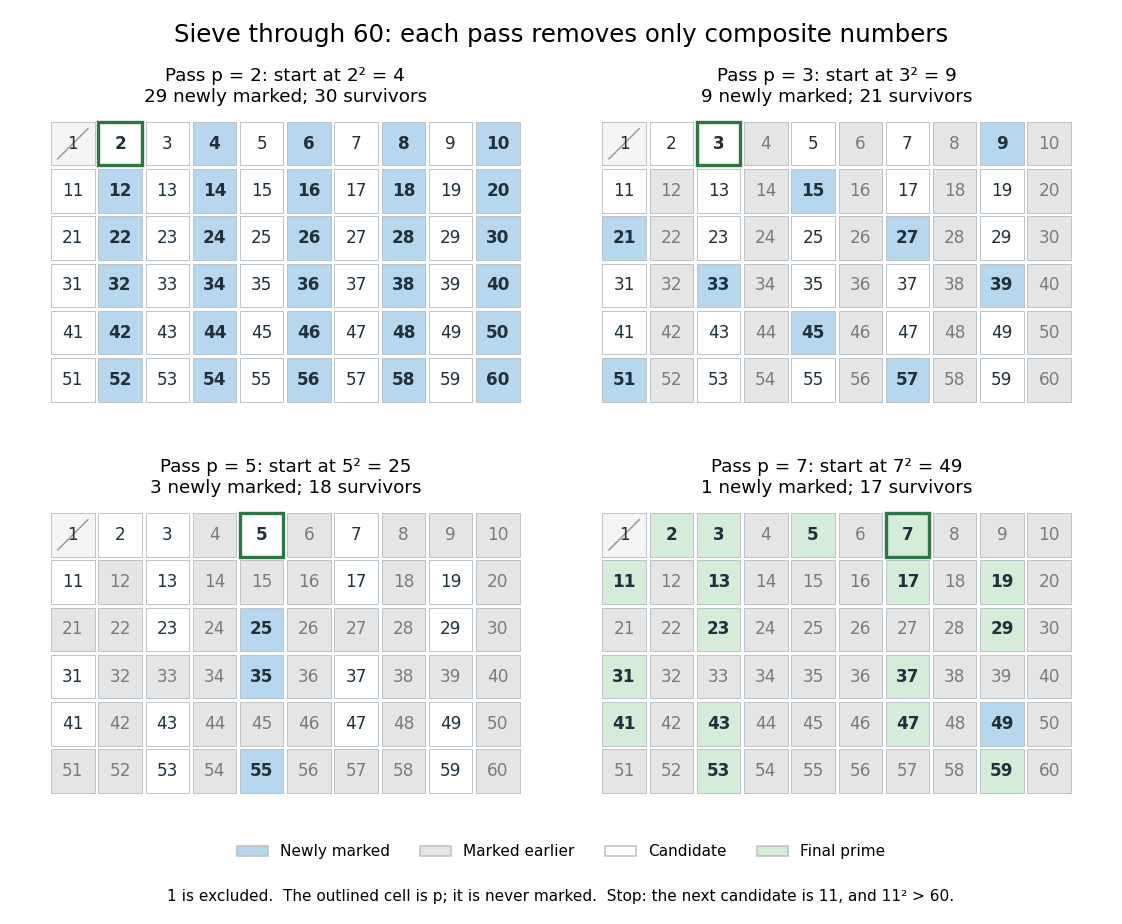
Four passes of the sieve of Eratosthenes through 60 leave seventeen prime numbers
. Blue cells are newly marked composite numbers; gray cells were removed earlier. White cells are candidates in the first three panels, and green cells are the final prime numbers. The outlined cell identifies the prime number used for that pass. One is excluded throughout. Details.The saving from starting at is justified by the smaller multiplier: if with , then has a prime factor , so has already marked . For , the earlier multiples have already been marked using or . The first new possibility is .
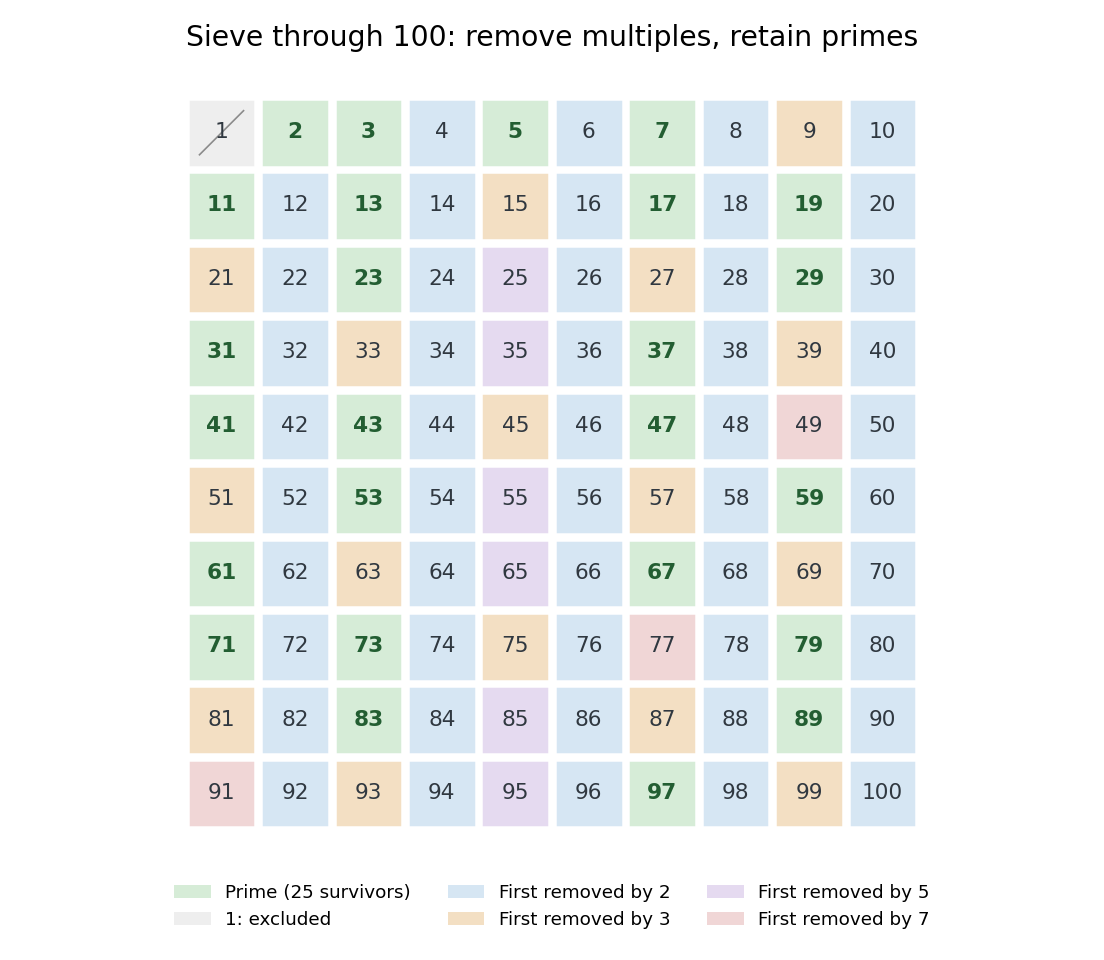
For , only the prime numbers need marking passes. They remove all the composite numbers, leaving 25 prime numbers. The diagram colors each composite number by its smallest prime factor, so it shows which marking pass removes it first. The excluded integer one is shown separately.
Why does the algorithm work? A surviving candidate cannot be a composite number, since its smaller prime factor would already have removed it. Conversely, marking proper multiples never removes a prime number. Every composite number at most has a prime factor at most , so no later pass is needed. The sieve of Eratosthenes is useful when an entire bounded list is wanted; primality testing of one large integer is a different computational task.
The historical name is supported by a surviving primary account: Nicomachus, in Book I, chapter 13 of Introduction to Arithmetic, names Eratosthenes and describes separating prime numbers from composite numbers by marking multiples among the odd integers beginning with three. That passage documents the sieve tradition; the bounded algorithm above and its starting rule are the formulation explained here, rather than instructions quoted from Euclid's Elements. [ref]
https://stoicheiamath.com/wp-content/uploads/2025/09/Nicomachus-Introduction-to-Arithmetic-Student-Edition.pdf#page=28. Nicomachus, Introduction to Arithmetic I.13.2–8, Martin Luther D'Ooge translation (1926), revised classroom edition by Nathanael Hahn (2025), pp. 24–25
Trial division searches for divisors of an integer by testing candidate divisions. For primality testing of an integer , testing the prime numbers up to suffices: any composite number has a prime factor in that range. After finding a prime factor, repeated division removes its prime power, and testing the remaining quotient gives an elementary integer factorization method. This is useful for small inputs, but the number of candidates can grow rapidly with the input's digit count.
Primality is the property of a positive integer being a prime number. Primality testing determines this property; integer factorization asks for factors and is a different computational task.
For an odd integer , write with odd. Choose a base uniformly from . It passes the Miller–Rabin test whenA nontrivial greatest common divisor of or failure certifies compositeness. Exponentiation by squaring computes ; at most further squarings test the other possibilities.
Every prime number passes: arithmetic modulo a prime number is a field, whose only square roots of one are and . The squaring chain ends at one by the Fermat little theorem; its first one is either the initial value or follows minus one.
For an odd composite number, at most one quarter of bases in the stated range pass. Thus independently sampled bases give false probable-prime probability at most , for each fixed composite input. A passing composite is a strong pseudoprime to that base.[ref]
Pinned article: Introduction to the OurBigBook Project
Welcome to the OurBigBook Project! Our goal is to create the perfect publishing platform for STEM subjects, and get university-level students to write the best free STEM tutorials ever.
Everyone is welcome to create an account and play with the site: ourbigbook.com/go/register. We belive that students themselves can write amazing tutorials, but teachers are welcome too. You can write about anything you want, it doesn't have to be STEM or even educational. Silly test content is very welcome and you won't be penalized in any way. Just keep it legal!
Intro to OurBigBook
. Source. We have two killer features:
- topics: topics group articles by different users with the same title, e.g. here is the topic for the "Fundamental Theorem of Calculus" ourbigbook.com/go/topic/fundamental-theorem-of-calculusArticles of different users are sorted by upvote within each article page. This feature is a bit like:
- a Wikipedia where each user can have their own version of each article
- a Q&A website like Stack Overflow, where multiple people can give their views on a given topic, and the best ones are sorted by upvote. Except you don't need to wait for someone to ask first, and any topic goes, no matter how narrow or broad
This feature makes it possible for readers to find better explanations of any topic created by other writers. And it allows writers to create an explanation in a place that readers might actually find it.
Figure 1. Screenshot of the "Derivative" topic page. View it live at: ourbigbook.com/go/topic/derivativeVideo 2. OurBigBook Web topics demo. Source. - local editing: you can store all your personal knowledge base content locally in a plaintext markup format that can be edited locally and published either:This way you can be sure that even if OurBigBook.com were to go down one day (which we have no plans to do as it is quite cheap to host!), your content will still be perfectly readable as a static site.
- to OurBigBook.com to get awesome multi-user features like topics and likes
- as HTML files to a static website, which you can host yourself for free on many external providers like GitHub Pages, and remain in full control

Figure 2. You can publish local OurBigBook lightweight markup files to either OurBigBook.com or as a static website.
Figure 3. Visual Studio Code extension installation.
Figure 5. . You can also edit articles on the Web editor without installing anything locally. Video 3. Edit locally and publish demo. Source. This shows editing OurBigBook Markup and publishing it using the Visual Studio Code extension. 
- Infinitely deep tables of contents:




All our software is open source and hosted at: github.com/ourbigbook/ourbigbook
Further documentation can be found at: docs.ourbigbook.com
Feel free to reach our to us for any help or suggestions: docs.ourbigbook.com/#contact