
Graphical corner frequency of a Lorentzian spectrum Created 2026-10-18 Updated 2026-10-20
For power spectral density , the low-frequency plateau is and the high-frequency asymptote is . Their intersection on a log-log plot gives the displayed corner frequency. Equivalently . Use the range unaffected by additional low-frequency noise or high-frequency filtering; a measurement chain can otherwise shift an apparent corner.
For the same massless spring obeying Hooke's law, the frequency is . The displayed mass ratio follows. For small independent frequency errors with common fractional standard uncertainty , monomial uncertainty propagation gives . If instead describes individual measurements and each sample mean uses independent trials, its standard error is smaller by , giving . Four times as many trials halve this statistical uncertainty; a common calibration error needs its covariance included.
Quantum Hall edge state 2026-10-18
A quantum Hall edge state is confined across a boundary but can extend along it and carry electric current. B. I. Halperin related these current-carrying boundary states to quantized Hall transport in a disordered two-dimensional system.[ref]
Quantized Hall conductance, current-carrying edge states, and the existence of extended states in a two-dimensional disordered potential by B. I. Halperin. Publisher abstract: transverse confinement, perimeter extension and current
Chern number and integer Hall conductivity 2026-10-18
For filled, separated, noninteracting magnetic Bloch bands, the Berry curvature integral over the magnetic Brillouin zone is an integer Chern number , giving . Patches of Berry connection meet through phases with integer windings; continuous gap-preserving changes cannot change . D. J. Thouless, M. Kohmoto, M. P. Nightingale and M. den Nijs developed this band argument; it does not establish the interacting fractional case.[ref]
Quantized Hall Conductance in a Two-Dimensional Periodic Potential by D. J. Thouless and others. pp. 405–407, Kubo formula and phase winding
Quantum Hall conductivity tensor inversion Created 2026-10-18 Updated 2026-10-20
Choose conventional surface current density along , magnetic field along , and negative electron charge. An isotropic in-plane response has the following sheet conductivity and sheet resistivity tensors for , :These are matrix inverses, rather than componentwise reciprocals. The sheet conductivity has units siemens, the sheet resistivity ohms. With , the sign is , agreeing with the negative Hall coefficient of a single electron species. Contact polarity can reverse the measured voltage sign, so quote the Hall magnitude. For a homogeneous strip of width and longitudinal probe separation , givesAt , , these reduce to and zero. A nonzero transverse sheet resistivity creates no local Joule heating: the antisymmetric contribution cancels in .
For an original nonideal example, choose , and . Then , while the Hall magnitude is below by the relative amount parts per million. An unwanted admixture in the Hall readout would instead introduce approximately . The chosen calculation shows why a small intrinsic tensor correction does not by itself guarantee an accurate contact measurement.
Quantum Hall plateau 2026-10-18
The degeneracy of a Landau level is per resolved internal branch in area . The filling factor varies continuously. Additional localized eigenstates need not carry bulk transport, allowing an integer plateau over an interval of ; a mobility gap need not be an empty spectral gap.[ref]
Quantized Hall Conductance in a Two-Dimensional Periodic Potential by D. J. Thouless and others. p. 405, gaps and localized tails
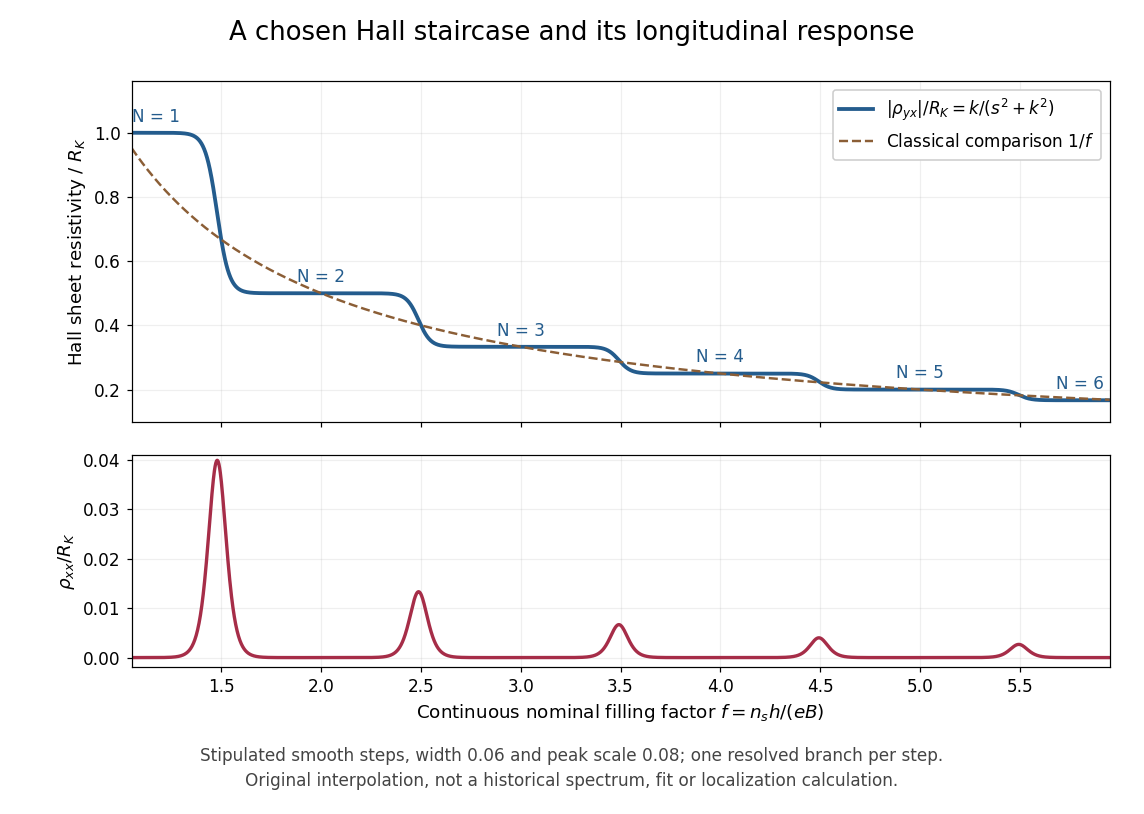
The plot is an original phenomenological construction, not measured data or a calculation of Anderson localization. It stipulates dimensionless transverse sheet conductivity and longitudinal sheet conductivity , with chosen , . Both are measured in units . The quantum Hall conductivity tensor inversion produces and . Regions near , yield plateaus near ; the model alone does not explain their microscopic robustness. Each step represents one resolved branch, without assuming unresolved spin or valley multiplicities.
Klaus von Klitzing, G. Dorda and M. Pepper reported a silicon MOSFET measurement in 1980. Its gate controlled an semiconductor inversion layer; transverse contacts measured the Hall voltage and separate longitudinal contacts measured dissipation. One sweep held , and fixed while varying gate voltage. Hall plateaus accompanied small longitudinal voltages. Device-geometry comparisons and high-input-impedance voltage measurements helped test whether contact placement or electrical loading produced the result.[ref]
New Method for High-Accuracy Determination of the Fine-Structure Constant Based on Quantized Hall Resistance by Klaus von Klitzing and others. pp. 494–496, Fig. 1 and precision-measurement discussion
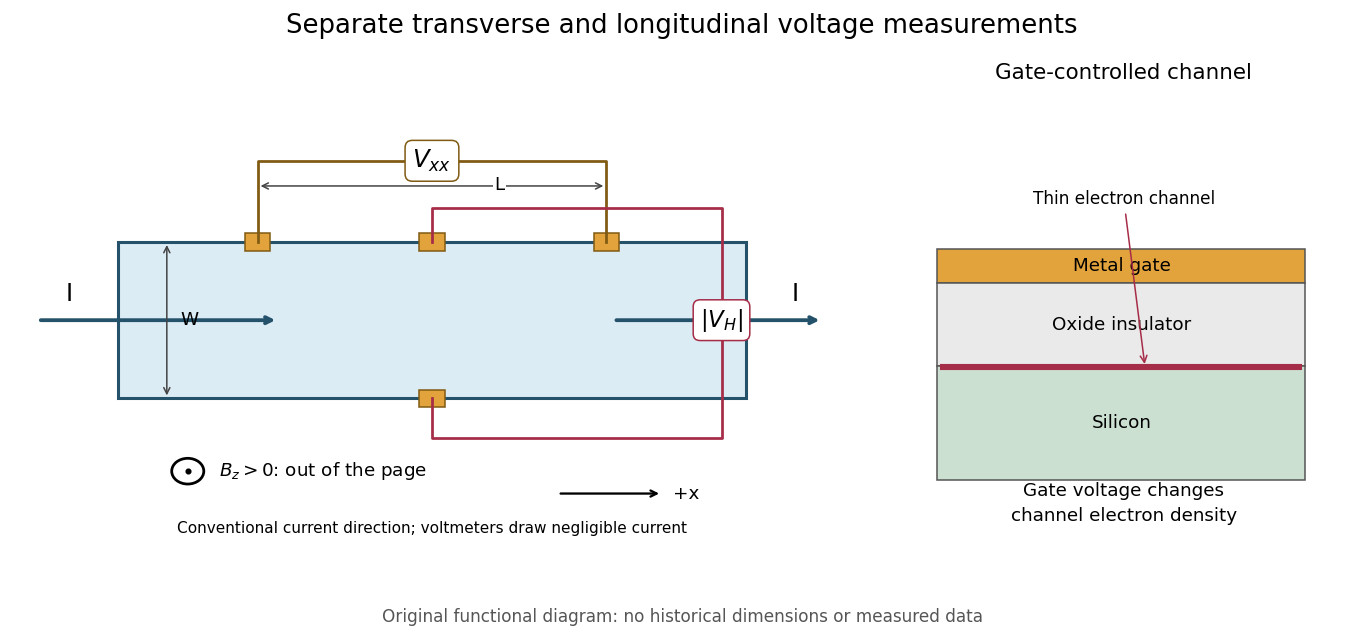


This original functional diagram separates transverse and longitudinal readouts; it does not reproduce the historical device's dimensions. The gate inset explains how a field-effect transistor provides an adjustable two-dimensional electron gas. A longitudinal voltage close to zero is a useful check because accidental longitudinal separation between Hall contacts can otherwise contaminate the transverse measurement.
von Klitzing constant 2026-10-18
The von Klitzing constant is . The current SI fixes the Planck constant and elementary charge exactly, so is exact; the displayed decimal is truncated. It differs from the historical conventional value .[ref]
Fundamental Physical Constants — Complete Listing by National Institute of Standards and Technology and others. 2022 CODATA adjustment: Planck constant, elementary charge, von Klitzing constant and conventional-value rows
As an original ideal example, and electric current give . Changing the Hall bar's width changes the transverse electric field required for this electric potential difference, while the ideal ratio remains .
On a regular level set , holding fixed gives . If is continuously differentiable and both and are nonzero, the implicit function theorem gives and . Multiplication proves the identity. The same held-fixed variable is essential, and a zero denominator invalidates the corresponding quotient rather than creating an infinite factor that may be cancelled formally.
Incompressible quantum Hall fluid 2026-10-18
An incompressible quantum Hall fluid has a bulk spectral gap against charged excitations; disorder can localize excess quasiparticles.[ref]
Anomalous Quantum Hall Effect: An Incompressible Quantum Fluid with Fractionally Charged Excitations by Robert Laughlin. pp. 1397–1398, incompressibility and impurity localization
Laughlin wavefunction Created 2026-10-18 Updated 2026-10-20
Robert Laughlin's 1983 variational method uses pairwise zeros to suppress close electron encounters within the lowest Landau level. For aligned spin, odd gives fermionic exchange symmetry.[ref]
Here enforces wavefunction normalization, is the magnetic length, and complex coordinates describe electrons in a magnetic field , , with the symmetric gauge. Reversing the orientation conjugates the polynomial without changing probability densities. The Gaussian function confines the wavefunction.
The exchange check is especially simple for two electrons. Writing , exchange sends , so . An aligned two-electron spin state is symmetric, requiring the spatial wavefunction to change sign. Hence works, whereas would give the wrong sign. At a close encounter, the probability density vanishes as : imposes a sixth-order zero, stronger than the quadratic zero at . This is the local geometric mechanism for avoiding a large repulsive Coulomb potential energy.
A useful large- counting outline follows directly from the polynomial. Each complex coordinate has maximum degree . A lowest Landau level orbital proportional to has its areal probability density maximum at , by differentiating its logarithm. This suggests droplet area , neglecting the boundary correction. Dividing by the degeneracy of a Landau level per area, , gives filling factor . This counting is a motivation for the fraction, not an independent proof that the wavefunction minimizes the interacting Hamiltonian.
Tsui-Störmer-Gossard fractional Hall experiment Created 2026-10-18 Updated 2026-10-20
Daniel Tsui, Horst Störmer and Arthur Gossard reported the effect in 1982. They grew gallium arsenide–aluminium gallium arsenide layers by molecular beam epitaxy, separating the two-dimensional electron gas from its semiconductor doping. They cut Hall bars and made indium contacts. Low-field measurements established number density and charge carrier mobility. A perpendicular magnetic field sweep measured transverse and longitudinal sheet resistivities at several temperatures. Cooling sharpened the plateau near and the longitudinal minimum at filling factor ; integer plateaus provided an internal comparison. The longitudinal minimum remained finite at the lowest temperature: zero-temperature vanishing was unresolved. This established anomalous transport, without directly measuring excitation electric charge.[ref]
Two-Dimensional Magnetotransport in the Extreme Quantum Limit by Daniel Chee Tsui and others. pp. 1559–1561, sample preparation, Figs. 1–2 and finite longitudinal minimum
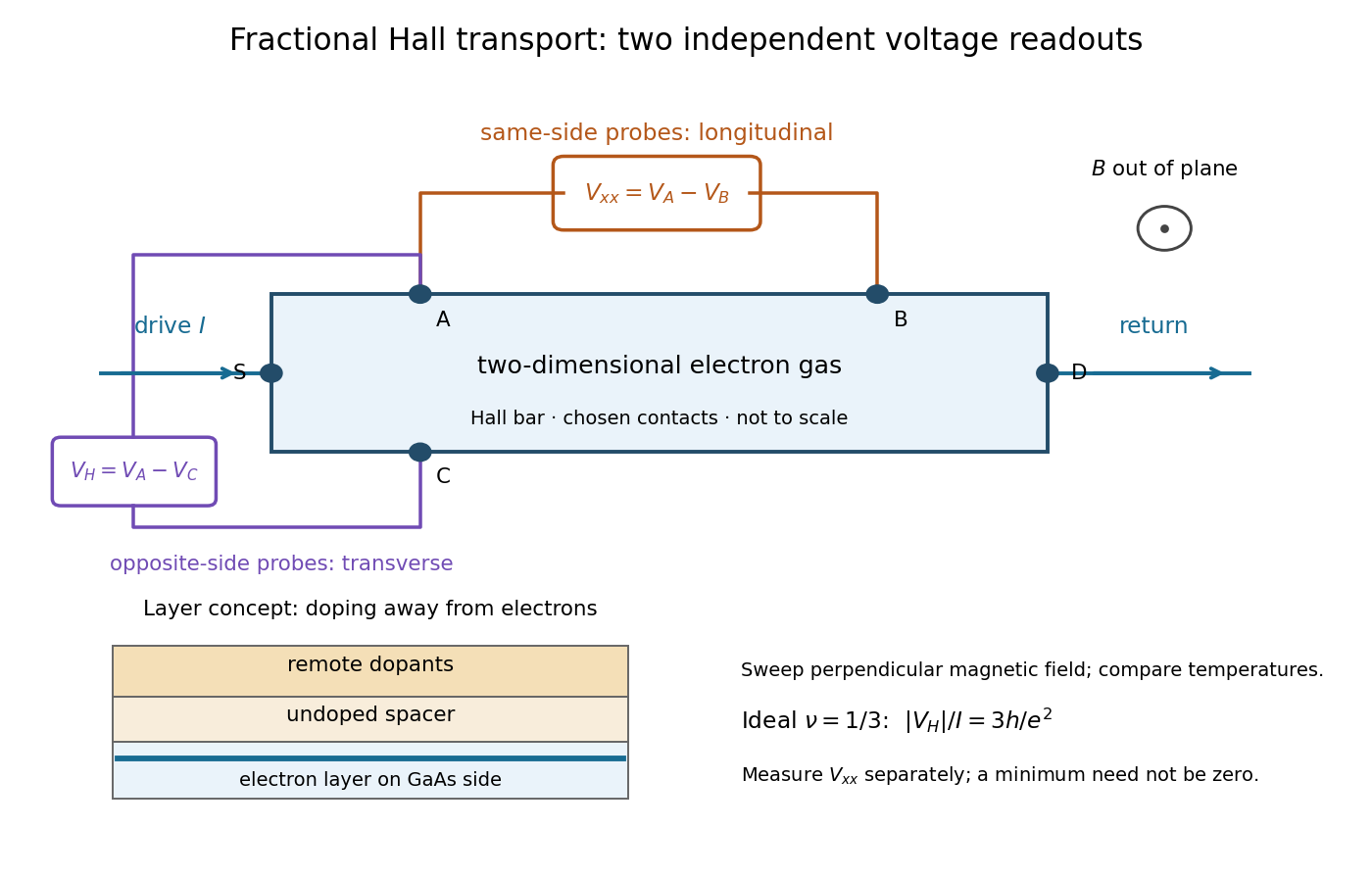

The two readouts test different statements. A single intersection with would also occur on the smooth classical relation at . A quantum Hall plateau instead persists over a magnetic field interval. Comparing transverse and longitudinal signals helps distinguish that plateau from a contact-placement artefact; the quantum Hall conductivity tensor inversion quantifies the contamination when longitudinal sheet resistivity is nonzero.
Later, 1997 shot noise measurements associated with quantum tunnelling at filling factor tested the excitation electric charge separately, finding . That is a different observable from a Hall plateau.[ref]
Observation of the e⁄3 Fractionally Charged Laughlin Quasiparticle by L. Saminadayar and others. Publisher abstract: tunnelling noise and inferred quasiparticle charge
Superconducting flux quantum Created 2026-10-18 Updated 2026-11-05
The magnitude of one magnetic flux unit for an electron-pair order parameter, whose electric charge has magnitude . The enclosing contour must satisfy the flux condition in fluxoid and flux quantization in a superconductor; it is not a statement that every finite area inside the material contains an integer number of these units.
Quasienergy 2026-10-18
A quasienergy is defined by an eigenvalue of the Floquet operator. It is determined modulo , because adding an integer multiple of that quantity leaves the complex exponential unchanged. A time-independent effective Hamiltonian can be defined by a branch of the matrix logarithm; its eigenvalues are the corresponding chosen quasienergies.
Pulse-and-precession spin one-half map Created 2026-10-18 Updated 2026-11-05
Multiplying the two matrix exponentials with the Pauli matrix multiplication law givesOne has . If , put and . The exponential of a Pauli vector gives . Its action on a Bloch vector is a rotation through about , and its quasienergies are modulo . When , its axis is arbitrary and the Bloch vector is unchanged.
Electron self-energy Created 2026-10-18 Updated 2026-10-25
The fermion self-energy of an electron in quantum electrodynamics. After renormalization, its contribution in a bound chemical atom is one source of the Lamb shift; other radiative corrections and nuclear structure also affect the observed energy levels.
Choose the Pauli matrices with , and let be an angular frequency. The computational basis is an orthonormal basis of energy eigenstates for the qubit Hamiltonian operatorIn this convention is the lower energy eigenstate; the labels describe a basis choice, not a universal ground state/excited state ordering. Start in the Hadamard basis pure state . ThenThe first factor in the second expression is a global phase. The ratio of the two probability amplitudes has relative quantum phase , so its sign follows directly from .
Multiplying this density matrix by each Pauli matrix and taking its trace gives the Bloch vector:The Bloch vector travels counterclockwise around the equator of the Bloch sphere, from toward when viewed from . A computational-basis measurement always has , while the Hadamard basis and eigenbasis measurements giveAt , the quantum state is up to a global phase, giving . At , it is up to a global phase, giving . Both retain equal energy measurement probabilities.
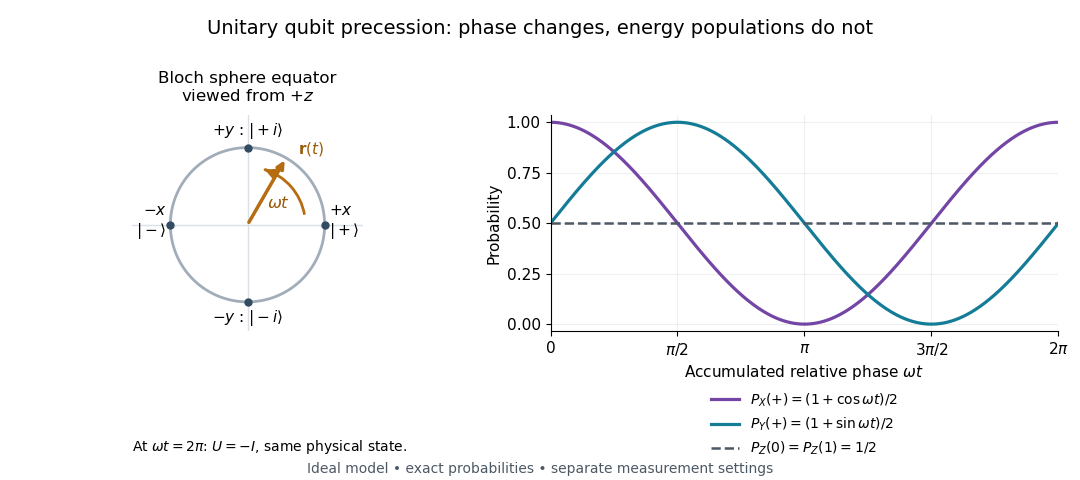

At , the time-evolution operator is , so . The physical quantum state ray, its density operator, and every measurement's probabilities have returned. The representative vector returns exactly only at , when . The minus sign is a global phase for this isolated evolution; comparing an evolved branch with an unevolved branch through a controlled unitary gate can make it a relative quantum phase, as explained in global phase of an uncontrolled quantum gate is unobservable.
Sheet resistivity 2026-10-18
The sheet resistivity tensor relates tangential electric field to surface current density: . It is the matrix inverse of the sheet conductivity tensor, when that inverse exists. Its SI unit is the ohm, rather than the ohm times metre used for bulk electrical resistivity. With a transverse response, individual tensor components are not generally reciprocals of the corresponding sheet conductivity components.
Matthiessen's rule 2026-10-18
Matthiessen's rule approximates the total electrical resistivity of a metal by the sum of separate scattering contributions. For a common parabolic energy band, approximately independent scattering mechanisms give for the respective momentum relaxation times, and hence . Correlated scattering, strongly angle-dependent processes or a complicated changing energy band structure can invalidate the simple addition.
There are unlisted articles, also show them or only show them.