
At the minimum of the steady vertical-field magnetoconvection dispersion relation, stationarity gives . With nonmagnetic value , eliminating the critical wavenumber gives the stated relation and . These hold for every nonnegative Chandrasekhar number, including its zero-field limit.
Three-amplitude vertical-field magnetoconvection Created 2026-10-14 Updated 2026-11-05
For one stress-free planar roll mode, thermal-time rescaling reduces the linear dynamics to , , . Its characteristic polynomial is . For and , steady marginality is . Oscillatory marginality is , with . A genuine Hopf bifurcation onset requires ; a formal imaginary-root formula with negative frequency squared is not an oscillation. The Routh-Hurwitz stability criterion selects the first crossing, while nonlinear coefficients determine criticality.
Source of an indecomposable module 2026-10-14
For an indecomposable module with vertex of an indecomposable module , a source is an indecomposable -module which is a direct summand of and for which is a direct summand of . It has vertex as a -module. Sources at a fixed vertex are conjugate by its normalizer.
Green correspondence Created 2026-10-14 Updated 2026-11-05
Let . Set and . Green correspondence pairs indecomposable modules with vertex for and : restriction has a unique vertex- summand, with the other summands relatively projective for ; induction has a unique vertex- summand, with the other summands relatively projective for . The two assignments are inverse and preserve sources. Its more general form applies to vertices contained in but not conjugate into any member of .
Full-vertex modules for a noncyclic p-group 2026-10-14
Every noncyclic finite finite p-group has a quotient . Over any field of characteristic , define a square-zero representation with basis by for , , for , , and . Here , , and is the span of the . An endomorphism induces the same scalar on the top and on ; the remaining maps from the top to form a square-zero ideal. Thus the endomorphism ring is local and the module is indecomposable. Inflating to and choosing gives infinitely many distinct dimensions with vertex : the trace of a relative-trace identity from any proper subgroup would force dimension zero in the field. This construction works over finite fields too.
Fixed-angle softness of an open-string amplitude Created 2026-10-14 Updated 2026-11-05
At high energy with fixed, reflection and Stirling formulas for the gamma function give the displayed exponential envelope, away from real-axis resonance poles or after suitable analytic continuation. It is softer than the power-law fixed-angle behavior of typical point-particle interactions and exposes the finite string length. This limit differs from the fixed- Regge limit and does not by itself prove finiteness of every loop amplitude.
Longitudinal velocity correlation 2026-10-14
For a separation parallel to a unit vector , the longitudinal velocity correlation is . In isotropic incompressible turbulence the transverse normalized correlation is and the trace is .
Kármán-Howarth equation 2026-10-14
The Kármán-Howarth equation evolves two-point correlations in homogeneous isotropic turbulence. In trace form it is . Integrating with radial volume weight reduces conservation of the Saffman integral to vanishing nonlinear and viscous boundary fluxes.
Superspace gauge connection Created 2026-10-14 Updated 2026-11-05
A gauge connection on superspace has both vector and spinor components. Subtracting the flat-frame torsion from the graded commutator of its covariant derivatives defines its supercurvature. The conventional four-dimensional spinor-curvature constraints leave one real vector superfield as a prepotential. Its chiral field-strength superfield contains the ordinary gauge curvature, gaugino and real auxiliary field.
Quotient vector bundle 2026-10-14
For a smooth vector subbundle , the quotient has fibers . Extend a local frame of a vector bundle of to one of ; the classes of the complementary frame vectors trivialize the quotient. Adapted transition functions of a vector bundle are block upper triangular, and their lower-right blocks give the quotient transitions. These are smooth and satisfy the cocycle identity, defining a smooth vector bundle. The projection is a smooth vector bundle morphism.
Orthogonal splitting of a vector subbundle 2026-10-14
A fiber metric on a smooth vector bundle gives a smooth orthogonal projection onto any vector subbundle. In a local frame of , let be the metric matrix and the columns of a frame of . Then , proving smoothness. The complementary subbundle maps isomorphically onto the quotient vector bundle. Explicitly is a vector bundle isomorphism , with inverse . This inverse is independent of the representative , but the splitting depends on the chosen metric.
Vector bundle endomorphism 2026-10-14
A smooth vector bundle morphism from a vector bundle to itself, covering the identity on the base, is a vector bundle endomorphism. It is fibrewise linear and is equivalently a smooth section of . In a local frame its matrix is smooth and changes by conjugation under changes of frame. An almost complex structure is a real endomorphism of the tangent bundle satisfying .
A fiberwise surjective morphism of constant-rank vector bundles has a kernel vector subbundle. For a morphism from a trivial rank- bundle, a local full-row-rank matrix gives the continuous kernel projection . Changing the local frame in the target leaves this projection unchanged. Thus its kernel defines a continuous map into the appropriate Grassmannian.
Gauss–Manin connection 2026-10-14
The flat connection on the complexified fibre-cohomology local system differentiates cohomology classes using topological parallel transport. For a smooth proper holomorphic family, relative de Rham cohomology identifies it with the connecting morphism obtained by retaining one base differential in the absolute de Rham complex.
Griffiths transversality 2026-10-14
In a variation of Hodge structure, differentiation lowers the filtration index by at most one. In the relative de Rham construction, an absolute form of degree at least contributes, after extracting one base differential, a relative form of degree at least . This filtration shift proves the condition for geometric variations.
For with and fixed , represent with having the standard normal distribution. Taking the natural logarithm of the absolute value gives the displayed identity. Its random second term has a common distribution, independent of , so this variance-stabilizing transformation gives an exactly constant variance. That variance is finite: the normal density is bounded near zero and , while normal tails control logarithmic growth at infinity. The transformation is defined almost surely, loses the sign of the mean, and does not produce an exact normal distribution. A zero mean makes the original observation identically zero and is outside its domain.
Exponential tail extension of Varadhan's lemma Created 2026-10-14 Updated 2026-11-05
For a continuous and a family satisfying a large deviation principle at speed , the displayed exponential tail condition extends Varadhan's lemma to unbounded above. Apply the bounded-above result to and split the full integral into and its tail; the tail is negligible and the truncated variational suprema increase to . A sufficient condition is for some , since the tail is at most .
Zero power sums force a finite complex multiset to vanish Created 2026-10-14 Updated 2026-11-05
Collect the distinct nonzero values among the as with positive multiplicities . The first power sums imply for . The coefficient matrix is an invertible weighted Vandermonde matrix, so all vanish, a contradiction unless . Its invertibility also follows because a polynomial vanishing at zero and all the has distinct roots and degree at most .
Andrews's carbon dioxide experiment Created 2026-10-14 Updated 2026-10-18
The 1869 The Bakerian Lecture: On the Continuity of the Gaseous and Liquid States of Matter by Thomas Andrews describes dried carbon dioxide trapped above mercury in a sealed capillary tube. A steel screw pressurized water in a strong copper tube; movable mercury transmitted the load. A second capillary tube held air as a pressure gauge. Flowing water around the visible capillary tubes controlled temperature; a thermometer read the bath. A cathetometer read column positions, converted to volume readings using weighed-mercury calibration.[ref]
The Bakerian Lecture: On the Continuity of the Gaseous and Liquid States of Matter by Thomas Andrews. Andrews, pp. 576–578 and Plate LXIII, figures 3 and 5–7: sample preparation, screw, coupled capillaries, water jackets and optical readout
Below the critical temperature, compression produced a visible liquid–gas boundary; above it, large density changes occurred without that boundary. Three trials gave as his critical temperature. Purity checks detected residual air; mercury height corrections accounted for unequal hydrostatic pressures. He explicitly left air nonideality and pressure-induced tube-capacity corrections unresolved, so his air-gauge pressures were approximate. These readouts support a liquid-gas critical point; they do not measure a homogeneous unstable loop or establish universal quantitative accuracy of the later Van der Waals equation.[ref]
The Bakerian Lecture: On the Continuity of the Gaseous and Liquid States of Matter by Thomas Andrews. Andrews, pp. 576, 578–580 and 583: residual air, approximate air-gauge pressure, hydrostatic corrections and three critical-temperature trials
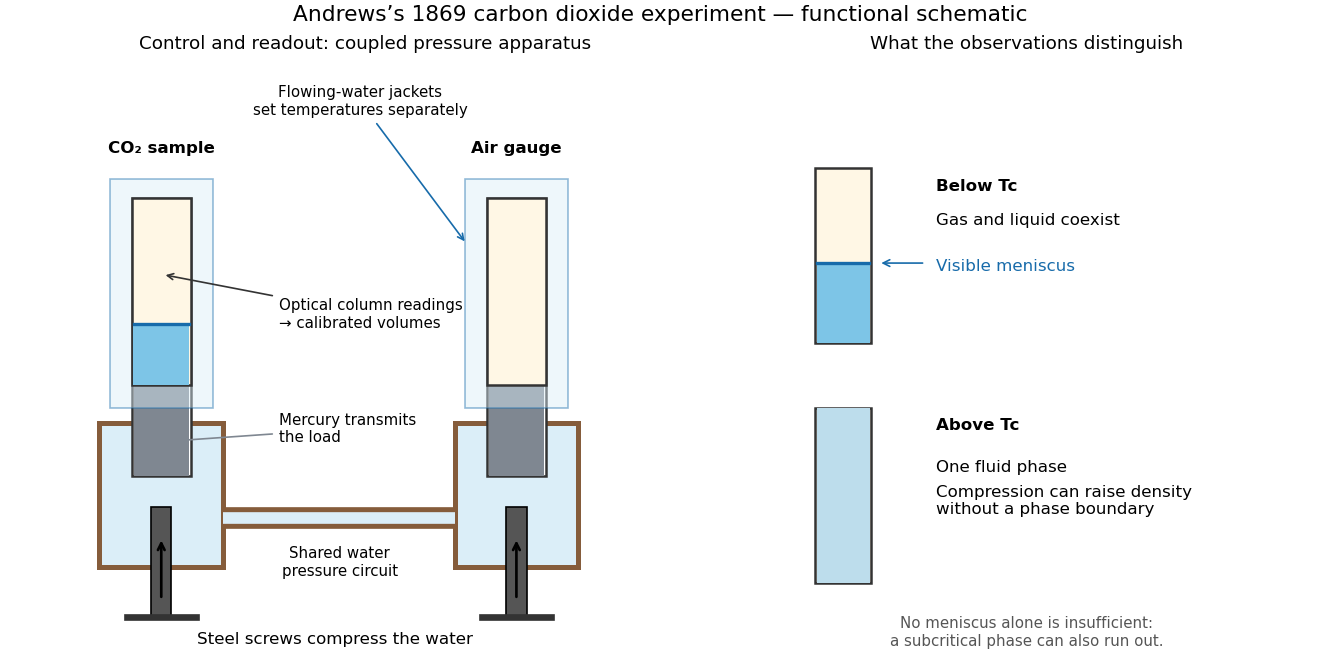
Andrews's carbon dioxide experiment: control, readout and the liquid-gas critical point
. Original functional schematic, not a scale reconstruction. The water circuit transmits compression through mercury to two samples; separate temperature jackets permit control of the sample and air gauge. The right panels distinguish a visible liquid–gas liquid meniscus from a single thermodynamic phase. Interpret alongside the experimental limitations above. Details.
A disappearing liquid meniscus by itself has more than one possible explanation: in ordinary subcritical condensation or evaporation, one thermodynamic phase can simply run out. The stronger critical-point inference combines temperature control, compression readings and the existence of a continuous route around the endpoint of the phase coexistence curve. On that route a dilute gas can become dense without crossing a two-phase boundary. This is what continuity of liquid and gas means; it does not remove their distinct equilibrium number densities below .
In his 12 December 1910 Nobel lecture, Johannes Diderik van der Waals explained gases and liquids through the same moving molecules, with attraction and finite size modifying their pressure. He also rejected the idea that constant should give universal numerical agreement. His critical-volume discussion explicitly retained derivatives of a volume-dependent : the familiar follows only when those derivatives are neglected. Thus the elegant constant-parameter Van der Waals critical point is a model result whose limitations were already part of its author's account.[ref]
The Equation of State for Gases and Liquids by Johannes Diderik van der Waals. The equation of state for gases and liquids, Nobel lecture delivered 12 December 1910, pp. 254–257: molecular continuity, constant-parameter caveat and critical-volume derivatives
Van der Waals liquid-gas coexistence Created 2026-10-14 Updated 2026-10-18
Below , the equilibrium liquid and gas have the same temperature, pressure , and per-particle chemical potential. For macroscopic bulk thermodynamic phases, neglect interface contributions. The Maxwell equal-area construction determines and byIt expresses equality of chemical potentials, since at fixed temperature. Equivalently, the equilibrium Helmholtz free energy per particle follows a common tangent line between the two endpoint states, lying below the homogeneous continuation between them. The construction uses that mathematical continuation to compare endpoints; it is not a physical compression path through negative isothermal compressibility states.[ref]
Statistical Physics by David Tong. §5.1.1, equation 5.5, Maxwell Construction and figures 36–37: chemical-potential equality and flat coexistence intervals
Here is a reproducible calculated example at . With , the homogeneous intersections solve the cubic equationThe Maxwell construction givesAll three roots of a polynomial satisfy . Only the smallest and largest are the phase coexistence endpoints; the middle one has negative isothermal compressibility. Equal pressures at three admissible values of volume therefore do not imply three stable thermodynamic phases. An analytic area check isAt full numerical precision, the residual is below in reduced units; independent numerical integration gives the same cancellation. At , the spinodal points are instead and .
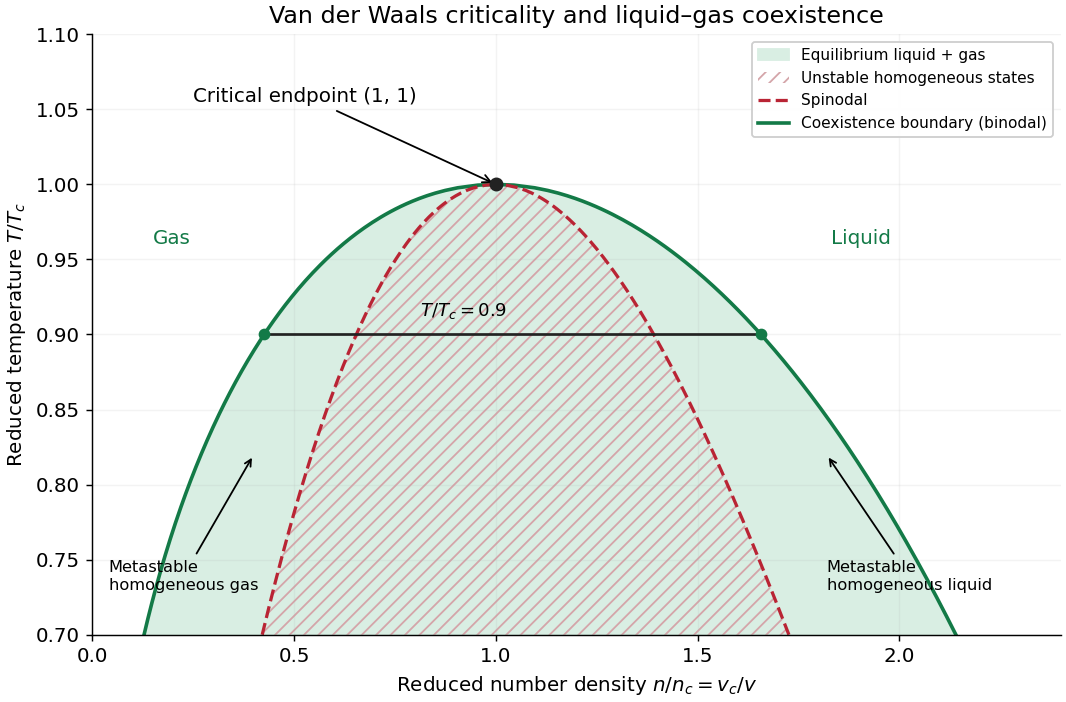

The equilibrium plateau changes the phase fraction rather than the endpoint densities. For a gas particle fraction and mean particle volume , the lever rule readsThus at gives : this is a particle fraction, not the volume fraction occupied by gas. Differentiating equality of chemical potentials along this model's phase coexistence curve yields the same Clapeyron equation explained below, , with latent heat per particle. Both endpoint differences vanish as the Van der Waals critical point is approached; the equation's critical limit must be taken as a ratio.
The Maxwell construction presumes a pure bulk fluid at thermodynamic equilibrium. Its endpoint equality does not specify how rapidly a real compression reaches equilibrium. A homogeneous metastable sample can persist while nucleation is delayed; the spinodal marks loss of local mechanical stability in this mean-field theory, rather than the equilibrium onset of condensation. Surface tension, finite sample size and impurities can affect the observed transition. These qualifications matter when comparing a mathematical Van der Waals isotherm with a visible liquid meniscus.
There are unlisted articles, also show them or only show them.