
Airy disk derivation 2026-10-14
Write and wavenumber . The pupil Fourier transform, normalized by pupil area, gives the Fraunhofer diffraction wave amplitude. In pupil polar coordinates,The angular average is because . The Bessel function of the first kind identity then reduces the radial integral to . Taking the squared magnitude yields the Airy disk light intensity profile.[ref]
The apparent division by zero is removable. The power seriesgives and . At the centre, every pupil contribution has the same wave phase, so their normalized sum is one. The first dark ring instead corresponds to with , rather than to the removable zero of at the origin.
Affine maps can collapse lines 2026-10-14
An affine map need not be injective. For , the direction belongs to the kernel of its linear part of an affine map. Consequently the whole line maps to , and every parallel line maps to . These are collapsed lines, not images with a surviving direction. Assertions that an affine map preserves distinct parallel lines require the appropriate noncollapse or injectivity hypothesis.
Affine maps preserve affine combinations Created 2026-10-14 Updated 2026-10-31
For coefficients with sum one, the defining identity follows from linearity:The translation appears once on both sides precisely because . In particular, midpoints map to midpoints, and a parameterized line segment , , maps to . A whole line has the same formula with ; its image is a line if , and a single point otherwise.
Keep the basis fixed and replace the origin by a point with old coordinates . Each point's coordinates change from to . For coefficients with sum one, the weighted coordinates becomeAdding the new origin gives the original point. This proves origin independence rather than asserting that the coordinate tuples themselves stay unchanged.
The requirement cannot be omitted. In the example , , blindly treating as a point gives in the old coordinates. If the new origin is , the two coordinates become and ; adding them and restoring instead gives . The coefficients sum to two, so this procedure has no origin-independent interpretation as a weighted point.
Alpha-adrenergic receptor Created 2026-10-14 Updated 2026-11-05
An alpha-adrenergic receptor belongs to the alpha branch of adrenergic receptors, divided into alpha-1 adrenergic receptors and alpha-2 adrenergic receptors. The branches differ in their common G-protein coupling and intracellular signals. Grouping them as alpha receptors identifies related pharmacology, but does not mean that all produce the same response or activate the same messenger pathway. [ref]
Pharmacological Characterizations of Adrenergic Receptors in Human Adipocytes by Thomas W. Burns and others. alpha-adrenergic responses and receptor-selective pharmacology
Beta-adrenergic receptor Created 2026-10-14 Updated 2026-11-05
A beta-adrenergic receptor is an adrenergic receptor subtype family commonly coupling to stimulatory G-protein signalling and increased cyclic AMP. Cellular responses include changes in cardiac activity or fuel mobilization, depending on subtype and tissue. Ligands can stabilize different receptor conformations, so binding affinity alone does not determine efficacy or signalling preference. [ref]
Order-induced acyclic orientation Created 2026-10-14 Updated 2026-11-05
Choose a strict total order of the vertices of a finite simple graph. Direct every edge from to when . Along every directed path, the index strictly increases. Returning to the starting vertex would require an impossible strict increase back to the initial index, so this is an acyclic orientation. The displayed comes from .
The chosen strict total order is a topological order of the resulting directed acyclic graph. Conversely, every acyclic orientation of a finite simple graph has a topological order, and orienting its edges from earlier to later in that order recovers it. Different topological orders can induce the same acyclic orientation, since vertices with no edge between them need not impose a choice of arrow.[ref]
Lecture 14: Graphs II: Depth-First Search. printed pp. 4–6: job scheduling, topological sorting and its edge-order correctness condition
An order respects reachability but does not create it: in a chosen topological order does not imply a directed path from to . For example, orient the two edges of the graph path using . The arrows are and ; there is no directed path from to , despite . In , however, reaches both directly and via . Following outgoing directed edges with graph search decides this directional reachability.[ref]
Lecture 14: Graphs II: Depth-First Search. printed pp. 1–2: directed adjacency lists contain outgoing edges; a search sees vertices reachable from its start
Work by Yannis G. Kevrekidis 2026-10-14
Work by Weston L. Tew 2026-10-14
Work by W. Haase 2026-10-14
Integer determinant and sublattice index 2026-10-14
For a square integer matrix with nonzero determinant, the image is a subgroup of the integer lattice. Its index of a subgroup isIn particular, gives all points with even first coordinate. The quotient has two cosets, represented by and , and the fundamental cell has area two. A determinant of two therefore counts how much integer information is missing from the image.
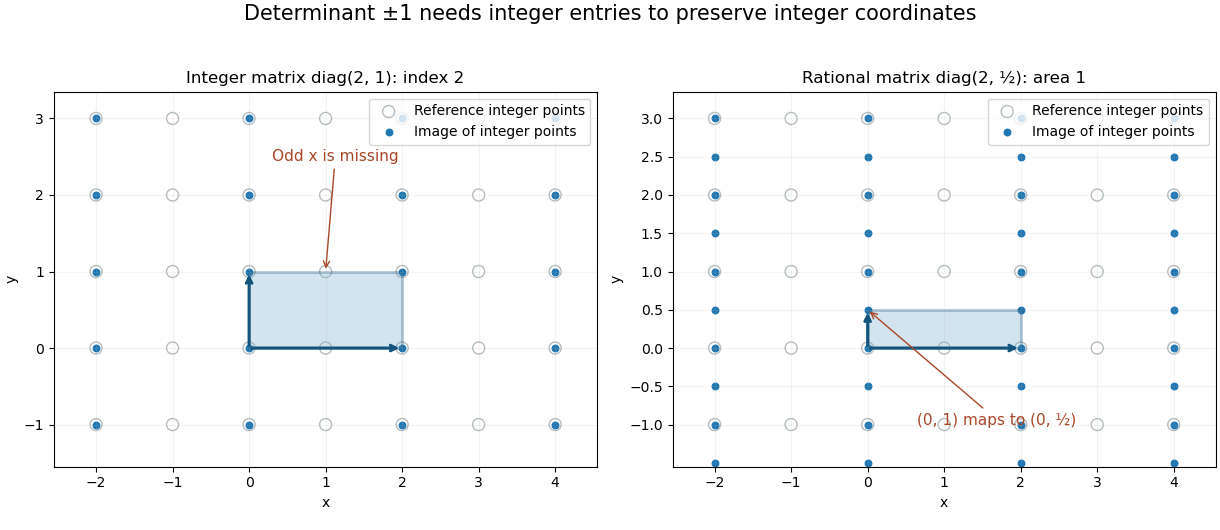
The integrality hypothesis is essential. The rational matrix has determinant one but sends to . Its generated Euclidean lattice has the same covolume as without being the same integer lattice. The unimodular matrix criterion combines an arithmetic condition with a geometric one.
A short proof of the index formula uses Smith normal form. Write , with unimodular matrices and positive integers . They preserve the relevant integer structure, so the quotient has the same size as , namely . No assumption that the matrix is orthogonal or its basis vectors are short is needed.
Unimodular change of lattice basis 2026-10-14
Let be real square invertible matrices whose columns are lattice bases. They generate the same Euclidean lattice precisely when[ref]
If , multiplication by merely permutes the integer coordinate vectors, so the two generated sets agree. Conversely, equality of the generated sets means every column of either basis is an integer linear combination of the other. Hence and for integer matrices . Substitution followed by multiplication by gives , so the integer inverse criterion for a unimodular matrix applies.
Equal real linear spans are a weaker condition: any two real square invertible matrices span the same ambient vector space. Even equal covolumes do not force the same Euclidean lattice. The requirement that the change matrix and its inverse matrix have integer entries provides the missing arithmetic information.
For a square integer matrix with nonzero determinant, the inverse matrix has integer entries exactly when . The adjugate matrix formula proves one direction:Every entry of is an integer cofactor, so division by or leaves integer entries. Conversely, if both and are integer matrices, their determinants are integers with product one. The only possibilities are that both are one or both are minus one. This explains why a general integer matrix with nonzero determinant need not have an integer inverse matrix.
Multiple edges 2026-10-14
Multiple edges are distinct edges with the same pair of endpoint vertices in an undirected graph. A multigraph permits them; a simple graph does not. In an orientation of a graph of a multigraph, each such edge receives its own direction, so two of them can supply opposite directed edges between the same vertices.
Saturation parameter Created 2026-10-14 Updated 2026-10-20
For a specified optical transition, the on-resonance saturation parameter is the light intensity divided by the saturation intensity. The independent-beam Doppler cooling force model assumes weak total excitation and defines separately for each beam.
Series truncation error 2026-10-14
For a convergent series with sum , the error from keeping only the first terms is the remaining sum . This truncation error exists even with exact arithmetic. The zeta series truncation error gives explicit bounds for positive reciprocal-power terms.
Convergence of a sequence in a topological space Created 2026-10-14 Updated 2026-10-25
A sequence in a topological space converges to if every open neighbourhood of contains all sufficiently late terms:For a metric space, this is the usual limit of a sequence condition expressed through open balls. For a Hausdorff space, distinct proposed limits have disjoint open neighbourhoods, so a sequence cannot eventually stay in both and the limit is unique. The sequence convergence in the cofinite topology demonstrates what can change when that separation property is absent.[ref]
Chapter 1: Topological spaces. Definition 1.5.5, Proposition 1.5.11 and Proposition 1.6.20: neighbourhood convergence, uniqueness and the metric formulation
Category of topological manifolds 2026-10-14
The category of topological manifolds has topological manifolds without boundary as its objects of a category and all continuous maps between them as its categorical morphisms. Allowing every dimension of a manifold lets maps connect spaces of different dimensions. Identity functions are continuous, and function composition preserves continuity, so the category laws are inherited from functions. Its isomorphisms are exactly homeomorphisms.
In coordinate charts on and on , a continuous map is represented locally by on . Changing coordinate charts changes this expression through topological transition maps, while itself stays fixed. This viewpoint separates the underlying continuous map from the coordinates used to describe it; restricting to smooth manifolds and smooth maps gives the corresponding smooth category.
Topological manifold with boundary 2026-10-14
For , a topological -manifold with boundary is a Hausdorff second-countable space locally homeomorphic to relatively open sets in the half-space . The openness here is in the subspace topology of , not necessarily in . Its intrinsic boundary consists of points sent to ; the remaining points have ordinary coordinate charts with images open in Euclidean space. The intrinsic boundary is independent of the chosen chart.[ref]
Week 2 course notes. Topology I: smooth manifolds, Week 2, Section 1.3, equation (21), Definition 1.21 and Remark 1.24, page 7
The closed interval illustrates the distinction: its interior points have open interval charts, while and have charts modeled on , using and . Its intrinsic boundary is . The circle has empty intrinsic boundary even though its boundary of a set as a subset of the Euclidean plane is the whole circle. A topological manifold without boundary is therefore a special case with , and a smooth atlas on the half-space charts gives a manifold with boundary in the smooth sense.
Two stereographic charts on the circle 2026-10-14
Take the circle with its subspace topology. Write for its west point and for its east point. Two coordinate charts obtained by stereographic projection areBoth take values in the entire real line. Geometrically, join to and intersect the resulting line with : the height is . Projecting from instead gives height . Each projection omits its own starting point, but the other coordinate chart includes that point. Hence .[ref]
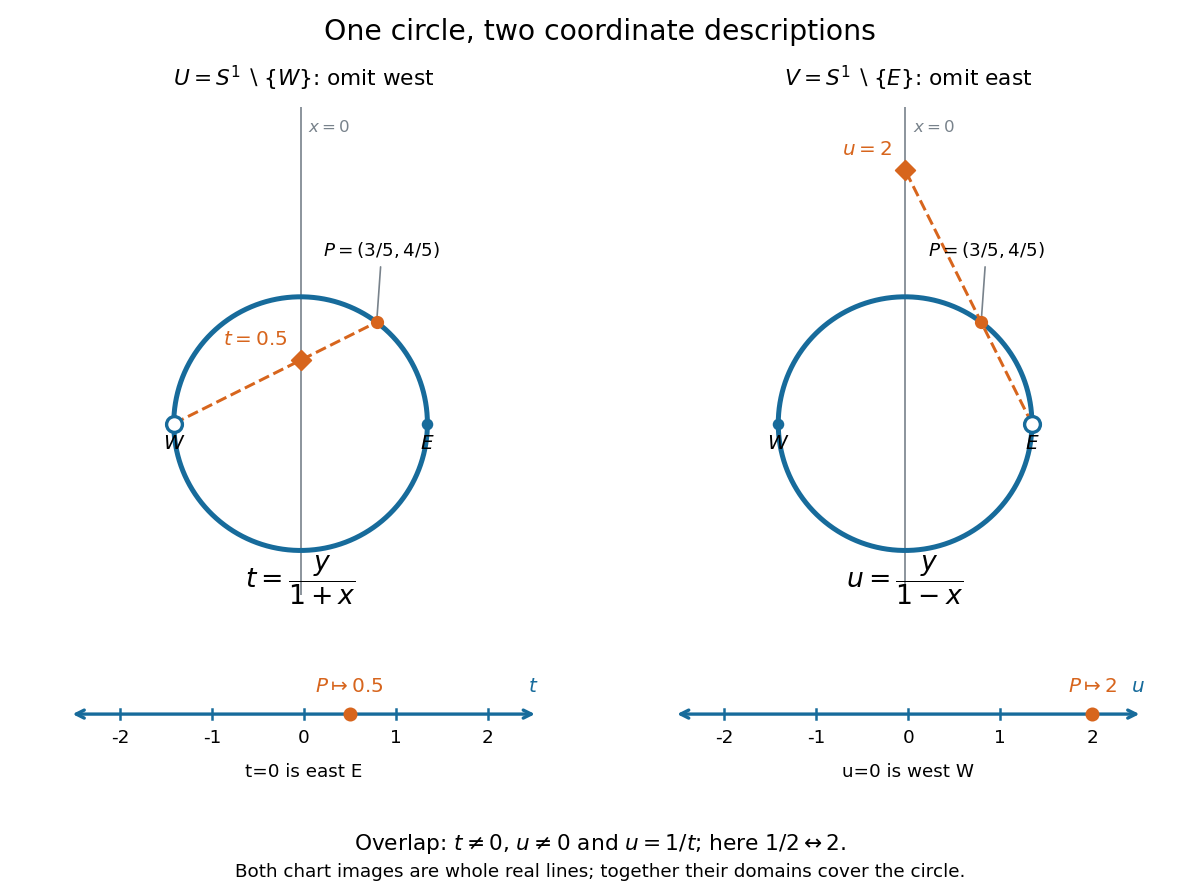


To verify the homeomorphisms, solve the displayed equations for . The inverse functions areEach formula lies on the circle, avoids its excluded point, and is continuous for every real argument. Substitution into the projection formulas returns or ; substitution in the other direction returns . Thus these are continuous bijections with continuous inverse functions, as required for coordinate charts. Since the Euclidean plane is Hausdorff and second countable, the subset with its subspace topology is too. This checks all three conditions for a topological manifold, rather than just drawing a smooth-looking curve.
On the overlap , both are excluded, so . Using , the topological transition map isFor example, has and . The two connected components of the overlap, the upper and lower arcs, correspond to the positive and negative parts of the punctured real line. The values and represent and , respectively, and belong to only one chart each. The reciprocal coordinate change and its inverse function are smooth functions away from zero, so this topological atlas also supplies a smooth atlas.
Why can neither chart be enlarged to a single coordinate chart on the whole circle? The circle is a closed set and a bounded set in the Euclidean plane, hence compact by the Heine-Borel theorem. A global coordinate chart would give a homeomorphism to a nonempty open set . Its image would be compact and therefore closed in the real line. By connectedness of the real line, this forces , which is not compact. This is the one-dimensional instance of no compact manifold has a single Euclidean chart. Locally the circle is indistinguishable from the real line; globally compactness obstructs a single chart.
There are unlisted articles, also show them or only show them.