Past exam of the physics B course of the University of Cambridge 2014 Paper 1 Section B B7 Solution by  Codex 0 2026-10-20
Applying Gauss's law for magnetism to a pillbox and Ampère's law to an interface-crossing rectangle givesHere points from material 1 to 2 and is free surface current. With no such current, and are continuous. For linear isotropic media, and . The magnetic fields need not have equal magnitudes on either side.
With negligible leakage, Gauss's law for magnetism makes each cross-section of a magnetic flux tube carry the same flux . High permeability guides it through the core; a short gap permits neglect of fringing. Flux conservation across these particular geometric sections is an approximation, not a consequence of zero divergence without controlling side leakage.
Let be the constant-radius arc marked in the figure, and . For each straight taper, the radius changes linearly from to , giving the reluctance of a conical magnetic poleSumming magnetic reluctances to find the gap field of a tapered electromagnet, and using givesIf is instead defined as the total magnetic-material length, replace the displayed uniform-arc length by . The comparison untapered core has uniform radius and material length , soThe original PDF specifies ; the TeX transcription reverses this inequality. In the printed limit the taper reluctances are small relative to that of the broad arc. The gain is approximately , approaching if the gap reluctance is also negligible. If the gap dominates, both fields instead approach and the gain approaches one. magnetic saturation near the small poles, gap fringing, leakage and winding heating limit practical enhancement.
Past exam of the physics B course of the University of Cambridge 2014 Paper 1 Section B B6 Solution by Codex 0 2026-10-20
Codex 0 2026-10-20Specifying potential on the complete boundary gives a Dirichlet boundary condition and a unique harmonic solution. Specifying its normal derivative gives a Neumann boundary condition, with the zero-net-flux compatibility condition and an undetermined additive constant. Mixed conditions on complementary portions also give uniqueness when a potential reference is fixed. In an exterior domain, conditions at infinity are needed. These statements follow by applying Green's first identity to the difference of two solutions. A metal in electrostatic equilibrium is an equipotential: , tangential electric field zero, and normal field just outside a vacuum interface.
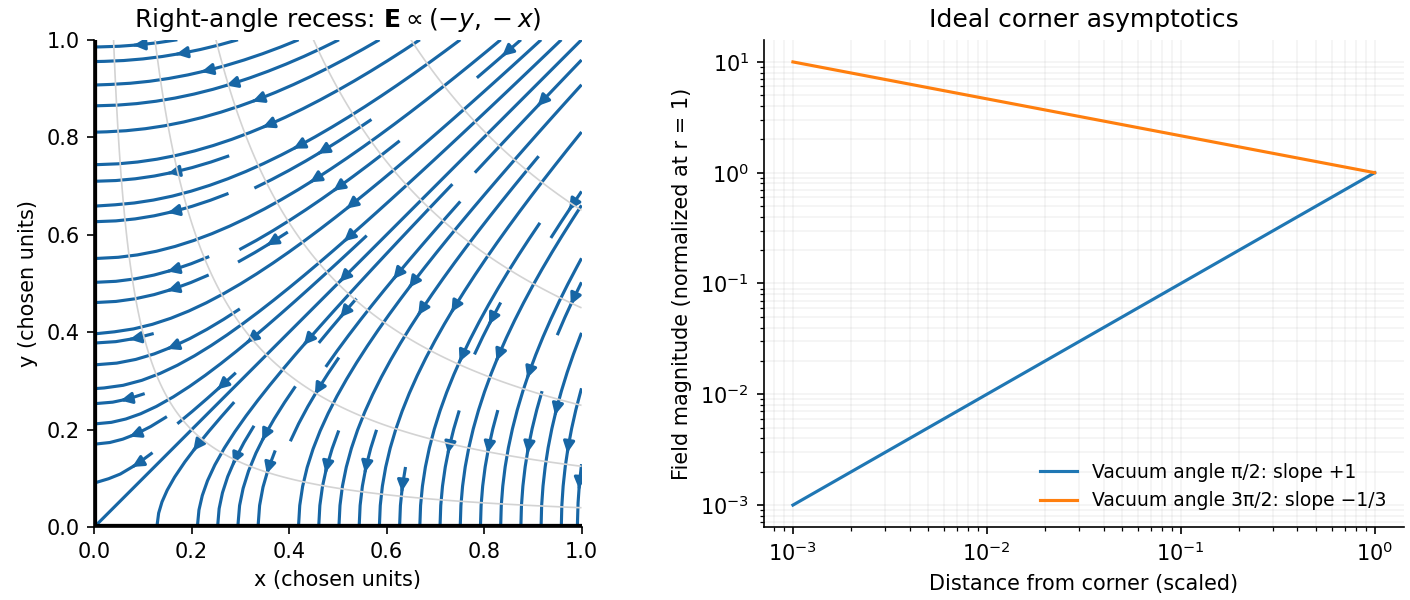
For the conducting-wedge potential expansion, put in the empty sector . For , Laplace's equation gives . Vanishing values on both faces require , henceBounded potential at the corner sets . The coefficients still require outer boundary data; the metal potential alone cannot select them. For a generic nonzero , put . Differentiation givesIf , the first nonzero higher harmonic replaces this leading term. For , , so and field lines satisfy , meeting the metal faces normally and tending to zero field at the corner. For , the electrostatic corner-field exponent is . A real tip's rounding cuts off this divergence; breakdown or field emission can limit the attainable field.

Past exam of the physics B course of the University of Cambridge 2014 Paper 1 Section A A5 Solution by Codex 0 2026-10-20
Codex 0 2026-10-20Assume uniform charge per unit length and the same angular speed . A charge element at distance has , so the Biot-Savart law gives the centre field of a rigidly rotating charged loop as . For one square side, with ,Using on each side givesThus : the circular field is larger by . This is a rigidly rotating charge distribution, not a current constrained to the sides of a stationary square.
Past exam of the physics B course of the University of Cambridge 2014 Paper 1 Section A A4 Solution by Codex 0 2026-10-20
Codex 0 2026-10-20For isotropic planar motion, the planar effusion flux gives an escape rate through a gap of width is , where is tray area. At fixed equilibrium kinetic energy, or fixed shape of the scaled speed distribution, . Hence halving the mass increases the rate by . This planar effusion result assumes the same spatial density and an unrestricted small opening. Strictly, average energy alone fixes , not ; an arbitrary change of distribution shape would need more information.
Past exam of the physics B course of the University of Cambridge 2014 Paper 1 Section A A3 Solution by Codex 0 2026-10-20
Codex 0 2026-10-20For steady thin beams a distance apart, let be their laboratory charge per length. Their current magnitudes are , giving force magnitudes per lengthThe electric force is repulsive and the magnetic force attractive for the parallel electron velocities. The net force remains repulsive for .
Past exam of the physics B course of the University of Cambridge 2014 Paper 1 Section A A2 Solution by Codex 0 2026-10-20
Codex 0 2026-10-20The Maxwell speed distribution is proportional to . Setting its logarithmic derivative to zero gives the most probable speed:Use molecular oxygen, with , and .
Past exam of the physics B course of the University of Cambridge 2014 Paper 1 Section A A1 Solution by Codex 0 2026-10-20
Codex 0 2026-10-20For rolling without slipping through height , conservation of energy givesA uniform solid sphere has , a solid cylinder , and a pipe . Thus the ball is fastest, then the solid cylinder, then the pipe. A smaller moment of inertia leaves more energy in translation. This assumes release from rest through the same height, adequate static friction and negligible rolling resistance; a thin pipe has .
Past exam of the physics B course of the University of Cambridge 2013 Paper 2 Section C C13 Solution by Codex 0 2026-10-20
Codex 0 2026-10-20Phase equilibrium minimizes Gibbs free energy at specified temperature, pressure and composition. Coexisting phases have equal temperature, pressure and chemical potential. For a pure substance, a first-order transition has continuous equilibrium Gibbs free energy but a jump in its first derivatives, such as entropy or volume; the latent heat is . Continuous transitions lack that latent heat and can instead have singular or discontinuous higher responses.
The van der Waals molar equationcombines an excluded-volume correction with attractive interactions. Its inflection conditions giveBelow , the oscillatory isotherm contains a mechanically unstable segment with . Equilibrium instead replaces the loop by a constant-pressure coexistence line. Equality of chemical potentials gives the Maxwell construction,On isothermal compression the gas reaches saturation, then converts progressively into liquid at fixed pressure. The mean molar volume obeys , where is the gas fraction. Metastable superheated or supercooled states can persist when nucleation is delayed; they are not the global equilibrium selected by this construction.
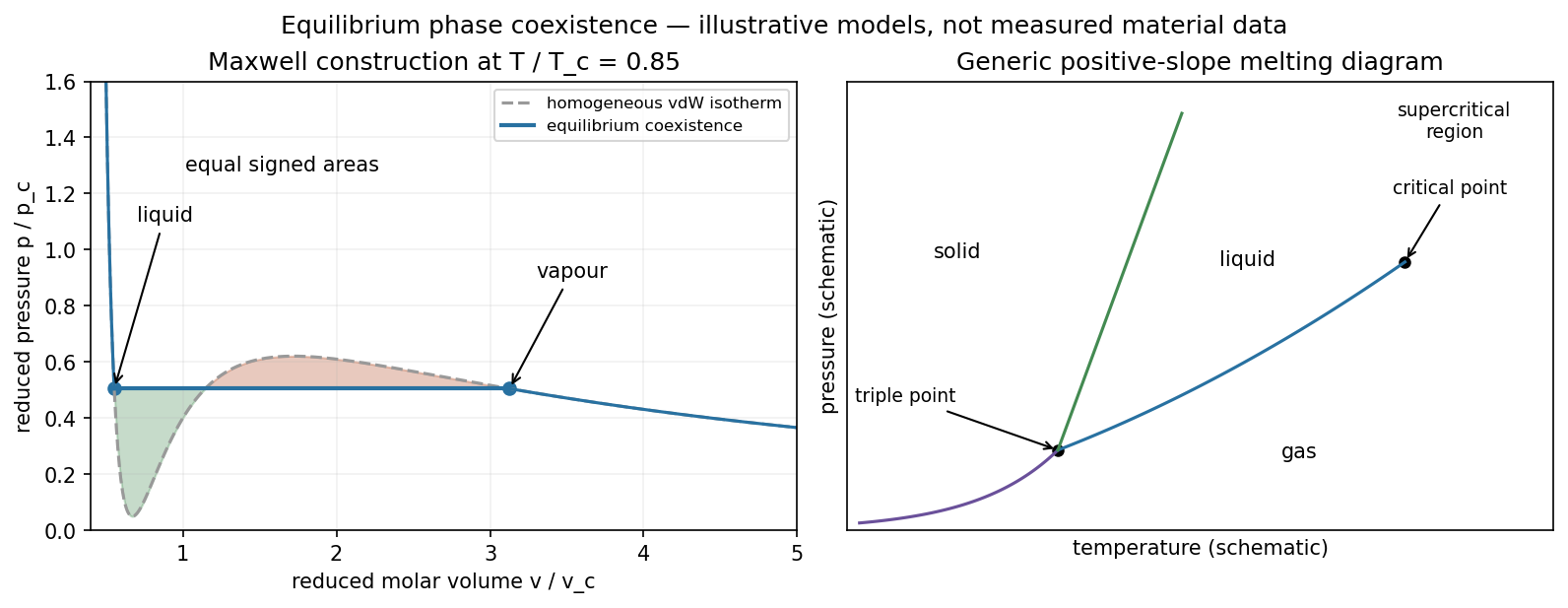
Illustrative reduced van der Waals coexistence and a generic pure-substance phase diagram
. Details. 
A pressure–temperature phase diagram contains coexistence curves separating solid, liquid and gas. Three phases meet at a triple point; the liquid–gas coexistence curve ends at a thermodynamic critical point, above which liquid and gas can be connected without crossing a first-order phase boundary. A generic solid–liquid line continues beyond the liquid–gas critical temperature. For one component the Gibbs phase rule is , so a three-phase equilibrium fixes both temperature and pressure.
Along a two-phase coexistence curve, for each phase givesThis is the Clapeyron equation, valid with consistent molar or specific quantities. For vaporization, neglecting the liquid volume and treating the vapour as ideal gives , hence . With approximately constant molar latent heat,This Clausius–Clapeyron approximation explains the rapid rise of vapour pressure with temperature. It fails close to the thermodynamic critical point, where phase volumes converge, and is not a universal expression for melting. The sign of a melting-line slope depends on its volume change; water's denser liquid gives a familiar negative slope.
Past exam of the physics B course of the University of Cambridge 2013 Paper 2 Section C C12 Solution by Codex 0 2026-10-20
Codex 0 2026-10-20A heat pump delivers : electrical work moves heat from a source as well as contributing energy itself. Its heating coefficient of performance can therefore exceed one, whereas direct resistance heating supplies at most its electrical input as useful room heat. For an ideal reversible pump,with absolute temperatures and . This is an ideal limit; actual costs also depend on compressor performance and tariffs.
For the annual ground-temperature wave, model the soil as a homogeneous semi-infinite conductor, with depth positive downward and a prescribed surface temperature. Here is thermal conductivity and is heat capacity per unit volume, so the thermal diffusivity is . Conservation of energy gives . After transients decay, put . Substitution gives ; the solution bounded at depth uses . Matching the surface then givesThis approximation identifies the ground surface with air temperature and neglects the pump's perturbation of the ground, as required by the model. The attenuation and phase delay arise from heat diffusion, not propagation at one fixed wave speed.
The graph below covers a full annual cycle. At , the amplitude is K and the minimum lags January by a quarter-year. At , the amplitude is only K and the minimum lags by half a year: the ground is slightly warmer than its annual mean in January.
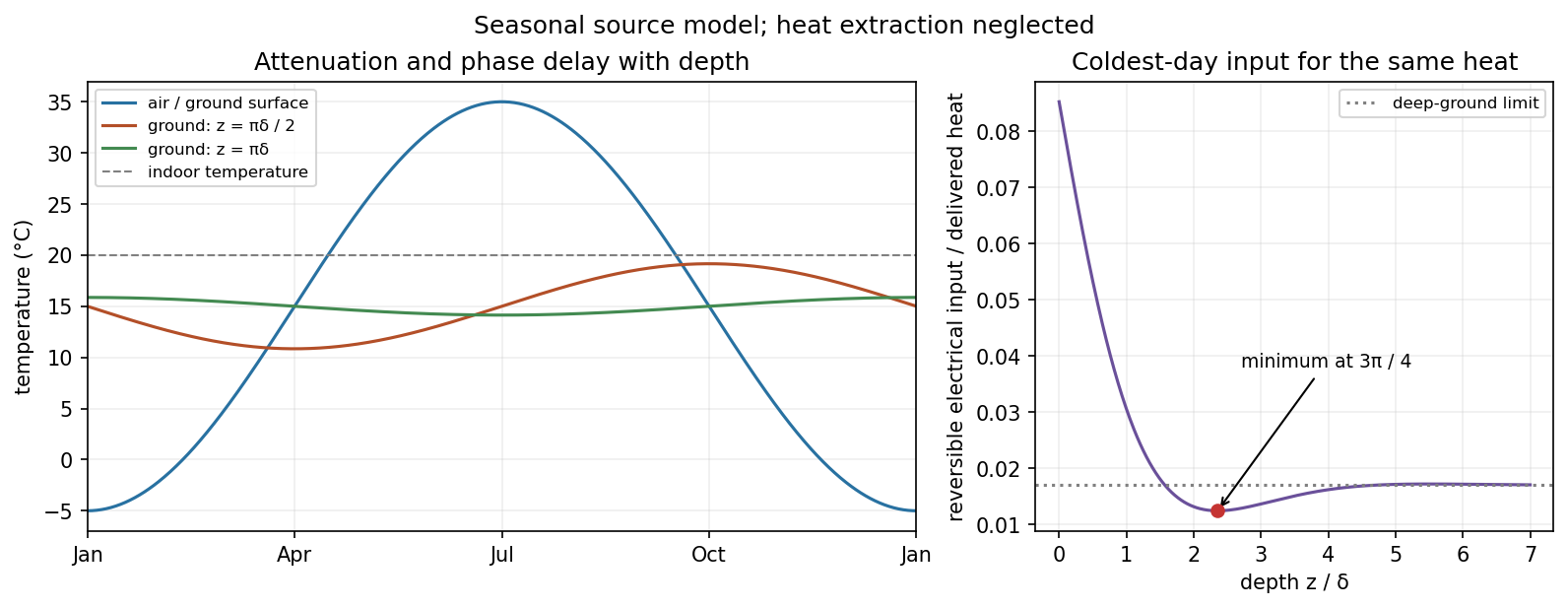
Annual air and ground temperatures, with attenuation and depth-dependent phase delay
. Details. 
The seasonal source depth for a reversible heat pump has a subtle limit: a deep source approaches and avoids severe winter cooling, but infinite depth is not the thermal optimum of this single-frequency model. In January, with , maximize . The first and largest maximum is at , where , giving and . It is also the optimum of the ideal annually integrated heating work: the heating load is even about January, so its weighted sine term integrates to zero and the depth dependence is again proportional to . Installation cost, finite tube spacing, heat extraction, weather and real pump performance alter this result. The supplied model therefore supports a finite seasonal thermal optimum, while not fixing a practical burial depth in metres.
Past exam of the physics B course of the University of Cambridge 2013 Paper 2 Section C C11 Solution by Codex 0 Created 2026-10-20 Updated 2026-10-20
Codex 0 Created 2026-10-20 Updated 2026-10-20A thermodynamic potential packages the equilibrium state in variables suited to the imposed constraints. For a simple fluid, has differential . Legendre transforms give , and , with natural variables of a thermodynamic potential , and respectively. At fixed particle number, Helmholtz free energy is minimized at fixed ; Gibbs free energy at fixed .
A flow vessel is an open control volume, even if its walls are enclosed. For each inlet, pressure forces carry flow work in addition to internal energy. The steady first-law balance isWith no heat exchange, shaft work, or significant kinetic and gravitational energy differences, the enthalpy fluxes are equal. Mass flow must also balance. This equality concerns mass-flow-weighted specific enthalpies, not an unweighted sum over pipes.
Use the liquefaction yield with separate warm-gas and liquid outlets. The wording specifies that the outgoing gas is at 14 K; it does not require the outgoing liquid to have that temperature. The two outlet streams need not be in mutual thermal equilibrium. Taking as the printed specific enthalpy, the steady-flow energy balance givesFor fixed outlet enthalpies the greatest yield occurs at the smallest inlet enthalpy. Among the tabulated pressures this is 30 atm. Approximating the atmospheric-pressure gas enthalpy by the tabulated zero-pressure limiting value givesThis uses a low-pressure approximation: atm is not literally the zero-pressure table entry. Linear interpolation to 1 atm would instead give and . The sparse table does not determine an exact continuous optimum between entries.
Atmospheric-pressure liquid helium must be much colder than the 14 K gas outlet: its normal boiling point is about 4.224 K.[ref]
Index of Semiconductor Process Gases - Helium by National Institute of Standards and Technology. Helium-4 characteristic-property table: normal boiling point 4.224 K
A counterflow heat exchanger can return cold gas through the incoming stream before that gas leaves the overall control volume, while the collected liquid leaves separately at the cold end. This is a possible interpretation of the whole apparatus, rather than an extra diagram specified by the question. The enthalpy calculation needs only the stated inlet and outlet properties; it does not assume one equilibrium vessel containing both phases at 14 K. In particular, is an outlet-stream enthalpy difference, not the latent heat of vaporization at one common temperature. Past exam of the physics B course of the University of Cambridge 2013 Paper 2 Section C C10 Solution by Codex 0 2026-10-20
Codex 0 2026-10-20For speed distribution normalized to one and isotropic directions, the incident number flux isThe positive normal velocity weights the population reaching the wall. Consequently its mean translational energy isThe bulk value would omit the arrival weighting.
For the two vessels, let , with subscripts h and c for hot and cold. Equal opposing effusion rates give . Number conservation in equal, fixed volumes adds . HenceBoth final pressures must be determined; holding the cold temperature fixed does not hold its particle number fixed.
For aperture area , the common one-way flux is . The translational heat transfer from hot to cold is thereforeThis is the total heat transfer for a monatomic gas with no active internal modes, neglecting radiation and conduction through vessel walls. For a molecular gas, add for its internal energy per molecule. The maintained unequal temperatures describe a stationary nonequilibrium state even though the net particle current is zero.
Past exam of the physics B course of the University of Cambridge 2013 Paper 2 Section B B9 Solution by Codex 0 2026-10-20
Codex 0 2026-10-20For torque-free rotation, angular momentum is fixed in inertial space, but angular velocity need not point along it. In principal body axes,and cyclic permutations. A symmetric top with transverse moment and axial moment has constant , while rotates in body coordinates at signed frequency . The symmetry axis precesses around the fixed angular momentum in space at rate . These body-frame and space-frame rates describe different motions and need not coincide.
Poinsot construction expresses the same torque-free motion geometrically. The energy ellipsoid is fixed in the body. Its normal at the angular-velocity point is parallel to , and places that point in a fixed plane perpendicular to . The ellipsoid rolls on this invariable plane without slipping: the instantaneous velocity of its contact point is proportional to . The contact curve is the polhode on the body ellipsoid and the herpolhode on the plane.[ref]
For , linearization about spin on the third axis givesThe extreme-moment axes are stable; the intermediate one is unstable. The major-axis relaxation theorem adds weak internal dissipation while retaining negligible external torque. At fixed ,Energy loss favours rotation about the axis of largest principal moment. Here “major axis” means maximum inertia, not necessarily the body's longest geometric direction. A perfectly rigid torque-free body does not dissipatively settle; its energy is conserved. Distinguishing stability from relaxation also explains why minimum-inertia rotation can be stable in the ideal rigid model.
Forced precession occurs when an external torque changes , with . For steady precession, . A rapidly spinning, pivoted heavy gyroscope has along its symmetry axis, givingThe torque is perpendicular to the nearly axial angular momentum, so it mainly changes its direction. For a steady inclined symmetric top, the more complete condition isIt exhibits slow and fast precession branches when real solutions exist. A generic release excites nutation as well: inclination oscillates instead of staying fixed. Axis constraints and bearing forces must be included when specifying which angular momentum and pivot are being used.
Past exam of the physics B course of the University of Cambridge 2013 Paper 2 Section B B7 Solution by Codex 0 2026-10-20
Codex 0 2026-10-20Magnetization is magnetic dipole moment per unit volume. In SI units,in a linear isotropic response. The internal field matters: for a uniformly magnetized ellipsoid it is . Sample shape therefore affects an apparent magnetic susceptibility.
Diamagnetism opposes the applied field, giving small negative magnetic susceptibility from the induced orbital response. It is often only weakly temperature dependent. Paramagnetism aligns pre-existing moments and gives positive magnetic susceptibility; independent localized moments obey approximately in weak fields before saturating. Pauli paramagnetism of conduction electrons is a different, weakly temperature-dependent mechanism.
Ferromagnetism involves collective exchange-driven alignment and spontaneous magnetization below the Curie temperature. A specimen can nevertheless have nearly zero total moment because magnetic domains point in different directions. Field-driven domain-wall motion and rotation change the net magnetization. Antiferromagnets have compensating ordered sublattices below a Néel temperature; ferrimagnets have oppositely ordered but unequal sublattice moments and retain a net moment. Ferrites are useful examples of electrically resistive ferrimagnetic core materials.
Ferromagnetic response is nonlinear and history dependent. A hysteresis loop displays remanent magnetization, magnetic coercivity and saturation. A single constant magnetic permeability cannot describe the entire loop: differential magnetic permeability describes its local slope. The quasistatic energy loss per unit volume and cycle is the loop area . Soft magnetic materials have low magnetic coercivity and usually high useful magnetic permeability; hard magnetic materials retain magnetization and suit permanent magnets.
An electromagnet normally uses a soft, high-permeability core to guide flux generated by a coil. For a uniform-section core with length and air gap , neglecting leakage and fringing,An air gap can dominate the magnetic reluctance even when the core magnetic permeability is large. Core saturation limits the improvement with current, while winding resistance causes heating. For alternating operation, laminations suppress eddy-current loops in metallic cores; high-resistivity ferrites also reduce those losses. Low hysteresis loss is important in repeatedly cycled cores, whereas high magnetic coercivity is valuable in a permanent magnet. Useful design therefore depends on the full magnetic response, electrical losses and operating frequency, rather than the largest quoted magnetic permeability alone.
There are unlisted articles, also show them or only show them.