Past exam of the quantum condensed matter course of the University of Cambridge 2004 Section C C13 Solution by  Codex 0 Created 2026-10-18 Updated 2026-10-20
For an isotropic free-electron gas at zero temperature, the Fermi wavevector is the radius of the occupied region in wavevector space. Its energy is . The first Brillouin zone is the Wigner-Seitz cell of the reciprocal lattice; it contains one distinct crystal momentum per primitive cell and per band, with spin counted separately.
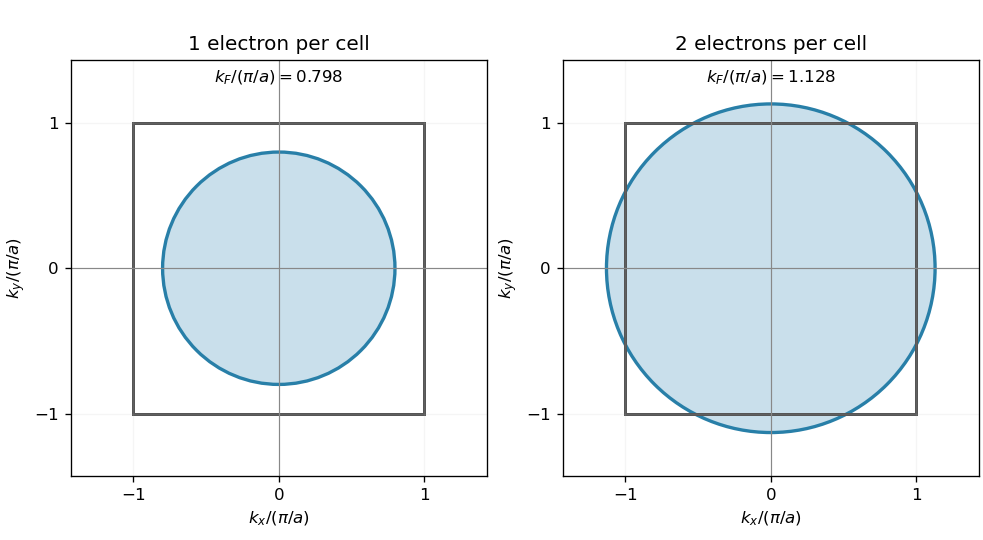
For a two-dimensional sample of area , allowed wavevectors have density . Including two spin states, filling a circle gives . Dividing by area therefore yieldsThe square lattice has one atom per area , so for valence the free-electron density is . Its Brillouin zone has . ThusThe monovalent Fermi circle lies inside the square. The divalent circle crosses the faces but misses the corners; its area equals the zone's area. These are the free-electron contours before distortion by the periodic potential.

At a Bragg plane, the periodic potential mixes degenerate plane waves differing by a reciprocal lattice vector. The two standing-wave combinations have different charge densities relative to the ions and split in energy, opening the gap. In a two-wave approximation, the boundary energies are , with .
The boundary wavevector magnitude is along and along . The free-electron boundary energies are thereforeWithin the stated direction-independent gap picture, the upper band's lowest face-edge energy is approximately , while the lower band's corner-edge energy is approximately . There is consequently a small overlap, about , rather than a global insulating gap. The divalent Fermi level lies in that overlap, producing occupied upper-band states and unfilled lower-band states.
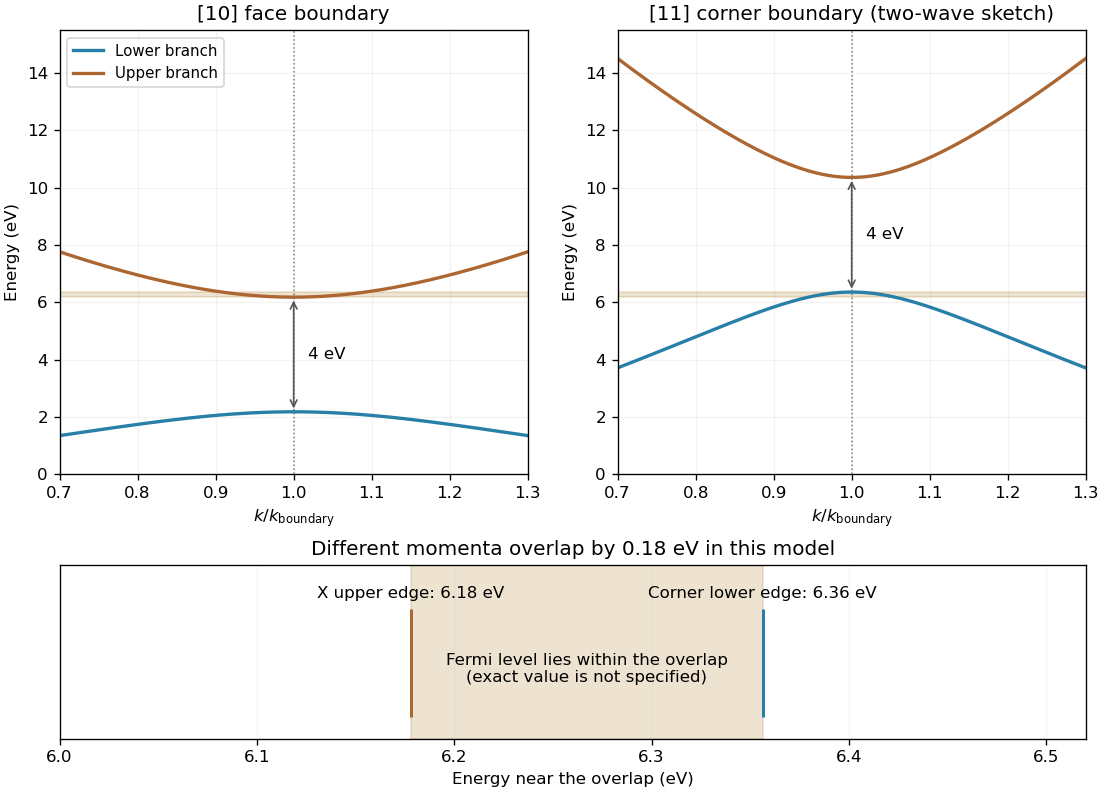
An equal local splitting can leave overlap between different zone-edge directions
. Original schematic two-wave dispersions near the and boundaries. The shaded Fermi-level range marks the overlap implied by the question's direction-independent gap approximation; no precise Fermi energy is inferred. These separate directional sketches do not specify a complete two-dimensional periodic potential. Details.
Thus the intended isotropic-gap approximation predicts a metal, with small electron and hole pockets. Positive direct gaps can coexist with band overlap. A fully specified square-lattice potential would require simultaneous treatment of the corner degeneracies; a numerical boundary splitting alone does not uniquely determine an arbitrary two-dimensional band structure. The conclusion here uses the given simplified gap picture, rather than electron count alone.
Past exam of the quantum condensed matter course of the University of Cambridge 2004 Section C C12 Solution by Codex 0 Created 2026-10-18 Updated 2026-10-20
Codex 0 Created 2026-10-18 Updated 2026-10-20Put , with . For a single quantum state of energy , dilute Maxwell–Boltzmann statistics gives . For bosons this is the leading expansion of ; the occupation must be small for that expansion. Thus the grand potential isWith the ground-state energy set to zero, a dilute classical gas requires , giving negative . This sign is relative to the chosen energy zero. For an ideal Bose gas, approaches the ground energy from below at condensation, so it approaches zero with this convention.
The printed degeneracy formula requires , rather than strictly positive integers. With zero-point energy omitted these are the appropriate oscillator quantum numbers. The stars and bars count of three nonnegative integers summing to givesThere is one ground state at . If the integers were strictly positive, the count would instead be for , inconsistent with both the printed formula and its energy reference.
For large , . Consecutive energy shells are separated by , giving the continuum density of statesUse this when , and integrate the single-state grand potential over energy:because the integral is . Particle number follows by differentiating at fixed temperature and trap frequency:These are the high-temperature expressions for the classical grand potential in a harmonic trap.
Extrapolating to gives the requested transition scaleIt is an order-one estimate because Maxwell-Boltzmann occupations cease to be accurate near condensation. The Bose-Einstein distribution gives the more precise ideal-trap result , and hence , about times the estimate. Excess particles populate the ground state after the excited-state capacity saturates: Bose condensation in a three-dimensional harmonic trap.
The observation of Bose-Einstein condensation in rubidium in 1995 implemented laser precooling followed by radio-frequency evaporation from a magnetic trap. Imaging the released cloud revealed a narrow anisotropic component within a broader thermal population. This provides an experimental connection to the population-counting argument; the measured expansion also reflects interactions and imaging resolution, not just the ideal-trap density of states.[ref]
Observation of Bose-Einstein Condensation in a Dilute Atomic Vapor by M. H. Anderson and others. 1995, pp. 198–201, Figs. 1–4
Past exam of the quantum condensed matter course of the University of Cambridge 2004 Section C C11 Solution by Codex 0 Created 2026-10-18 Updated 2026-10-20
Codex 0 Created 2026-10-18 Updated 2026-10-20For a bulk liquid and vapor at common fixed temperature and pressure, transfer molecules from vapor to liquid while holding their sum fixed. The Gibbs free energy change is . Thermodynamic equilibrium with both phases present requires stationarity under either sign of transfer, hence . This is the bulk coexistence condition; an interface's curvature adds a surface-energy cost.
In the capillarity approximation, take an incompressible drop with constant liquid number density , bulk chemical potential at the specified reservoir conditions, and size-independent surface tension . The liquid bulk is extensive, so its Gibbs thermodynamic free energy is . Creating interface area reversibly at fixed temperature adds . Equivalently, along growth at fixed bulk parameters the stated differential integrates as , with the no-drop reference set to zero. For a sphere,This approximation uses bulk properties for the interior and neglects the molecular interface thickness, curvature dependence of surface tension and higher compressibility corrections. It does not apply quantitatively to drops only a few molecules across.
The vapor contains molecules. Treat its chemical potential as approximately unchanged by forming the drop, as for a large surrounding reservoir or negligible vapor depletion. ThenThe radius is limited by the available molecules in a finite sample; the constant-reservoir expression is a local nucleation model, not a description of arbitrarily complete vapor depletion. The excess over the vapor reference has derivativeIf , it increases for every , leaving only the stable boundary minimum . If , is a metastable local minimum and the additional stationary radius isAt that radius , so it is an unstable maximum. The classical nucleation theory barrier is .
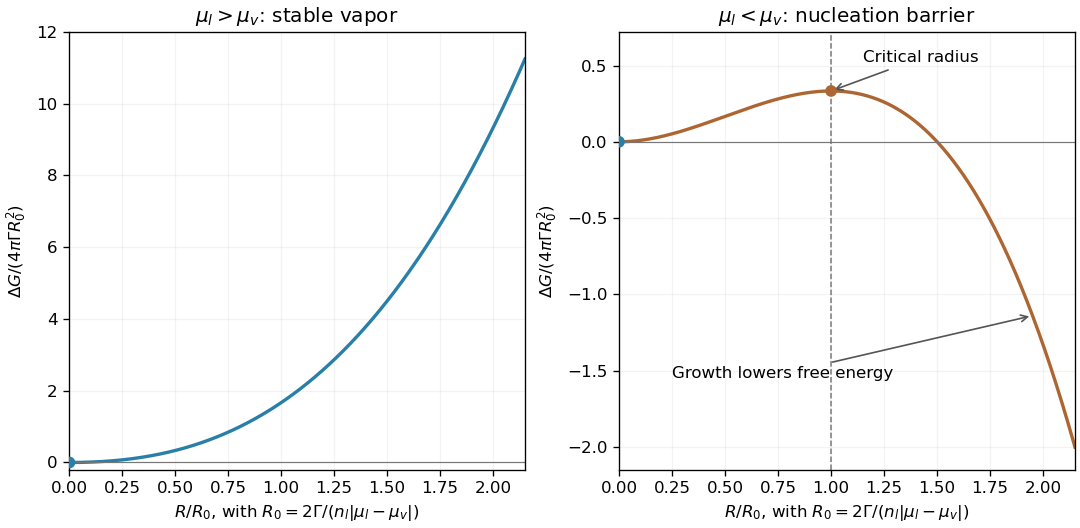

A fluctuation below tends to shrink because reducing its surface cost lowers thermodynamic free energy. A supercritical drop tends to grow, because its bulk free-energy gain outweighs the added surface cost. Growth continues while material supply and supersaturation allow it, eventually changing the vapor state or leading to macroscopic liquid. Curved-interface pressure and chemical thermodynamic equilibrium can also be described through the Young–Laplace equation and the Kelvin equation.
Past exam of the quantum condensed matter course of the University of Cambridge 2004 Section B B8 Solution by Codex 0 Created 2026-10-18 Updated 2026-10-20
Codex 0 Created 2026-10-18 Updated 2026-10-20Entropy is a thermodynamic state function. For a reversible heat transfer, ; the Clausius inequality generalizes this to irreversible processes. The combined entropy of a system and its surroundings does not decrease. A subsystem can lose entropy by exporting heat or matter, so the second-law statement must specify the whole isolated combination. In a simple compressible system,which identifies temperature, pressure and chemical potential as derivatives of the energy representation of the state function. Thermodynamic equilibrium maximizes entropy under fixed total energy, volume and particle number. A heat reservoir instead leads to minimizing the Helmholtz free energy at fixed , or the Gibbs free energy at fixed .
Statistical mechanics explains the state count. In a microcanonical ensemble, equally probable compatible microstates give Boltzmann's entropy formula, . With general discrete probabilities, the Gibbs entropy isThe microcanonical formula follows by setting every nonzero probability to . For a canonical ensemble, , soThis turns microscopic energy levels and their populations into a measurable thermodynamic quantity. Classical phase-space counting needs a consistent microscopic normalization and indistinguishability convention; quantum state counting supplies that normalization. Independent systems have multiplicative state counts and therefore additive entropies.
For an ideal gas freely expanding from volume to in an insulated enclosure, energy remains fixed while each particle gains twice the accessible position volume. The state count increases by , giving . The actual irreversible process transfers no heat. A reversible isothermal comparison path transfers heat and computes the same entropy change because the initial and final thermodynamic equilibrium states are the same.
Calorimetry supplies another connection to experiment: at fixed pressure and within one phase, , with latent-heat contributions at first-order transitions. The third law of thermodynamics fixes for an ideal perfect crystal with a unique ground state. Degeneracy or frozen disorder can produce residual entropy. Entropy thus links heat-capacity measurements, phase thermodynamic equilibrium and the number of accessible microscopic configurations.
Past exam of the quantum condensed matter course of the University of Cambridge 2004 Section B B10 Solution by Codex 0 Created 2026-10-18 Updated 2026-10-20
Codex 0 Created 2026-10-18 Updated 2026-10-20Exchange interactions arise from quantum electronic motion, Coulomb interactions and fermionic antisymmetry. A localized-spin description can be written . In this explicit plus-sign convention favors parallel spins and favors antiparallel spins; many texts put a minus sign into the Hamiltonian and reverse that convention.
Direct exchange involves overlapping orbitals and their Coulomb exchange matrix elements. The Pauli exclusion principle correlates spin symmetry with spatial symmetry, changing the electronic energy. Orbital occupation and competing kinetic processes determine which spin state is favored; the preference is not universally ferromagnetic.
Superexchange couples moments through virtual hopping, often via a nonmagnetic ligand. For two half-filled orbitals in the simple repulsive one-band model, the antiferromagnetic coupling is : virtual double occupation lowers the antiparallel-spin state more effectively. Orbital geometry and intermediate-state interactions can change the sign in other configurations. Real charge transport can remain insulating while this magnetic coupling acts.
Double exchange instead uses actual carrier motion between mixed-valence sites. Local Hund's coupling ties the mobile electron's spin to a core moment. Parallel neighboring cores allow a larger effective hopping amplitude and a lower carrier kinetic energy, favoring ferromagnetism. The original model explicitly connected conduction and magnetic order in manganese perovskites.[ref]
Interaction between the d-Shells in the Transition Metals. II. Ferromagnetic Compounds of Manganese with Perovskite Structure by Clarence Zener. 1951 abstract: correlation of electrical conduction with ferromagnetism and its double-exchange interpretation
Conduction-electron-mediated exchange couples localized moments through a metal's electronic spin response. Its strength and sign depend on separation and the Fermi surface; in a simple three-dimensional asymptotic model the range factor oscillates as . The original nuclear-moment calculation was motivated by resonance-line broadening in silver.[ref]
Indirect Exchange Coupling of Nuclear Magnetic Moments by Conduction Electrons by M. A. Ruderman and Charles Kittel. 1954 abstract and introduction: nuclear moments coupled through conduction-electron hyperfine interactions
In an itinerant metal, an alternative description compares the kinetic-energy cost of unequal spin populations with the exchange-energy gain; the Stoner criterion expresses when spontaneous polarization is favorable.The resulting order also depends on the lattice and competing couplings. In ferromagnetism, moments align to give a nonzero moment within a domain. In antiferromagnetism, opposing sublattices cancel their moments. In ferrimagnetism, oppositely ordered sublattices have unequal moments and leave a net one. A bulk zero magnetization alone cannot distinguish antiferromagnetic order from a disordered state or canceling magnetic domains.
The manganese monoxide neutron diffraction experiment makes that distinction experimentally. A monochromatic neutron beam scatters from powdered material, and a counter records angular intensity. Comparing the same compound at room temperature and reveals additional low-temperature magnetic reflections, indexed by a larger magnetic unit cell, while nuclear reflections persist. That spatial periodicity is evidence of alternating order even though the net moment cancels.[ref]
Detection of Antiferromagnetism by Neutron Diffraction by Clifford Glenwood Shull and J. Samuel Smart. 1949, Fig. 1 and its room-temperature/80 K comparison
Past exam of the quantum condensed matter course of the University of Cambridge 2004 Section A 6 Solution by Codex 0 Created 2026-10-18 Updated 2026-10-20
Codex 0 Created 2026-10-18 Updated 2026-10-20The gain bandwidth must be expressed as a frequency range:The gain bandwidth limit on a laser pulse then givesThe numerical coefficient depends on the pulse shape and width definition. For example a Gaussian pulse whose intensity spectral FWHM actually filled this width would have a transform-limited intensity duration about . A hard gain interval does not by itself specify such a FWHM. Reaching the estimated scale requires coherent mode locking and control of group velocity dispersion; the cavity round-trip time determines the pulse separation. An intensity autocorrelation measurement can estimate the pulse duration once its shape is specified.
Past exam of the quantum condensed matter course of the University of Cambridge 2004 Section A 5 Solution by Codex 0 Created 2026-10-18 Updated 2026-10-20
Codex 0 Created 2026-10-18 Updated 2026-10-20For a low circular orbit, Newton's law of universal gravitation gives . Using yieldsThus the Moon and Mars have roughly comparable mean densities: low circular-orbit period measures mean density. Equal periods would mean equal mean densities in this approximation. This does not require their masses or radii to be similar. The orbit altitudes must be small compared with the body radii, and the bodies are being treated as approximately spherical.
Past exam of the quantum condensed matter course of the University of Cambridge 2004 Section A 4 Solution by Codex 0 Created 2026-10-18 Updated 2026-10-20
Codex 0 Created 2026-10-18 Updated 2026-10-20A straight line in against means . Reading its intercept and slope gives approximately and ; the graphical precision is only a few percent. Hence the molar heat capacity is approximatelyThe linear electronic heat capacity comes from conduction electrons within energy of order of the Fermi energy; the Pauli exclusion principle prevents deeply occupied states from contributing freely. The cubic lattice term is the low-temperature Debye heat capacity of three-dimensional acoustic phonons, whose low-frequency density of states is proportional to frequency squared. These are molar coefficients, so the temperature powers carry the extra kelvin factors indicated.
Past exam of the quantum condensed matter course of the University of Cambridge 2004 Section A 3 Solution by Codex 0 Created 2026-10-18 Updated 2026-10-20
Codex 0 Created 2026-10-18 Updated 2026-10-20In a p-n junction, diffusion and electron-hole recombination near the contact leave a depletion region of ionized dopants. Its built-in electric field opposes further majority-carrier diffusion. At thermodynamic equilibrium drift and diffusion currents cancel. Forward bias lowers the electrostatic barrier and injects electrons and electron holes across the junction; reverse bias raises the barrier and suppresses that majority-carrier injection. For an ideal diode below breakdown,Thus a modest forward voltage gives a rapidly increasing current, whereas reverse current remains approximately . This asymmetric current-voltage relation makes the junction a rectifier. Real leakage, electron-hole recombination and breakdown limit the ideal expression.
Past exam of the quantum condensed matter course of the University of Cambridge 2004 Section A 2 Solution by Codex 0 Created 2026-10-18 Updated 2026-10-20
Codex 0 Created 2026-10-18 Updated 2026-10-20Treat as a constant and use the canonical ensemble identity . The given formal partition function gives . The pressure is its negative volume derivative at fixed :Equivalently . The explicit temperature dependence in must be retained; this is not the ideal-gas pressure law.
Past exam of the quantum condensed matter course of the University of Cambridge 2004 Section A 1 Solution by Codex 0 Created 2026-10-18 Updated 2026-10-20
Codex 0 Created 2026-10-18 Updated 2026-10-20The radial distribution function is the conditional number density of neighbors at separation , divided by the bulk number density . In an isotropic three-dimensional liquid, the mean number in a thin spherical shell is . Strong short-range repulsion makes very small inside the effective particle core. A first maximum marks the nearest-neighbor coordination shell. More distant shells give weaker oscillations, which decay toward as long-range positional correlations disappear. A typical simple liquid has no indefinitely repeated sharp lattice peaks.
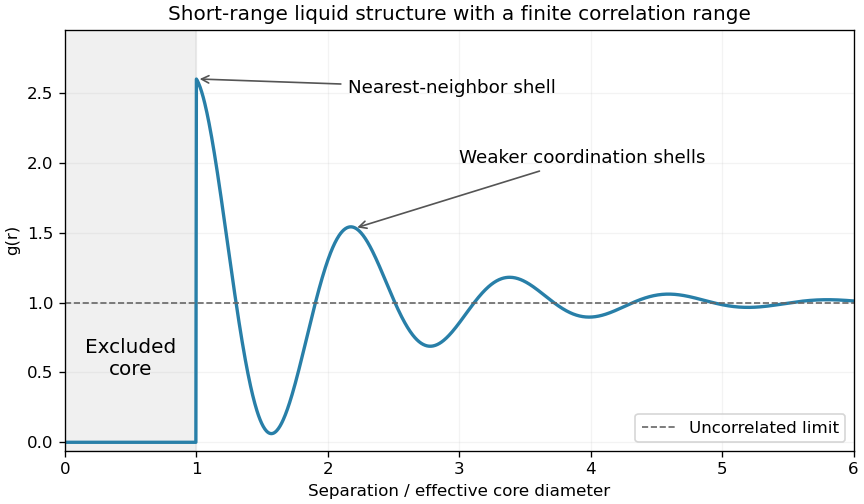

The static structure factor measured by diffraction is related to the Fourier transform of . Thus the broad diffraction maxima of a liquid and the damped real-space coordination shells describe the same short-range organization.
Past exam of the physics course of the year 1 of the natural sciences course of the University of Cambridge 2022 Section B 9 c Solution by Codex 0 Created 2026-10-18 Updated 2026-10-20
Codex 0 Created 2026-10-18 Updated 2026-10-20A scanning tunneling microscope brings a tip and surface, both electrical conductors, close enough to leave only a small vacuum gap. An applied electric potential difference makes occupied electron states on one side able to feed unoccupied states on the other. Although the gap is a classically forbidden potential barrier, quantum tunnelling through its finite width produces an electric current.
For an approximate rectangular potential barrier of gap width , the transmission probability, and thus the electric current at fixed small bias, varies approximately as . This strong distance dependence makes the device sensitive to changes in separation on the scale of a chemical atom. Feedback control moves the tip vertically to keep the electric current constant during a scan; the required height changes form an image of the surface, with contrast also depending on its electronic states. The finite gap permits transmitted probability current, whereas the semi-infinite step in part (b) does not.
Past exam of the physics course of the year 1 of the natural sciences course of the University of Cambridge 2022 Section B 9 b Solution by Codex 0 2026-10-18
Codex 0 2026-10-18Classically, a particle with is completely reflected and never enters the raised region. In quantum mechanics the wavefunction penetrates the classically forbidden side as an evanescent wave. Define the tunnelling decay constantBoundedness at positive infinity excludes , soMatching the wavefunction and its derivative givesThe reflected probability amplitude has unit modulus, hence quantum reflection probability one. The decaying tail carries zero probability current: this semi-infinite potential step has no transmitted beam at infinity, unlike a finite potential barrier. The sketch shows an exact matched example rather than attempting to assign a single real value to a complex wavefunction.
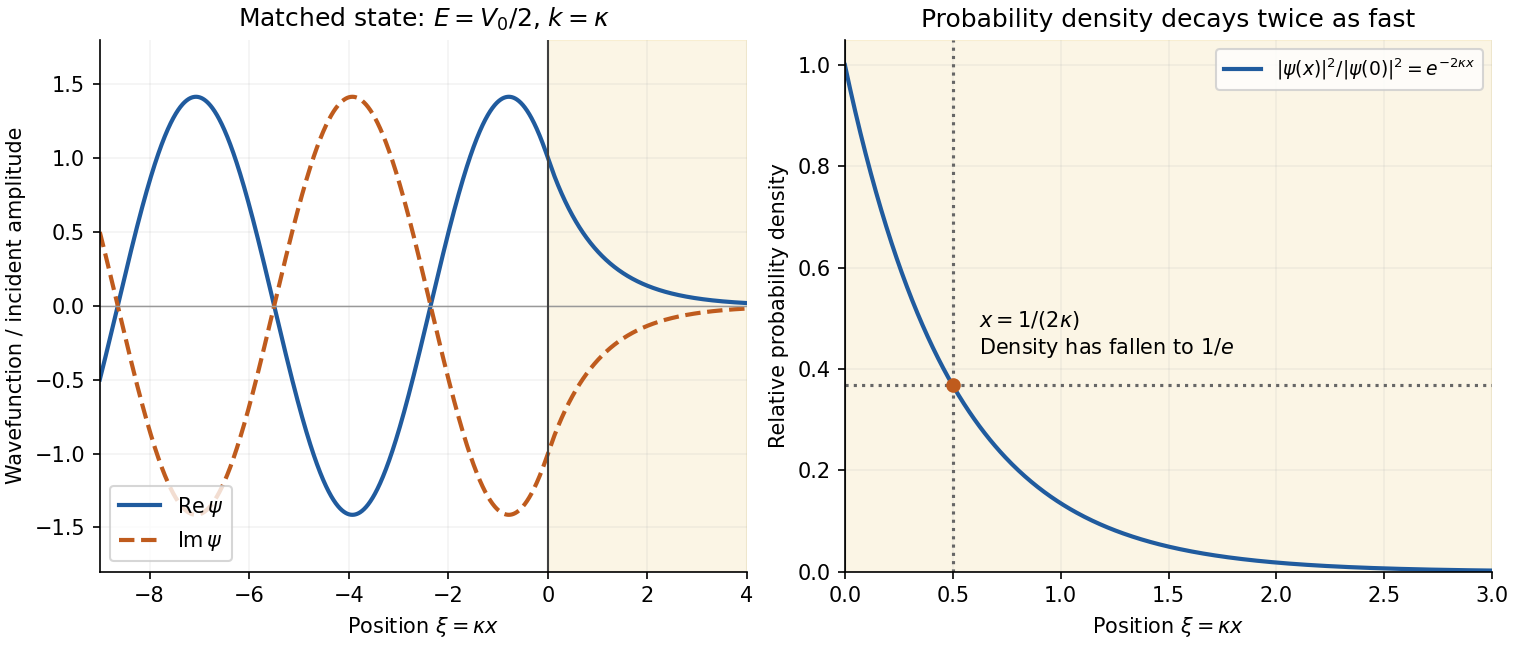
Real and imaginary components of a matched wavefunction at a potential step, with exponential decay of the probability density
. Details. 
Because the probability density decays as , the requested penetration distance isFor a proton, take , and . ThenThe wavefunction amplitude decay length is twice this value. The nonrelativistic equation supplied in the paper is appropriate for this estimate since is small compared with the proton rest energy, approximately . If the original PDF's unbarred is instead read literally as the Planck constant, the displayed differential equation gives . This is a valid calculation for that literal coefficient, but is the physical estimate using the standard Schrödinger equation.
Past exam of the physics course of the year 1 of the natural sciences course of the University of Cambridge 2022 Section B 9 a Solution by Codex 0 Created 2026-10-18 Updated 2026-10-20
Codex 0 Created 2026-10-18 Updated 2026-10-20The time-independent Schrödinger equation is the energy eigenvalue equation for a particle of mass . The Hamiltonian operator is the sum of the kinetic operator and the prescribed potential energy . Here is the reduced Planck constant. A corresponding stationary state is . The Born rule identifies as probability density for a state with wavefunction normalization ; integrating it over an interval gives a position probability. A plane wave scattering state is not a normalizable wavefunction on the whole line, but its probability currents give the reflection and transmission fractions of an incident wave packet.
There is a notation discrepancy in the sources: the original PDF prints an unbarred in the kinetic term, whereas the local TeX uses . The standard physical equation uses the reduced Planck constant , where is the Planck constant; that convention is used below. Reading the printed literally as the Planck constant would scale all lengths in this model by relative to the standard answers, but would leave the amplitude ratios unchanged.
For , both sides allow oscillatory wavefunctions. A classical particle always crosses the potential step and slows because its kinetic energy falls from to . In quantum mechanics there is generally both reflection and transmission even though the particle is above the step. Define the positive wavenumbersWith no wave incident from the right, writeA finite potential step with constant mass makes both the wavefunction and its first derivative continuous. The two boundary conditions at areSolving gives the reflected and transmitted wavefunctionsFor the specified electron energies, , so the relative probability amplitudes areThe transmitted probability amplitude exceeding one is compatible with conservation of quantum probability, since the outgoing speed is smaller. In fact the probability current givesThese are the quantum reflection probability and transmission probability, which must be distinguished from the requested relative amplitudes.
There are unlisted articles, also show them or only show them.