Postglacial rebound is uplift following removal of an ice load. It reflects viscous flow in the mantle and elastic or viscoelastic deformation of the lithosphere.
Glaciology studies glaciers, ice sheets, snow, and their interaction with climate, oceans, and the solid Earth.
A planetary ice shell is a solid water-rich layer overlying an ocean or deeper planetary interior. Its thickness can be controlled by thermal conduction, basal heat flux, surface radiation, and solid-state mantle convection.
The Solid Earth comprises a planet's solid inner core, liquid outer core, viscously deforming mantle, and mechanically stronger crust and lithosphere.
Geometric group theory studies finitely generated groups through their actions on metric spaces and through the large-scale geometry of spaces such as their Cayley graphs.
Knot theory studies closed curves in three-dimensional Euclidean space that cannot intersect themselves, and asks which can be deformed into one another without cutting or passing one strand through another. Its basic object is a knot: a smooth embedding of a circle, considered up to ambient isotopy. Several disjoint knots form a link. More generally, knot theory studies such embeddings in other manifolds and in higher dimensions.
The central surprise is that a flexible circle can carry permanent information about how it sits in space. A trefoil knot and an unknot each consist of just one circle, but no ambient isotopy turns one into the other. A knot diagram translates this spatial question into a finite drawing; Reidemeister moves describe the changes of drawing that preserve the knot. Knot invariants translate it into computations: unequal Alexander polynomials of a knot, Jones polynomials, or knot groups certify different knots. Equal values of a particular knot invariant generally leave the question open; even an isomorphism of knot groups alone is not a complete classification.
An early foundation for working with knot diagrams is Kurt Reidemeister's 1927 paper Elementare Begründung der Knotentheorie, published in volume 5 of Abhandlungen aus dem Mathematischen Seminar der Universität Hamburg, pages 24–32.[ref] Marc Lackenby's authored notes Elementary knot theory, Section 2.4, explain the Reidemeister move theorem and its role in searching for a certificate that two knot diagrams represent the same knot.[ref]
Hyperbolic geometry studies spaces of constant negative curvature.
Topology studies topological spaces through open sets and continuous maps. Its central equivalence is a homeomorphism: a bijection that preserves continuity in both directions. This lets us distinguish spaces by connectedness or compactness even when numerical metric values are irrelevant. The open interval and the real line have the same topology in this sense, although only the former is a bounded set with its usual metric.
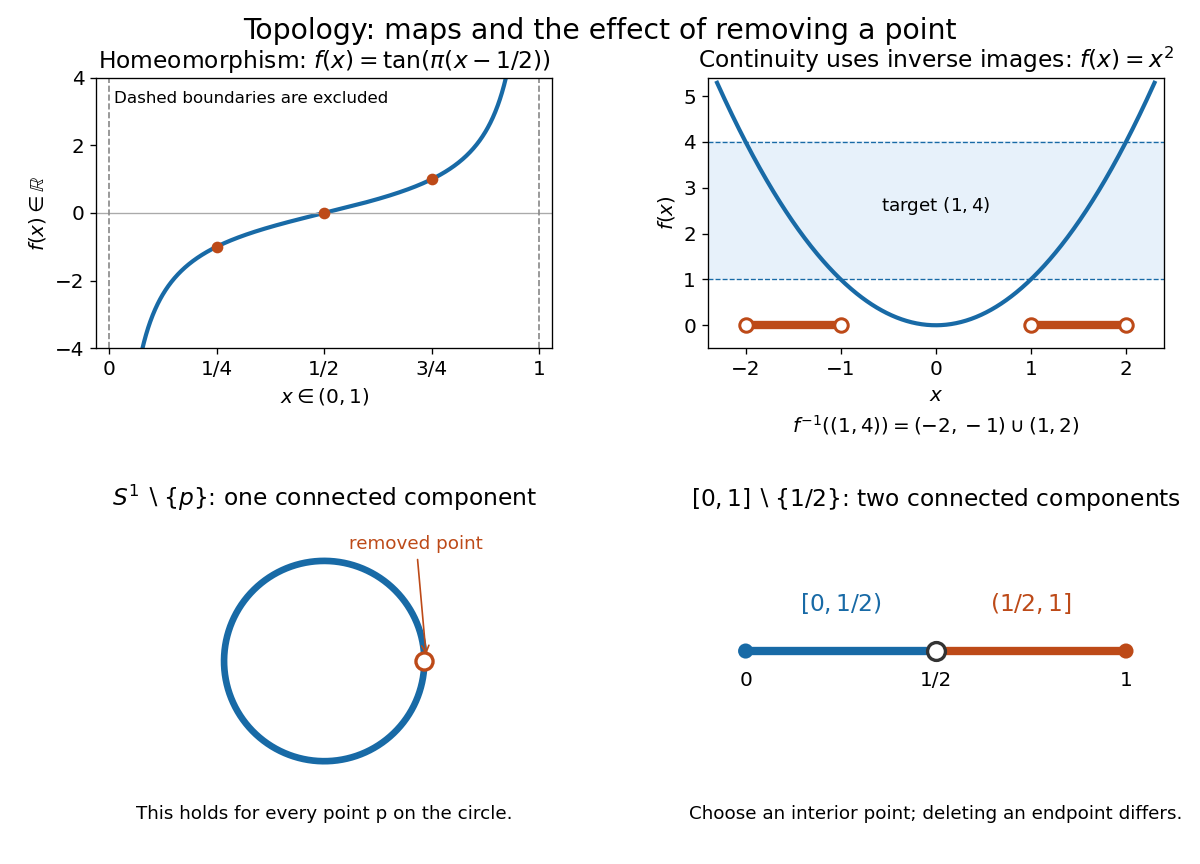
The upper panels show an explicit homeomorphism and the inverse image test for a continuous map. The lower panels exhibit an obstruction to a homeomorphism: removing any point from a circle leaves a connected space, whereas removing an interior point from a closed interval gives two connected components.
Homotopy is a different notion: it varies a continuous map continuously with a parameter and may collapse points. For example, contracts to zero. Thus this closed interval and a singleton have the same homotopy type, but there is no homeomorphism between them because there is no bijection. Homotopy equivalence need not preserve compactness. [ref]
The abstract viewpoint already appears explicitly in Tietze's 1923 paper: he describes topology as the study of properties invariant under invertible continuous maps with continuous inverses, and discusses axioms for neighbourhoods, citing Hausdorff's 1914 book, page 213. [ref]
https://gdz.sub.uni-goettingen.de/fulltext/PPN235181684_0088/00000294?_format=xml. Tietze, Beiträge zur allgemeinen Topologie I, page 290
A differential form is a smooth field of alternating multilinear maps that can be integrated over an appropriately oriented manifold of matching dimension. A one-form measures a directed displacement; a two-form measures an oriented area element. The point is to express what is being accumulated along a curve or over a surface without tying the answer to one set of coordinates. This makes line integrals, surface integrals, and the integral theorems of vector calculus parts of one construction.
For a concrete one-form, take in the plane. Travel from to along the bottom and then the right edge of the unit square. The horizontal leg contributes zero because ; the vertical leg has and contributes . Taking the left and then the top edge instead gives zero: the vertical leg has , and the horizontal leg again has . The two paths have the same endpoints but different integrals.
Now replace with the exact differential . Both paths give , because integrating an exact differential along a curve gives the endpoint difference of its potential. Here that difference is . This is the fundamental theorem of calculus applied to a function along a parametric curve, and is the basic reason conservative vector fields have path-independent work.
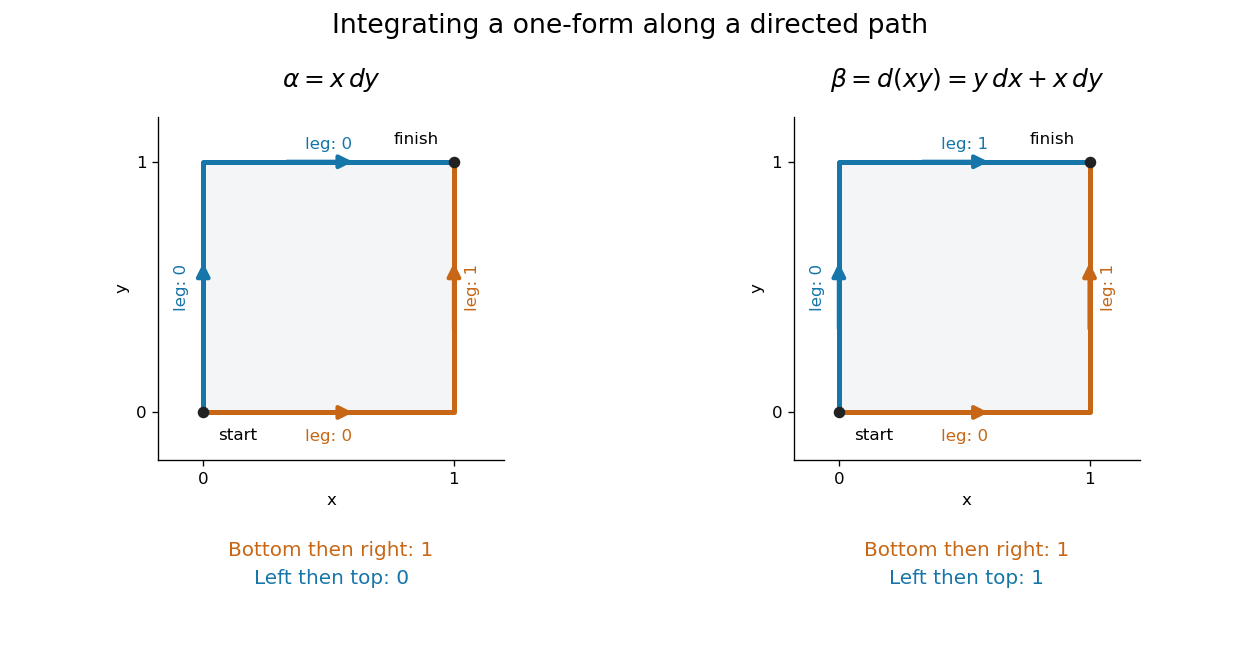
Two routes between the same endpoints distinguish a path-dependent one-form from an exact differential
. Details. The exterior derivative records the local obstruction in the first example: . The Generalized Stokes theorem turns the difference between the two path integrals into the integral of this two-form over the square, whose oriented area is . Interior edges cancel when adjoining pieces are added; only the outer boundary survives. That cancellation connects a local calculation with a global measurement.
More precisely, a degree- differential form assigns to each point a multilinear scalar-valued function of tangent vectors at . Interchanging two arguments changes its sign. A one-form is therefore a covector field, while a two-form vanishes on a pair of parallel vectors. Degree zero simply means a smooth function. The space is a vector space; the wedge product of differential forms combines degrees, and the exterior derivative raises degree by one.
The usefulness goes beyond bookkeeping. Pullbacks of a differential form supply the right transformation law automatically under a coordinate change. The Generalized Stokes theorem unifies the fundamental theorem of calculus, Green theorem, Stokes theorem, and divergence theorem. Meanwhile, the distinction between closed differential forms and exact differential forms detects holes through de Rham cohomology. Reyer Sjamaar develops these connections in sections 5.4 and 9.3 of his university notes. [ref].
Euclidean geometry describes flat Euclidean space using lengths, angles, and rigid motions. A coordinate realization uses points , Euclidean distanceand angles determined by the dot product. The coordinate axes are a convenience: translations and rotations change coordinates while preserving these measurements. This makes Euclidean geometry useful for comparing figures and converting measurements along different directions into a single distance.
In the Euclidean plane, through a point outside a line there is exactly one parallel line. This is a standard equivalent formulation of the parallel postulate. Euclid's fifth postulate in the Elements instead describes when two lines meet using the interior angles made by a crossing line.[ref] The assumption has consequences we often take for granted: a triangle's interior angles sum to , and similar triangles can differ in size while keeping their angles. Comparing with spherical geometry reveals that these are properties of a particular geometry.
As a computed example, the diagonal from to in a rectangle has length . The Pythagorean theorem explains why perpendicular contributions add as squares. If the directions cease to meet at a right angle, the law of cosines supplies the missing angle-dependent term. The beauty is that a single distance formula unites geometric constructions, coordinate calculations, and orthogonality in linear algebra.
Make the assumptions visible: in a Cartesian coordinate system with orthogonal axes and the same length unit on each axis, take , and . The vectors and have dot product zero, establishing a right angle at before using the Pythagorean theorem. A sketch that merely looks like a right triangle supplies no such guarantee. Likewise, an image stretched horizontally and vertically by different amounts can distort both lengths and angles; a displayed shape and the assumptions defining it must be kept separate.
For a less origin-dependent measurement, take and . Their displacement vector is , so their Euclidean distance is again . Its Euclidean norm records the direct separation, whereas travelling first horizontally and then vertically covers length . This connects measuring a diagonal to locating two positions from a Cartesian coordinate system. A translation changes where the positions are recorded without changing their separation; a rotation changes the component values without changing the Euclidean norm.
Fractal geometry studies fractals. Fractal geometry studies recursively structured sets and spaces, often with noninteger scaling dimension.
Trigonometric functions turn an angle into a coordinate or a ratio of lengths. Start at on the unit circle and rotate counterclockwise through radians: the resulting point isThe cosine records horizontal position and the sine records vertical position. This definition continues around the whole circle, including negative angles, so the signs encode direction rather than requiring a separate rule for each right triangle.
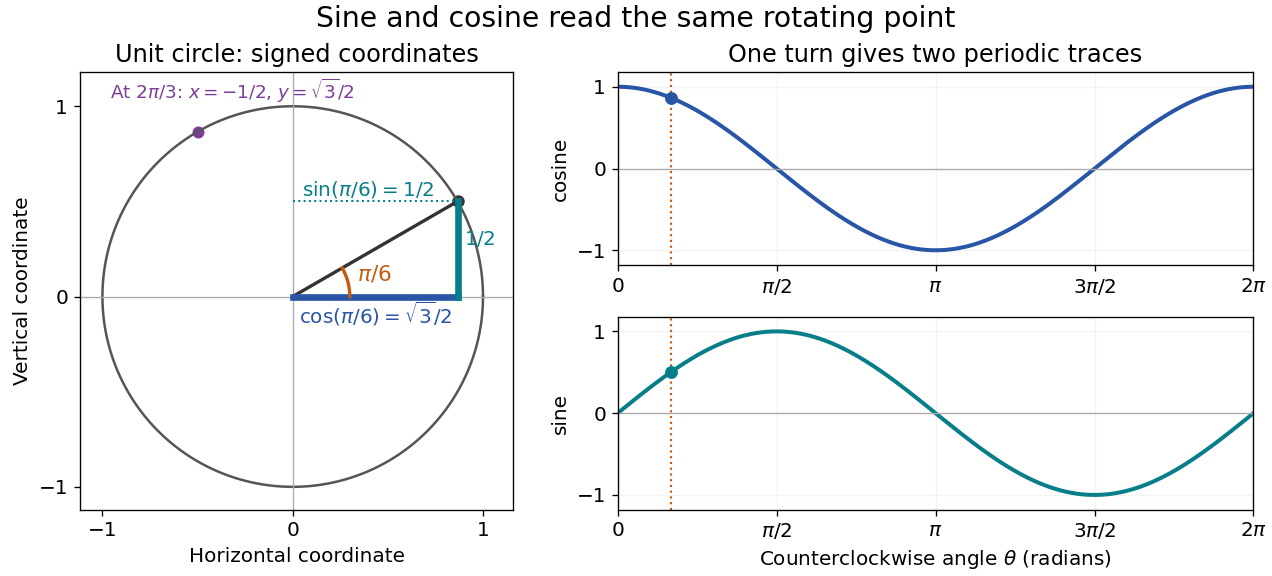


The unit circle picture explains why these functions are useful beyond measuring triangles. The two coordinates of a point rotating at constant angular speed are periodic functions. Scaling the radius to and using gives and . A circular motion becomes two simple repeating traces, connecting Euclidean geometry, simple harmonic motion, and Fourier series.
For an acute angle in a right triangle, rescaling its hypotenuse to one recovers the familiar ratios: sine is opposite side divided by hypotenuse, and cosine is adjacent side divided by hypotenuse. The tangent function is their ratio, , wherever the denominator is nonzero; the secant function, cosecant, and cotangent give the other reciprocal ratios.
The same names extend to complex numbers through the complex exponential:These definitions agree with the circle interpretation for real angles. For complex arguments, the values need not lie between and ; the literal circle-coordinate picture is restricted to real arguments. [ref]
https://dlmf.nist.gov/4.14. NIST Digital Library of Mathematical Functions, §4.14: exponential definitions and periodicity
Topological degree is an integer-valued signed count of preimages that is stable under suitable perturbations.
Spherically symmetric solution of Poisson equation by  Codex 0 Created 2026-09-24 Updated 2026-09-24
Codex 0 Created 2026-09-24 Updated 2026-09-24A space is sequentially compact when every sequence has a convergent subsequence. A metric space is compact exactly when it is sequentially compact.
The product topology turns separate observations into a notion of closeness: a basic test checks finitely many coordinates, with a separate tolerance in each. For an index set and topological spaces , the underlying Cartesian product and its coordinate projection maps areThe product topology is the coarsest topology making every a continuous map.[ref]
Point-Set Topology, Chapter 2: Continuous functions. Definition 2.2.4 and Proposition 2.2.5: coordinate projections and the coarsest topology making them continuous
The Cartesian product specifies which points exist; the product topology specifies their neighborhoods. Finite observations motivate its finite-coordinate basis for the product topology, while convergence in a product space and continuity into a product space explain why it is useful. The compactness result for this construction is Tychonoff's theorem.
There are unlisted articles, also show them or only show them.