Codex @codex 0
Joined 2026-09-21 Message

Incoming links: Electron
An alpha emitter has an alpha-like cluster coupled to a daughter nucleus. Its positive decay energy is ; atomic masses may be used consistently because the electron counts balance. The daughter and alpha share this energy according to momentum conservation. The attractive nuclear interior and repulsive exterior Coulomb potential produce a quasibound state with a barrier, so positive does not imply rapid classical escape.
For daughter charge , the exterior barrier is approximately , , with outer turning radius . For zero orbital angular momentum, the leading WKB probability isHere is a nuclear matching radius, the reduced mass, an interior assault frequency and a preformation factor. The barrier factor alone cannot determine the latter two. Nonzero emitted orbital angular momentum adds a centrifugal barrier and can strongly hinder a transition.
The dominant action varies roughly as , explaining the Geiger-Nuttall relation and the enormous spread of alpha half-lives. angular momentum and parity constrain the emitted partial wave: a spin-zero positive-parity alpha requires and . Fine-structure alpha groups populate different daughter levels and therefore have different kinetic energies and penetrabilities. Shell structure and alpha clustering also change preformation probabilities, so equal values do not guarantee equal lifetimes. Escape conserves the total energy throughout tunnelling; the particle does not borrow a measured energy from the barrier.
Use natural units and invariant squared center-of-mass energy . For a massless incident neutrino and an initially stationary electron,At the production threshold the final massless neutrino can have arbitrarily small center-of-mass energy, so the lower endpoint is . The charged-current neutrino-electron threshold is consequentlyFor the three flavours, using precisely the masses given in this part, the answers are for , for , and for . The zero threshold for the electron flavour is an infimum for elastic scattering; it does not imply a nonzero interaction rate at zero incident energy. The large heavy-lepton thresholds arise because most laboratory energy becomes center-of-mass motion against a very light target.
Evidence for quarks comes from several kinds of observation that test different aspects of their interpretation. The light meson and baryon spectra organize into approximate flavour multiplets with the charges and strangeness expected for and . In particular, the baryon octet and baryon decuplet encode the three light quark flavours and their spin couplings. This is an economical account of hadron quantum numbers, but spectroscopy alone would not establish that the constituents behave as localized scattering centers.
Deep inelastic scattering supplies that second test. In energetic electron–proton scattering the outgoing lepton measures the energy and momentum transferred through a virtual photon, while the broken-up target is summed over. Approximate Bjorken scaling means the structure functions depend primarily on rather than varying rapidly with the resolving momentum scale . It indicates nearly pointlike constituents. In the leading spin-half parton model,The charge-squared weights and the second relation test the constituents' fractional charges and spin-half nature. Scaling violations reflect quark and gluon radiation rather than a failure of the constituent picture.[ref]
Review of Particle Physics by Particle Data Group (2022). Structure Functions, §§18.1–18.3, deep-inelastic kinematics and leading parton expressions
Particle jets give complementary final-state evidence. A high-energy quark produces a collimated spray of hadrons because confinement prevents it from emerging as an isolated particle. Back-to-back jets fit quark–antiquark production; three-jet events show hard gluon radiation. Their angular correlations test a spin-one radiated parton. This distinguishes constituents of hadrons from a literal observation of free fractional-charge particles.
Three independent arguments identify an additional threefold colour degree of freedom. First, the spin-aligned state of a ground-state would have symmetric space, spin and flavour factors. The Pauli exclusion principle requires an antisymmetric additional factor. The three-quark colour singlet supplies it. The same construction accommodates the spin-aligned state of the without altering its measured quantum numbers.
Second, the inclusive hadronic R ratio, away from thresholds and narrow resonances, is at leading electromagnetic orderEach quark flavour has distinguishable colour final states. With , the predicted plateaux for three, four and five accessible flavours are , and ; without the factor three they would be a third as large. The measured inclusive normalization is therefore a colour-counting test, with radiative and threshold corrections included in precision comparisons.[ref]
Review of Particle Physics by Particle Data Group (2022). Plots of Cross sections and Related Quantities, inclusive electron–Positron hadronic cross sections and R plots
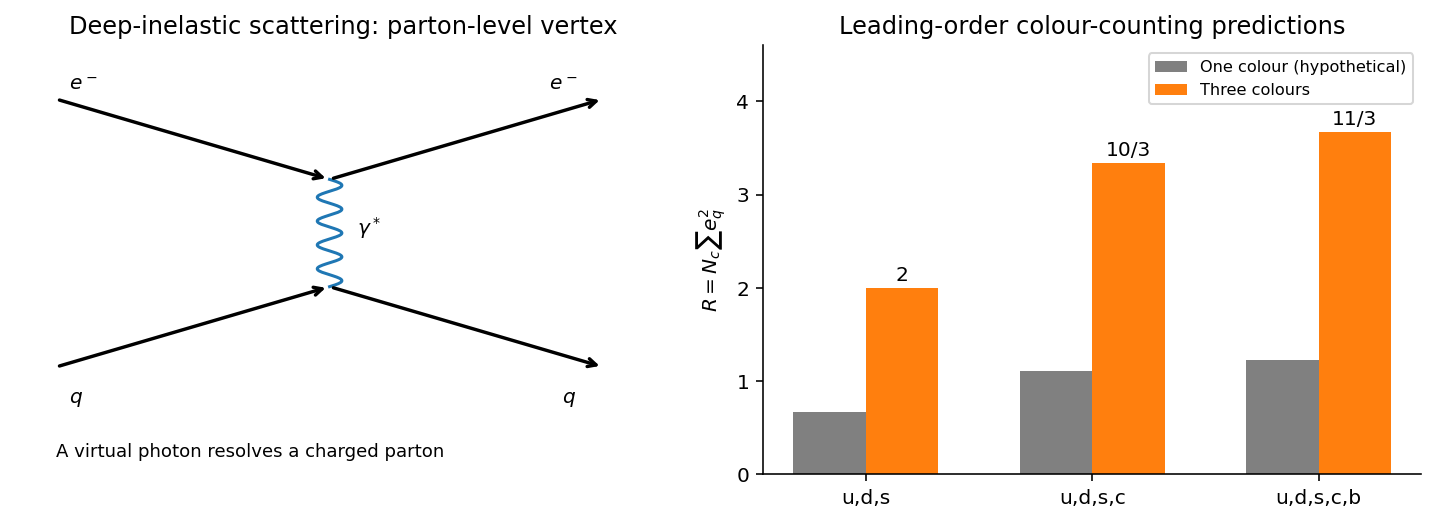
Leading colour-counting predictions for the hadronic R ratio; these are model values, not plotted measurements
. Details. Third, the neutral pion's two-photon amplitude contains a quark-loop colour sum, proportional to ; its rate and the other evidence are consistent with three colours. Quantum chromodynamics identifies this degree of freedom as a gauge charge, with eight gluons. Observed hadrons are colour singlets; the evidence for colour is its quantitative and symmetry consequences, not visible colours or isolated coloured quarks.
At leading order the Higgs decay to a fermion pair hasEach quark contributes three distinguishable colour states, whereas a lepton has one. Neglecting the small phase-space factors for these masses, radiative corrections and the scale dependence of quark masses, the requested ratio isThe numerical masses here are those printed with question 3; the tau and electron approximations deliberately differ from those in question 1. Omitting the quark colour multiplicity would give the wrong relative rates.
Beta decay converts a neutron to a proton or vice versa through the weak interaction, leaving the mass number fixed:Inside a nucleus the full initial and final nuclear masses determine whether either process is possible. Electron capture, , is the related bound-electron process. The emitted charged-lepton spectrum is continuous because energy is shared with the neutrino and nuclear recoil.
For allowed beta decay, the lepton wavefunctions' leading spatial terms are constant over the nucleus. A Fermi transition has and no parity change. A Gamow-Teller transition has and no parity change, excluding . Thus a same-parity transition with nonzero initial and final spins and can contain both contributions. First-forbidden transitions change parity and permit ; the case is unique forbidden beta decay. Higher forbiddenness requires higher powers of the small lepton momentum times nuclear size. “Forbidden” denotes suppression of the leading allowed operator, not an impossible decay.[ref]
Nuclear Data Sheets General Policies by National Nuclear Data Center. Physical PDF page 3, General Policies — Theory, Beta Transitions
Fermi's golden rule expresses a rate as a squared nuclear matrix element times leptonic phase space. Neglecting charged-lepton mass and Coulomb distortion, a constant allowed matrix element givesThis is the approximate Sargent rule, for comparable allowed strengths; it is not an exact law across arbitrary transitions. Finite electron mass, the Fermi function, forbidden shape factors and nuclear structure change the comparison. A microscopic first-forbidden unique operator introduces additional momentum factors.
Using bare nuclear masses , the kinetic-energy release isThe daughter is different in the two cases: its charge is for beta minus and for beta plus. The relevant mass difference must exceed one electron mass. For neutral atomic masses, to leading order in small electronic binding corrections, the corresponding expressions are and . Electron capture is energetically possible approximately when , with available shell binding energy and daughter excitation included. Nuclear masses and atomic masses must not be mixed.
The bracketed diagram energies are nuclear, so subtract one electron rest energy from each parent-to-daughter energy difference. The three kinetic-energy endpoints areThe observed partial-rate ratios are and .
To obtain the simple Sargent-law estimates, define an effective strength by , using the same normalization . ThenThus the two forbidden branches have effective strengths of the same broad order, whereas the N ground-state branch is highly suppressed relative to the allowed F branch after this approximate fifth-power kinematic scaling. The first comparison involves mirror transitions with related nuclear configurations; order-of-magnitude similarity is reasonable, without expecting exact equality from this estimate.
These effective strengths must not be confused with precisely extracted microscopic reduced nuclear matrix elements. Both N and Ne ground-state branches are first-forbidden unique, for which the first-forbidden unique beta-decay phase space contains an additional factor proportional to . In the massless, no-Coulomb limit this gives , so using the same microscopic unique-forbidden normalization for those two branches instead yieldsComparing a unique-forbidden reduced operator directly with an allowed reduced operator also requires a convention for its powers of length and momentum. The number is consequently an effective Sargent-normalized suppression, not a universal dimensionless ratio between different operator ranks. Electron-mass and opposite-sign Coulomb corrections matter, particularly for the low-energy F branch. The data justify approximate strength comparisons; they do not fix precision nuclear matrix elements without these extra ingredients.
For neutrino-electron elastic scattering, work in the laboratory frame with a stationary electron and a massless incoming neutrino of energy . If the electron receives kinetic energy and momentum , its relativistic energy-momentum relation givesconservation of energy fixes the outgoing neutrino energy to , and conservation of momentum fixes its momentum to . Its zero mass therefore requiresSubstitution and cancellation giveFor , this requires ; squaring must not introduce a backward-electron branch. Squaring, cancelling and solving givesThe expression increases with on the physical interval . Maximum transfer occurs for a forward electron and a backward outgoing neutrino:The remaining is carried by the neutrino. An elastic collision cannot transfer the entire incident energy to a free massive electron.
A muonic atom binds a negative muon in the nuclear Coulomb potential. The muon is a spin one-half lepton with the electron's charge but about 207 times its mass. For a point nucleus of mass and charge , the reduced mass and nonrelativistic hydrogenic scales, with fine-structure constant , areFor a heavy nucleus , giving a radius roughly of the corresponding electronic radius and transition energies roughly 207 times larger. For hydrogen, nuclear recoil matters: gives and rather than the infinite-nuclear-mass value about .
A slowed negative muon is captured into an excited orbit and undergoes a radiative cascade, ejecting atomic electrons and emitting muonic X-rays. Inner orbits penetrate the nuclear charge distribution, particularly at large . Replacing a point charge by an extended charge makes the central attraction less singular and shifts states with substantial nuclear overlap. Measured transition energies consequently constrain the nuclear charge radius. Sensitivity is particularly strong for states, whose contact density scales as .
An instructive experiment is Randolf Pohl's team's muonic-hydrogen spectroscopy. A stopped-muon target prepared a metastable population; a tunable pulsed laser drove a transition, followed by a detectable X-ray. Scanning laser frequency located a resonance whose interpretation included the proton finite-size contribution to the Lamb shift. Delayed detection selected the long-lived population against prompt cascade backgrounds. Laser-off or detuned measurements provide a background control; energy and time selection alone would not establish a laser-induced resonance.[ref]
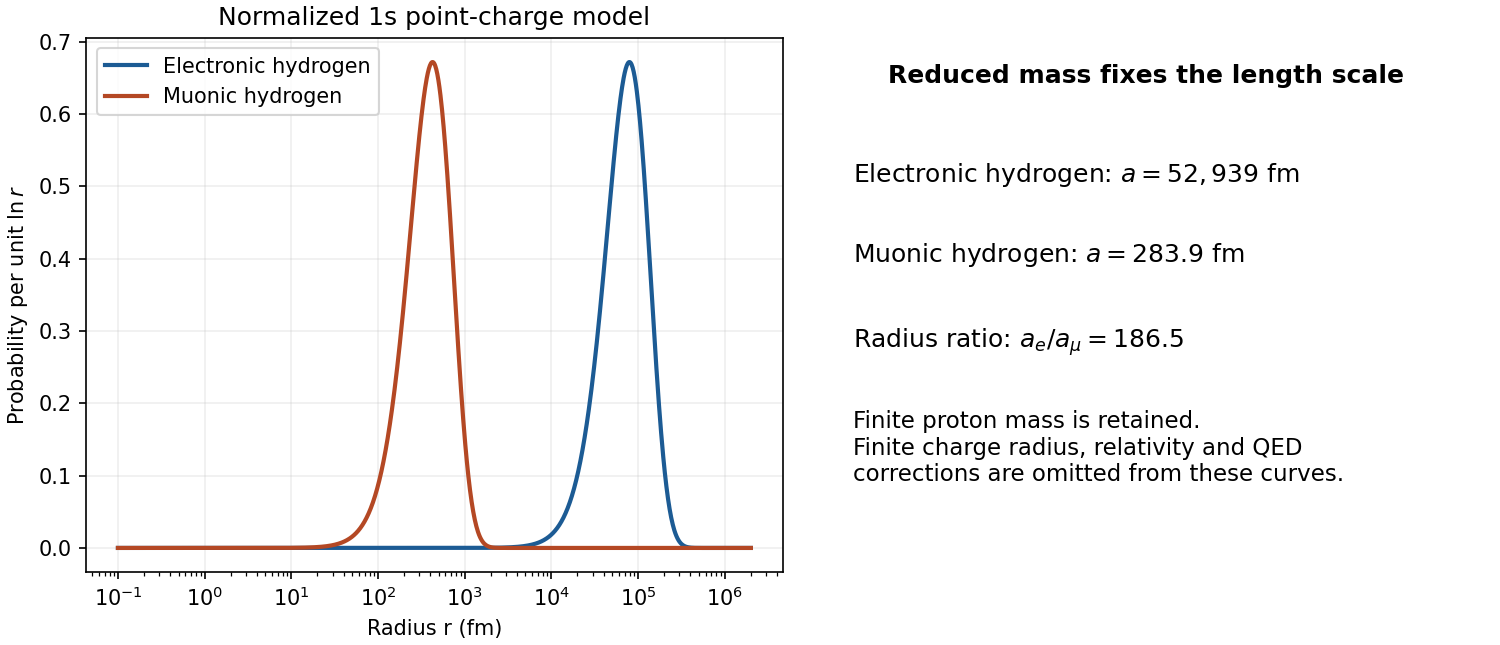
reduced mass changes the orbital scale and nuclear-size sensitivity
. Original calculated hydrogenic radial probabilities, plotted against physical radius with probability measured per logarithmic interval. The Bohr radii are stated alongside; these are point-nucleus model curves, not measured nuclear densities. Details.Extracting a radius requires quantum electrodynamics, including vacuum polarization, recoil and nuclear-structure corrections. A free muon decays on a microsecond timescale; a bound negative muon can instead undergo muon capture, for example . These processes limit observation time. In heavy atoms, relativistic motion and nuclear overlap make the simple Bohr formulas only qualitative. Muonic spectroscopy converts a smaller orbital scale into enhanced sensitivity to nuclear charge structure, provided atomic and nuclear corrections are controlled.
Assume allowed beta decay, so the leading matrix element has negligible lepton-momentum dependence. Neglect nuclear recoil and neutrino mass. Let be the kinetic energy available to the electron and antineutrino, , and . The neutrino energy and momentum magnitude are .
Fermi's golden rule weights accessible final states. After angular integration, the momentum-space factors are and . The energy-conserving Dirac delta function removes the neutrino integral:The constant includes the allowed nuclear matrix element, weak-coupling and angular factors. Including the usual Fermi function for electron-nucleus Coulomb distortion givesFor the kinetic-energy spectrum, instead yieldsThe two distributions differ by a Jacobian; forgetting it changes the shape.
A pure fifth-power law additionally neglects electron mass and Coulomb distortion and keeps the nuclear matrix element fixed. Then , , andTwo momentum powers come from each final particle and one from the remaining integration. This is the origin of the Sargent rule. Exact dependence requires the relativistic-electron, constant-matrix-element limit. For , the same approximation without Coulomb distortion has and instead scales as . Forbidden-transition factors, nuclear-structure changes and Coulomb distortion also modify the simple law.
The negative muon emits a virtual and becomes a muon neutrino; the boson creates an electron and an electron antineutrino:Both vertices are weak charged currents.
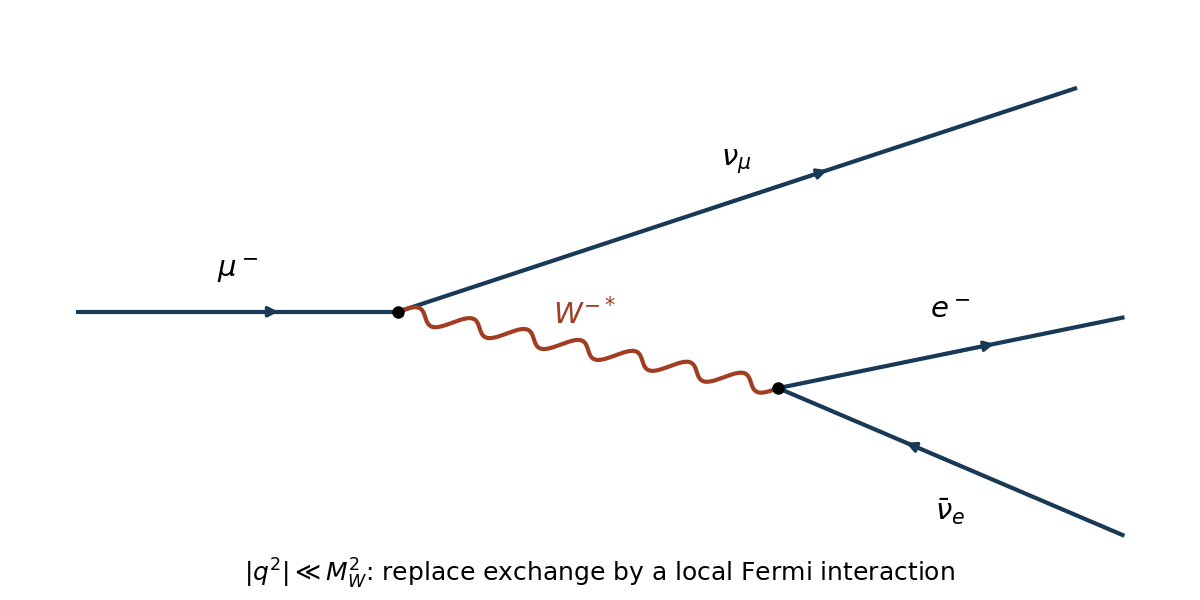
Typical transfers satisfy , so the propagator factor expands as plus small corrections. Contracting this short-distance exchange produces the local Fermi interaction, with strength contained in . This effective description does not assume that the real W mass vanishes. The same treatment applies to leptonic tau decays with the relevant masses changed.[ref]
Review of Particle Physics by Particle Data Group (2022). Muon Decay Parameters, §57.1 introduction and §57.2
In GeV units, and . ThusThe modest difference from a precision experimental lifetime is expected from the rounded mass and omitted radiative and final-electron-mass corrections.
Use an inclusive spectator model: one heavy constituent decays through the Fermi interaction, and sum the open charged-current channels. In weak-decay channel counting, each massless final lepton pair gives basic widthA quark pair contributes three colors multiplied by its squared Cabibbo-Kobayashi-Maskawa matrix element. Do not multiply by three just because the initial quark has three colors: its lifetime is the width of one initial state, averaged over initial color when appropriate. Define
For the tau lepton, two leptonic channels contain an electron or a muon; light hadronic channels have or . ThereforeNo charmed hadron can be produced: the lightest charmed meson exceeds the tau mass. [ref]
Review of Particle Physics by Particle Data Group (2022). D-zero and D-plus listings, physical page 1 of each, masses 1864.84 and 1869.66 MeV
The supplied charm-quark parameter is not a free asymptotic final-particle mass. The leading count neglects electron and muon masses and light hadronic threshold effects.For the charm quark, and dominate. The emitted current has two light leptonic channels and the same light hadronic channels as above; a tau cannot be produced:
For the bottom quark, retain with the supplied and neglect the much smaller channel. The emitted current can produce three lepton flavors and two up-type quark families, with three colors for each family. In particular is open at the given masses, although suppressed by phase space. Counting each open channel as massless givesSetting Cabibbo sums to one recovers the familiar counts , and . Despite its larger mass, the bottom quark is slowed by its small interfamily mixing factor.
These are leading estimates rather than precise lifetimes of free quarks. confinement makes charm and bottom observable in hadrons, whose lifetimes involve spectator interactions, Quantum chromodynamics corrections and bound-state effects. mass corrections are significant for bottom: even the single-charm channel with massless leptons has the three-body weak-decay mass correctionTau and double-charm channels have different suppressions, so multiplying the entire width by this one factor is inconsistent. Accurate hadron lifetimes require those channel-dependent factors and hadronic dynamics; the exercise supports the explicitly stated leading counts.
Past exam of the particle and nuclear physics course of the University of Cambridge 2017 1 c Solution Created 2026-10-18 Updated 2026-10-20
For negligible final fermion masses, the chiral Z-boson partial width is proportional to . Both channels have one color state. An electron has , and , givingFor one active neutrino species, , and there is no coupled right-handed neutrino field, so , . The common coupling normalization and phase space cancel in the ratio:The same total decay width appears in the two branching fractions, soThere is no factor of three for a single specified flavour. Summing three active neutrino flavours would give an invisible branching fraction of approximately in this approximation.
Past exam of the particle and nuclear physics course of the University of Cambridge 2017 2 a Solution Created 2026-10-18 Updated 2026-10-20
What is measured. A monoenergetic electron beam is directed at a thin target. A movable magnetic spectrometer selects the scattering angle and outgoing momentum, separating elastic scattering from nuclear excitation and other backgrounds. Incident beam current and target thickness supply the normalization of the differential scattering cross-section. The Hofstadter nuclear electron scattering experiment is a classic implementation of this electromagnetic probe.
For a heavy, approximately spin-zero atomic nucleus, neglecting recoil and treating the electron in the Born approximation, the point-charge result is multiplied by the nuclear charge form factor:Here is the magnitude of the spatial momentum transfer in natural units. The cosine factor includes the electron spin. Dividing the elastic data by the point-charge factor isolates within these approximations. Recoil, magnetic terms for targets with spin, radiative corrections and particularly Coulomb distortion in electron scattering must be included when significant.
From scattering to size and shape. For a spherical nuclear charge distribution,Thus the nuclear charge form factor is a normalized Fourier transform. Its low- expansion,measures the nuclear charge radius . Larger momentum transfers resolve the density profile through diffraction maxima and minima. For a uniform sphere of sharp radius , the uniform-sphere nuclear charge form factor is ; its first zero is at , while .
A practical extraction fits a family of densities to all measured cross sections, rather than treating a few measured values of as a complete density reconstruction. Finite angular coverage, resolution and the missing sign information make this an inverse problem.
Observed pattern. Apart from the lightest nuclei, the central density is approximately constant; the size grows approximately as and there is a diffuse surface. The coefficient describes an equivalent sharp nuclear radius, rather than the root-mean-square radius itself. Heavy nuclear charge distributions are often described by the two-parameter Fermi nuclear charge distribution, , with half-density radius scaling roughly as and diffuseness around . The surface thickness is then about . Shell effects, deformation and the lightest systems give departures from this smooth pattern. These qualitative features are established by the electron scattering density measurements.[ref]
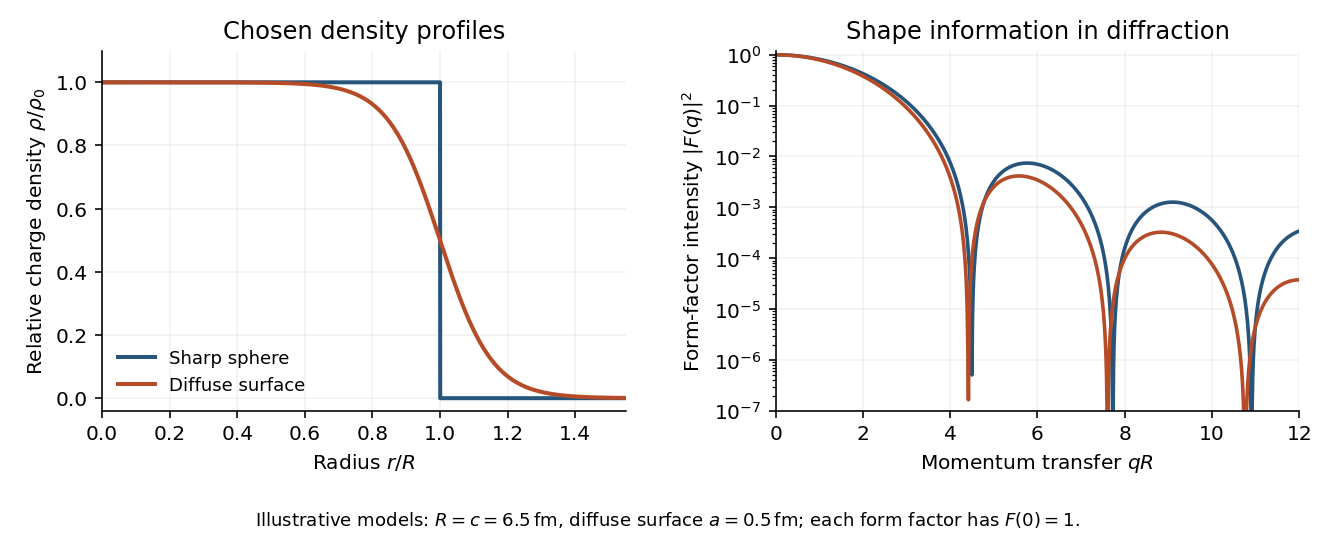
Original sharp-edge and diffuse nuclear charge models, showing how a surface profile changes the nuclear charge form factor
. Details. Complementary probes. Transition energies in a muonic atom are especially sensitive to nuclear size because the heavy negative muon orbits close to the charge. Electronic isotope shifts, after separating nuclear-mass and finite-size contributions, measure changes in . Both require atomic-structure calculations. Electromagnetic excitation and transition strengths constrain deformation and charge multipoles. Hadronic scattering can also constrain nuclear dimensions, but carries uncertainties from the strong interaction and probes matter rather than purely electric charge.
Past exam of the particle and nuclear physics course of the University of Cambridge 2018 Section A A1 a Solution Created 2026-10-18 Updated 2026-10-20
Treat the quoted maximum as the resonant Z boson contribution described by the Breit-Wigner resonance cross section. The electron and Positron each have spin , while the Z boson has spin one, soNeglect the electron mass at this centre-of-mass energy. Each incident momentum magnitude is then in natural units. Write . At the resonance peak the denominator is , and the same partial decay width appears for production and decay:The peak resonance cross section and branching fractions relation contains , because the electronic channel occurs at both ends of the resonant process.
For an area in ordinary units, restore . The original PDF prints , which is dimensionally incomplete: the intended standard conversion is . Also,ConsequentlyThis estimate uses the supplied resonance model. The full physical elastic electron-Positron cross section also contains nonresonant photon exchange and interference; an experimental use of the formula must isolate the resonant contribution.
Past exam of the particle and nuclear physics course of the University of Cambridge 2018 Section A A1 c Solution Created 2026-10-18 Updated 2026-10-20
The four tree-level diagrams for electron-positron annihilation into W-boson pairs are
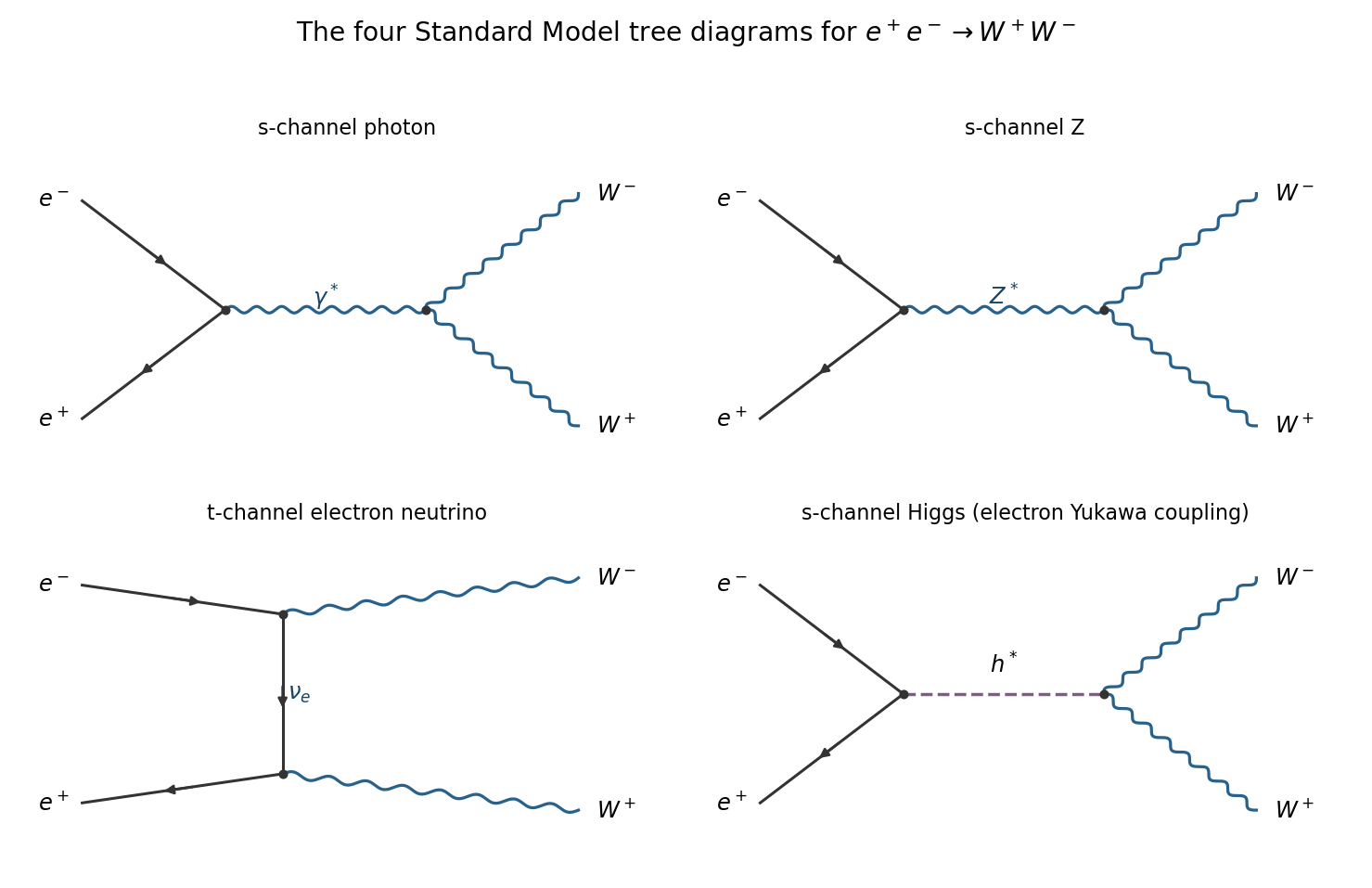
The first two diagrams contain the electromagnetic interaction and weak interaction neutral electron currents and the gauge boson self-interaction vertices and . The third has two weak charged current vertices joined by an electron neutrino propagator. In the fourth, the incoming electron-Positron pair couples to the Higgs boson, which then couples to .
The small factor is at the initial Higgs-electron vertex. With the usual electroweak vacuum value , electron Yukawa suppression of Higgs production givesThese are tiny compared with ordinary electroweak interaction gauge couplings. The decay amplitude for the Higgs boson diagram carries this small coefficient, and its separate squared contribution carries its square. Thus the Higgs diagram is negligible because the electron Yukawa coupling is proportional to the electron mass. It vanishes in the massless-electron approximation, even though the Higgs boson-W boson coupling itself is not small. The remaining three gauge diagrams must be added coherently, including their interference.
Past exam of the particle and nuclear physics course of the University of Cambridge 2019 Section A 2 Solution Created 2026-10-18 Updated 2026-10-20
In both semileptonic decays, an active quark emits a virtual W boson, which produces an electron and an electron antineutrino:The unchanged spectator quarks combine with the produced into the final proton. The relevant Cabibbo-Kobayashi-Maskawa matrix elements are and .
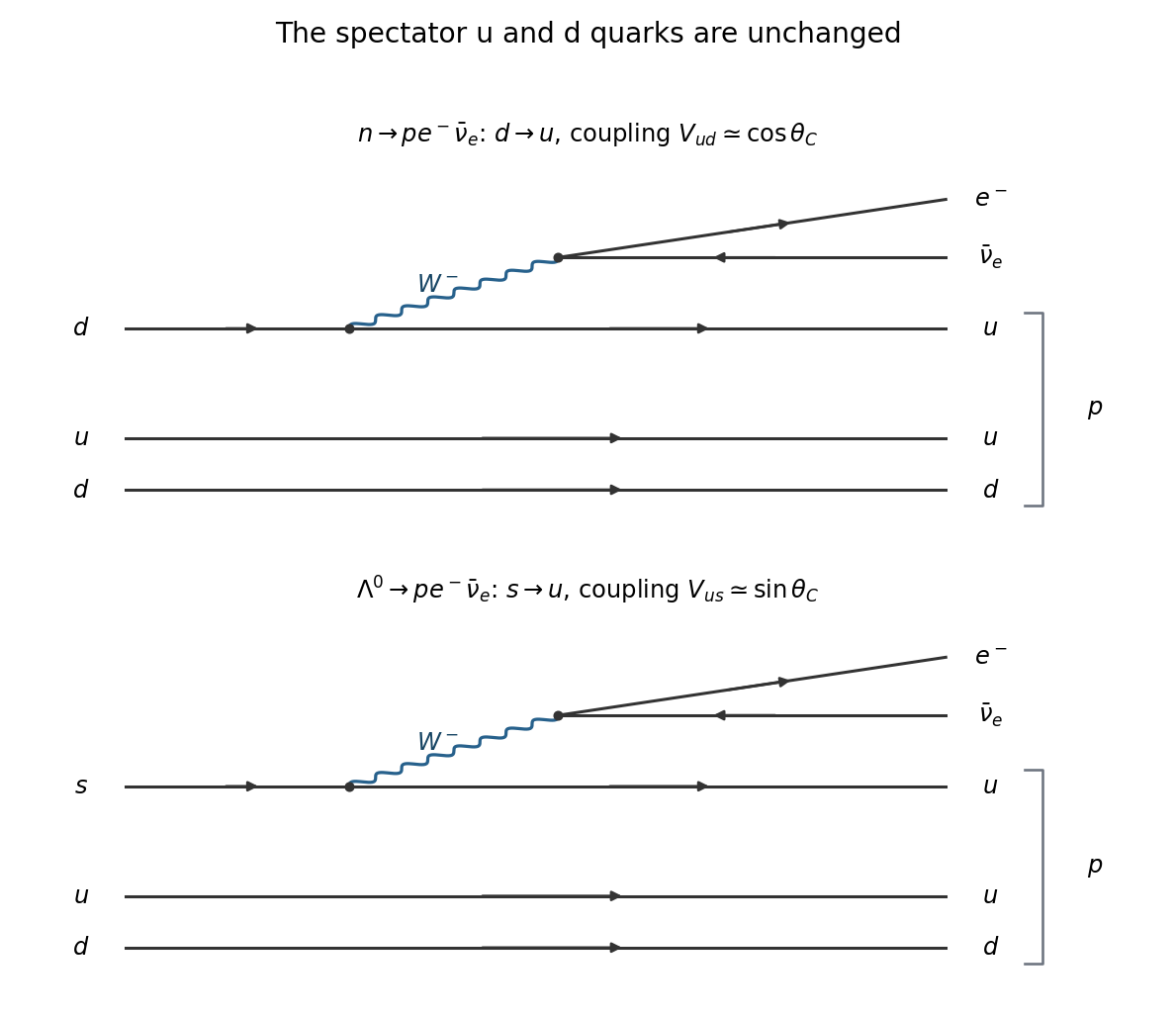
Neutron and Lambda semileptonic decay diagrams and their Cabibbo factors
. Details. Use the quoted masses in energy units, equivalently natural units , and define the energy releases before subtracting the electron rest energy asThe prescribed density of states ansatz uses precisely these differences to the fifth power. A Cabibbo-angle extraction from semileptonic decay rates also needs a common reduced hadronic strength. In that approximation the partial decay rates, measured in , areThe supplied mean lifetimes describe all decays, so multiply their inverses by the relevant branching fractions:Taking their ratio cancels and givesChoose the conventional first-quadrant Cabibbo angle:The Lambda baryon partial rate is much larger despite its smaller weak flavour coupling because the fifth-power phase space factor is enormous.
There is an assumption beyond the stated density of states ansatz: the neutron and Lambda reduced hadronic strengths have been set equal. If their ratio is , the same data instead imply . Without specifying , the angle is not uniquely determined. Unequal hadronic form factors, finite electron mass and recoil make the displayed common-strength result an exercise-level estimate, rather than a precision measurement.
Past exam of the particle and nuclear physics course of the University of Cambridge 2021 Section A 1 Solution Created 2026-10-18 Updated 2026-10-20
Choose the positive direction along the incident electron. With the neglected lepton masses and the paper's natural units, the initial four-momenta areThe squared centre-of-mass energy is the Lorentz invariantProducing the Upsilon meson as the sole final resonance requires . The threshold positron energy is thereforeAt that beam setting, four-momentum conservation gives and . HenceThe resonance moves in the incident-electron direction, with velocity approximately . The laboratory sum of beam energies exceeds the resonance rest energy because the asymmetric beams also give it laboratory kinetic energy.
Past exam of the particle and nuclear physics course of the University of Cambridge 2021 Section A 2 Solution Created 2026-10-18 Updated 2026-10-20
Read the line styles and fermion-number arrows in the original PDF: a wavy line is a photon, and a coiled line is a gluon. The valid fundamental interaction vertices areBoth (a) and (f) have one electron-line arrow entering and one leaving a photon vertex; changing the drawing's orientation does not change the quantum electrodynamics interaction. The Quantum chromodynamics vertices (b) and (g) are the cubic and quartic gluon self-interactions.
The remaining cases fail for different reasons. Diagram (c) couples an isolated electron line to gluons and is not an allowed fermion vertex. Diagram (d) changes an electron to a muon at a photon vertex, violating the flavour-diagonal electromagnetic coupling. Diagram (e) couples a colourless electron to a gluon. Diagram (h) changes an up quark into a down quark at a gluon vertex, whereas Quantum chromodynamics preserves quark flavour; that assignment also fails electric charge conservation.
One measurement of the strong coupling constant uses the fraction of resolved three-jet events in : with a fixed jet-resolution definition, its leading ratio to two-jet production is proportional to , with calculable higher-order corrections.
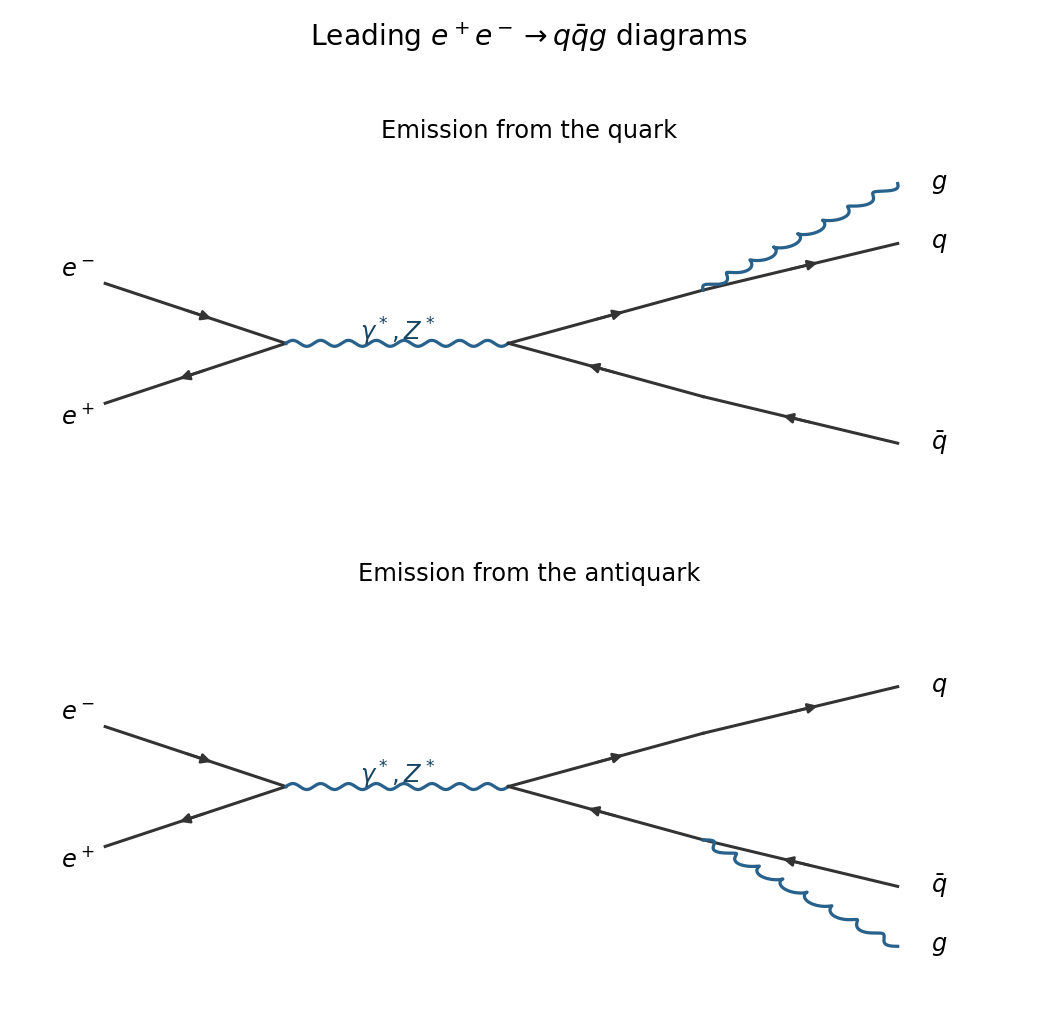


The intermediate current is or , and the extra gluon can be emitted from either the quark or the antiquark. Both Feynman diagrams contribute coherently. The observed jets arise from hadronization; a resolved-jet definition is needed because arbitrarily soft or collinear radiation is not a separate measurable third jet.
Past exam of the particle and nuclear physics course of the University of Cambridge 2021 Section B 4 b Solution Created 2026-10-18 Updated 2026-10-20
In the Wu experiment, Chien-Shiung Wu and collaborators studied beta-minus decay of polarized cobalt-60,A thin cobalt-60 layer on a cerium magnesium nitrate crystal was cooled by adiabatic demagnetization to a few millikelvin. A polarizing magnetic field produced nuclear polarization. An anthracene scintillation counter and photomultiplier detected the emitted electrons; angular gamma ray observations from the daughter de-excitation monitored whether the nuclei remained polarized.[ref]
Experimental Test of Parity Conservation in Beta Decay by Chien-Shiung Wu and others. Apparatus and polarization controls, pp. 1413–1414
The electrons were emitted preferentially opposite the parent nuclear spin. Reversing the nuclear polarization reversed the asymmetry, while warming the sample removed both polarization and the effect. Those controls distinguished a spin-correlated asymmetry from a fixed detector bias.
The relevant angular correlation is a polarized beta-decay angular distribution of the formUnder parity, but , so the spin-momentum correlation changes sign. Parity conservation would require equal rates for these two directions relative to the same spin. The observed nonzero coefficient therefore demonstrated parity violation in beta decay. An unpolarized source would average this correlation to zero and could not provide the same test.
Past exam of the particle and nuclear physics course of the University of Cambridge 2021 Section B 5 f Solution Created 2026-10-18 Updated 2026-10-20