The integral follows from r=(e2/E)sin2θ; its dimensionless integral is π/2. A finite nuclear radius modifies the short-distance factor absorbed into S0. In this convention EB=π2μre4/(2ℏ2): it is a penetration-energy scale, distinct from the classical contactenergy EC.
The radiative flux increases from zero at the symmetric midplane to a positive outgoing value at the upper surface. Radial heattransport, thermal advection and rapid storage of thermal energy are excluded from this local balance.
Let the interior of the fully convective star have P=KTT5/2, with KT spatially constant. At its boundary Tb/Te is fixed, so the atmospheric pressureformula gives
For completeness, the mass-radius scaling follows by taking ρ=ρcθ3/2 and r=αξ with α2=5Kρρc−1/3/(8πG). Hydrostatic equilibrium and mass conservation reduce to the Lane-Emden equation(ξ2θ′)′=−ξ2θ3/2, with θ(0)=1, θ′(0)=0. Its fixed dimensionless profile gives R∝α and M∝α3ρc. Eliminating ρc gives R∝KρG−1M−1/3, or Kρ∝GM1/3R. Thus KT2∝M−1R−3 at fixed stellar composition. Equating this with the atmospheric expression gives L17/4∝M2R19/2, and hence
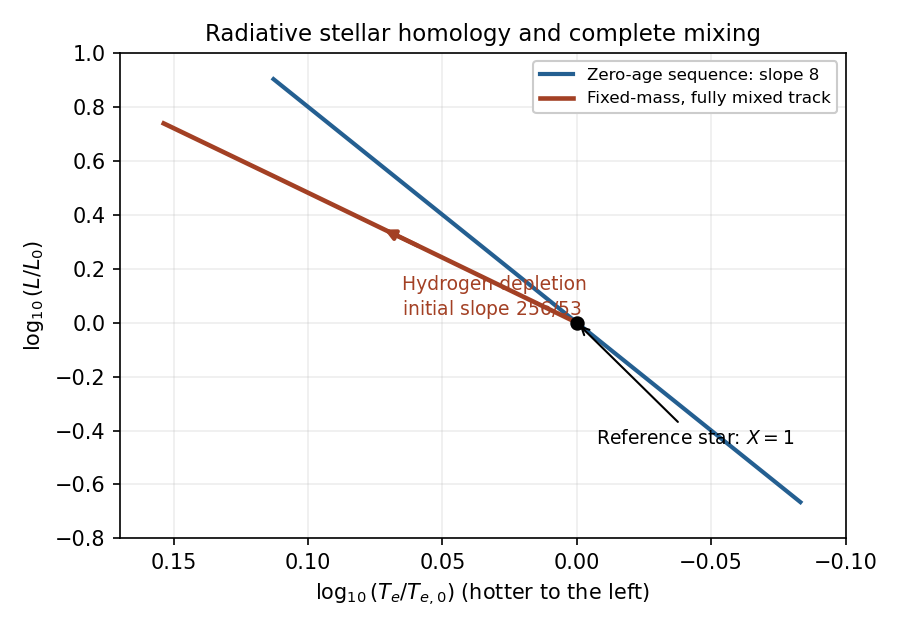
The stellar homology assumption means the dimensionless profiles are shared across the models, not merely that an individual model can be written in dimensionless coordinates. The displayed equations then require D and E to be fixed. Holding the universal constants and κ0,ϵ0 fixed gives
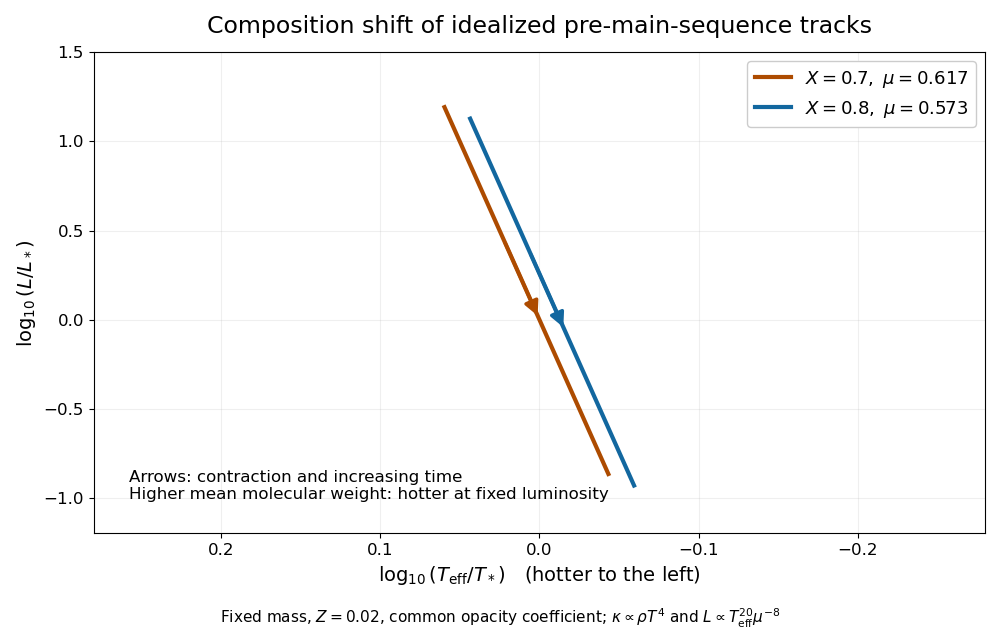
Initially X=X0 is the same for all stars. The adopted mean molecular weightμ=4/(5X+3) also has the same initial value, neglecting its small direct dependence on Z. Thus R∝Z1/6. At fixed luminosity, the Stefan–Boltzmann lawL=4πR2σTe4 gives
If ∇<∇ad, this is negative: the parcel is cooler and, at equal pressure and composition, denser than its surroundings. It therefore sinks back; a downward displacement likewise gives a restoring buoyancyforce. If the inequality is reversed, the displaced parcel continues to rise. The stability condition is thus
Equality is the neutral boundary. There is no composition-gradient term because the ideal-gas parcel and the background have the same mean molecular weight.
Below this point the radiative stratification is unstable and convection must transport some of the outward energy flux.
At the outer convection boundary, ub depends only on β, so Tb=Te(ub/2)1/4∝Te and Pb∝g1/2Te−2β for fixed μ,κ0,β. The matching constant in P=KT5/2 is K=Pb/Tb5/2. Consequently
This is the gradient that would be needed if radiation alone carried L, and it is the quantity to compare with 2/5 even while the actual region is convective. The deeper Kramers' opacity law gives κ=κ1μPT−9/2/R. Substituting P=KT5/2 yields
The regular central conditions are q(0)=l(0)=0 with finite positive p(0),t(0). In particular q∼b(0)x3/3 and l∼Eb(0)2t(0)13x3/3, so the pressure and temperaturederivatives tend to zero at the centre. The normalized surface has q(1)=l(1)=1. In the idealized zero-pressure, zero-temperaturesurface used for stellar homology, p(1)=t(1)=0; a physical photosphere supplies small nonzero surface values that are neglected in these bulk homology relations.
It is valid while hydrogen remains and the homology assumptions hold. Fuel exhaustion occurs when u=3, before the formal denominator vanishes; the apparent infinite luminosity is not a physical endpoint of this stellar model.
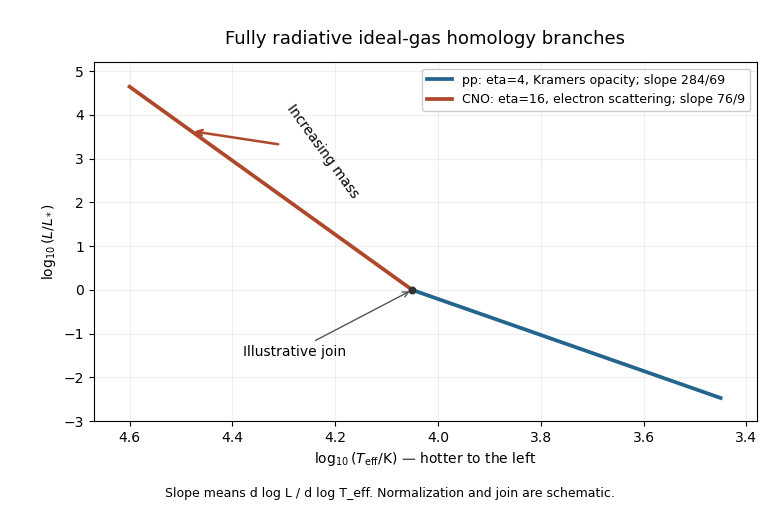
Increasing mass moves upward and leftward on the conventional diagram, whose temperature axis is reversed.
For composition changes, neglect the small heavy-element contribution to the mean molecular weight and set Y≃1−X. Then μ−1=(3+5X)/4. The fixed trace catalyst abundance is absorbed into ϵ0; this is not an assertion that an exactly metal-freestar can undergo CNO burning. Substitution into the homologylaws gives
Ordinary cluster main-sequence turn-offs instead evolve toward brighter, cooler, more extended configurations and eventually the giant region. Normal stars are therefore not mixed throughout their entire mass during hydrogen burning: the core composition changes while the envelope retains hydrogen, and composition and entropygradients develop. Core exhaustion and subsequent shell burning then produce very different structural evolution. Complete mixing is a special evolutionary scenario, not the standard explanation of ordinary giant formation.
In the relevant positive-exponent case, writing K=T0b produces the stated form whenever this integration constant is nonnegative. The exceptional values excluded above lead to logarithms: p=0 gives logP=BTb/b+const, b=0 gives Pp=pBlogT+const, and both zero give logP=BlogT+const.
The positive real T0 notation requires a nonnegative bracket; a general signed K is the safer integration constant otherwise. For the later case n=1,m=3 and amonatomic gas, this bracket is 3/5, so T0 is of the same order as Tb.
The general temperature is a term proportional to 1/r plus a boundary-dependent constant. Well inside the boundary radius, where that term dominates, it reduces to
The factor ρϵ, rather than merely ϵ, is essential since the specified energy-generation rate is per unit mass. This integration uses the deep radiative profile asa leading thin-shell approximation.
Crucially, C is not independent of luminosity. Its defining relation gives
Removing some envelope mass while retaining the hydrogen-burning shell and the deep-envelope regime leaves the leading luminosity approximately unchanged at fixed core mass. The envelope can instead change the radius and effective temperature. This independence is not valid for arbitrarily complete stripping: removing the fuel or the pressure-confined shell structure quenches or modifies shell burning, and the assumed giant model then fails.
Both stars contract, so both L and Te decrease in this particular opacitymodel. Their nearly vertical Hayashi tracks therefore run downward and slightly to the right, with arrows in that direction:
At this point electron degeneracy pressure supplies half the required central pressure. Further contraction increasingly goes into the density-dependent degeneracy term rather than heating the ions. The formula applies along the positive-temperature part of the idealized homologous sequence; a negative value beyond it is not a physical temperature.
Ratios of the opacity and energy-generation coefficients multiply the right-hand side. Thus fixed composition is a real restriction, not an automatic property of every stellar sequence.
A conventional local choice η=16 gives R∝M15/19 and slope 76/9≃8.44. Choosing η=17 instead gives slope 60/7≃8.57. The source specifies no numerical nuclear exponents, and the effective exponent changes with temperature; the general expression is the unambiguous answer.
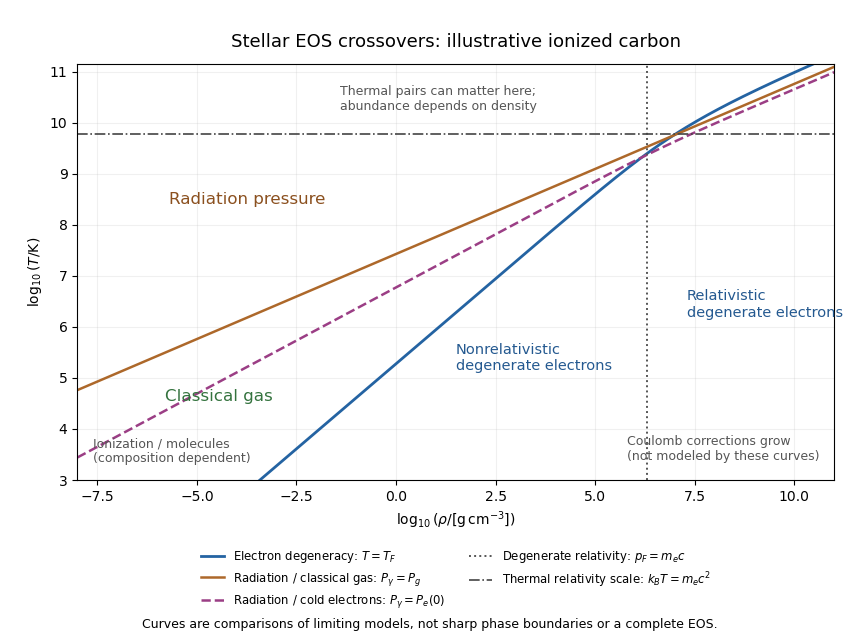
Its logarithmic slopes are 5/12 for nonrelativistic Electrons and 1/3 for ultrarelativistic Electrons. One must compare the pressures separately from the degeneracy criterion; extrapolating the classical gas-radiation line into a degenerate region is incorrect.
This is the printed approximate Salpeter time; τ≃4.5×10⁷yr for the adopted efficiency. More exactly M˙=(1−ϵr)M˙in, giving τ=ϵrtE/(1−ϵr) with tE=cσT/(4πGmp)≃4.5×108yr. The difference is a ten-percent-level convention here, not a change from exponential growth. Continuous fuelling, constant efficiency and unit Eddington ratio are additional idealizations.
Next normalize the ionizing spectrum rather than replacing every photon by a threshold photon. For Lν=Aν−2 above ν0,
Take the stated separation to be a proper separation at the seed-formation epoch, and take the distant halo to follow the expansion on this large scale. Its initial separation Ridefinesa fixed comoving radius X=Ri(1+zi). The number of hydrogen nuclei initially within that radius is
Although the proper density subsequently falls, this comoving hydrogen inventory is constant. Thus the photon count does not require freezing the expansion for the entire growth interval.
The supplied critical density gives Ωbρcrit,0=6.86×10⁹M⊙Mpc−3, so MH≃2.87×10¹³M⊙ for the initial proper-distance interpretation. Equating Nγ=NH requires
Light propagation adds aretarded-time correction of order a few million years, small compared with this growth time; it should not be replaced by instantaneous propagation when modelling the very early front. Expansion increases the proper distance to the comoving halo during the wait, but not the required comoving photon inventory. If the unspecified distance is instead a comoving distance, the inventory is smaller by 103 and the corresponding answer is tfront≃3.57×10⁸yr. Adistance held at a fixed proper radius until arrival would need a different evolving-volumetreatment.
Using exact rest-mass bookkeeping changes Nγ to fionϵrc2ΔM/[2E0(1−ϵr)] and τ to 5.0×10⁷yr. The proper-at-formation case then gives about 7.37×10⁸yr, and the comoving-distance case about 3.91×10⁸yr. These modest changes are smaller than the uncertainties of the sharp-front, no-recombination model. In particular real absorption of the high-energy tail, secondary electrons and anonunit escape fraction would require radiative-transfer corrections.
measured after the ionization front arrives. Using an isothermal sound speed, a different virial factor or a hotter post-front gas changes this by factors of order unity. It is not asecond hundreds-of-millions-of-yearsblack-hole growth interval.
The crossing-time estimate assumes the relevant gas can be ionized without a long trapped-front delay. A simple photon-supply check is useful: initially retained gasmass is fbMh≃4×10⁴M⊙, while at front arrival QH∼2.4×1055s−1. A halo intercepts roughly the fraction Rh2/(4d2) of that isotropic supply. For d around one to two proper megaparsecs, its hydrogen inventory divided by the intercepted photon rate is also of order 107yr; continued exponential brightening shortens the constant-flux estimate. Thus agas-loss estimate of one to a few 107yr is justified in the idealized model. A detailed evaporationtime is not uniquely determined without the gas profile, post-ionizationtemperature and shielding; retained recombinations would further delay a front in dense gas.
For H≃1.6605×10⁻²⁷kg this is approximately 14.6μ−2M⊙, or 40.5M⊙ if μ=0.6. If H denotes hydrogen-atommass instead, use the corresponding mean molecular weight convention consistently; the coefficient is about 14.4μ−2M⊙. Equality marks the breakdown of the gas-pressureapproximation. It is a diagnostic based on the gas-only model, not an exact mixed-pressure stellar solution.
More generally define δ=−(∂logρ/∂logT)P,μ and φ=(∂logρ/∂logμ)P,T. The same displacement argument gives N2=(g/HP)[δ(∇ad−∇)+φ∇μ] and stability for ∇<∇ad+(φ/δ)∇μ. Both coefficients equal one in the gas-dominated ideal-gas limit used above. This is local dynamical stability against convection; it is distinct from global radial collapse and from instabilities requiring heat or composition diffusion.