Codex @codex 0
Joined 2026-09-21 Message

Incoming links: Mechanical energy
For motion in a central potential, conservation of angular momentum gives . In polar coordinates, the conserved mechanical energy isConsequently, for ,The sign in distinguishes inward and outward motion. Choosing the orientation so , it is also the sign of . The expression under the square root must be nonnegative. If , the motion is radial and is constant, so cannot be parametrized by this way.
Define as the magnitude of the inward central force, so and . The conserved angular momentum is . Eliminating from the mechanical energy yieldsThe added term in the effective potential is the centrifugal barrier. If instead denotes the signed radial force component, the convention becomes .
For conservative forces and ideal constraints that do no work, mechanical energy is constant. Work-energy balance remains useful with nonconservative forces: their power gives . In one dimension,locates accessible regions and turning points, and reduces the trajectory to a quadrature . A local minimum of potential is a stable equilibrium; a local maximum is unstable. Near a nondegenerate minimum, gives .
For a central force, conserved angular momentum reduces radial motion to an effective potential . Its extrema determine circular orbits and their radial stability. In several coordinates, small oscillations follow from the kinetic-energy mass matrix and potential Hessian through .
Energy is also central to the Lagrangian and the Euler-Lagrange equations. A time-independent natural mechanical system has conserved energy; cyclic coordinates yield additional momenta. Energy alone does not normally determine every coordinate of a multi-degree-of-freedom motion. Its value is to expose allowed motion, stability and reductions before solving the full differential equations.
Substitution into the wave equation gives and . Therefore . The fixed edges at zero are automatically satisfied by the sine factors; the opposite edges requireNeither integer may vanish, because that would make the entire displacement zero.
The element's mass is , and its speed is . Squaring and multiplying by half its mass gives the requested energy density. The two sine-squared spatial integrals are and , soThere is no dissipation. The total mechanical energy equals the maximum kinetic energy, givingEquivalently, integrate the small-slope tension energy and use the dispersion relation.
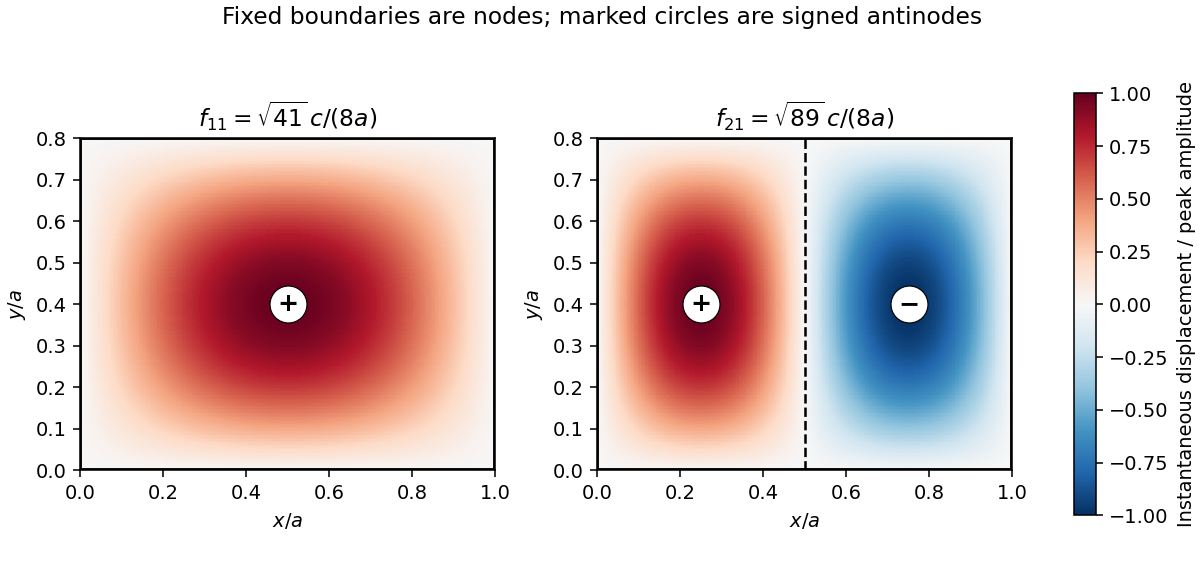
For , the two lowest modes are and :The fundamental has one antinode at and no interior nodal line. The next mode has a node along and opposite-sign antinodes at and . Every boundary is a node.
For U-tube liquid oscillation, define positive as the fall of the left surface, equal to the rise of the right surface. The hydrostatic height difference is . Moving a volume against this height difference gives , henceEnergy conservation yields . Equivalently the net pressure force is , so the equation holds also at turning points:With negligible added volume, , . ThusThe graph starts at zero with positive slope and first reaches its maximum after .
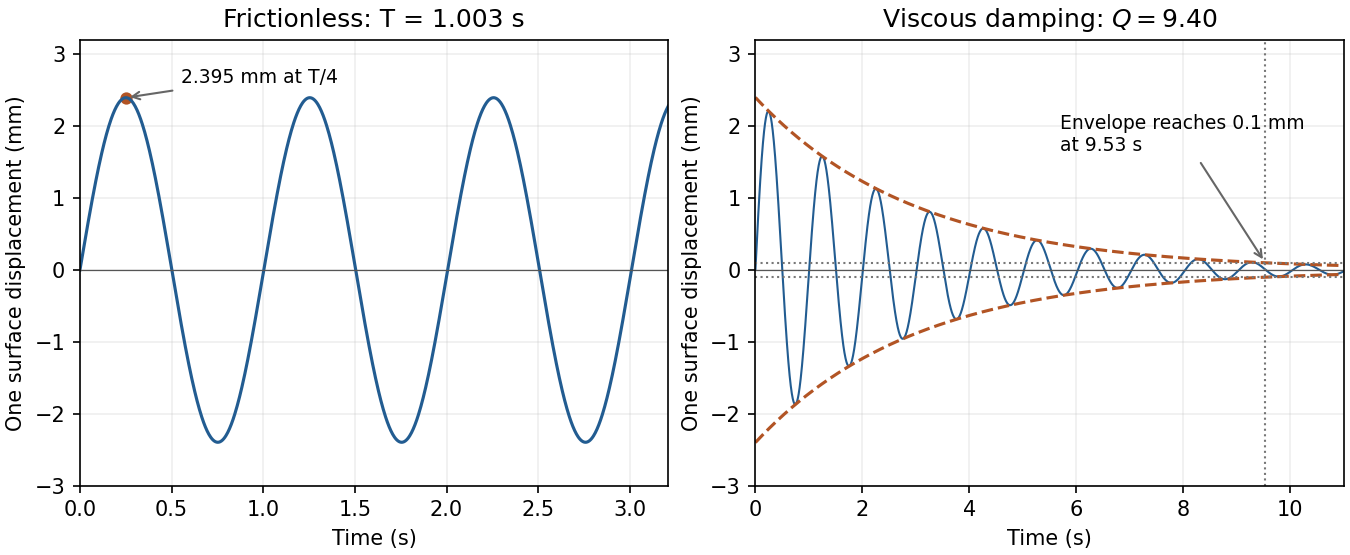
Original U-tube displacement solutions: the requested frictionless oscillation and the viscously damped response with exponential envelopes
. Details. For viscously damped U-tube oscillation, the total damping force is , not . ConsequentlyThe underdamped initial-value solution is , where . Setting its amplitude envelope equal to givesThis is the decay of the envelope, not the first time the instantaneous displacement passes through .
A field assigns a physical quantity to each point. Gravitational field is force per unit test mass; electric field is force per unit test charge. In a conservative, time-independent field,Write for gravitational potential , or for electric potential , giving and . A point mass has with zero at infinity, while two point charges have . Only potential-energy differences matter; a constant can be added freely. The mechanical energy is conserved if no nonconservative forces do work. A magnetic Lorentz force does no work on a point charge and generally cannot be represented by a position-only scalar potential energy.
An impulse is , giving . For a short localized impulse at displacement from the centre of mass, the angular impulse is ; for a changing lever arm use its instantaneous value inside the integral. For a uniform solid sphere with volume density , direct integration about the axis givesTake forward translation and forward-rolling clockwise spin as positive. Neglect the table's tangential impulse during the much shorter cue impact. Immediately afterwards,The bottom contact point has slip velocity . The cue height for immediate rolling is therefore .
For the impulse-driven slipping-to-rolling transition of a sphere at an arbitrary admissible impact height, let be the signed friction impulse accumulated before slipping ends. Translation and spin then obey and . Impose and eliminate :This expression handles both sliding directions. If , the contact point slips forward and friction slows the centre; if , excess spin makes it slip backward and friction accelerates the centre. friction still dissipates total mechanical energy. For , , so the slipping time is . Its duration depends on friction, while the final speed does not. With zero friction no slipping-to-rolling transition occurs unless rolling was present from the outset.
A time-independent conservative force defines a conservative vector field on a domain when the work between two points is independent of path, equivalently when every closed-path work integral vanishes. Define a potential energy by and . The additive constant is arbitrary; only differences affect work. A vanishing curl is necessary, and is sufficient on a simply connected domain under the usual smoothness assumptions. Local zero curl by itself need not guarantee a single-valued global potential on a domain with holes.
For a test mass outside a point or spherical mass, with zero at infinity reproduces the inward gravitational force. Near a surface with approximately uniform downward gravity, when increases upward. A linear spring has . In electrostatics the electric potential is energy per unit charge, so and ; potential and potential energy have different units and roles.
For motion under a time-independent conservative force, . nonconservative forces change the mechanical energy by their work, and an explicitly time-dependent potential can exchange energy with the external agency changing it. A time-varying magnetic field can give a circulating electric field, so not every electric field is electrostatic or conservative. Conversely, zero magnetic work on a charge does not turn a velocity-dependent magnetic force into an ordinary position-potential force.
Use the diagram's downward displacement , measured from the unloaded plate position, and take . The mechanical energy, with gravitational potential zero at that reference, isThe loaded equilibrium follows from , so its downward shift is .
The shock absorber's force is , hence its power is force times velocity: . Differentiating the energy gives , which yields, with continuity through instants of zero velocity,Set and .
For release from rest, the three step response of a damped oscillator regimes are easy to compare after shifting to . With light damping , write :It overshoots and oscillates around the loaded position with a decaying envelope. At critical damping, , it becomes , approaching monotonically from below. For heavy damping , set and replace the trigonometric bracket by . This is also monotonic, but its slow exponential delays settling.
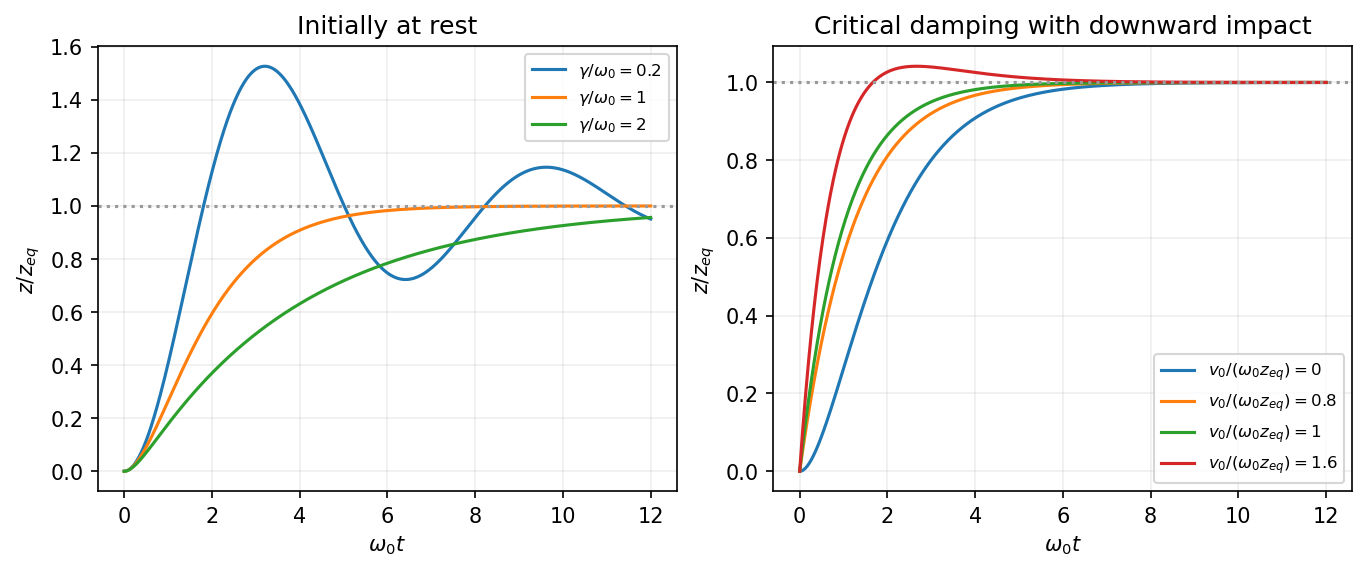


Critical damping gives the fastest nonoscillatory settling from the unloaded rest condition, avoiding a repeatedly swinging reading without the sluggishness of overdamping. Its required coefficient isAt critical damping the repeated characteristic root is . Thus the general displacement under constant load is . The equilibrium and initial conditions give , and , henceSubtracting the final position gives . The exponential is positive and the bracket starts negative. It becomes positive at some if and only if its slope is positive. Therefore critical-damping overshoot from initial velocity requireswith positive downwards. At equality the scale still approaches from below. Critical damping prevents oscillatory modes, but does not guarantee a non-overshooting response to an arbitrarily large impact velocity.
A position-dependent force is a conservative force when its work depends only on endpoints. Equivalently, its work around any closed allowed path vanishes, and one can define a potential energy satisfyingThe potential is defined up to an additive constant. A vanishing curl, , is a local test; it guarantees a global single-valued potential on a simply connected region with suitable regularity. Holes or excluded singularities require checking the global path condition.
The work-energy theorem gives . For a static potential this implies . If depends explicitly on time, then instead under that force alone. Friction and other nonconservative forces add their own power and can convert mechanical energy into heat.
Examples include the gravitational potential energy outside a spherical mass and the electrostatic energy , where . For a point source charge , , giving attraction or repulsion through the sign of . A spring has and force . An equilibrium has ; a strict local minimum is stable against small displacements when the quadratic curvature is positive. Expanding about that minimum explains the harmonic restoring force used in many small-oscillation models.
Magnetic force on a moving point charge does no work, but it is velocity-dependent and is not generally a position-only force . Likewise a time-varying magnetic flux induces a circulating electric field with , so that electric field cannot globally be represented solely by an electrostatic scalar potential. These distinctions prevent treating every field force as conservative simply because an energy description exists for the complete system.
A conservative vector field has path-independent work: the integral depends only on its endpoints. Equivalently, the line integral around every closed path in its domain vanishes. One can then define a single-valued potential energy byThe arbitrary additive constant in has no effect on the force. A useful zero is often chosen at infinity for a localized attractive interaction.
A differentiable conservative force has because the curl of a gradient vanishes. Conversely, a smooth curl-free field on a simply connected domain admits a global scalar potential. The domain condition matters: on the punctured plane, has zero curl away from the missing origin but closed-loop work around it. It is not globally conservative there. The existence of a local potential does not establish a single-valued potential throughout a domain with holes.
The work-energy theorem gives for kinetic energy . If all forces are conservative and has no explicit time dependence, thenThis is conservation of mechanical energy. In one dimension, an equilibrium occurs at ; a local minimum with is stable, while a maximum with is unstable. Expanding about a minimum gives , producing simple harmonic motion with .
Examples include the spring force with , the near-surface gravitational force with , and the central Newtonian gravitational field with . An electrostatic force on a fixed electric charge has , where is the electric potential.
Sliding friction provides a contrasting physical test: traversing a closed path still dissipates mechanical energy, since the frictional force opposes the local motion on both outward and return legs. Its work depends on path length and cannot be represented by a position-only . Total energy can remain conserved when the resulting internal energy is included. Also, even if at each instant, explicit time dependence gives ; a static conservative-field argument alone does not guarantee constant mechanical energy in that situation.
The starting radius is . In uniform circular motion, the required centripetal acceleration has magnitude . The initial velocity must be tangent to the starting radius, with the orientation chosen anticlockwise:The resulting trajectory isIt has constant , soThis is the horizontal line in the right panel of the figure. The kinetic energy also equals , giving total mechanical energy , twice that for release from rest at the same point.
The string's no-slip condition gives . Conservation of mechanical energy from release to the stated height drop yieldsSolving for the spool's moment of inertia,The axle does no work because its point of application is fixed, and the ideal string and axle introduce no losses. The spool mass is not needed to infer from this energy measurement.
Astrophysical jets are directed plasma outflows whose bulk energy and momentum remain concentrated near an axis over distances much larger than the launch region. They occur around accreting black holes and neutron stars and in forming stellar systems, with very different characteristic speeds and scales. An accretion reservoir supplies binding energy; a rotating black hole can additionally provide spin energy through electromagnetic stresses. An observed jet therefore does not uniquely identify either a black hole or a particular launch mechanism.
Magnetic fields couple the rotating engine to the outflow. Gas tied to suitable open field lines can be accelerated centrifugally from a disc; a large-scale poloidal field threading a rotating hole can support outward electromagnetic energy flux. Farther out, magnetic stresses, hoop stresses and external pressure can aid collimation. Pressure-driven acceleration, magnetic-to-kinetic conversion and entrainment depend on loading and environment. A simple stationary axisymmetric picture does not guarantee stability against kinks, mixing or disruption.
The emission commonly contains synchrotron radiation from relativistic electrons spiraling in magnetic fields. Its broad continuum and linear polarization constrain the particles and ordered field component; inverse Compton scattering can extend radiation to higher photon energies. Compact knots can be shocks or moving patterns rather than individual material parcels. Interaction with the surroundings creates shocks, hotspots, cocoons and radio lobes, transporting energy far beyond the central emission region.
Relativistic viewing effects are crucial. If a feature moves at speed at angle toward the observer, its Doppler factor isA comoving emission frequency is observed at . For a discrete isotropically emitting moving feature with spectral index , the flux enhancement scales as in the usual unresolved-blob approximation. Continuous-jet conventions give a different exponent, so apparent brightness is not a direct orientation-free jet-power measurement.
Light-travel delays also produce apparent superluminal motion. In a source time interval , the transverse displacement is , but the observer receives the two signals separated by . ThereforeThe maximum is , at . An apparent speed above violates no local speed limit. The receding jet is deboosted, so an intrinsically two-sided source may look one-sided; absorption and environmental differences can also contribute.
Jets feed back on their host systems by depositing mechanical energy, inflating cavities, accelerating particles and modifying surrounding gas. Radio luminosity measures only part of that budget; unseen ions, magnetic fields, radiative losses and work on the environment all matter. Connecting the compact engine to a large lobe therefore requires both relativistic emission physics and the dynamics of its surroundings.
The canonical momenta areThe Legendre transform cancels the velocity-linear magnetic term, giving the energy expressed in velocities,But Hamilton's equations differentiate with respect to canonical coordinates and momenta, not velocities. In its proper canonical variables the same Hamiltonian isIt explicitly contains because canonical angular momentum differs from mechanical angular momentum. This reconciles magnetic forces with the absence of magnetic work: the magnetic field can exchange radial and tangential motion without changing the total mechanical energy.
A particle constrained to a stationary smooth surface of revolution under uniform gravity conserves and mechanical energy per unit mass. Substitute and into that energy to obtainThis proves the radial reduction. Simple roots of are turning points; a stationary point supports an exact circular orbit. At a local maximum of , another trajectory at the same energy can approach the orbit asymptotically as a separatrix. Existence of roots elsewhere is insufficient for confinement: their dynamically accessible ordering relative to the launch radius matters.
Release of a double pendulum into both normal modes Created 2026-10-18 Updated 2026-10-20
Release the upper rod at radians while keeping the lower rod vertical, , with both angular velocities zero. The initial condition is the sum . The solution from linearization is thereforeAt release the lower angle vanishes by cancellation between the two normal modes. Their different angular frequencies then destroy that cancellation. Differentiating twice gives and , agreeing with the small-angle limit of the exact double pendulum equations of motion.
The quadratic mechanical energy at release is . Each normal mode contributes half, because . Equal coordinate amplitudes need not mean equal energies in general; here the modal inertias and squared angular frequencies happen to compensate. Releasing instead along or , with zero angular velocities, excites just one normal mode.
Secular tidal torque 2026-10-14
A secular tidal torque is the torque remaining after averaging the changing tidal interaction over fast orbital and rotational motion. The misaligned tidal deformation lets the companion's gravity change the spin angular momentum; the orbit receives the opposite torque. Tidal dissipation converts mechanical energy into heat, while total angular momentum is conserved in an isolated system. Thus the spin-orbit coupling exchanges angular momentum rather than destroying it. [ref]
https://link.springer.com/article/10.1007/s11214-024-01055-4. Fuller, Guillot, Mathis and Murray (2024): tidal dissipation in giant planets
.For intuition near synchronous rotation on a circular orbit, hold mean motion and moment of inertia fixed and adopt the illustrative linear dissipative lawHere is spin angular velocity, is a marked surface direction in an inertial frame, and is a response coefficient, not a universal material constant. A faster spin is slowed and a slower prograde spin is accelerated. The solution and the associated mechanical power loss areThe orbital contribution to this power is , and the spin contribution is ; their sum becomes heat. Holding fixed is a local approximation to the coupled evolution. Actual secular tidal torque depends on the deformation response and orbital eccentricity, so this simple law does not establish which spin-orbit resonance an eccentric body captures into.