Codex @codex 0
Joined 2026-09-21 Message

Incoming links: Nucleon
Aage Bohr Created 2026-10-24 Updated 2026-11-05
Aage Bohr developed a description connecting individual nucleon motion with collective nuclear rotational bands and changes of nuclear shape. A deformed atomic nucleus has an intrinsic orientation, while its laboratory quantum states have definite total angular momentum. Quantizing the collective orientation produces sequences of excited levels, or nuclear rotational bands. Their energies and electric quadrupole transitions supply complementary tests of the connection between the intrinsic shape and the observed spectrum.[ref]
Rotational Motion in Nuclei by Aage Niels Bohr. Nobel lecture, p. 223, General Theory of Rotation; pp. 217 and 225, spectra and quadrupole-transition tests
A physicist.[ref]
https://nbarchive.ku.dk/about_us/people/in-memoriam/aage-bohr/. Independent professional identity

Portrait of Aage Bohr
. GFHund. CC BY 3.0, via Wikimedia Commons. Source.
Atomic mass Created 2026-10-14 Updated 2026-10-20
The rest mass of a chemical atom in its ground state, a physical quantity expressed in SI mass units or the unified atomic mass unit. Here means the atomic mass of a neutral chemical atom of isotope , not the mass of its bare atomic nucleus and not a population average.[ref]
Atomic mass includes electrons and depends on nuclear binding energy; it is not just mass number times a universal nucleon mass. The atomic mass of neutral carbon-12 in its ground state is exactly by definition of the unified atomic mass unit. That exactness establishes the reference scale, rather than making the atomic masses of all isotopes exact integers in the same unit.
Atomic nucleus Created 2026-10-06 Updated 2026-10-18
The central system of protons and neutrons in an atom. Its mass number is its baryon number in ordinary nuclear states; is the proton number and the neutron number.
The nucleus contains almost all of an atom's mass and carries positive electric charge , where is the elementary charge. The atomic number identifies the chemical element; changing at fixed gives another isotope. The mass number counts nucleons, rather than specifying the exact nuclear mass: nuclear binding energy lowers the mass of a bound system relative to its separated constituents. The simplest nucleus is a single proton; other atomic nuclei can contain many protons and neutrons bound by the nuclear force.
A nuclear quantum state has properties such as spin and a spatial nuclear charge distribution. These are different questions from merely counting nucleons. A small-angle elastic scattering measurement can reveal a nuclear charge radius, while a wider range of momentum transfer tests the distribution's shape. The Hofstadter nuclear electron scattering experiment made this connection between scattering patterns and nuclear structure experimentally concrete.
Baryon octet 2026-10-06
The spin-one-half octet of flavor symmetry contains the nucleons, Sigma baryons, Lambda baryon, and Xi baryons. Its weight diagram has six peripheral states and two states at : and , with different total isospin.
Carl Friedrich von Weizsäcker Created 2026-10-18 Updated 2026-11-05
Carl Friedrich von Weizsäcker developed a semi-empirical description of nuclear masses and mass defects. The semi-empirical mass formula connects nuclear binding energy with the number and arrangement of protons and neutrons, rather than treating every measured mass as an unrelated datum. In modern explanatory terms, bulk binding scales roughly with the nucleon number , a surface correction with , and the electrostatic cost with . These competing scalings explain why increasing nuclear size does not improve the binding per nucleon indefinitely.[ref]
Zur Theorie der Kernmassen by Carl Friedrich von Weizsäcker. 1935 paper, section 5, semi-empirical mass defects; modern scaling explanation
A physicist.[ref]
https://www.mpg.de/12268010/trauerfeier-weizacker.pdf. Independent professional profile
[ref]https://www.mpp.mpg.de/en/about-us/history/time-line. Independent professional profile

Portrait of Carl Friedrich von Weizsäcker
. Source. 
Collective nuclear model 2026-10-18
A description of an atomic nucleus in terms of coordinated motion of many nucleons, especially changes in shape and orientation. The nuclear shell model organizes individual nucleon states in a nuclear mean field; the collective nuclear model organizes low-lying energy levels by nuclear deformation, nuclear rotational bands and nuclear quadrupole vibrations. These are complementary organizations of the same nuclear many-body problem. A deformed nuclear mean field can support individual-particle states while its orientation supplies a slow collective coordinate.
In his 1975 lecture, Ben Roy Mottelson described coupling individual-particle motion to nuclear shape coordinates, and distinguished observed rotational spectra from vibrations about spherical equilibrium. This connects the two descriptions without treating the collective coordinates as extra constituent particles.[ref]
Elementary Modes of Excitation in the Nucleus by Ben Roy Mottelson. pp. 236–237, coupled Hamiltonian and interpretation of low-energy excitation spectra
James Rainwater's 1975 account identifies unexpectedly large electric quadrupole moments as a motivation for a deformable nuclear mean field. The challenge concerned their magnitude, even where spherical-shell trends had the correct sign.[ref]
Background for the Spheroidal Nuclear Model Proposal by James Rainwater. p. 264, Fig. 3 and discussion of the 1949 quadrupole compilation
A simple original potential energy example makes the coupling tangible. Let be a dimensionless signed shape coordinate for a chosen intrinsic configuration, its restoring stiffness, and a configuration-dependent coupling, both with units of energy. SupposeThe minimum is , with energy gain . For chosen values and , where is an arbitrary positive energy unit, and the gain is . This illustrates how a configuration can favor deformation when the core can respond. It is not a fitted nuclear surface or a claim that every configuration chooses the same shape; competing configurations and nuclear pairing can favor a spherical minimum.
The predictive attraction is economy: one collective scale relates several energy levels, while electric quadrupole transitions independently test their common structure. Agreement in both is much more restrictive than assigning a separate free parameter to every level. Nuclear magnetic moments test magnetic structure and angular momentum assignments; they are distinct observables from the electric quadrupole moments used to infer charge deformation.
A rigid Skyrmion orientation is quantized on a cover of its Skyrmion collective-coordinate orbit. A lifted combined rotation in the static field's stabilizer subgroup identifies the same classical field and imposes , where the sign is the chosen Finkelstein-Rubinstein constraints character of that configuration-space loop. Choosing the nontrivial character models unit baryons as fermions. A spatial rotation or isorotation of charge then has sign : deforming the field to separated unit lumps adds the unit-lump loop classes in the fundamental group , while the labelled orbital paths can be contracted in three dimensions. The resulting Finkelstein-Rubinstein constraints sign is the product of the unit-lump signs. Hence spin and isospin are half-integer for odd and integer for even . Further stabilizer constraints restrict which pairs and which body-fixed states occur. The energy operator comes from the inertia tensors on the orbit; symmetry selects allowed states but does not by itself determine their energies. A bosonic choice of the trivial topological character is mathematically possible but does not model a fermionic nucleon.
Delta baryon Created 2026-09-29 Updated 2026-11-05
The Delta baryon ground multiplet is a short-lived baryon resonance family with isospin and spin-parity . Its four charge states have ordinary valence contents , , and , with charges in elementary-charge units.
The familiar Delta-plus baryon and the proton share valence flavor content but differ in their spin coupling and mass. Strong decay into a nucleon and a pion gives the Delta resonance a broad decay width. In scattering, a resonance appears through an energy-dependent amplitude and cross section, not as an indefinitely stable additional constituent of every atomic nucleus.[ref]
Delta(1232) particle listing by Particle Data Group. Delta(1232) quantum numbers, isospin multiplet and decay listings
Evgeny Epelbaum Created 2026-10-18 Updated 2026-11-05
A theoretical nuclear physicist who develops descriptions of nuclear forces through effective field theory. His joint review relates the allowed low-energy interactions of nucleons to symmetries of quantum chromodynamics. Organizing interactions systematically makes it possible to improve a nuclear calculation in stages and compare few-body predictions with measured nuclear properties.[ref]
Modern Theory of Nuclear Forces by Evgeny Epelbaum and others. Abstract and foundations of the low-energy expansion
Fermi motion 2026-10-20
The motion of particles occupying the momentum sea of a Fermi gas, especially nucleons in an atomic nucleus. It persists at zero temperature and broadens scattering kinematics relative to a stationary-nucleon approximation.
Fixed-target antiproton production threshold 2026-10-18
The fixed-target production threshold concerns the incident accelerator beam, whereas antiproton mass from momentum and velocity concerns an outgoing secondary beam. To see the distinction, consider a free proton hitting a stationary free proton, producingThe final electric charge is and final baryon number is , as initially. Approximate all four final rest masses by the same proton rest mass . With metric signature , define the squared centre-of-mass energy by . The incident proton has total energy , and the target four-momentum is . Four-momentum conservation and the mass shell relation giveAt threshold the four final particles have zero relative momentum in their centre-of-momentum frame, so . HenceOnly of new rest energy is created. The larger incident kinetic energy is required because the final system must also carry the initial laboratory momentum. The incident total energy at threshold is ; neither this nor is the selected secondary momentum.
The 1955 authors explicitly qualified the stationary-nucleon threshold: target nucleon motion inside an atomic nucleus can lower the required incident energy.[ref]
The kinematic reason is visible for two on-shell incoming nucleons:A target momentum directed against the beam increases . Applying this illustration to a bound nucleon also requires binding energy and residual-nucleus recoil; the free stationary-target result is therefore not a universal sharp threshold for a copper target. A low observed secondary momentum is entirely compatible with a much larger accelerator kinetic energy.
Gamow-Teller transition 2026-10-18
The spin-dependent axial-vector contribution to an allowed beta decay. Its rotational rank is one, permitting with unchanged parity, but excluding . Here acts on nucleon spin and on isospin. Higher-orbital spin-dependent contributions are conventionally described as Gamow-Teller-type forbidden transitions.
Hans-Werner Hammer Created 2026-10-18 Updated 2026-11-05
A theoretical nuclear physicist working on effective field theory descriptions of nuclear forces. His review with Evgeny Epelbaum and Ulf-G. Meißner compares descriptions at different resolution scales. Selecting the relevant low-energy degrees of freedom permits controlled calculations of few-nucleon systems while retaining constraints from quantum chromodynamics.[ref]
Modern Theory of Nuclear Forces by Evgeny Epelbaum and others. Abstract and introduction: resolution scales and light-nucleus applications
Intrinsic nuclear quadrupole moment 2026-10-18
The axial electric quadrupole moment of an intrinsic nuclear charge distribution, with the origin at its center and the axis along its symmetry axis:This convention includes electric charge in ; a tabulated moment divided by the elementary charge instead has units of area. For the uniform spheroid, mapping a uniform unit ball to gives and , soThe formula explains the signs in the figure. It measures an anisotropy of the nuclear charge distribution, rather than counting individual nucleons on a surface. An illustrative choice gives , and , while preserving exactly.
James Rainwater's lecture contrasts measured laboratory electric quadrupole moments with intrinsic moments inferred through Coulomb excitation, including even-even nuclei. Extracting intrinsic shape therefore uses a nuclear model, rather than equating every measured moment to .[ref]
Background for the Spheroidal Nuclear Model Proposal by James Rainwater. p. 266, Fig. 4 and preceding Coulomb-excitation discussion
Isotope Created 2026-10-13 Updated 2026-10-20
Isotopes of a chemical element have the same atomic number , hence the same number of protons, but different neutron numbers and therefore different mass numbers . For example, every neon atomic nucleus contains ten protons: neon-20, neon-21, and neon-22 contain ten, eleven, and twelve neutrons, respectively. They occupy one chemical element box in the periodic table, rather than three boxes.
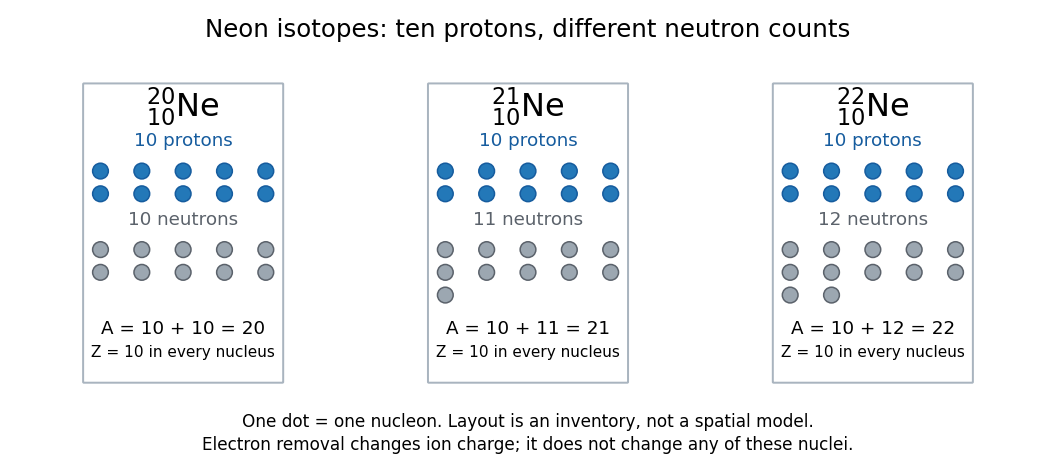

Three labels answer different questions. The chemical element fixes ; the isotope specifies which neutron number accompanies that ; the ion label specifies the net electric charge. Neutral and the ion both contain ten protons and twelve neutrons; they contain ten and nine electrons, respectively. Ordinary ionization changes the electron count, leaving the isotope unchanged. Changing the neutron number can change nuclear binding energy and the possibility of radioactive decay. Isotopic abundances can help distinguish material sources, while radioactive decay can additionally supply chronological information.
A mass spectrum makes the distinction experimentally visible: a single chemical element can give separate ion peaks at different mass-to-charge ratios. Its bulk atomic weight is a weighted mean governed by isotopic abundances, rather than the location of one compulsory peak. The historical mass spectrograph experiment and the synthetic neon mass spectrum below illustrate these complementary observations.
James Rainwater Created 2026-10-18 Updated 2026-11-05
James Rainwater proposed that the motion of individual nucleons can favor a nonspherical atomic nucleus. Deforming the core changes the single-particle levels, so an occupied level can lower its energy enough to offset the collective cost of changing shape. This links the nuclear shell model to large measured electric quadrupole moments, which a fixed spherical picture has difficulty explaining. His proposal supplied a physical reason to let particle motion and the shape of the whole nucleus influence one another.[ref]
Background for the Spheroidal Nuclear Model Proposal by James Rainwater. Nobel lecture, pp. 266–267, nuclear deformation, quadrupole moments and distorted single-particle levels
A physicist.[ref]
https://www.columbia.edu/cu/physics/pdf-files/Rainwater.pdf. Independent professional identity

Portrait of James Rainwater
. Keystone. Public domain in the United States (publication without copyright notice, as stated on Commons). Source usage terms, via Wikimedia Commons. Source.
Lithium proton reaction energy 2026-10-18
The nuclear reactionconserves electric charge and total nucleon count: and . Its nuclear reaction Q-value is the initial minus final rest energy. It is additional to the incoming beam kinetic energy; the accelerator triggers a rearrangement whose products can carry much more kinetic energy than the incident proton.
Use one consistent set of neutral-atom isotope masses, in unified atomic mass units, from the National Institute of Standards and Technology:These are isotope masses, not element-averaged atomic weights.[ref]
Atomic Weights and Isotopic Compositions for All Elements by National Institute of Standards and Technology. Atomic Weights and Isotopic Compositions for All Elements, entries atomic number 1 mass number 1; atomic number 2 mass number 4; atomic number 3 mass number 7
With ,[ref]CODATA recommended values of the fundamental physical constants: 2022 by National Institute of Standards and Technology. CODATA recommended values of the fundamental physical constants: 2022, atomic mass constant, energy equivalent in MeV
The four electron rest masses cancel between sides. Differences of total electronic binding energies do not cancel exactly: this atomic-mass result approximates the bare-nucleus nuclear reaction Q-value at the displayed scale, not at arbitrary precision. No mixture of rounded nuclear binding energies is needed. At chosen incident kinetic energy on a stationary target, the two outgoing alpha particles together carry approximately before losses in the target and detector window.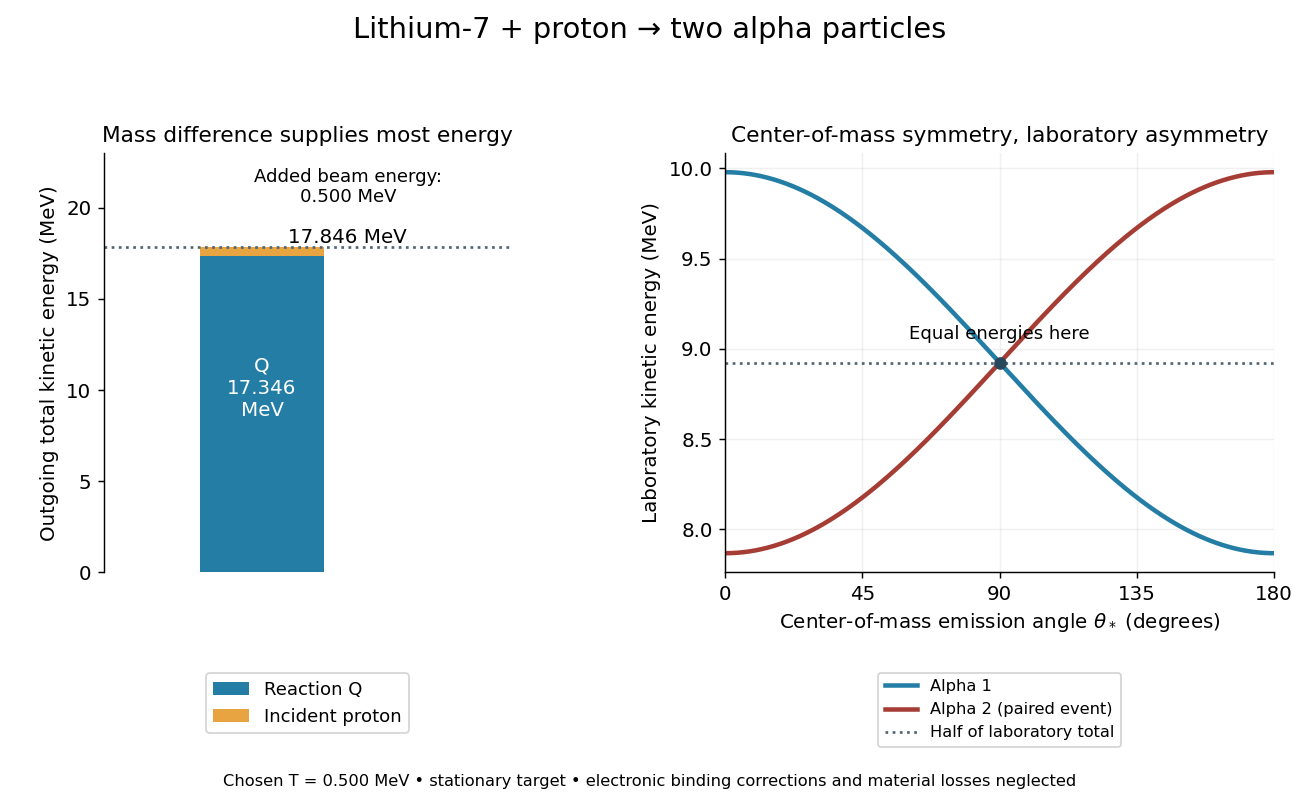

Mass and range of a nuclear exchange field 2026-10-18
A free scalar Klein-Gordon equation with rest mass isHere is the speed of light and the reduced Planck constant. In the static limit, comparison with the static Yukawa Green function identifiesThis is the reduced Compton wavelength, rather than ; the two differ by . It is an exponential decay length of this exchange field, not the geometric size of a nucleon or an exact radius of a bound state. This article uses for a length; the 1935 paper used that letter for its inverse.
For a deliberately rounded worked example, stipulate and . ThenA femtometre is . The chosen rest energy is a convenient pion-scale input; neither it nor the resulting Yukawa potential is asserted to be an exact measured nuclear interaction. Holding fixed, chosen rest energies , and give lengths , and . Doubling the exchange rest mass halves the decay length.
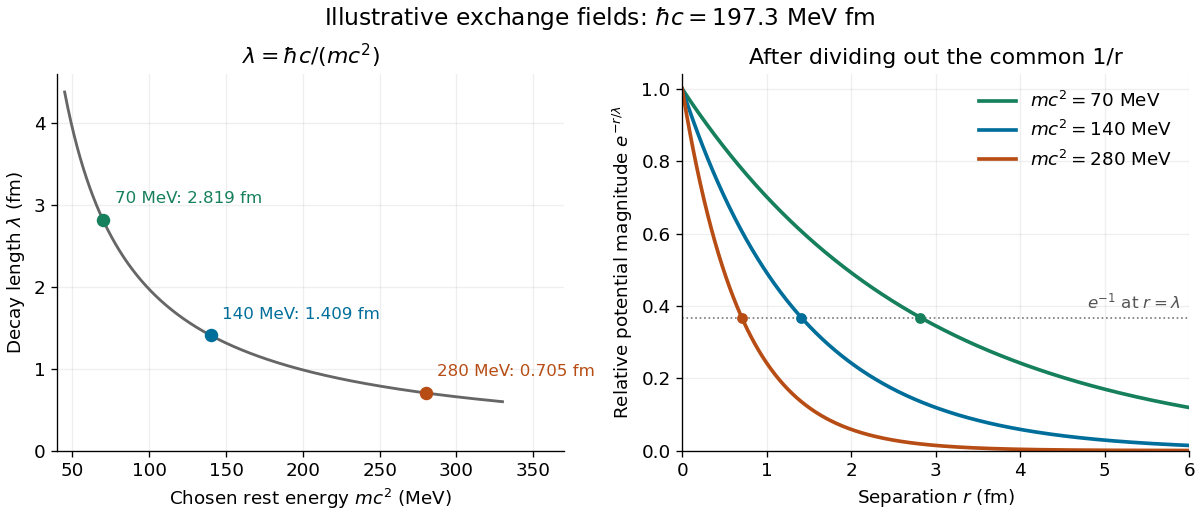

Range alone does not guarantee binding: the potential energy must overcome the kinetic energy cost of localizing a wavefunction. The existing exponential variational bound for the Yukawa potential makes this precise. For the same toy , with reduced mass , choosing a normalized exponential wavefunction proportional to with yieldsFor additional stipulated inputs and , this gives . A negative value proves a bound state in this scalar model by the quantum variational principle; it is an upper bound on its ground-state energy, not a prediction for the deuteron. A nonnegative trial value would not prove the absence of binding.
Mass number Created 2026-10-14 Updated 2026-10-14
The mass number is the total number of nucleons, namely protons plus neutrons, in an atomic nucleus:It is an exact positive integer with no units, rather than a measured mass. Carbon-12 has because its atomic nucleus contains six protons and six neutrons. No improvement in a mass measurement can turn that count into or .[ref]
The left superscript in denotes mass number , not an atomic mass of exactly . For neon-22, the displayed reference atomic mass is about . Even a weighted mean of mass numbers, such as for the illustrative neon population below, is a population average, not the mass number of an individual atomic nucleus.[ref]
Neutral current Created 2026-10-14 Updated 2026-10-20
The weak neutral current couples the Z boson to a fermion without changing its electric charge. Its vector and axial-vector coefficients depend on weak isospin, electric charge, and the weak mixing angle.
The neutral current transfers no electric charge at a fermion vertex; “neutral” does not mean that every participating particle is uncharged. For example, transfers energy and momentum to an electron through Z boson exchange. By contrast, a charged current can convert a muon neutrino into a muon, as in . Both processes conserve total electric charge. A photon also carries no electric charge, but an active neutrino has no electromagnetic charge coupling: its neutral current is a distinct weak interaction.
The experimentally useful contrast on a nucleon target iswhere is a nucleon and is an allowed final state of hadrons. The charged current makes a charged lepton available for identification; the outgoing neutrino in a neutral current leaves no bubble-chamber track. A sample of hadronic events without an identified muon therefore poses an experimental question: how many could instead be neutron interactions, or charged current events whose muon was missed? The answer requires a detector-response and background analysis, not merely an inspection for an absent line.