Field of discrete masses. Newton's law of universal gravitation and superposition give the gravitational field away from the source points:It is the force per unit test mass, with units , and points toward each positive source mass.
Infinite circular cylindrical rod. Let be the radius of the circular cross-section, so , and write for the linear mass density. Choose a coaxial cylindrical Gaussian surface with radius and length . Translation and rotation symmetry make . The end caps have zero field flux because their normals are axial; on the curved surface the outward-normal component is the constant negative value . Gauss's law for gravity therefore givesThe gravitational field of an infinite uniform cylinder inside the material instead has enclosed mass , giving . The exterior result assumes a circular cylindrical rod; area by itself would not specify the exact near field of a noncircular cross-section.
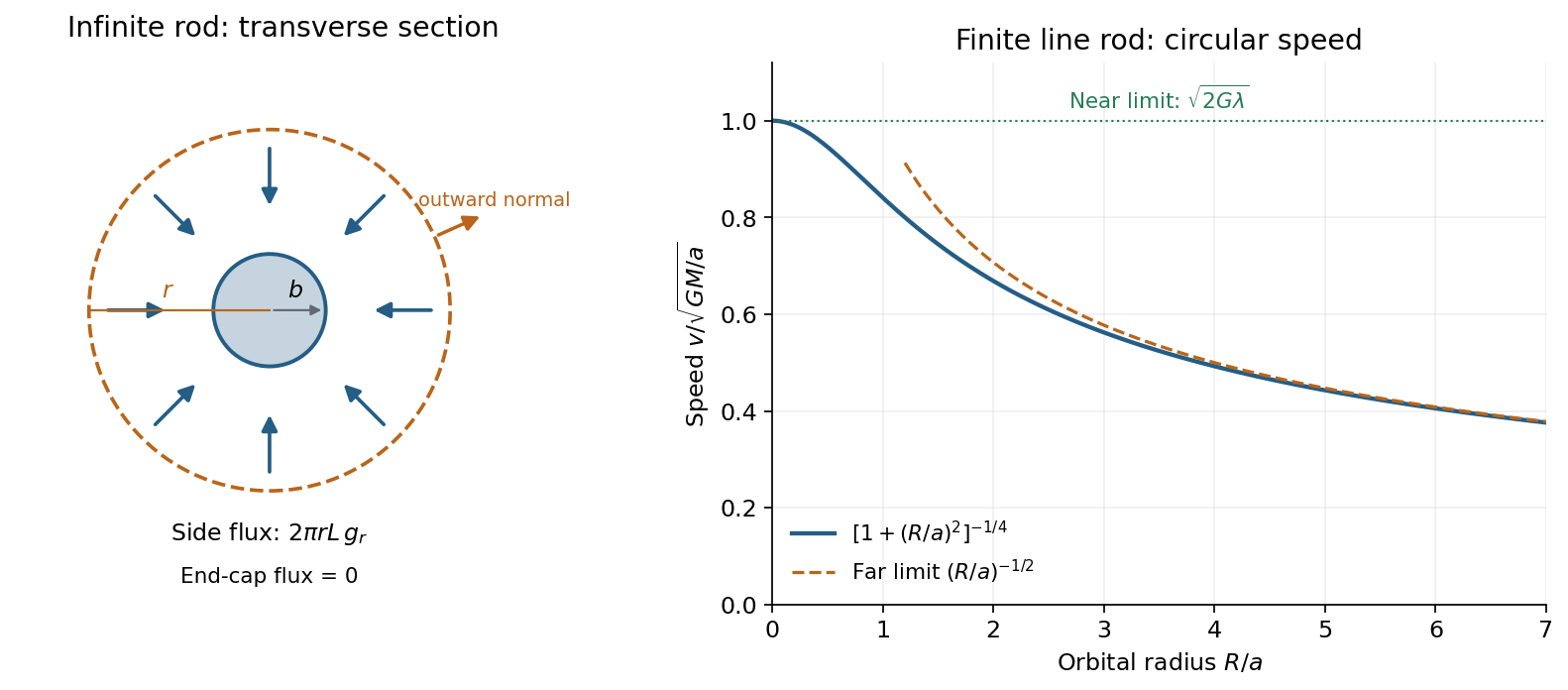
Gaussian-cylinder cross-section for an infinite rod and the circular-speed curve of a finite line rod
. Details. 
In the left panel the dashed circle is a transverse section of the coaxial Gaussian surface; the field points inward and the surface normals outward. Its side area is .
For an exterior circular orbit, Newton's second law equates the force required for centripetal acceleration to gravity:The orbital speed is independent of radius and of the orbiting object's mass, for orbits outside the infinite rod.
Finite rod. Taking the supplied field as the gravitational field of a finite uniform line segment, the corresponding balance at radius isSince , its two limits areThe first reproduces the infinite-rod result: a nearby observer sees a very long source. The second is the familiar circular orbit speed about a point mass, since a distant observer cannot resolve the rod's length. The dimensionless curve isIt starts at a constant plateau and decreases smoothly, approaching an dependence far away. For , , consistent with the sketch.
Derivation of the finite-rod field. Put the source along on the axis. In its central perpendicular plane, an element is at distance . Its field magnitude is , and its inward radial component has the extra factor . The axial components cancel between and . ThusReplacing by givesThe integral treats the source as a line mass. For a finite cylinder of nonzero cross-section, the displayed finite-rod formula is a thin-rod approximation, not an exact field for all . Its near-rod limit should therefore be read as , keeping the orbit outside the material; the apparent line-source singularity at does not describe the interior of a real cylinder.
An electric dipole is a localized pair of opposite electric charges, or more generally a neutral electric charge distribution with nonzero first electric moment. For charges and separated by displacement directed from negative to positive, the electric dipole moment isA neutral molecule can have a permanent electric dipole moment when its positive and negative charge centres do not coincide. An applied electric field can also produce an induced electric dipole moment by distorting an initially nonpolar electric charge distribution.
At distance in vacuum, expand the difference of the two point-charge potentials to first order in the separation. The leading electric potential isThe monopole term cancels because the net electric charge is zero. Taking gives the electric dipole fieldOn the dipole axis its magnitude is and its direction is along ; in the equatorial plane the magnitude is and the field points opposite to . The decay is faster than the field of an isolated point charge.
In a uniform external electric field, the opposite forces on the two charges cancel in their resultant but form a couple. Its torque isFor a fixed permanent electric dipole moment, the interaction potential energy isDifferentiating with respect to orientation recovers the torque. Parallel alignment minimizes and is stable against a small rotation; antiparallel alignment maximizes and is unstable. Rotating a fixed dipole slowly from parallel to antiparallel requires external work .
A nonuniform electrostatic electric field can also exert a net force. Expanding the two charge forces gives , which equals for a fixed dipole in a curl-free electrostatic field. Thus a suitably aligned dipole is attracted toward stronger field. An induced electric dipole moment requires care in computing energy: when for constant isotropic electric polarizability, building the dipole costs energy and the effective interaction is , rather than substituting directly into the fixed-dipole formula. These field, torque and energy effects explain molecular orientation and electric polarization.
A conservative vector field has path-independent work: the integral depends only on its endpoints. Equivalently, the line integral around every closed path in its domain vanishes. One can then define a single-valued potential energy byThe arbitrary additive constant in has no effect on the force. A useful zero is often chosen at infinity for a localized attractive interaction.
A differentiable conservative force has because the curl of a gradient vanishes. Conversely, a smooth curl-free field on a simply connected domain admits a global scalar potential. The domain condition matters: on the punctured plane, has zero curl away from the missing origin but closed-loop work around it. It is not globally conservative there. The existence of a local potential does not establish a single-valued potential throughout a domain with holes.
The work-energy theorem gives for kinetic energy . If all forces are conservative and has no explicit time dependence, thenThis is conservation of mechanical energy. In one dimension, an equilibrium occurs at ; a local minimum with is stable, while a maximum with is unstable. Expanding about a minimum gives , producing simple harmonic motion with .
Examples include the spring force with , the near-surface gravitational force with , and the central Newtonian gravitational field with . An electrostatic force on a fixed electric charge has , where is the electric potential.
Sliding friction provides a contrasting physical test: traversing a closed path still dissipates mechanical energy, since the frictional force opposes the local motion on both outward and return legs. Its work depends on path length and cannot be represented by a position-only . Total energy can remain conserved when the resulting internal energy is included. Also, even if at each instant, explicit time dependence gives ; a static conservative-field argument alone does not guarantee constant mechanical energy in that situation.
Faraday's law of induction relates an induced electromotive force to the rate of change of magnetic flux. Choose a positive orientation around a loop and its associated surface normal by the right-hand rule. For a stationary conducting loop,Unlike an electrostatic field, the induced electric field generally has nonzero curl; the differential form is . For a moving circuit, magnetic flux transport for a moving circuit includes the magnetic Lorentz force on the charges:where is the local wire velocity. Thus changing the field or moving a conductor can produce induction.
The minus sign is Lenz's law: an induced electric current, when a closed conducting path permits it, produces a magnetic field opposing the change of linked flux. It need not oppose the original field itself. For example, increasing flux through a loop produces a current tending to reduce that increase; decreasing the same flux reverses the current. The opposition is consistent with conservation of energy: external mechanical or electrical work is needed to maintain a change against its inductive reaction.
For a coil of turns, define the magnetic flux linkage , reducing to when every turn links the same flux. For fixed geometry and a linear magnetic response, self-inductance is defined by , and the coil's induced electromotive force isThe corresponding terminal voltage drop, with the passive sign convention, is . It opposes changes in electric current; it does not require the current itself to vanish.
Building the current from zero requires power . Integrating gives the energy stored by an ideal inductor:This energy is stored in the magnetic field and can be returned when the current falls. In a series RL circuit driven by a constant voltage , Kirchhoff's voltage law gives . Starting with zero current, , with time constant . This makes the resistance to rapid current changes directly observable. Two coils also have mutual inductance: changing primary current induces secondary electromotive force with a polarity determined by the chosen winding orientations, the principle behind a transformer.
For a light test particle of mass outside a spherical source of mass , Newton's law of universal gravitation gives . It is a central force, so its torque about the source vanishes and angular momentum is conserved. The motion therefore lies in a fixed plane when . Its gravitational potential energy is , and conservation of mechanical energy givesHere is specific orbital energy and is specific angular momentum. A Kepler orbit has polar equationThe angle is measured from periapsis. The conic section is an ellipse for and , a parabola for and , and a hyperbola for and . The circle is the elliptical case. The special case is radial motion and must be handled as a degenerate limit. Bound ellipses have the source at one focus, which is Kepler's first law.
For a bound orbit of semi-major axis , . Combining this with the energy equation gives the vis-viva equation:The particle therefore moves faster near periapsis and slower near apoapsis. Conservation of angular momentum also gives constant areal velocity, , expressing Kepler's second law. Using the ellipse's area and gives the orbital periodwhich is Kepler's third law.
A circular orbit follows from centripetal acceleration , giving and . The minimum escape velocity from radius follows from the marginally unbound condition :These ideal orbits neglect drag force, other gravitating bodies and changes in the central source. For two comparable masses, the relative two-body problem uses instead of . An orbiting object is continuously in free fall; the inward gravitational force changes its direction even when its speed is constant. These inverse-square results assume the physical variation of gravity with radius, rather than extending a near-surface constant- approximation to an entire orbit.
Articles by others on the same topic
There are currently no matching articles.