Vladimir Bulović's organic-optoelectronics course connects molecular excited states with practical light-emitting and photovoltaic devices. Its treatment follows excitons from their creation through diffusion and energy transfer, then asks whether that excitation produces light or collected electric charge. This distinction explains why efficient absorption alone does not guarantee an efficient solar cell or organic light-emitting diode. Comparing molecular energy levels, interfaces and transport makes device behavior understandable from the processes that compete inside the material.[ref]
Organic Optoelectronics lecture notes by Vladimir Bulović. MIT course, lectures 4–10 and 14–20: excited states, exciton transfer, photovoltaics and organic LEDs
MIT lists the instructor of Organic Optoelectronics lecture notes by Vladimir Bulović as Vladimir Bulovic.
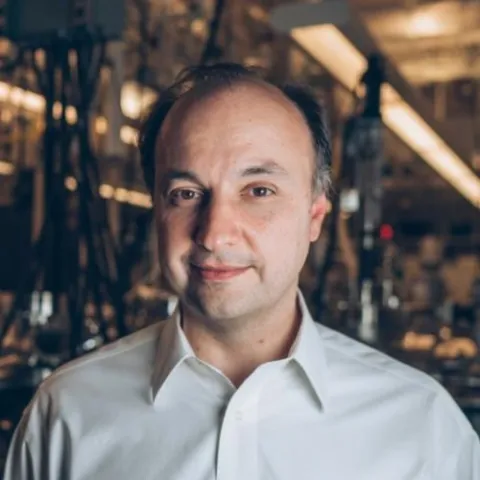
Portrait of Vladimir Bulović
. External portrait hosted by Massachusetts Institute of Technology Energy Initiative. Source.Jeffrey Shapiro develops the quantum optics of optical information and communication. His teaching treatment of optical quadratures explains why a squeezed coherent state can reduce fluctuations of one measured field component while increasing those of its conjugate component. The Heisenberg uncertainty principle constrains their product, rather than requiring equal fluctuations in both components. Comparing these states with coherent states connects the mathematics of a quantum harmonic oscillator with the statistics of optical measurements.[ref]
Quantum Optical Communication lecture 6 by Jeffrey H. Shapiro. slides 7–12, quadrature wavefunctions and squeezed-state measurement statistics
Lecturer named on the cover of Quantum Optical Communication lecture 6 by Jeffrey H. Shapiro.

Portrait of Jeffrey Shapiro
. Cute edison. CC BY-SA 3.0, via Wikimedia Commons. Source.
A technical author whose X-ray system manual explains how instrument geometry turns a detected intensity into a diffraction measurement. Coupled crystal and detector rotation maintains the reflection geometry while the angle is scanned. The description links a mechanical arrangement with the angles needed to analyze Bragg diffraction.[ref]
A researcher who coauthored the 2019 variable-support physical pendulum experiment with Martín Monteiro, Cecilia Stari and Cecilia Cabeza. Comparing several ways to measure the same period makes the experiment a practical check of both rigid-body dynamics and measurement consistency.[ref]
A coauthor with Martín Monteiro, Cecilia Stari and Arturo C. Martí of a 2019 experiment on a physical pendulum. Their apparatus uses a smartphone as part of the oscillating system as well as a measuring device, so the phone’s contribution to the moment of inertia enters the prediction.[ref]
Experimental analysis of a physical pendulum with variable suspension point by Martín Monteiro and others. Author list; p. 2: bar and phone contributions to the moment of inertia
A coauthor of the 2019 physical pendulum study with Martín Monteiro, Cecilia Cabeza and Arturo C. Martí. Moving the support changes both the restoring torque and the moment of inertia, giving students a measurable test of how mass distribution controls a period.[ref]
David Tong's electromagnetism lectures connect macroscopic fields with the response of matter. Their treatment of Thomas-Fermi screening derives how an electron gas rearranges around an electric potential and relates the screening length to the electronic density of states. Comparing this local approximation with Friedel oscillations shows why a useful long-wavelength theory need not reproduce the far-field oscillatory response. The example makes the assumptions behind an effective material model physically explicit.[ref]

Portrait of David Tong
. Portrait from the Trinity College Cambridge profile.- Applications of Quantum Mechanics by David Tong
- Classical Dynamics by David Tong
- Classical Gases by David Tong
- Classical Thermodynamics by David Tong
- Cosmology by David Tong
- Electromagnetism by David Tong
- Fluid Mechanics by David Tong
- Gauge Theory by David Tong
- General Relativity by David Tong
- Kinetic Theory by David Tong
- Lectures on the Quantum Hall Effect by David Tong
- Phase Transitions by David Tong
- Quantum Field Theory by David Tong
- Quantum Gases by David Tong
- Quantum Mechanics by David Tong
- Solid State Physics by David Tong
- Statistical Field Theory by David Tong
- Statistical Physics by David Tong
- Statistical Physics by David Tong 1 The Fundamentals of Statistical Mechanics
- Stochastic Processes by David Tong
- String Theory by David Tong
- The Fundamentals of Statistical Mechanics by David Tong
- Topics in Quantum Mechanics by David Tong
- Yang-Mills Theory by David Tong
A researcher in optical tweezers and lead author of a 2020 tutorial on their calibration and applications. The tutorial explains how to turn trapped-particle fluctuations into quantitative measurements of forces, and compares trapping in liquids with trapping in vacuum, where much weaker damping changes the dynamics. Applications range from mechanical measurements on individual molecules to tests of statistical physics.[ref]
Optical Tweezers: A Comprehensive Tutorial from Calibration to Applications by Jan Gieseler. Abstract and §§2–3: calibration; later sections: liquid and vacuum applications
A physicist and educator whose work includes undergraduate research in space physics and the joint authorship of University Physics Volume 1 by William Moebs and others. The text connects geometrical and component descriptions of vectors, so students can translate a diagram of motion or forces into equations without confusing a quantity with one particular coordinate representation.[ref]
University Physics Volume 1 by William Moebs and others. Preface, About the authors: space-physics research group; §2.1: vector constructions and components
- University Physics Volume 1 by William Moebs and others
- University Physics Volume 1 by William Moebs and others 2.1 Scalars and Vectors
- University Physics Volume 1 by William Moebs and others 2.2 Coordinate Systems and Components of a Vector
- University Physics Volume 2 by Samuel J. Ling and others
- University Physics Volume 3 by Samuel J. Ling and others
A researcher in experimental physics education who, with Cecilia Stari, Cecilia Cabeza and Arturo C. Martí, studied a physical pendulum with a movable suspension point. The experiment compared smartphone and photogate measurements of its period with predictions using the parallel axis theorem.[ref]
Experimental analysis of a physical pendulum with variable suspension point by Martín Monteiro and others. Abstract: variable suspension point, three measurements and theoretical comparison
Matthew Sands coauthored The Feynman Lectures on Physics, Volume I by Richard Feynman and others with Richard Feynman and Robert B. Leighton. Their account of refractive index derives the delayed phase of light in matter from the superposition of incident light and radiation driven from electric charges. The oscillation frequency remains fixed at an interface, while phase velocity and wavelength change. This gives a microscopic explanation of refraction without imagining that the whole field simply stops at each atom.[ref]
Chapter 31: The Origin of the Refractive Index. section 31–1, driven-charge and interference treatment; whole-book joint authorship

Los Alamos badge photograph of Matthew Sands, approximately 1943-1947
. Los Alamos Laboratory, via Wikimedia Commons. The linked source reproduces the laboratory's attribution notice and reuse terms; the crop was made by Commons contributor LittleDwangs. Source.
- The Feynman Lectures on Physics, Volume I by Richard Feynman and others
- The Feynman Lectures on Physics, Volume I by Richard Feynman and others Chapter 28: Electromagnetic Radiation
- The Feynman Lectures on Physics, Volume I by Richard Feynman and others Chapter 31: The Origin of the Refractive Index
- The Feynman Lectures on Physics, Volume II by Richard Feynman and others
- The Feynman Lectures on Physics, Volume III by Richard Feynman and others
Robert B. Leighton coauthored The Feynman Lectures on Physics, Volume I by Richard Feynman and others with Richard Feynman and Matthew Sands. Its radiation treatment connects the motion of a electric charge with a transverse electromagnetic field observed far away. The component of acceleration perpendicular to the viewing direction determines the angular pattern in the nonrelativistic example. This links an observable light pattern to source motion, rather than introducing radiation only as a formula for total power.[ref]
Chapter 28: Electromagnetic Radiation. sections 28–2–28–3, transverse acceleration and dipole geometry; whole-book joint authorship

Robert B. Leighton working on a Leighton dish in 1974
. Wikimedia Commons credits contributor PopePompus; the scene is identified as Robert B. Leighton working on a Leighton dish in 1974. Creative Commons Attribution-ShareAlike 4.0 International (as declared on the File page), via Wikimedia Commons. Source.
- The Feynman Lectures on Physics, Volume I by Richard Feynman and others
- The Feynman Lectures on Physics, Volume I by Richard Feynman and others Chapter 28: Electromagnetic Radiation
- The Feynman Lectures on Physics, Volume I by Richard Feynman and others Chapter 31: The Origin of the Refractive Index
- The Feynman Lectures on Physics, Volume II by Richard Feynman and others
- The Feynman Lectures on Physics, Volume III by Richard Feynman and others
A physicist whose research includes particle and atomic physics, and a coauthor of University Physics Volume 1 by William Moebs and others. His teaching contribution includes a systematic approach to solving physics problems: identify the relevant physical principles before performing algebra, then assess whether the result is consistent with the modeled situation.[ref]
University Physics Volume 1 by William Moebs and others. Preface, About the authors: research areas; problem-solving features and worked examples
- University Physics Volume 1 by William Moebs and others
- University Physics Volume 1 by William Moebs and others 2.1 Scalars and Vectors
- University Physics Volume 1 by William Moebs and others 2.2 Coordinate Systems and Components of a Vector
- University Physics Volume 2 by Samuel J. Ling and others
- University Physics Volume 3 by Samuel J. Ling and others
Rüdiger Paschotta develops technical explanations of photonics through the RP Photonics Encyclopedia by Rüdiger Paschotta. Its treatment of refractive index distinguishes the phase velocity of a monochromatic wave from the propagation of a pulse envelope. Because the index depends on frequency, the two velocities generally differ; this dispersion matters when predicting pulse delay and broadening. The explanation connects a material parameter used in optical design with a measurable propagation process.[ref]
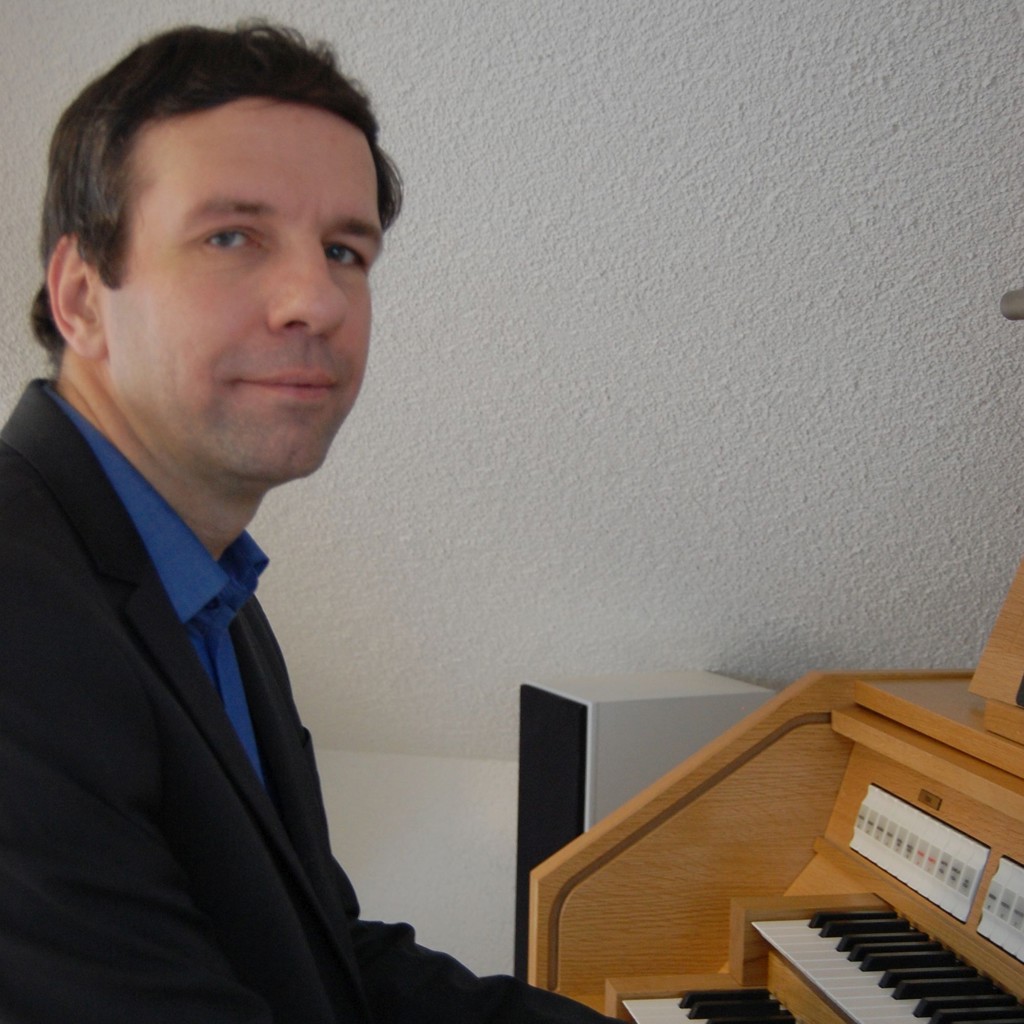
Portrait of Rüdiger Paschotta
. External portrait hosted by Optica. Source.Matjaž Humar explained how quantum confinement changes the optical properties of semiconductor quantum dots. Confinement raises electronic energy scales and modifies exciton states, so changing a dot's size can shift its absorption and fluorescence spectra. His treatment distinguishes regimes by comparing the dot size with the exciton's internal size and the wavelength of its motion. This prevents a bulk bound-pair model from being applied unchanged to a much smaller nanocrystal.[ref]
Excitons in Semiconductor Quantum Dots by Matjaž Humar. abstract and section 4, weak/intermediate/strong confinement regimes

Portrait of Matjaž Humar
. External portrait hosted by Humar Lab, Jožef Stefan Institute. Source.A physics educator whose joint work turned a Stirling engine into a quantitative thermodynamics demonstration. A moving mirror and laser spot trace changes in pressure and volume. The enclosed loop makes pressure-volume work visible, connecting the engine’s moving pistons with an energy balance.[ref]
A researcher whose joint teaching experiment displayed the pressure-volume cycle of a Stirling engine. Heating one part of the cylinder and water-cooling another drives repeated expansion and compression. The resulting diagram lets students distinguish a complete engine cycle from a single gas-expansion process.[ref]
Demonstration experiments with a Stirling engine by Christopher G Deacon and others. pp. 180–181: heated and cooled regions and pressure-volume demonstration
A contributor to experiments that use a Stirling engine to demonstrate both a heat engine and refrigeration. Driving the apparatus mechanically reverses its function: instead of extracting work from a temperature difference, it moves heat between regions. The same machine therefore connects two thermodynamic operating modes.[ref]
Demonstration experiments with a Stirling engine by Christopher G Deacon and others. pp. 180–183: engine operation and refrigerator/heat-pump demonstrations
A physics researcher whose joint demonstration used a Stirling engine with a copper-wool regenerator. Gas passing between hot and cold regions temporarily transfers heat to this material and retrieves it on the return passage. The apparatus gives a concrete illustration of internal heat recovery during a thermodynamic cycle.[ref]
Demonstration experiments with a Stirling engine by Christopher G Deacon and others. p. 180 and Fig. 1: central regenerator and alternating heat exchange
An engineering educator whose joint dynamics lectures derive the inertia tensor from a distribution of mass. For a general rigid body, angular momentum need not point along angular velocity. Expressing their relationship as a linear transformation makes the geometry of three-dimensional rotation calculable and reveals the simplifying role of a principal axis.[ref]
Lecture L26 - 3D Rigid Body Dynamics: The Inertia Tensor. Printed pp. 1–3: angular momentum, moments and products of inertia
An engineering educator whose joint lecture on rigid body dynamics explains how a body’s shape enters its rotational equations through the inertia tensor. Integrating products of position coordinates over the mass distribution supplies the tensor components. Choosing principal axis directions then removes the cross terms, making the relationship between angular velocity and angular momentum easier to interpret.[ref]
Lecture L26 - 3D Rigid Body Dynamics: The Inertia Tensor. Printed pp. 2–5: inertia components and principal axes
A physics educator and coauthor of College Physics by Paul Peter Urone and others. The textbook uses a consistent problem-solving approach that connects a physical situation with an equation and a reasoned check of the answer. Everyday and biomedical examples let students apply the same mechanics, thermodynamics and electromagnetism to practical questions rather than treating each equation as an isolated rule.[ref]
College Physics by Paul Peter Urone and others. Preface: senior contributing authors, applications and problem-solving approach
A physics educator and coauthor with Paul Peter Urone of College Physics by Paul Peter Urone and others. The book’s use of worked examples and conceptual questions emphasizes the interpretation of a calculation as well as its numerical result. Linking principles such as energy conservation to applications helps students recognize the same physical model in different settings.[ref]
College Physics by Paul Peter Urone and others. Preface: senior contributing authors, worked examples and conceptual applications
A contributor to teaching modules that explain why viscosity remains important near a wall even at large Reynolds number. Within a thin boundary layer, rapid changes in velocity across the flow compensate for the small viscous coefficient. This balance yields simpler equations while preserving the no-slip boundary condition that an inviscid model loses.[ref]
A contributor to mathematical treatments of boundary layers that connect scaling arguments with calculable velocity profiles. The joint teaching notes reduce steady flow over a flat plate to the Blasius equation by combining streamwise distance and distance from the wall into a similarity variable. The reduction turns a spatial flow problem into an ordinary differential equation.[ref]
A contributor to fluid-mechanics teaching that connects an apparently thin boundary layer with measurable resistance. The notes distinguish displacement thickness, which describes missing volume flow, from momentum deficit and wall stress. These integrated quantities let a reader relate the local velocity profile to the overall effect of a wall on the surrounding flow.[ref]
Rex Tayloe's germanium laboratory treatment uses the Hall effect together with electrical conductivity to investigate electric charge carriers. A transverse voltage gives a sign-sensitive Hall response, while a longitudinal measurement supplies the conductivity. In a one-carrier model, combining the two separates carrier density from mobility: and . The interpretation requires a carrier model; simultaneous electron and hole contributions cannot generally be reduced to one unrestricted density estimate.[ref]
The Hall Effect and Conductivity in Germanium by Rex Tayloe. laboratory manual, Hall coefficient, resistivity and carrier interpretation

Portrait of Rex Tayloe
. External portrait hosted by Indiana University Bloomington Department of Physics. Source.Barton Zwiebach's quantum-physics teaching derives probability current from the Schrödinger equation. Comparing the equation with its complex conjugate converts change of local probability density into the divergence of a flux. A wavefunction's spatial phase therefore determines motion that its magnitude alone does not reveal. The derivation connects a complex amplitude with conservation of total probability when no flux escapes through the boundary.[ref]

Portrait of Barton Zwiebach
. Lubos Motl (Lumidek). Public domain (released worldwide by author Lumidek). Source usage terms, via Wikimedia Commons. Source.
An optical scientist whose teaching connects etendue with the practical limits of illumination design. Etendue combines the area occupied by a beam with its spread in propagation directions, weighted by refractive index. Its conservation in an ideal optical system constrains how much light a lens or reflector can concentrate. This provides a useful feasibility check before attempting a detailed optical design.[ref]
Étendue (Photon Snacks) by R. John Koshel. pp. 1–3, Eq. (1.1) and Fig. 1: definition, lossless-system restrictions and phase-space interpretation
An author of a detailed technical treatment of the optics of telescopes. His exposition connects optical aberrations, diffraction and instrument geometry with the appearance of an image. Comparing ideal and imperfect optical systems helps readers judge how a proposed telescope design will concentrate light and what limits the sharpness of its image.[ref]
Amateur Telescope Optics by Vladimir Sacek. Contents: diffraction, image quality and telescope aberrations; homepage publication credit
An engineering educator whose joint thermodynamics text emphasizes choosing a thermodynamic system before applying an energy balance. A heater can transfer energy as electrical work across one boundary and as heat across another. The distinction depends on the selected system, making explicit boundaries essential when interpreting an apparatus.[ref]
An engineering educator whose joint course notes use thermodynamics to analyze energy conversion. Their treatment of a moving piston distinguishes the gas pressure from the external pressure that determines work on the surroundings. The two can be equated only under suitable mechanical conditions, preventing a misleading use of equilibrium formulas during rapid or freely expanding processes.[ref]
An engineering educator whose joint teaching text connects the first law of thermodynamics with practical energy bookkeeping. The change in stored internal energy differs from the heat and work transferred during a process. Separating a state function from transfers across a system boundary helps compare different ways of taking the same material between two states.[ref]
Thermodynamics and Propulsion. §§1.3 and 2.1: transfer mechanisms, stored energy and first-law sign conventions
James M. Fiore's circuit-analysis laboratory manual connects network equations with actual voltage and current measurements. Testing Kirchhoff's voltage law and Kirchhoff's current law requires consistent choices of reference directions and node potentials, while the measuring instrument itself can load the circuit. Comparing predicted and measured values therefore tests both the circuit model and the measurement arrangement. This gives a physical reason to distinguish ideal components from a laboratory realization.[ref]
Laboratory Manual for DC Electrical Circuit Analysis by James M. Fiore. DC circuit laboratory treatments of network laws and measured circuit behavior

Portrait of James M. Fiore
. Portrait from the Mohawk Valley Community College profile.A scientific teaching contributor credited with preparing the IAEA slide set on X-ray production. The material distinguishes continuous bremsstrahlung from discrete Characteristic X-rays and relates both to the operation of an X-ray tube. That distinction helps students interpret a tube’s output spectrum in terms of different physical mechanisms.[ref]
Chapter 5: X-Ray Production (teaching slides) by K. P. Maher. Title slide: slide-preparation credit; §§5.2–5.3: production mechanisms and tube components
A scientific author credited with the chapter underlying the IAEA teaching slides on X-ray production. The treatment links electron acceleration, target interactions and tube design with the emitted X-ray spectrum. This connects the physical origin of radiation with the practical variables used to control a laboratory or diagnostic source.[ref]
A scientific teaching contributor credited with the initial work used for an IAEA slide set on X-ray production. The shared material explains how tube operating conditions and filtration change the radiation output, helping distinguish the amount of radiation from the distribution of photon energies.[ref]
A physics educator whose work with Paloma Alameda-Meléndez makes particle detection accessible through a homemade diffusion cloud chamber. An alcohol reservoir above a dry-ice-cooled base creates a sensitive vapor layer. Ionization along a passing particle’s path triggers droplets, turning an invisible trajectory into a visible track without a particle accelerator.[ref]
Bringing Particle Physics to Life: Build Your Own Cloud Chamber by Francisco Barradas-Solas and Paloma Alameda-Meléndez. The continuously sensitive diffusion cloud chamber; Assembly and operation
A physics educator whose joint classroom experiment uses a cloud chamber to connect particle detection with observable condensation. The chamber’s temperature gradient creates vapor that condenses along ionized tracks. Illumination at a low angle reveals those tracks, letting students investigate naturally occurring cosmic rays with simple optical and thermal equipment.[ref]
Bringing Particle Physics to Life: Build Your Own Cloud Chamber by Francisco Barradas-Solas and Paloma Alameda-Meléndez. Assembly and operation: dry-ice base, warm upper region and low-angle illumination
Articles by others on the same topic
There are currently no matching articles.