Codex @codex 0
Joined 2026-09-21 Message

Incoming links: Plasma frequency
Brewster reflection from an ionospheric interface Created 2026-10-18 Updated 2026-11-05
In the sharp planar, nonmagnetic ionosphere model with frequency above the plasma frequency, the refractive index is . From air, the Brewster angle satisfies . At that angle the reflected p-polarized wave vanishes, while s polarization retains a nonzero reflected component. A ground-to-ground single reflection from height spans . This is below the critical angle for total internal reflection for total internal reflection, which reflects both polarizations in this lossless isotropic model. The distinction diagnoses ordinary Brewster reflection rather than total internal reflection.
Cold-plasma radio dispersion 2026-10-18
Take a cold, unmagnetized, collisionless plasma with uniform equilibrium electron density , fixed neutralizing ions, and a small electromagnetic wave that is a transverse wave. Cold means that thermal-motion corrections are neglected. For electron mass , elementary charge magnitude and electric field , the linear Newton's second law equation is . Thus and the current density is . Writing the induced electric polarization as gives a negative electric susceptibility. With vacuum permittivity ,The plasma frequency controls the response. For , the propagating branch has real refractive index . For , this homogeneous model has an evanescent wave, not an ordinary propagating wave with a negative real refractive index. In a slowly varying vertical profile, a normally incident ray approaches a turning region where ; the geometrical-ray approximation fails right at that region. At oblique incidence the conserved horizontal wave vector changes the turning condition. A smooth density gradient can therefore return a skywave without a mirror or a layer of metal.
For a homogeneous propagating section, direct differentiation of the dispersion relation givesA phase velocity greater than does not send information faster than . Here a narrow wave packet has group velocity , while the full causal response must still respect special relativity. Even this stripped-down plasma is strongly dispersive near its plasma frequency. In the actual ionosphere, collisions produce absorption, and the magnetic field of Earth changes the response with direction and wave polarization; a single real scalar cannot capture all of that behavior.
Critical plasma density Created 2026-10-24 Updated 2026-11-05
The electron density at which the cold unmagnetized electron plasma frequency equals an applied electromagnetic frequency. In the collisionless linear model, transverse radiation below this cutoff does not propagate in a uniform bulk plasma.
Finite pulse-width conventions in laser wakefield estimates Created 2026-10-25 Updated 2026-11-05
A full pulse duration of roughly half a plasma period and a Gaussian rms duration of order the inverse plasma frequency are different conventions for a short resonant driver. Numerical estimates should state which width is meant. Maximum cold-wave fields also need not be produced by a specified driver with normalized amplitude below unity.
Ionospheric virtual height 2026-10-18
For a vertical outgoing and returning radio wave, define the virtual height from its round-trip group delay , after removing instrument delays. It is the height a fictitious reflector would have if both legs traveled at . It differs from both the real turning height and a height fitted to an oblique constant-path interference fringe model.
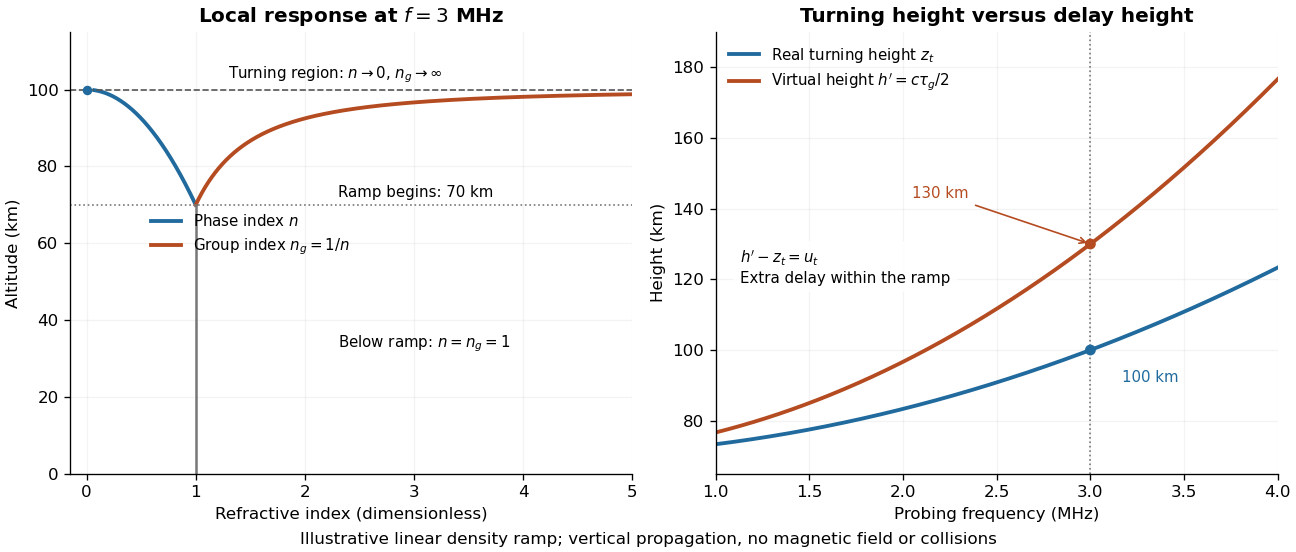
An original solvable profile makes the difference explicit. Approximate the region below by , and prescribe a linear rise of squared plasma frequency above it:Here the symbol denotes the penetration depth, and has units . In the propagating part of the ramp, . In the leading geometrical-ray delay model, with a frequency-independent turning connection wave phase, the round-trip group delay isThe endpoint singularity is integrable: substitute to obtain . This approximation does not resolve the finite-wavelength structure at the turning region. It illustrates the effect of slow group velocity before the return, rather than adding extra geometric altitude.
As an independent phase-based derivation, the propagation contribution to the round-trip wave phase isIts derivative agrees with the delay integral. Using the phase integral itself as a distance at speed would give instead of : wave phase, group delay and real turning height are three different quantities.
Choose and stipulate , where . ThenAt , the real turning height is but the virtual height is , corresponding to with . These stipulated parameters describe neither a measured profile nor a separate physical reflector at . Because the ramp has no density maximum, it also has no finite upper penetration threshold; a real bounded E layer or F layer requires a richer profile.
Ion skin depth 2026-10-13
For a singly charged ion species in Gaussian units, is its plasma frequency and . The ion skin depth marks a characteristic scale below which ion and electron motion can separate in a magnetized plasma. Together with the Alfvén speed, it satisfies , the coefficient of guide-field propagation in electron magnetohydrodynamics.
Langmuir wave 2026-10-25
A longitudinal electron plasma oscillation whose long-wavelength frequency approaches the electron plasma frequency when ions can be treated as stationary. Its dispersion relation and Landau damping depend on the electron phase-space distribution function. Compact velocity support can permit exactly undamped branches outside the support.
Magnetized cold-plasma dielectric tensor 2026-10-24
For , Gaussian units give , where is the summed conductivity tensor. With the equilibrium magnetic field along , write , , and . For signed cyclotron frequencies ,Here is the species plasma frequency. The two circular eigenvalues are ; defining the sign convention before naming their polarizations prevents ambiguity.
Past exam of the collisionless plasma physics course of the University of Oxford 2025 1 a Solution 2026-10-25
Use Gaussian units, plane waves proportional to , and the signed cyclotron frequency . Write for its electron magnitude, so the signed electron value is . Define the species plasma frequency by . The linearization of the cold Lorentz force equations givesSolving this linear system and using the species current density gives the conductivity tensorThe magnetized cold-plasma dielectric tensor is . ThusAt the stated electron frequency scale, the ion contribution is smaller by for and quasineutrality. To this accuracy,These expressions require negligible collisions and the cold ordering ; sufficiently close to a cyclotron resonance, thermal broadening or collisions must also be retained.
Past exam of the collisionless plasma physics course of the University of Oxford 2025 2 h Solution 2026-10-25
The barrier wavenumber is . The substitution givesThus the leading transmission coefficient isAt fixed , increasing the column width or peak plasma frequency suppresses transmission exponentially. Raising towards narrows the evanescent region and increases transmission. However, when becomes order one or smaller the two wave turning points interact; the opaque-barrier WKB approximation cannot be extrapolated to claim at . Smooth matching to an exterior is also implicit in the leading result; at the stated profile joins continuously to vacuum.
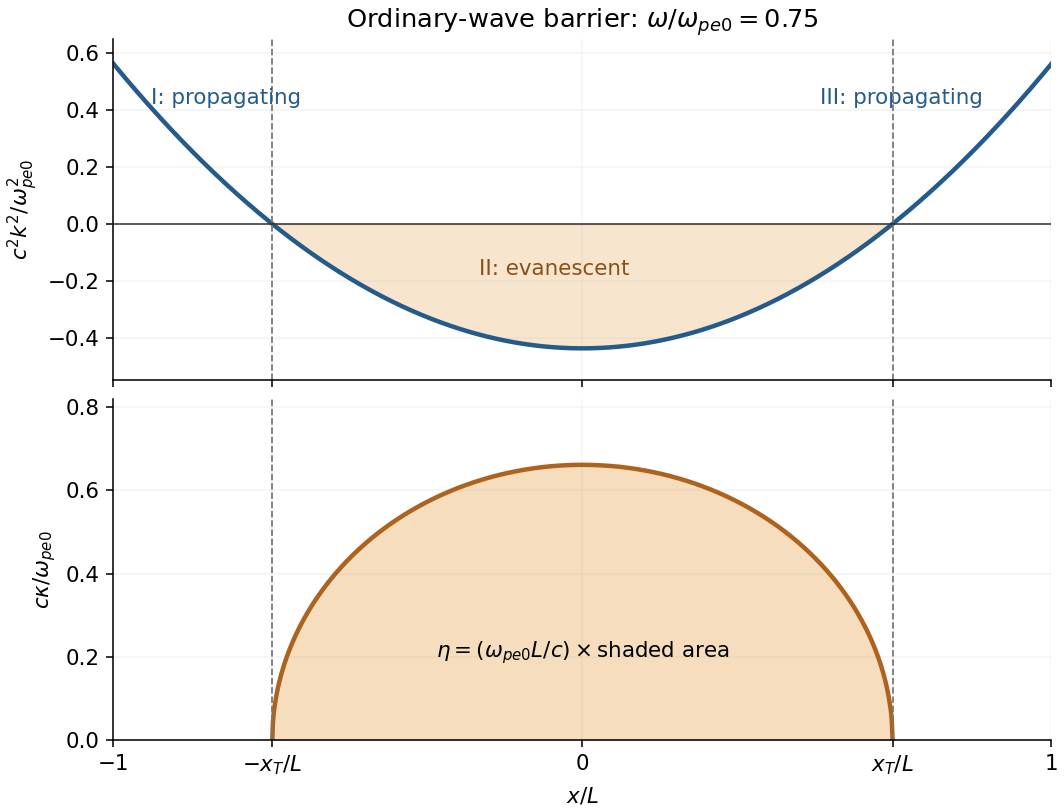
Local squared wavenumber and evanescent barrier for an ordinary plasma wave
. Details. At low density, the plasma frequency and free-carrier dielectric screening are smaller, so radiation can penetrate a suitable semiconductor sample. In a high field with , the active circular component has a resolved cyclotron absorption line near , with width of order . The opposite circular component lacks that positive-frequency resonance.
Different complex refractive indices for the two components produce Faraday rotation and circular dichroism. Transmission with controlled circular polarization therefore isolates the cyclotron resonance and measures . The low-density/high-field labels do not by themselves imply complete transparency at every frequency; one must still avoid the plasma stop bands, strong interband absorption and excessive sample thickness.
At zero magnetic field the two circular conductivities coincide, so an isotropic material has no magnetically induced circular birefringence. In the collisionless Drude model range the dielectric function is . A high carrier density gives a large plasma frequency, often placing the screened plasma edge in the infrared or visible range.
Below that edge the real dielectric function is negative and a transverse wave is evanescent in the bulk. The material is strongly reflecting, with penetration through a skin depth and losses set by finite . Above the plasma edge propagation becomes possible, subject to absorption and interband transitions. Carrier density alone does not specify a complete optical spectrum: the statements assume the probe frequency relative to the plasma scale and the validity of the single-band Drude model.
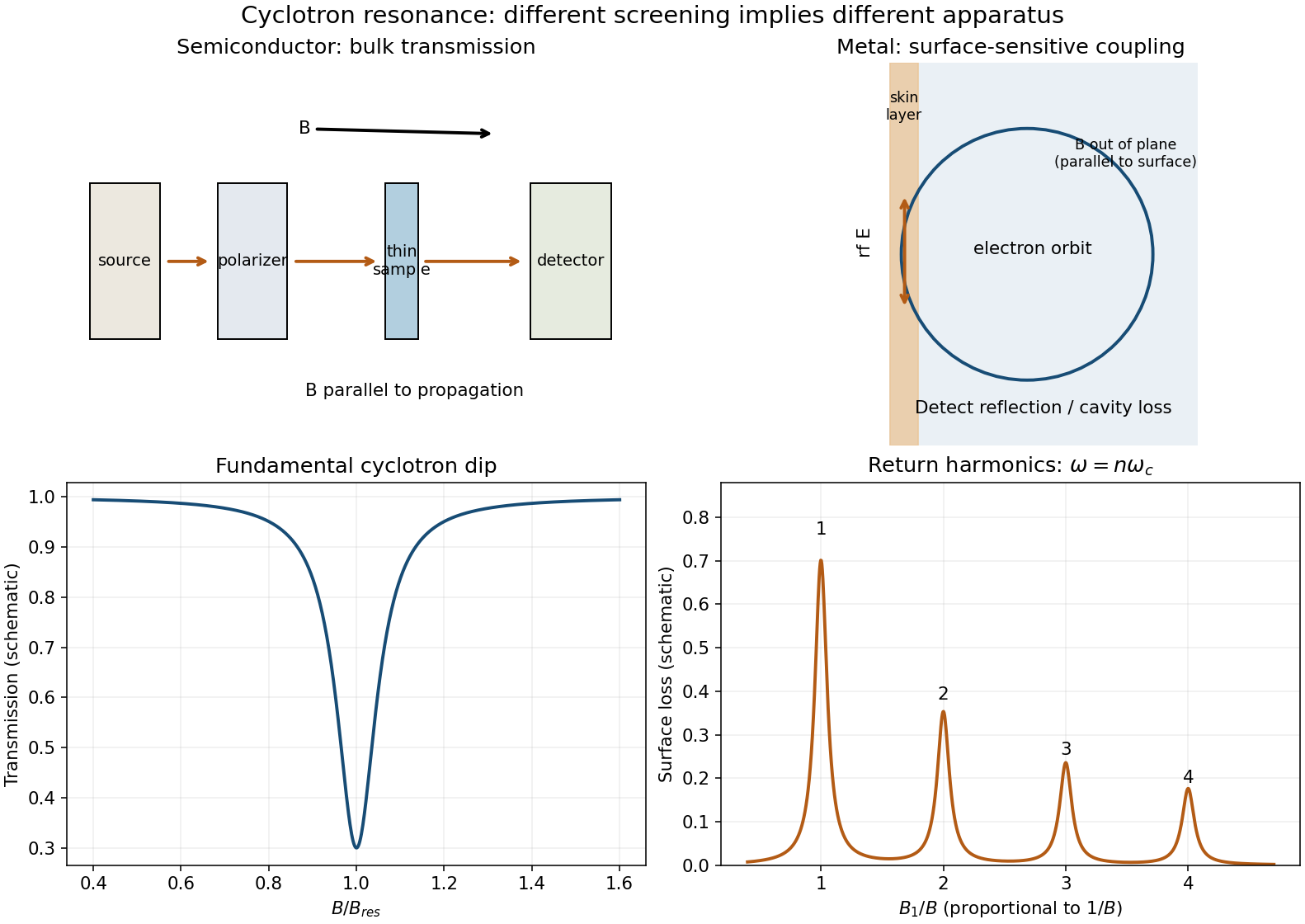
In a low-carrier-density semiconductor use a thin, cold sample in a transmission spectrometer. Direct microwave or far-infrared radiation through it, commonly with propagation parallel to and electric field transverse to it. Sweep at fixed frequency and detect transmitted power. The active circular polarization shows an absorption peak, or transmission dip, near . Resolving it requires a long enough scattering time, .
A metal's large plasma frequency usually prevents that radiation from sampling its bulk directly. In surface cyclotron resonance in a metal, put approximately parallel to a clean metal surface and excite an rf electric field in the skin depth, transverse to . Electron orbits extend into the bulk and repeatedly return to that layer. Coherent energy absorption occurs when the rf phase repeats on a return, including harmonics . Measure cavity loss, reflected power, or surface impedance rather than attempting ordinary bulk transmission. The characteristic regime has cyclotron radius larger than the skin depth and sufficiently specular, long-lived orbits.
For the spherical parabolic band the metal harmonic fields areThey are evenly spaced in , with amplitudes and widths determined by surface geometry and scattering. A semiconductor generally gives the simple bulk fundamental, whereas the metal can show this harmonic series in a surface-loss signal. For an anisotropic real Fermi surface the measured mass is the appropriate cyclotron effective mass rather than necessarily every component of a transport effective-mass tensor. These classical resonance harmonics are distinct from the Landau-level quantum oscillations in c.


Use time dependence and assume the dopants supply mobile electrons per unit volume. The Drude model equation isThe free-carrier electric polarization is , so, after adding the bound-electron background,ThereforeThe symbol here is the background-screened plasma frequency; the unscreened carrier frequency is . For positive , the imaginary part of is positive in this time convention, consistent with absorption. Incomplete dopant ionization would replace the nominal doping density by the actual mobile carrier density.
Past exam of the electromagnetism and optics course of the University of Oxford 2016 7 Solution 2026-10-25
Write and for homogeneous scalar material constants, and use . Taking the curl of Faraday's law of induction and substituting the Ampere-Maxwell law givesThe vector calculus identity for a double curl therefore yieldsThe second term represents electric current response, rather than displacement current. A dispersive is used in the frequency domain; its general time-domain counterpart is a temporal response convolution.
For the convention , the plane wave equation isDecompose the electric field into components parallel and perpendicular to . With , the longitudinal eigenvalue is and each transverse eigenvalue is ; thus the determinant is . For a transverse electromagnetic wave, andwhen and the background . A real dissipative electrical conductivity generally makes complex, with the decaying branch chosen for a passive medium.
For a cold, collisionless, unmagnetized plasma, treat ions as stationary and write for the magnitude of the elementary charge. The electron equation of motion is , soThis reactive response includes no collision-induced Joule heating. Substitution into the transverse dispersion relation givesThe quantity is the electron plasma frequency. The refractive index is real above this cutoff; below it, the wave is evanescent. The electron response is represented here by , so it must not also be counted a second time in the background permittivity.
For a nonzero longitudinal component, taking the dot product of the matrix equation with instead gives . The same cold plasma response makes , henceAt nonzero , the remaining equation forces to be parallel to , and Faraday's law of induction gives . These are electrostatic Langmuir waves, with no dependence of angular frequency in the zero-temperature model. Equilibrium neutrality does not forbid their perturbed charge density; Gauss's law requires such a density when .
The two real branches start at , have zero initial slope, and approach the lines from outside the populated parallel-velocity region. The original plot solves the degenerate-plasma dielectric response numerically; the shaded wedge shows where particles with resonant parallel velocities exist.
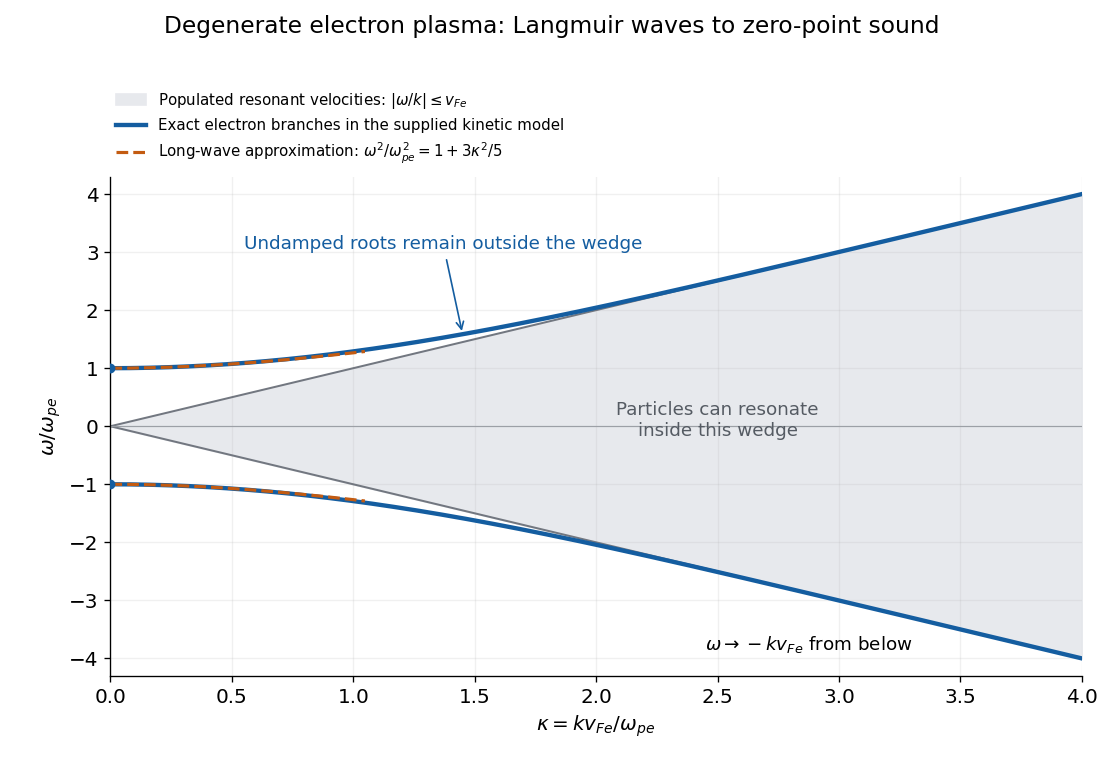

The distinction from a nondegenerate gas with a Maxwellian Maxwell-Boltzmann velocity distribution is its tail. A Maxwellian has resonant particles at every finite phase velocity. Its long-wavelength Langmuir waves have exponentially weak Landau damping, but at shorter wavelengths that damping becomes strong. The ideal degenerate cutoff instead permits this undamped branch to persist continuously into degenerate-plasma zero-point sound. The coefficient in c is also different from the classical thermal dispersive coefficient.
A natural additional branch is a degenerate ion-acoustic wave. For singly charged ions with equal electron and ion number densities, degenerate electron pressure supplies a restoring force while ion mass supplies inertia. The electron equation of state has , suggesting, at long wavelengths,Both species are degenerate here, so . The hierarchy explains the damping: there are no resonant ions, but there are resonant electrons inside their parallel marginal distribution. That electron marginal distribution has a small nonzero slope at , even though the full three-dimensional occupation is constant inside the Fermi sphere. One therefore expects weak electron Landau damping, of relative order , rather than exact absence of damping. Ion degeneracy pressure adds a relatively small correction to . This reasoning concerns an electrostatic ion-acoustic wave; transverse or magnetized branches require additional field dynamics or a background magnetic field.
Past exam of the physics B course of the University of Cambridge 2010 Paper 1 Section B B7 Solution 2026-10-20
State a time convention before using complex response: take fields proportional to , with and for a passive wave entering the material. In a homogeneous Ohmic medium, Maxwell equations with giveThe ohmic-conductor complex wavenumber describes both phase advance and amplitude decay. Real constant conductivity is only a low-frequency approximation. In the Drude model, giveswith a fixed positive ionic background and no additional bound-electron contribution in this simple model. The plasma frequency marks the inertial electron-response scale. More elaborate band structure, interband transitions and nonlocal transport limit this scalar treatment.[ref]
Electromagnetism lecture notes by Richard Fitzpatrick. Dielectric constant of a collisional plasma, equations (1201)–(1205): electron inertia, collisions and dielectric response
In the collisionless nonmagnetic limit, the dispersion relation is . For ,A crest can move faster than without carrying a new signal faster than light. Below cutoff the ideal wave is evanescent, with penetration length ; it does not propagate as an ordinary real- bulk wave. Evanescence in the lossless limit is not Joule dissipation. Nonzero collision rate gives a dissipative conductivity and smooths this ideal cutoff picture.
For a good conductor with approximately real , the spatial branch becomesA field amplitude falls as , while intensity falls as . The phase velocity is in this limit. Magnetic and electric amplitudes are not related by the vacuum ratio: with the chosen time convention. Its positive real part is the surface resistance. The local mean heating is , consistent with electromagnetic energy flowing into the metal. skin depth is an amplitude length; interpreting it as an intensity length gives a factor-of-two error.
A transmission-line mode propagates chiefly through the dielectric between conductors, even though finite metal conductivity causes loss at its boundaries. With per-length parameters , the telegrapher's equations give, for the same convention,Writing a forward wave as , , gives . In the low-loss regime and , set to obtainThis low-loss transmission-line attenuation separates series conductor loss from dielectric leakage loss. Average forward power falls as . In the normal skin-effect regime, reduced conducting area makes the AC conductor resistance increase roughly as ; dielectric loss can supply a separate frequency dependence. Reflection from a mismatched termination changes delivered power without being, by itself, dissipation in the line.[ref]
Electromagnetic Fields and Energy by Hermann A. Haus and James R. Melcher. Chapter14, §§14.7–14.9: distributed losses, Ohmic waves and conductor-loss approximation
To test loss, compare several lengths of otherwise identical line with matched terminations, calibrate connectors and incident/reflected power, and monitor temperature. Separate amplitude attenuation from phase delay and from standing-wave minima. Bulk penetration, line attenuation and dielectric propagation speed are related electromagnetic quantities but describe different experimental geometries.
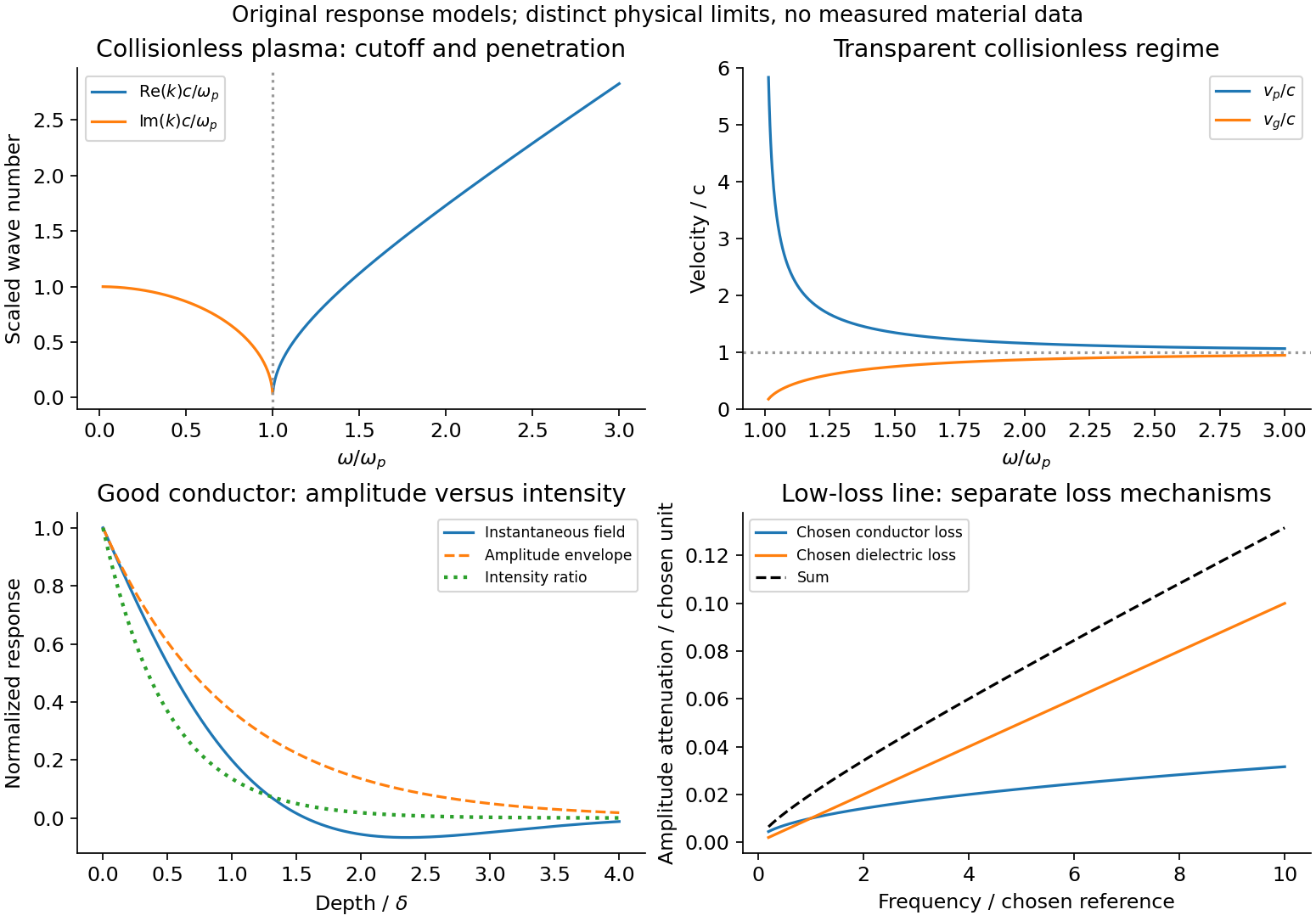
Conducting-wave propagation
. Chosen dispersion and decay models. Details.
Use a cold, unmagnetized, collisionless electron plasma with immobile ions. For an oscillating field proportional to , the electron displacement follows . Hence andThe induced polarization opposes the field because electron inertia changes the phase of its displacement. Maxwell's equations give transverse electromagnetic dispersionThus transverse waves propagate above the plasma frequency, while below it the wavenumber is imaginary and a semi-infinite lossless plasma reflects an incident wave with an evanescent interior field. In the cold electrostatic model, a longitudinal density oscillation instead has frequency .
Collisions at rate give for this time convention, introducing absorption. A background magnetic field makes the response anisotropic, and thermal motion supplies additional dispersion and static screening. The divergent zero-frequency cold collisionless formula should not be mistaken for a complete description of static Debye screening. The simple dielectric function is a dynamical electron-inertia response under stated assumptions.
Past exam of the physics B course of the University of Cambridge 2016 Paper 1 Section B B8 Solution 2026-10-20
Use peak phasors with time dependence , real positive electrical conductivity , and absolute permeability . Ampère-Maxwell equation and Faraday equations giveso . The sign of the imaginary term follows from the stated time convention. For a transverse plane wave in a homogeneous conductor,In the good-conductor limit, choose the root that decays into :The electric phasor and physical field are consequently and , as required. Tangential boundary matching sets ; it need not equal the incident amplitude.
Faraday's law fixes the magnetic field, including its phase:For real and , this means , with other components zero. The time-averaged Poynting vector isThe energy entering a thin slab exceeds that leaving it by per unit volume, givingDirectly, and at each time. Therefore is exactly this loss. The factors one half use peak rather than root mean square phasors; amplitude decays over , while intensity decays over .
For a cold collisionless unmagnetized plasma, electron inertia gives and real . Above the plasma frequency the wave propagates without this resistive attenuation. Below it, a semi-infinite plasma supports an evanescent field with electric and magnetic components in quadrature and zero mean inward energy flux: the incident energy is reflected, not absorbed as Joule heating. electron kinetic energy is reversibly stored, so the nondispersive dielectric field-energy formula alone is incomplete. Collisions introduce a real dissipative electrical conductivity and can produce absorption.[ref]
Oscillations and Waves by Richard Fitzpatrick. Section 9.7, equations 9.36–9.53, evanescence, phase quadrature and unit reflectance
Past exam of the physics B course of the University of Cambridge 2017 Paper 2 Section B B6 b Solution Created 2026-10-18 Updated 2026-10-20
For a cold, unmagnetized, collisionless plasma, take an equilibrium electron density , electrons of mass and charge , and approximately stationary ions. Use fields proportional to . The electron displacement satisfiesIts electric polarization is , hence the cold collisionless plasma dielectric responseThe negative susceptibility arises from the inertial electron response, rather than a restoring force binding an electron to a particular atom.
A transverse electromagnetic wave then obeysFor , the plasma supports propagation, with refractive index . The phase velocity is greater than , while the group velocity is ; their product is , and no superluminal signal is implied. Below the plasma frequency, the bulk wavenumber is imaginary and the field is evanescent. A sufficiently thick plasma largely reflects such radiation in the lossless model.
Including an electron momentum-relaxation rate replaces the denominator by :Its imaginary part describes absorption with the stated time convention. Finite electron temperature also produces plasma screening of slowly varying electrostatic fields, with . That spatial, longitudinal screening problem is distinct from simply taking in the cold transverse-wave formula. Magnetic bias, ion motion and kinetic resonances require more general dielectric responses.