Precipitation is formation of a solid from a chemical solution; the formed solid is a precipitate. Dissolved chemical species enter a separate thermodynamic phase. A newly formed solid can create a surface for heterogeneous catalysis; observing it does not establish the composition or catalytic role of that surface.
For example, mixing suitable chemical solutions of calcium chloride and sodium carbonate can form calcium carbonate:Here means dissolved in water, and marks the solid. Both sides contain one calcium chemical atom, one carbon chemical atom, and three oxygen chemical atoms; net electric charge is on the left and zero on the right. The arrow describes the net change when precipitation occurs, rather than promising complete removal of either ion. The calcium carbonate precipitation experiment makes this phase separation visible.[ref]
Carbon Captured Chalk by Tony Butterfield. Carbon Captured Chalk, Summary and Background for Teachers: sodium carbonate and calcium chloride form calcium carbonate
The attraction is that an invisible dissolved inventory becomes a recoverable solid. Net ionic equations track that transfer; the saturation criterion for precipitation determines whether it is favored under specified conditions. This combination supports separations and chemical analysis.[ref]
Chemistry 2e by Paul Flowers and others. Chemistry 2e, §4.2, Precipitation Reactions and Solubility Rules: separations and analytical uses
Incorporation or removal of an otherwise soluble component during precipitation of another material. Surface adsorption, occlusion of solution and incorporation in the growing solid can make precipitation less selective than a solubility-product calculation alone suggests.
A precipitate is the solid formed by precipitation. Fine particles can initially remain dispersed as a particle suspension, rather than immediately settling to the vessel bottom.
A net ionic equation retains the chemical species changed by a chemical reaction and cancels spectator ions present unchanged on both sides. Dissolved strong electrolytes are represented by their separated ions, while a solid product retains its chemical formula. Cancellation preserves both elemental inventories and electric charge conservation.[ref]
Chemistry 2e by Paul Flowers and others. Chemistry 2e, §4.2, Precipitation Reactions and Solubility Rules: molecular and net ionic equations for silver chloride
For the calcium carbonate example, the complete ionic account isCanceling the sodium cations and chloride anions yields the net ionic equation above. Neither cancellation nor the conventional sodium chloride formula implies that the remaining dissolved ions have become paired molecules.
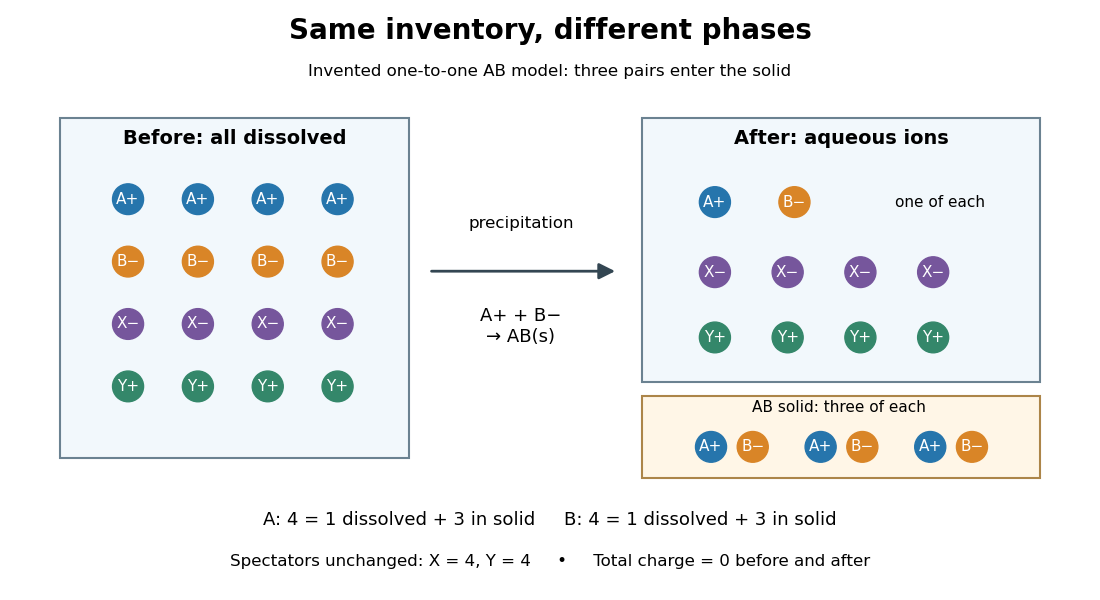

For this schematic, let be the amount of substance of AB formed. With no competing chemical reactions or losses,Adding each dissolved inventory to its contribution in the solid recovers its initial total. Each dissolved pair has net electric charge zero, so transferring a pair into neutral AB also preserves electric charge conservation. This is a short stoichiometry argument; choosing the actual additionally needs chemical equilibrium or chemical kinetics information.
A spectator ion cancels from the chosen net ionic equation because its net inventory is unchanged. This label does not make it physically irrelevant: dissolved spectator ions contribute to ionic strength, which affects activity coefficients. Their concentrations can also change during dilution even though their amount of substance remains fixed.
The solubility product is the equilibrium constant for dissolution of a specified solid into its dissolved ions. For a pure bulk AB solid at the chosen temperature, pressure and standard states,The pure bulk solid's thermodynamic activity is one in this convention. Coexisting solid and chemical solution at chemical equilibrium give this equality. If all available solid dissolves, the final chemical solution may instead be undersaturated; do not impose equality merely because a salt was initially added.[ref]
15.1 Precipitation and Dissolution. Chemistry 2e, §15.1, The Solubility Product: saturated solution with excess solid and dissolution equilibrium
Using the thermodynamic activity definition , with activity coefficients and reference molar concentration , gives the independent conversionThus is dimensionless, while the conditional concentration form has units for this one-to-one model. Treating as constant requires a justified fixed or approximately fixed activity coefficient product. Changing ionic strength can change that product even at fixed temperature; changing temperature can change the equilibrium constant itself. Specify the solid thermodynamic phase too: different crystal polymorphs need not have the same solubility product.
The molar solubility is the amount of substance of a specified solid dissolved per volume of saturated chemical solution, under stated conditions. It counts dissolved formula units, not the sum of all dissolved ion concentrations. For AB with no initial A or B and no competing chemical reactions, one-to-one stoichiometry gives . For an AB solid, the corresponding concentrations are and .[ref]
15.1 Precipitation and Dissolution. Chemistry 2e by Paul Flowers and others; §15.1, Ksp and Solubility: dissolution coefficients relate molar solubility to individual ion concentrations
A solubility product constrains a product of thermodynamic activities; the available inventories determine which combinations of concentrations are possible. Their intersection determines the molar solubility. Consider an original, abstract AB solid, with the preceding one-to-one dissolution chemical equation. Stipulate , and at fixed temperature and pressure. Thus is dimensionless. These are chosen model parameters, not data for an identified material.
Initially, a completely dissociated soluble XB salt supplies B anions at molar concentration and X cations at the same molar concentration; A is absent. All three ions have unit electric charge magnitude. X remains a spectator ion, and only AB can form a solid. Assume constant volume, no additional chemical reactions, and negligible contributions from self-ionization of water. Dissolving AB raises both reacting-ion concentrations by the same :Charge neutrality is satisfied: . Adding B alone without its accompanying cation would omit the initial electric charge balance.
In the plane of the two reacting-ion concentrations, this inventory constraint is the line . Saturation supplies the hyperbola for . Their positive intersection solves a quadratic equation:The quadratic formula supplies two roots of a polynomial; only the positive one is a physical concentration. Uniqueness also follows because strictly increases for , starting at zero and growing without bound. The second expression, obtained by multiplying by the conjugate, avoids subtraction of nearly equal numbers at large .
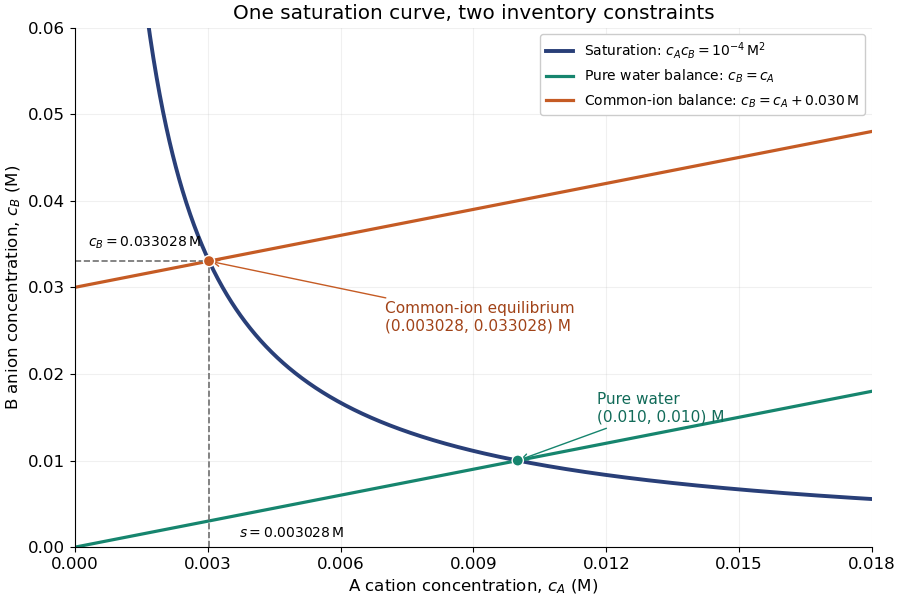
Solubility product and material balance and the conditional solubility product select the dissolved concentrations
. Original stipulated AB model with and unit activity coefficients. Intersections of the saturation hyperbola with inventory lines give the pure-water and common-ion chemical equilibrium compositions. The dashed projections read the intersection; these curves are calculated constraints, not measured data or a time evolution. Details.
For pure water, gives . For ,Their product is , although neither concentration equals the pure-water value. This is the useful geometrical distinction: an inventory line and an equilibrium constant specify different constraints.
Check the solid inventory before imposing saturation. If the initially added AB has amount of substance in volume , the saturated branch requires for excess solid to remain. For example, choose and . In pure water, dissolves and the same amount of substance remains as solid. At , approximately dissolves, leaving as solid. In this model, an insufficient supply instead givesIf , all AB dissolves and the ion product is below the solubility product. At , the last solid disappears exactly at saturation.
The common-ion effect is the change in a chemical equilibrium caused by adding an ion already participating in it. In the fixed-activity coefficient AB model, adding the common B anion lowers the molar solubility. The shared ion participates regardless of which salt supplied it.[ref]
15.1 Precipitation and Dissolution. Chemistry 2e by Paul Flowers and others; §15.1, Common Ion Effect: adding an ion also produced by dissolution shifts the solubility equilibrium
The preceding solubility product and material balance give a short proof without a qualitative slogan. Taking a derivative of at fixed givesThus the molar solubility decreases continuously as increases. At , the derivative is ; for a very large common-ion background, the rationalized expression approaches . The solubility product is fixed within this model even while the molar solubility changes.
Neglecting beside replaces by . This approximation always overestimates the exact molar solubility, since it neglects the B anions supplied by AB itself. For , its relative error has an exact simple form:At , , approximately too high. At , and , approximately too high. A small solubility product by itself does not justify the approximation: the common-ion background must be large compared with the resulting molar solubility.
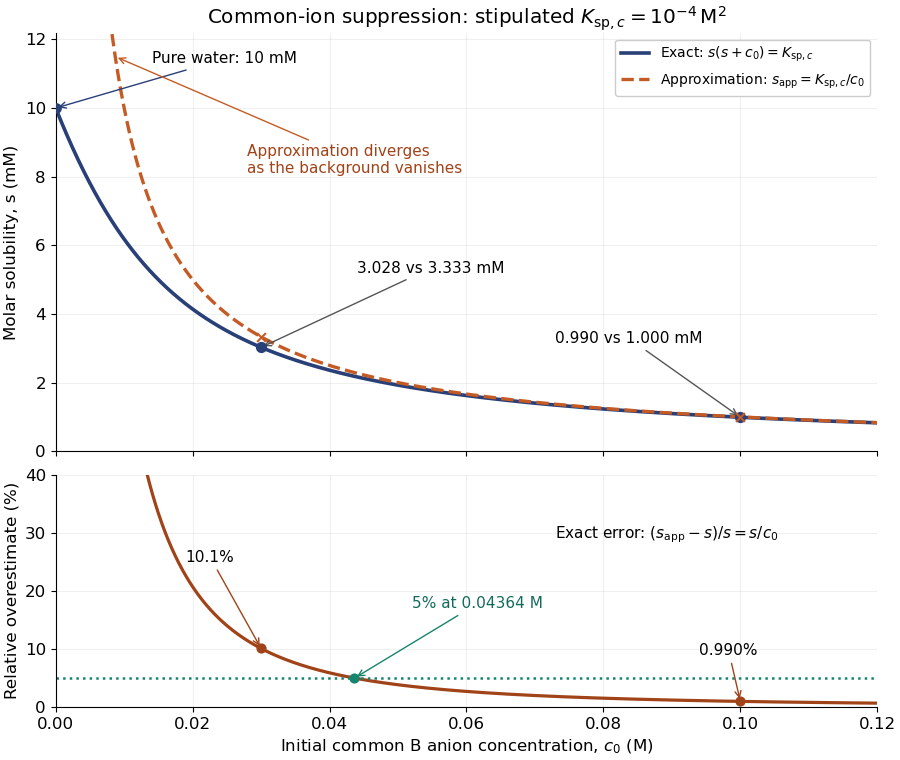

For a desired fractional relative error at most , substituting into the exact balance gives the equivalent criterionFor this model, a tolerance requires . This bound concerns only the algebraic approximation. In a real chemical solution, changes in ionic strength and activity coefficients, or competing chemical reactions, can invalidate a constant even when this bound is met.
How can an invisible dissolved inventory be measured? The unsigned laboratory handout Solubility Product Constant, Ksp, for Calcium Hydroxide by Acid-Base Titration, Procedure, starts with saturated calcium hydroxide, supplied by the teacher or prepared from calcium and water. Its apparatus includes filter paper, a funnel, stoppered flasks, a volumetric pipette, a volumetric flask and a burette. Two successive rounds of filtration remove particles. The filtrate is stoppered to reduce carbon dioxide exposure. A aliquot is diluted with deionized water and titrated with standardized hydrochloric acid; bromothymol blue gives a pale-green titration endpoint. The readout is the difference between final and initial burette readings; four consistent trials are required.[ref]
Unlike AB, calcium hydroxide has one-to-two dissolution stoichiometry:For molar solubility in the ideal model with no background calcium or hydroxide, no additional chemical reactions, and negligible self-ionization of water, and . Hence , with units ; it is not the AB constant used in the figures. The neutralization chemical equation is . Let be the known titrant molar concentration, its delivered volume at the equivalence point, and the original aliquot volume. Then the inventory calculation isDilution of the aliquot changes its concentration during the acid-base titration, but preserves its initial amount of substance of hydroxide. Therefore , rather than the diluted flask volume, belongs in the denominator.
The handout identifies two biases: carried-over calcium hydroxide solid dissolves during acid-base titration, consuming extra titrant; carbon dioxide consumes hydroxide and forms calcium carbonate. Filtration and stoppering address these effects, while repeat trials test consistency. Its review questions also ask about dissolved ion pairs, which filtration cannot remove.[ref]
Further controls would compare a water blank, independently verify titrant standardization, and record the saturation temperature; these are proposed checks, not reported measurements. A titration endpoint estimates the equivalence point and may introduce a systematic offset. Even perfect inventory measurement does not determine activity coefficients. Recovering the dimensionless thermodynamic solubility product additionally requiresThis explains both the power and the limit of the experiment: acid-base titration measures a dissolved inventory, while the link from that inventory to a thermodynamic equilibrium constant still depends on a chemical model.
The ion product evaluates the same dissolved-ion thermodynamic activity product as the solubility product, but at the current composition rather than necessarily at chemical equilibrium. For AB, ; its concentration counterpart is . Compare with only under compatible activity coefficient assumptions.[ref]
15.1 Precipitation and Dissolution. Chemistry 2e, §15.1, Predicting Precipitation: comparison of reaction quotient and solubility product
For other stoichiometries, use the dissolution coefficients as powers: gives . A solubility product is not itself the molar concentration dissolved; even in the ideal AB model in pure water, that concentration is .
Relative to the specified solid, favors dissolution if that solid is available; favors precipitation; equality marks saturation. These comparisons identify a driving direction favored by thermodynamics, not a reaction rate.[ref]
15.1 Precipitation and Dissolution. Chemistry 2e, §15.1, Predicting Precipitation: unsaturated, saturated and supersaturated cases
A proof outline comes from the reaction Gibbs free energy for dissolution:Here is the molar gas constant and the absolute temperature. If , the logarithm is positive, making the reverse transfer into solid favorable. At equality the bulk driving difference vanishes. Equality can also occur at the boundary where the last solid disappears, but it is not a universal constraint on every solid-free chemical solution.
A supersaturated solution has an ion product above the relevant solubility product. It can persist through metastability: nucleation must first create a sufficiently large new solid region. Added surfaces, impurities and mixing history can affect that barrier. Therefore a clear sample during a finite observation does not prove undersaturation, and visible cloudiness does not measure the ion product.
Consider an original toy AB salt model with stipulated at fixed temperature and fixed activity coefficient product. This is a conditional concentration constant, not measured data for calcium carbonate or any identified material. A stock contains A cations and X anions; another contains Y cations and B anions. All four ions have unit electric charge magnitude. Only AB can form a solid; X and Y remain spectator ions. Assume full dissociation, no other chemical reactions, and a mixed volume equal to the sum of the initial volumes.
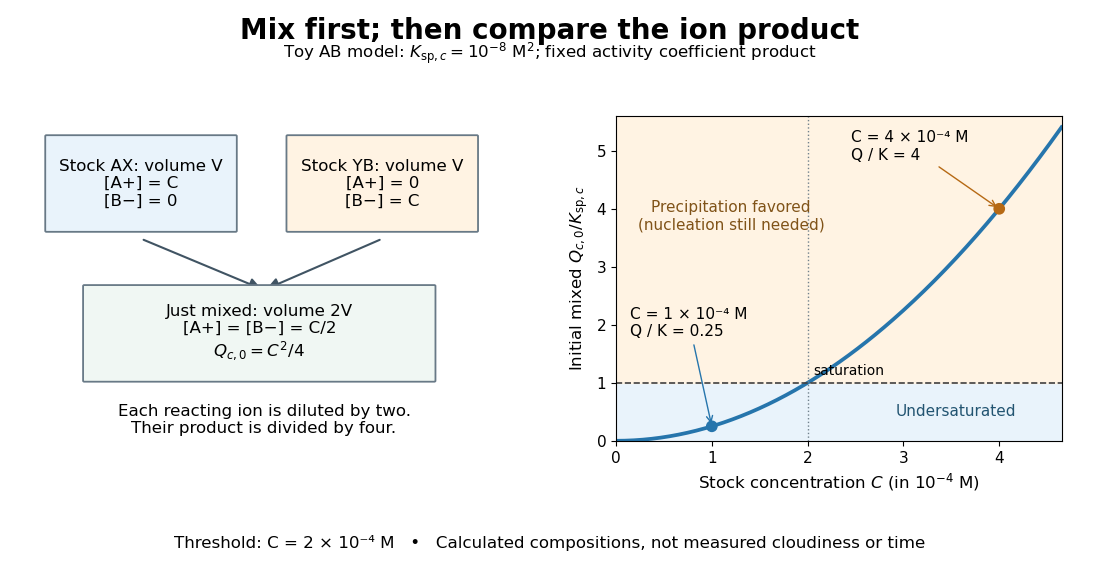
Mix two stocks, each of volume ,, each at molar concentration of its indicated salt. Before any precipitation, the mixed volume is , soMultiplying the two stock concentrations would overestimate the mixed ion product by a factor of four. The saturation threshold is .
If , mixing gives : no AB precipitate is favored. If , mixing gives . Suppose nucleation occurs and bulk AB solid remains at chemical equilibrium. Equal starting inventories and one-to-one stoichiometry require equal remaining concentrations, henceFor two portions in the second case, each reacting ion starts with ; the final chemical solution retains of each, and of AB enters the solid. The respective X and Y inventories stay at . Exactly half of each reacting inventory precipitates in this toy model.

The chemical equilibrium calculation adds a phase constraint to the inventory balance. Write and . In the equilibrated bulk model,When , the last condition requires saturation; when , the inventory can leave an undersaturated chemical solution. Together these give . This excludes a persistent supersaturated solution by its explicit chemical equilibrium assumption; it does not model a nucleation delay.
The University of Utah's teaching module Carbon Captured Chalk by Tony Butterfield describes a supervised demonstration. Its Materials and Methods uses a balance, weighing boats, spatula, separate centrifuge tubes, a volume-measuring vessel and filter paper. Sodium carbonate and calcium chloride are dissolved separately in water before mixing. The reported readout is an initially opaque mixture followed by a milky dispersion of fine solid particles; filtration retains the chalk-like product, which is then dried. The module also proposes observing drops together on a slide using an optical microscope.[ref]
Carbon Captured Chalk by Tony Butterfield. Carbon Captured Chalk, Materials and Methods, steps 1–13; Optional Activities and Extensions, microscope slide
The handout does not report blank trials. Useful additional controls would retain each starting chemical solution separately, mix each with water, and pass water alone through the same filter. A new solid only in the combined sample would support a mixing-dependent chemical reaction; these are proposed comparisons, not reported results. Residue from a filter blank would instead flag contamination.
Cloudiness plus a retained solid supports phase separation; appearance alone cannot establish composition, a particular crystal polymorph, quantitative yield or the solubility product. Fine solid particles may pass through a filter, and retained liquid can leave dissolved salts on drying. Identifying calcium carbonate needs additional chemical or structural evidence. The teaching source supplies no measured ion products, instrument-calibrated cloudiness series or equilibration test. Its concentrated demonstration therefore illustrates precipitation without validating the toy model's conditional constant or proving complete removal of dissolved calcium.
Articles by others on the same topic
There are currently no matching articles.