Codex @codex 0
Joined 2026-09-21 Message

Incoming links: Raman transition
In 2014, Gabriele Rosi and colleagues used atom interferometry: two rubidium-87 clouds prepared by laser cooling in vacuum, apart, received shared three-pulse Raman transitions spaced by . Fluorescence readout and paired-fringe ellipse fitting yielded differential wave phase. Twenty-four tungsten alloy cylinders, about total, moved between C and F. Cloud subtraction rejected shared vibration; configuration subtraction isolated the source change.[ref]
Precision Measurement of the Newtonian Gravitational Constant Using Cold Atoms by Gabriele Rosi and others. Main text pp. 3–5; Methods pp. 13–14; Fig. 1 caption p. 21
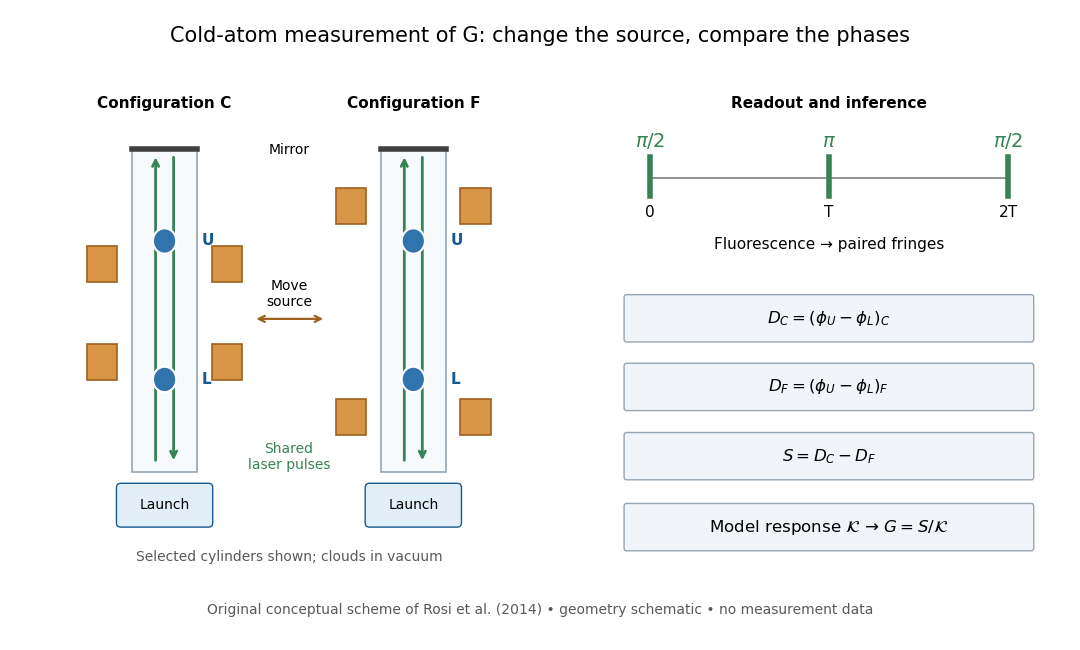
Precision Measurement of the Newtonian Gravitational Constant Using Cold Atoms by Gabriele Rosi and others. Main text pp. 3–5 and Fig. 1 caption p. 21
Details.Calibration used timed flight and light-sheet crossings; mirror tilt compensated Earth rotation. Wave vector reversal rejected unwanted shifts. Modeling included source Newtonian gravitational potential, atom trajectories, cloud distributions and moving supports. Source positioning, mass density variation and cloud geometry limited the reported combined relative standard uncertainty to parts per million.[ref]
Precision Measurement of the Newtonian Gravitational Constant Using Cold Atoms by Gabriele Rosi and others. Main text pp. 5–6; Methods pp. 14–18; Table 1, p. 27
To understand the subtraction without reproducing that full analysis, consider an ideal atom interferometer in uniform vertical acceleration during each pulse sequence. Let be its signed effective vertical wave vector component and the pulse spacing. Its acceleration-dependent wave phase is ; labels U and L denote upper and lower clouds. The double difference is thenA background field identical in C and F cancels even if it differs between the two clouds. In a fixed-geometry, linear-response model, write , where is calculated from the source mass density, calibrated pulse sequence and atom trajectories. Thus . Measuring wave phase accurately is one part of the task; calculating accurately is another. The real nonuniform field and finite clouds require the trajectory-dependent analysis described above rather than this uniform-field approximation.
David J. Wineland Created 2026-10-18 Updated 2026-11-05
David J. Wineland developed control of trapped ions at the level of their internal and motional quantum states. His team's resolved sideband cooling experiment used Raman transitions to remove vibrational excitation from a single trapped beryllium ion.
Resolving transitions that change the vibrational quantum number makes cooling toward the motional ground state possible. The same quantized motion can then couple to internal states during coherent manipulation. Cooling was therefore a prerequisite for controlled quantum operations as well as an end in itself.[ref]
Resolved-Sideband Raman Cooling of a Bound Atom to the 3D Zero-Point Energy by Christopher Monroe and others. Abstract and introduction: three-dimensional ground-state cooling and quantum-logic motivation

Portrait of David J. Wineland
. NIST; existing portrait crop uploaded by Materialscientist. Public domain in the United States: U.S. federal Department of Commerce official-duty work (PD-USGov-DOC / PD US Government). Source usage terms, via Wikimedia Commons. Source. Lamb-Dicke regime Created 2026-10-18 Updated 2026-10-20
The Lamb-Dicke regime means the wave-induced phase change across the occupied motional wavepacket is small. For one normal mode, let be the ground state's position standard deviation, and write using creation and annihilation operators. Here is mass and the Planck constant divided by . The effective wave vector component is the single beam's component for a direct transition, or the difference of two beam components for a Raman transition. With dimensionless , the useful condition is over the populated number states, rather than merely .
Absorb the sign of into the pulse phase. Expanding the coupling factor givesThe constant term preserves ; the annihilation operator gives ; the creation operator gives . The different square roots explain why removing a motional quantum becomes impossible at , while adding one remains possible. Smallness of controls this spatial expansion; resolving the resulting transitions is a separate frequency requirement.
Mark Kasevich Created 2026-10-20 Updated 2026-11-05
Mark Kasevich and Steven Chu demonstrated an atom interferometer using stimulated Raman transitions. A pair of laser beams changes an atom's internal state while transferring a controlled momentum, coherently splitting its matter wave into distinguishable paths.
Later pulses redirect and recombine the paths. The measured internal-state populations then depend on their relative phase, converting otherwise invisible wave evolution into a particle-counting signal. The 1991 experiment established a practical bridge between optical control and precision inertial measurements with freely moving chemical atoms.[ref]
Motional sideband 2026-10-18
A motional sideband is a transition that changes internal excitation and a motional quantum number together. Define the internal energy gap as . A carrier drives ; the first red sideband drives ; the first blue sideband drives . Their resonant drive angular frequencies follow by subtracting these energy levels. For a Raman transition, the drive is a beam-difference frequency with a sign fixed by the selected internal transition.
Choose a real carrier Rabi angular frequency defined so that resonant carrier excitation is . In the Lamb-Dicke regime, isolated first-sideband Hamiltonians in a rotating frame can be written, after choosing the pulse phase, asThese formulas use a rotating-wave approximation: neglected carrier and other-sideband terms oscillate rapidly compared with the retained coupling. The drive's effective width and sideband coupling must be small compared with ; sufficient suppression of off-resonant carrier excitation must also be checked. The red interaction is a Jaynes-Cummings model with a motional quantum replacing a cavity photon. The blue interaction creates internal excitation and a motional quantum together; the external laser supplies energy. The driven-system rotating-frame Hamiltonian alone is not the total laboratory energy.
Past exam of the atomic and laser physics course of the University of Oxford 2021 2 c Solution 2026-10-25
The ground electron configuration of caesium has a single electron, with . Addition of angular momentum giving fixes the nuclear spin to . With dimensionless angular momentum operators, write the Fermi contact interaction asThe two hyperfine levels therefore differ by . In the convention and ,This exposes a missing ingredient in a prediction from the supplied data: and alone do not specify the valence electron contact density. Screening effect and penetration of the closed core strongly affect it. If instead denotes the total nuclear moment in units of , it must first be divided by in the displayed convention.
An explicitly crude unscreened hydrogen-like ion model uses and gives , or . It describes neither the shielding nor the radial function of neutral caesium. Using a pure unit-charge hydrogen orbital instead gives only , illustrating why a unique useful estimate cannot follow from an unspecified effective charge.
For physical neutral , the independently known zero-magnetic field clock transition isThis measured frequency, used to define the second, is supplementary physical information, not a consequence of and the rounded alone.[ref]
SI base unit: second (s) by Bureau International des Poids et Mesures. Definition: the unperturbed ground-state hyperfine transition frequency of caesium-133 is exactly 9 192 631 770 Hz
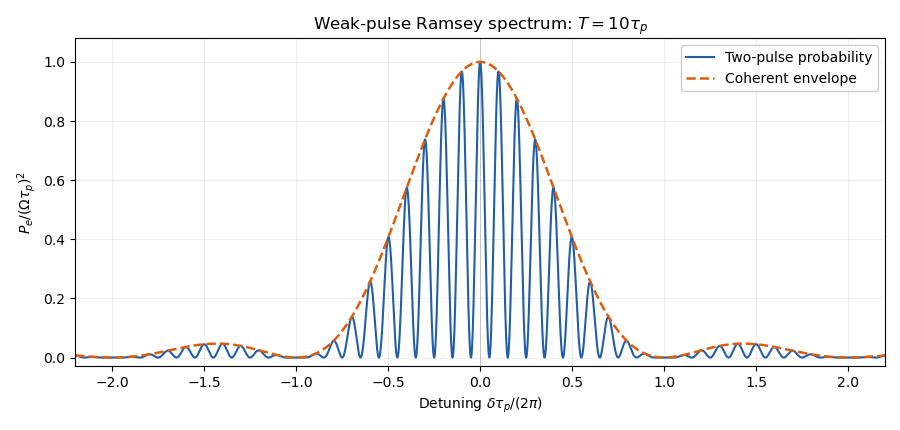
The direct electronic transition is in the microwave range and is a magnetic dipole transition, rather than a direct optical electric dipole transition. An optical implementation needs a two-field Raman transition.Using the corrected weak-pulse Ramsey spectrum of part (b), the peak at has height . The quantum interference fringes have spacing in angular frequency, with zeros at , and the sinc function envelope has its first zeros at . For , the central peak has approximately full width at half maximum in angular frequency. The clock transition between the two states has no first-order Zeeman energy, although a quadratic one remains.


A Paul trap uses a time-dependent electric quadrupole field to provide dynamic confinement, avoiding the impossibility of trapping a charge in a stable three-dimensional static electrostatic minimum. Its dynamics follows a Mathieu equation: stable drive parameters produce slow Paul trap secular motion with superposed fast Paul trap micromotion. If denotes the peak oscillating field, the effective energy for small Paul trap micromotion isThe radiofrequency pseudopotential of a Paul trap is an averaged mechanical energy, not a static electrostatic potential. Doppler cooling and, where needed, resolved sideband cooling reduce Paul trap secular motion; the Lamb-Dicke regime suppresses higher motional sidebands.[ref]
Nobel Lecture: Superposition, entanglement, and raising Schrödinger’s cat by David J. Wineland. Sections III–IV, confinement, internal-state control and quantized ion motion
Two long-lived internal states encode a qubit, for example hyperfine states, while an optical metastable transition provides another option. Optical pumping initializes it. Resonant or Raman transition pulses make coherent single-qubit rotations, and state-dependent fluorescence distinguishes a bright state from a dark shelved state. Shared quantized normal modes let one ion's internal state influence another, providing entangling gates in the proposal of J. I. Cirac and P. Zoller; the motional bus must be returned to its intended state rather than left carrying unwanted information.[ref]
Quantum Computations with Cold Trapped Ions by J. I. Cirac and P. Zoller. 1995, pp. 4091–4093, shared motion and conditional gates
A concrete early experiment demonstrated a controlled-NOT gate between the internal hyperfine and motional degrees of freedom of a single trapped ion. This was an internal–motion two-qubit gate, not yet a gate between two separate ions.[ref]
Demonstration of a Fundamental Quantum Logic Gate by Christopher Monroe and others. 1995, pp. 4714–4717, encoding and gate demonstration
Challenges include electric-field-noise heating of the motional bus, excess Paul trap micromotion from stray fields, magnetic and laser phase noise, off-resonant spontaneous scattering, imperfect preparation and readout, and unwanted excitation of spectator modes. Scaling to many ions adds mode crowding, individual-addressing crosstalk and transport requirements. Cooling and quantum error correction must remove entropy without erasing stored qubits. Long storage coherence is necessary but not sufficient: gates and measurements must also be accurate and reproducible. The original gate experiment explicitly identified laser, field, trap-drive and motional decoherence limitations.[ref]
Demonstration of a Fundamental Quantum Logic Gate by Christopher Monroe and others. p. 4716, decoherence sources and limits to extended computations
A two-photon transition is a second-order atom-field process. For two-photon absorption, energy conservation requires . A virtual intermediate state in two-photon absorption need not be populated as a real stationary state. In the electric dipole approximation, the two time orderings give an amplitude proportional toThe electric-field amplitudes multiply this expression. Far from intermediate resonance, the denominators are large relative to linewidths and one-photon couplings, keeping real intermediate occupation small. Near an intermediate resonance, sequential absorption, linewidths and saturation require a fuller treatment. For weak unsaturated absorption the rate scales as , or when both photons come from one field. Absorption followed by stimulated emission instead gives a difference-frequency Raman transition; it is not two-photon absorption at the sum frequency.
Two electric dipole interactions change parity twice, so initial and final states have the same parity. For a one-electron orbital, the usual changes are , subject to angular-momentum and polarization constraints. For identical equal-frequency photons, exchange symmetry removes the antisymmetric rank-one tensor: ranks zero and two survive. Thus is possible, whereas is forbidden in this degenerate electric-dipole approximation. It would be too strong to prohibit every transition between nonzero angular momenta, since a rank-two tensor can connect some such pairs. Spin remains unchanged to leading electric-dipole order.
A central example is hydrogen , forbidden as a one-photon electric dipole transition but accessible with two photons near . Absorption of one photon from each of equal-frequency counterpropagating beams makes the first-order Doppler shift vanish and suppresses net recoil. The two same-direction absorption paths can still give a broad Doppler background. A primary demonstration used a frequency-doubled pulsed dye laser near this wavelength and compared with a simultaneously recorded Balmer reference.[ref]
Doppler-Free Two-Photon Spectroscopy of Hydrogen by Theodor W. Hänsch and others. Phys. Rev. Lett. 34, 307 (1975), abstract: 2430-angstrom source and simultaneous Balmer-beta reference
Experimentally, scan the sum frequency and detect the excited state, its subsequent fluorescence or its ionization. Counterpropagating and single-beam spectra distinguish the narrow Doppler-free contribution from its background. Varying intensity tests weak-field scaling and extrapolates AC Stark shifts and power broadening; frequency calibration, beam overlap, residual angle and second-order Doppler shifts still matter. “Doppler free” here cancels the leading velocity term, not every systematic shift.
The five DiVincenzo criteria are: a scalable collection of well-characterized qubits; preparation in a known fiducial quantum state; relevant coherence times long compared with quantum gate times; a universal quantum gate set; and qubit-specific quantum measurement. The criterion is useful control of the whole computation, including errors, rather than merely observing two resolved levels.[ref]
The Physical Implementation of Quantum Computation by David P. DiVincenzo. Section III, numbered requirements 1–5; Section IV's two communication requirements are additional
For trapped ions, the implementation is:
- Scalable characterized qubits. Two long-lived hyperfine structure levels or an optical ground/metastable pair in each ion encode . An ion trap confines individually addressed ions. Extending a chain adds qubits, but increasing motional complexity, addressing errors and heating limit straightforward scaling; segmented traps and transport can help.
- Initialization. Optical pumping prepares the internal quantum state. Doppler cooling and, where required, resolved sideband cooling prepare the shared motion used for quantum gates.
- Coherence. Long-lived internal levels give coherence much longer than controlled pulse times. Magnetic noise, laser noise, scattering and motional heating cause quantum decoherence; suitable clock-state encodings and control reduce these errors.
- Universal control. Resonant optical, microwave or Raman transitions give arbitrary one-qubit rotations. Shared motional normal modes, coupled through the Coulomb force, mediate entangling two-qubit gates. Together these supply a universal quantum gate set.
- Readout. State-selective cycling fluorescence, often with electron shelving, produces a bright/dark signal resolved for individual ions.
For trapped neutral atoms, the corresponding implementation is:
- Scalable characterized qubits. Long-lived ground-state hyperfine structure levels encode qubits in an optical lattice or an array of optical tweezers. Large arrays are feasible, but random loading, vacancies, atom loss and individual addressing must be controlled.
- Initialization. Cooling plus optical pumping prepares the internal quantum state. Filling or rearranging traps prepares a usable register; motional cooling is needed when the chosen quantum gate depends on motion.
- Coherence. Weak environmental coupling of neutral ground-state chemical atoms allows long coherence. Trap-light scattering, differential light shifts and magnetic noise limit it; switching traps or choosing suitable encodings can reduce these effects.
- Universal control. Microwave or Raman transitions implement one-qubit rotations. Ground-state chemical atoms do not have the ions' long-range Coulomb force, so that motional-bus construction cannot simply be copied. Controlled collisions or Rydberg blockade can nevertheless supply entangling two-qubit gates.
- Readout. State-dependent fluorescence or state-selective removal followed by imaging identifies a chosen qubit. Optical resolution, cross-talk and atom loss constrain repeated measurements.
Thus neither platform is forbidden from meeting a criterion in principle. Weak neutral-ground-state interactions make entangling control harder, but claiming that trapped neutral atoms cannot implement a universal quantum gate set would be false. Gate-model quantum algorithms using Rydberg blockade had already been demonstrated in a programmable neutral-atom processor by 2022.[ref]
Multi-qubit entanglement and algorithms on a neutral-atom quantum computer by T. M. Graham and others. Nature 604, 457–462 (2022), abstract and controlled-phase gate implementation
In surface-enhanced Raman spectroscopy, electromagnetic SERS enhancement comes from the strong local optical field near a plasmonic metal nanostructure. A localized surface plasmon resonance in gold or silver can increase both the field driving a molecular Raman transition and the coupling of its emitted light to the far field. A common estimate isoften summarized as an enhancement when pump and Stokes frequencies see similar responses. Sharp tips and narrow interparticle gaps can produce intense hot spots.
Chemical SERS enhancement changes the molecule's Raman polarizability through adsorption, electronic hybridization or a metal–molecule charge-transfer resonance. It is more sensitive to molecular identity and binding geometry than a purely electromagnetic field enhancement, and generally requires close contact.
Tune particle size, shape and gap geometry so that a plasmon resonance overlaps the excitation and Raman frequencies, and bring the target into the enhanced-field region. Reproducible adsorption sites, low fluorescence background and clean reference spectra are as important as a large local enhancement. A hot spot does not guarantee that a dilute sample occupies it; a detection limit cannot be computed from concentration alone. Au or Ag improve the signal per suitably located molecule, while sampling and background determine the practical limit.
Raman scattering 2026-10-18
Raman scattering is inelastic scattering of light in which the outgoing photon has a different frequency because matter gains or loses internal energy. Molecular vibration is a particularly useful recipient: a visible photon can reveal an internal energy spacing normally associated with infrared frequencies. Rayleigh scattering supplies the much stronger, approximately unchanged-frequency reference. The distinction concerns the transferred energy, rather than merely a change of direction or the colour of the illuminating beam.
The elementary bookkeeping is conservation of energy:Here is the Planck constant, and are the incident and scattered photon frequencies, and are initial and final internal molecular energies. This expression neglects translational recoil and Doppler broadening; those can matter in sufficiently precise gas measurements. A positive internal energy change gives Stokes Raman scattering, and a negative one gives Anti-Stokes Raman scattering. The energy difference determines a possible line position, but it does not by itself establish that a transition is optically allowed or predict its strength.
The spontaneous molecular process developed here has a connection to the Raman transition used in atomic measurement methods: two photon interactions transfer an internal energy difference. Coherently driving that process with two applied light fields is a different experimental regime from collecting weak spontaneous Raman scattering beside an illuminating beam.
Raman sideband cooling experiment of 1995 2026-10-18
In 1995, Christopher Monroe and collaborators cooled one ion in a ring/endcap Paul trap. They used Doppler cooling and optical pumping into . Red-sideband Raman transitions transferred population to , followed by dissipative recycling. Repeating across three directions yielded a reported three-dimensional ground state population of about .[ref]
Resolved-Sideband Raman Cooling of a Bound Atom to the 3D Zero-Point Energy by Christopher Monroe and others. Monroe and others, Resolved-Sideband Raman Cooling of a Bound Atom to the 3D Zero-Point Energy, 1995, pp. 4011–4013, Fig. 1 and Table I
A variable-frequency Raman transition probe, an exchange pulse and a cycling detection beam converted state populations into fluorescence collected through optics onto a position-sensitive photomultiplier. Red/blue asymmetry inferred motional occupation; varying probe duration tested the thermal assumption. Off-resonant processes and independently observed heating limited cooling.[ref]
Resolved-Sideband Raman Cooling of a Bound Atom to the 3D Zero-Point Energy by Christopher Monroe and others. pp. 4012–4014, Fig. 2, Table I and final heating discussion
Raman transition Created 2026-10-14 Updated 2026-11-05
A Raman transition changes an atom's internal state through a two-photon interaction involving an intermediate level. In a stimulated Raman transition, absorption from one applied beam and stimulated emission into another supply a net energy and momentum .
The beams can be detuned from the intermediate state so that it is only weakly populated while their difference frequency is resonant with the desired transition. This couples long-lived states without requiring a directly allowed optical transition between them. Co-propagating and counter-propagating beams give different momentum transfer, which matters for velocity sensitivity and atom interferometry.
Resolved sideband cooling 2026-10-18
Resolved sideband cooling removes motional quanta by selectively driving a red motional sideband and then resetting the internal quantum state through spontaneous emission or optical pumping. Spectral resolution requires the effective cooling-transition width smaller than the motional angular frequency in the same units. A narrow Raman transition can meet that requirement even when the optical transition used for Doppler cooling is broad.
The reset is essential: the coherent red motional sideband merely exchanges internal and motional excitation reversibly. To see the distinction, an ideal pulse sends to ; the same interaction can send it back. An ideal dissipative reset instead takes to , with information and energy carried into the environment. Repeating this cycle accumulates population near the motional ground state. Recoil during the reset can add motion, and off-resonant excitation can disturb ; neither is included in the ideal pulse below.
Steven Chu Created 2026-10-14 Updated 2026-11-05
Steven Chu developed methods for cooling and manipulating neutral chemical atoms with light. His optical-trapping work showed how a tightly focused beam could confine dielectric particles through the balance of optical gradient force and optical scattering force.[ref]
With Mark Kasevich, he also demonstrated an atom interferometer using stimulated Raman transitions. Laser pulses split and recombined atomic matter waves, converting a relative path phase into a measurable internal-state population. These experiments use optical momentum transfer as a tool for both manipulation and precision measurement.[ref]

Portrait of Steven Chu
. United States Department of Energy; individual photographer not identified. Public domain in the United States as a federal employee’s official-duty work. Source usage terms, via Wikimedia Commons. Source.